


Iraq’s Government Deadlock Has Produced Two Cross-Sectarian Camps Fighting Over One Session
Iraq’s parliament has scheduled a session on 11 April to elect a president, after a late-March signature drive claiming more than 220 MPs forced the question into the open. If the session holds, it would elect PUK nominee Nizar Amedi and immediately trigger the constitutional fifteen-day clock for naming a prime minister, reopening a file frozen since the Coordination Framework’s nomination of Nouri al-Maliki collapsed under American pressure and internal Shiite dissent. The fight is no longer about the presidency. It is about whether Sudani’s camp can use the presidency vote to break Maliki’s grip on the premiership file and force government formation while the country is being hit by sozens of U.S.-Israeli airstrikes on Iran-aligned militias and retaliatory militia attacks on the Kurdistan Region.
On 27 March, MPs began collecting signatures on the main parliamentary WhatsApp group for a Monday session to elect the president. The number rose from 177 to 222 within 48 hours. MP Mustafa al-Kubaisi from Sunni Taqaddum faction claimed the quorum had been met. By 29 March, Speaker Heibat al-Halbousi said further delay was no longer acceptable. Parliament’s presidency stopped short of fixing the date immediately, saying it would consult bloc leaders first, a concession that gave the rival camp time to regroup. The result was the 11 April date: a 10-day window that satisfied neither side.
Context: Iraq voted on 11 November 2025. Sudani’s coalition came first with 46 seats but far short of a majority. Government formation stalled under two overlapping disputes: a Kurdish fight over the presidency between the PUK’s Nizar Amedi and the KDP’s Fuad Hussein, and a Shiite struggle over the premiership. The Framework formally nominated Maliki on 24 January. Trump warned Washington would stop helping Iraq if Maliki returned, a veiled threat of economic strangling given that Iraq’s oil revenue, which accounts for roughly 90 percent of its national budget, is processed through an account at the Federal Reserve Bank of New York. Ammar al-Hakim and Qais al-Khazali opposed it from inside the Framework. Halbousi’s Taqaddum rejected it outright. By February, Maliki himself said he would be “OK” being replaced if the Shiite factions approved it by majority. His candidacy was never formally withdrawn, but by March it was dead.
The war then compounded the deadlock. After the U.S.-Israeli campaign against Iran begun on 28 February, Iraq became a secondary theatre. American and Israeli strikes hit PMF sites across Iraq. Militia factions retaliated with attacks in the Kurdistan Region, including a drone strike near the residence of Kurdistan Region President Nechirvan Barzani. The delay camp argued government formation should wait until after the war. The acceleration camp argued a country under attack without a fully empowered government was in a worse position. One MP put it bluntly: if the plan is to wait until after the war, someone should ask Trump for a written letter explaining when he intends to end it.
Under Iraq’s constitution, the presidential election session requires at least 220 of the parliament’s 329 members physically present, a two-thirds quorum threshold imposed by a Federal Supreme Court ruling. The president then has fifteen days to task the nominee of the largest parliamentary bloc with forming the government. That sequencing is what makes the presidency vote a premiership fight.
Analysis: What is now clear is that those who have been against Maliki’s resurgence and those who are against Barzani have converged into a solid camp with a numerical advantage in the Iraqi parliament. The key pillars are Sudani, who has sought a second term but stumbled against fierce opposition from Maliki, and two important Shiite leaders who have publicly opposed Maliki’s nomination from the start: Ammar al-Hakim and Qais al-Khazali. Among Sunnis, Mohammed al-Halbousi of Taqaddum has been vehemently against Maliki’s nomination from the beginning and was the only faction to explicitly say it would not join the next Iraqi cabinet if the prime minister were Maliki, but Halbousi has been equally opposed to Barzani. Then there is the PUK, whose opposition has been more indirect, rooted in its rivalry with the KDP over the Iraqi presidency, but given that Masoud Barzani is now closely aligned with Maliki and was in fact the only non-Shiite faction to clearly support Maliki’s nomination, these overlapping rivalries have culminated in the emergence of two blocs that are both cross-sectarian, each including Shiite, Sunni, and Kurdish factions.
The goal of the Sudani camp is clear: elect Nizar Amedi, who would then task Sudani to form the next cabinet. As KDP presidential nominee Fouad Hussein said in a recent interview, this push is more about the prime minister than the president. Notably, while Trump publicly vetoed Maliki for the premiership, the Maliki/Barzani camp now claims the United States is also against a second Sudani term. There has been no formal American statement to that effect, but they cite Sudani’s recent decision to allow the militias to respond to attacks against them. Interestingly, the Huquq faction, the political wing of Kataib Hezbollah and the most pro-Iran militia and the most targeted by U.S.-Israeli strikes, has in fact been explicitly against Sudani, calling him pro-American and meek on attacks against them.
The pro-Sudani camp’s core consists of Sudani’s Reconstruction and Development bloc with 51 to 54 MPs after post-election expansion, Qais al-Khazali’s Sadiqoun with 28 seats, the PUK with 17 seats, Ammar al-Hakim’s Hikma and the National State Forces alliance with 18 seats, and Halbousi’s Taqaddum along with allies including Jamahir with around 40 seats. New Generation with 3 seats and Rayan al-Kildani’s Babylon with 3 seats are also in this camp, and Halwest with 5 seats is closely aligned. On paper, this camp has a numerical advantage in parliament.
But the majority is not the point. To elect the president, Sudani’s camp does not need more MPs than its rival. It needs 220 in the chamber. That is the threshold the Maliki/Barzani camp is trying to deny.
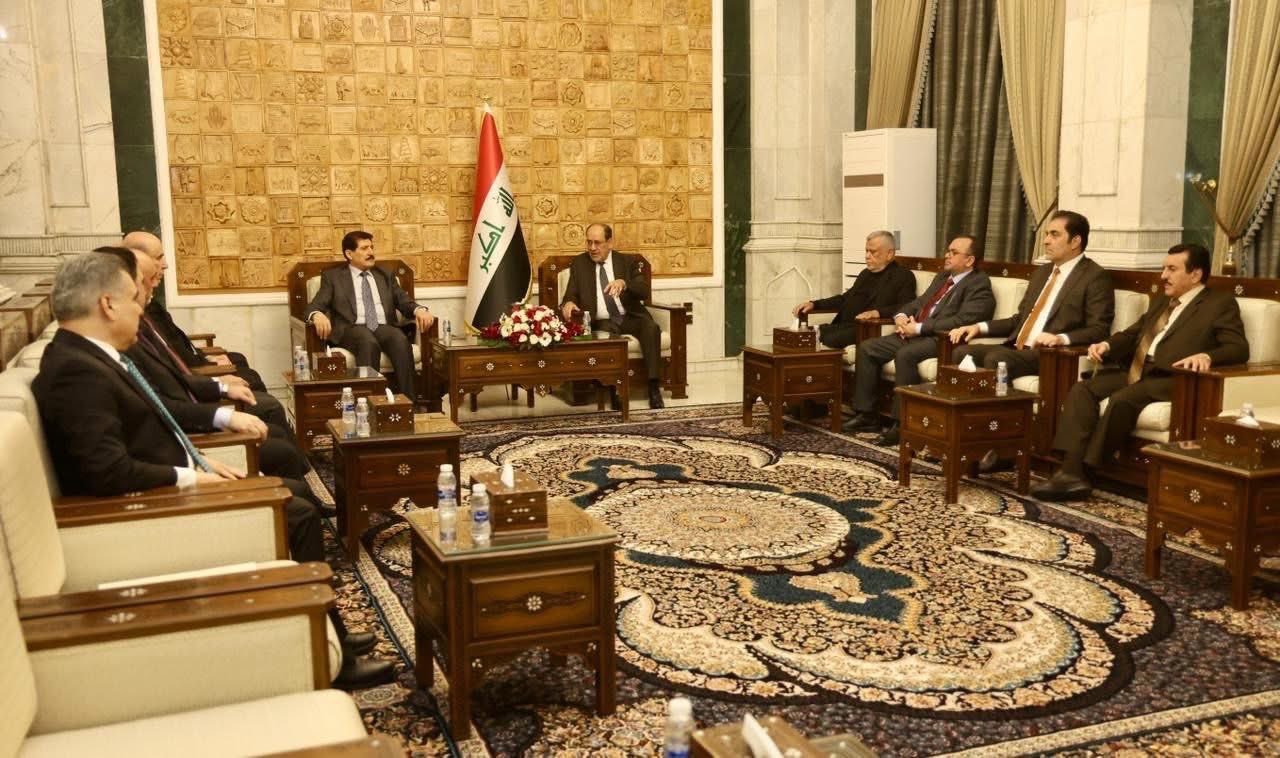
The composition of that rival camp became clearer on 31 March, when a KDP delegation visited Baghdad and met with the Shiite factions aligned against the session. The meetings included Maliki and his State of Law ally AbdulHussein al-Musawi, Hadi al-Amiri of Badr, Mohsen al-Mandalawi of Asas, and Amer al-Fayiz of Tasmim. Humam Hamoudi’s Abshir Ya Iraq, with 4 seats, is also in this orbit: Hamoudi’s opposition to a second Sudani term is well established. In total, the clearest backers of the delay camp account for the KDP’s 26 seats plus 5 allied minority quota seats, Maliki’s approximately 30 seats across the remaining State of Law core, al-Amiri’s Badr with 20 seats, Asas with 8, Tasmim with 5, Abshir Ya Iraq with 4, and given Sunni leader Khamis al-Khanjar’s ties to Barzani, his roughly 10 seats might be in this camp, though Khanjar, as part of the broader Sunni alliance, opposed Maliki’s nomination, so his stance remains unclear. That puts the hard delay camp at just over 100 seats.
Between the two camps sit actors who are hedging. The Sunni Azm alliance with 16 seats and a handful of smaller factions have appeared on both sides of different bloc counts, positioning themselves to extract the best terms from whichever camp prevails.
The Maliki/Barzani camp does not need to outnumber its rival. It needs to prevent the Sudani camp from assembling 220 bodies in the chamber on 11 April. With 329 total seats, denying quorum requires keeping at least 110 MPs out of the hall. The hard delay camp’s roughly 100 plus seats are not quite enough on their own, which is why the swing actors in the middle, and any wavering MPs inside the pro-session blocs, matter so much. The Maliki/Barzani camp’s strategy is not to win a vote. It is to stop one from happening.
That the session slated for late March was postponed to 11 April shows the pro-Sudani camp is still not confident it has the numbers. Barzani still wants delay. The pro-session camp is treating 11 April as a deadline. The Framework’s own post-compromise statement called for speeding up the presidential election, but that language papers over the real division: the camp around Hikma, Sadiqoun, and Sudani’s bloc wants to elect Amedi and then task Sudani, while the camp around Maliki, Asas, and to a lesser extent Badr wants to prevent exactly that.
The pause was partly a concession to Barzani, who publicly called for postponement on 29 March, and partly an attempt to prevent an immediate visible rupture inside the Framework. If the pro-Sudani camp had forced the Monday session and the Maliki camp had boycotted, the Framework would have been formally split on the most consequential vote of this cycle. By agreeing to 11 April, the acceleration camp bought time to pull hesitant actors into the chamber while giving Barzani a face-saving window. The Kurdish factions are already divided and have no actual alliance, but the Shiite factions are all under the Coordination Framework formula: they too are already divided, but a vote would crystallise the split. The Framework has around twelve key members who appear split roughly in half, but the Sudani group commands far more MPs because several of the pro-Maliki members represent only a few seats each.
For now the pro-Sudani bloc appears to have the upper hand due to its numerical advantage, but based on recent developments it still does not have the numbers to reach the 220 MPs needed for quorum. Some pro-Sudani officials, including Baha al-Araji, head of Sudani’s Reconstruction and Development bloc, have claimed that Hadi al-Amiri’s Badr, Azm of Muthanna al-Samarrai, and part of Maliki’s own State of Law coalition are with their camp. But the appearance of al-Amiri (20 seats) and AbdulHussein al-Musawi (12 seats as part of State of Law) alongside Maliki in the 31 March meetings clearly contradicts that framing, which helps explain why the session was postponed. Still, some Badr and State of Law MPs did sign the campaign to organise the session, suggesting there is room for manoeuvring at the individual MP level even where bloc leaderships are aligned against.
If the quorum holds and Amedi wins, the consequences are severe for the delay camp. A constitutional fifteen-day clock starts for the new president to task the largest bloc’s nominee with forming the government. That nominee would almost certainly be Sudani. The Framework would have been functionally split: one part helping reopen the path to a second Sudani term, another still trying to block it. The Framework could survive as a label. It could not survive as a single command structure.
Maliki’s blocking power would be sharply diminished. The KDP would lose its ability to freeze the process on timing, though it would retain leverage over cabinet composition, budget, and oil. Barzani’s broader strategic position would not collapse, but his ability to dictate the pace of Iraqi government formation from Erbil would take a serious hit.
If the session fails, Iraq falls back into the same deadlock under the compounding pressure of regional war. But even a failed attempt would reveal that the old top-down discipline inside Iraq’s major alliances has weakened. Once MPs use cross-bloc signature campaigns to force the constitutional sequence, the system has moved into a more fragmented phase where government formation is no longer a controlled elite settlement but an increasingly public contest.
Iraq’s 11 April session is about the premiership, about whether Sudani’s return can be forced through parliament over the objections of Maliki and Barzani, and about whether the Coordination Framework can still function as a single bloc.


