


The PKK’s New Media Map Is a Political Map
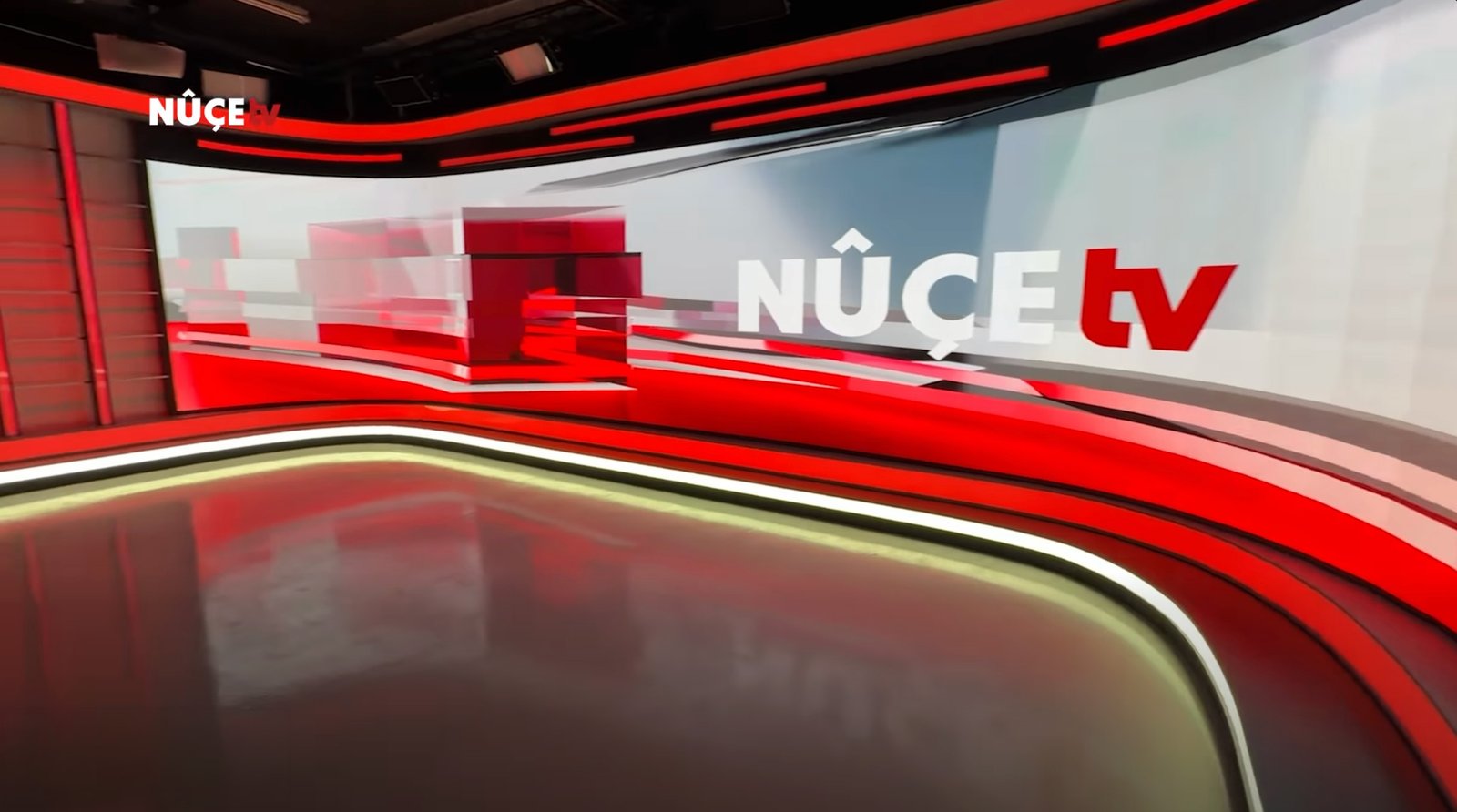
The PKK-aligned movement has launched a new political-news channel, Nûçe TV, as part of a wider restructuring of its media network. The channel began broadcasting on 15 May, Kurdish Language Day, and is based in Germany, a key centre of the pro-PKK Kurdish movement in Europe, with regional bureaus in Diyarbakir, Qamishli, and Sulaimani.
The geography maps the movement’s current political terrain. Diyarbakir is the centre of Kurdish legal politics in Turkey; Qamishli is the main base of SDF-linked Kurdish politics in Syria; Sulaimani is controlled by the PUK, the Kurdish party most closely aligned with the PKK and SDF regionally. Nûçe TV is expected to absorb the movement’s main political-news function from Sterk TV, which has long hosted senior PKK figures but is now being repositioned as a cultural and non-political platform.
The restructuring extends beyond Nûçe TV. Zagros 24, a new Iran-focused channel broadcasting in Kurdish and Persian, replaces Aryen TV, which broadcast only in Kurdish. KurdFM, launched through FED-GEL in Germany, adds a pan-Kurdish radio platform in several Kurdish dialects, while a Kurdish Academy has been established in Switzerland with a focus on language, education, and cultural preservation.
Context: These changes come as the PKK, its Syrian affiliates, and the broader pro-PKK Kurdish movement enter a new phase shaped by the Turkey peace process, SDF integration in Syria, and a wider shift toward legal-political organisation.
Three simultaneous political tracks are driving the shift. The PKK is integrating into Turkey’s legal-political order through the ongoing peace process, with Ocalan’s written guidance from Imrali cited as the ideological framework. The SDF has committed to integration into Syrian state structures. And the PUK, whose Sulaimani zone Ankara once punished with an airspace ban over PKK facilitation accusations, has seen that ban lifted and its role quietly repositioned as a necessary management channel for the transition rather than a hostile rear-base.
Analysis: Nûçe TV matters less as a standalone outlet than as a map of where the movement now sees its political future. Germany anchors the diaspora infrastructure; Diyarbakir connects it to legal Kurdish politics in Turkey; Qamishli links it to its Syrian arm; Sulaimani places it inside the PUK-aligned Iraqi Kurdish space now central to managing the PKK and SDF transition. The channel’s geographic footprint describes the new political terrain.
That terrain is no longer primarily territorial. The old model was built around armed leverage, mountain legitimacy, parallel institutions, and zones of autonomous control. The new model is being built around legal politics, cultural rights, diaspora organisation, and Kurdish actors embedded inside existing states while remaining connected across borders. Sterk TV’s shift toward cultural programming, taken alongside the launch of Nûçe TV, KurdFM, Zagros 24, and the Kurdish Academy, points to a movement preparing for legality rather than disappearance.
The PKK is not leaving politics. It is trying to change the form through which it remains politically present. In Turkey, that means moving through Ocalan’s framework toward legal participation. In Syria, it means the SDF surviving through integration into state structures. In Iraq, it means the PUK’s Sulaimani zone moving from being treated by Ankara as a hostile rear-base to being recast as a necessary channel for managing the transition. The same network that once drew Turkish pressure is now becoming useful precisely because it has the channels Turkey and Washington need to manage the process.
A possible Mazloum Abdi-Ocalan meeting would add another layer to this logic. If confirmed, it would close the symbolic gap between the Turkey and Syria tracks, making the SDF’s move toward integration legible as a deliberate Ocalanist strategy rather than simply a retreat under pressure. In that sense, the media restructuring and the Abdi-Ocalan track are part of the same story: both help translate military contraction into political transition.
What is being built is a cross-border Kurdish political presence across Turkey and Syria, with Iraq increasingly part of the same regional architecture: cultural enough to operate legally, political enough to coordinate across borders, integrated enough to fit the new regional order. The media launches are the most visible part of that architecture and the clearest signal yet of where the movement believes it is going.
The US strategic shift is pushing in the same direction. The Pentagon’s FY2027 counter-ISIS budget drops the Ministry of Peshmerga Affairs training-and-equipment line from $61 million to zero, but has not cut all Kurdish-linked funding. What has changed is the routing: former SDF fighters are now funded as personnel integrated into the Syrian army, and PUK-linked SWAT units are supported as part of the Iraqi federal counter-terrorism service rather than as regional Kurdish institutions. The operational map expands to include Lebanon and Jordan, but the preference throughout is consistent: recognised state forces, federal security structures, or Kurdish-linked fighters who can be presented as part of a state-integration process.
Tom Barrack’s role reflects the same calculus. As US ambassador to Turkey and special envoy for Syria, with the Iraq file added to his portfolio, he represents an approach that treats Turkey, Syria, Iraq, Lebanon, and Jordan as connected files rather than separate theatres. Kurdish actors are not being eliminated from that picture. They are being pushed into state frameworks and positioned as connective tissue inside a broader regional security and economic order.
For the KDP, this is structurally difficult. Its power rests on the older formula the new model is beginning to supersede: autonomous KRG institutions, party-family control over security and economic networks, Peshmerga as a direct Western partner, and Erbil as a privileged bilateral address for Ankara and Washington. Neither Turkey nor Washington now needs from the KDP what the KDP was built to provide. This is not a coordinated campaign against it. The problem is structural. The Barzani system cannot integrate into the new model without weakening the very foundations of its own power. Family control over the KRG’s security apparatus, independent foreign relationships, and Erbil’s quasi-state role are precisely what the new framework asks Kurdish actors to subordinate to existing states. The PUK can route its value through Baghdad, federal counterterror channels, and Sulaimani’s brokerage role. The KDP would have to give up far more of what makes it powerful.
The accumulating pressures on the KDP are better read as symptoms of that structural devaluation. The Peshmerga funding cut weakens the security relationship underpinning its claim to be the West’s primary Kurdish partner. The DOJ investigation naming General Mansour Barzani damages the family’s US standing at the moment it is most exposed. The prolonged failure to form a KRG cabinet since the October 2024 election has hollowed out the region’s institutional credibility, and inside Baghdad the KDP’s ability to set Kurdish terms is increasingly being bypassed by PUK-backed coalitions that can function without its consent. The KDP still controls Erbil and Duhok, won the 2024 Kurdistan parliamentary election, and remains important to Turkey for border management, trade, and energy. But it is increasingly outside the coalition shaping the next phase of Kurdish politics.
Iran remains in a separate lane. Turkey, Syria, and Iraq now have integration tracks: the PKK into legal politics, the SDF into Syrian state structures, PUK-linked forces into Iraqi federal channels. Iran has no equivalent. Its Kurdish file remains tied to regime pressure, opposition politics, and Kurdish-Persian messaging across a different party landscape. Zagros 24’s Kurdish-Persian format reflects a distinct arena, not an afterthought. Iran is part of the pan-Kurdish map but not yet part of the same integration framework.


