


Pentagon Zeroes Out Peshmerga Funding as Lebanon and Jordan Enter the Picture
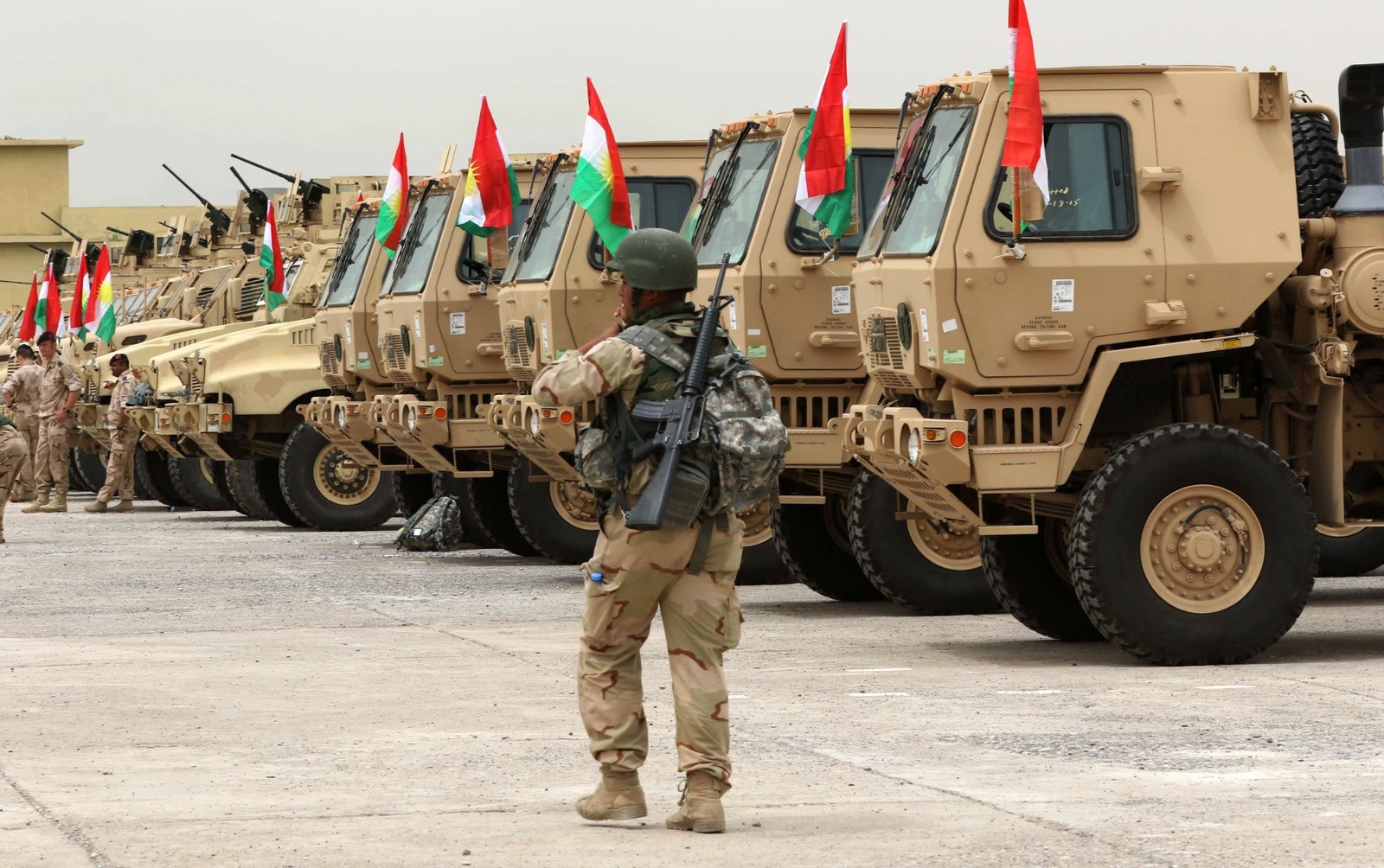
The Pentagon’s budget request for next year proposes to end U.S. training and weapons support for the Kurdistan Regional Government’s Ministry of Peshmerga Affairs entirely. The line is worth $61 million this year. Next year it goes to zero. What remains is a medical sustainment allocation of just over $1 million. Federal Iraqi forces and Syria stay funded, and for 2027, Lebanon and Jordan enter the same counter-ISIS fund for the first time. A Sulaimani security unit in the PUK sphere sees its allocation increase.
Context: Pentagon support for the Peshmerga as a named, standalone force has no history before the ISIS war. The channel opened as a wartime emergency: around $354 million in 2015, $415 million in 2016, then roughly $290 to $365 million through the end of the decade. After the territorial defeat of ISIS, the numbers declined steadily, but the channel remained. Around $257 million in 2022, $207 million in 2023, $164 million in 2024, $139 million in 2025, $77 million this year. Next year’s request takes it to $1.35 million. The decline across the past five years was gradual. The move from $77 million to near-zero is not.
Analysis: Washington has a clean explanation for the cut, and it is not wrong, exactly. The U.S.-KRG memorandum of understanding signed in September 2022 ran for four years and expired this past September. Peshmerga stipends had already ended before that, with Washington expecting Baghdad to absorb the salary burden. Next year’s request follows that window without a renewal in place.
The problem with that explanation is the training and equipment line. Stipends ending makes sense within the MOU frame. A $61 million equipment line going to zero does not follow automatically from an MOU expiring. Washington had options: extend the memorandum, negotiate a revised version, or route continued support through a different mechanism. It has done exactly that in harder political circumstances elsewhere. In Syria, the SDF’s territorial control has largely collapsed, former SDF elements have nominally integrated into a new Syrian security structure, and the political environment has transformed entirely. U.S. funding for Syria nonetheless stays at $130 million, almost exactly where it was. While the formula changed, the money did not. Therefore, there is likely more to the Peshmarga weapons delivery cut when you look at the bigger picture and the geopolitical circumstances.
The money itself is also not the point. Sixty million dollars is not a significant sum in U.S. defense terms – a single media channel in the Kurdistan Region might run a comparable annual budget. What the line represents is access: to American weapons, to equipment contracts, to the institutional recognition that a force sits inside the U.S. security architecture, and losing it means losing that status, not just the cash. The funds appear to have been redirected toward Lebanon and Jordan, which partly explains the cut when placed in its wider context. Lebanon enters the counter-ISIS fund for the first time, framed around the Lebanese Armed Forces, border security, and special operations capacity. Jordan enters for the first time, explicitly described as a platform for regional missions as the U.S. reduces its direct footprint in Syria and the broader Levant. Counter-ISIS is the statutory label, but the regional design being built underneath it is about anti-Iran pressure and a consolidation of U.S. support behind central governments and state-recognized forces – which is also why Syria’s funding remains, now framed around units integrated or being integrated into the new Syrian army.
The KDP’s position makes the cut harder to read as purely bureaucratic, as simple as the MoU expiring on schedule. During the February 2026 war between the U.S., Israel, and Iran, there was a plan, or at minimum a serious American and Israeli interest, in activating Iranian Kurdish opposition factions for cross-border operations from Iraq’s Kurdistan Region. The plan appears to have collapsed at the last minute. Kurdish factions denied receiving material support, denied planning imminent action, and the KRG publicly rejected any role in expanding the conflict into Iranian territory. Trump said publicly that the U.S. had sent weapons to Kurdish intermediaries for Iranian protesters and that those weapons never reached them, adding that there would be consequences. Kurdish groups denied the framing. The details remain contested, but placed alongside the sequence of events that follows, the picture becomes harder to read as coincidence.
In addition to the weapons cut, the Justice Department has named Mansour Barzani explicitly in a public statement, alleging he was implicated in a bribery and money laundering scheme involving fuel delivery contracts to U.S. troops in Erbil. What makes the timing notable is that the conduct alleged dates to 2016 to 2020 — meaning the underlying events are at least five years old. Cases like this take years to build, and the law moves on its own timeline. What is new is the decision to name him publicly, now, placing the most senior Barzani military figure inside a U.S. legal case tied to contracts for American forces at precisely the moment the broader MoPA channel is being cut.
The political sequence in Baghdad reinforces the same reading. The KDP boycotted the Iraqi presidential session. Parliament went ahead anyway. A PUK-affiliated candidate, Nizar Amedi, was elected president over a field that included the KDP-backed candidate Fuad Hussein. Most factions attended within days despite the KDP’s stated boycott. The U.S. ambassador visited the new president. Amedi tasked Ali Zaidi with forming a government, and Washington signaled engagement. The KDP position was treated as inconvenient rather than essential.
Even more noteworthy is that in the same budget, Sulaymaniyah SWAT, a PUK-linked special operations unit, sees its allocation rise from $4 million to roughly $5 million. If the Peshmerga cut were simply about the ISIS mission winding down or an MOU expiring, that line would also be gone. The Pentagon frames it as a law-enforcement partner recognized by Baghdad and working directly with U.S. special operations forces. Its actual political location is not obscure to anyone following Kurdish security politics: Sulaymaniyah Asayish, PUK sphere, direct SOF integration.
None of this proves a single coordinated decision to punish the KDP. What it shows is a pattern the official ISIS explanation does not account for. It is worth noting that both the PUK, via its Sulaymaniyah SWAT force, and SDF fighters, though named as “former SDF fighters”, remain funded to varying degrees by Washington, leaving KDP-linked forces as the only Kurdish faction entirely out. And beyond the intra-Kurdish signalling, the nature of the rerouting does suggest a transition toward a different regional security framework, one channelled more directly through state actors, strengthening them from within and positioning them to counter Iranian influence as much as to counter ISIS.


