


Why Turkey’s PKK Peace Process Has Stalled
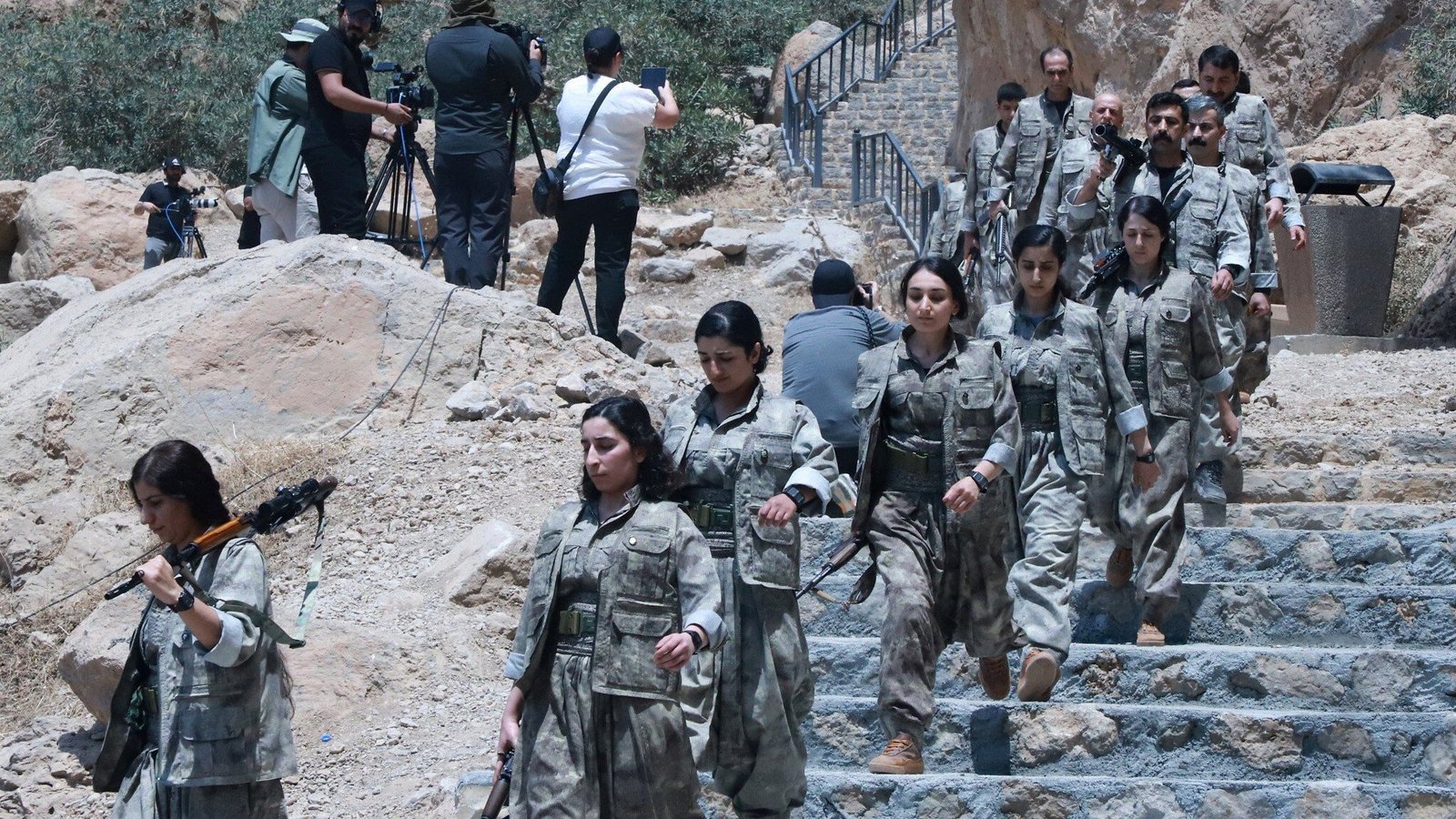
More than a year after Abdullah Ocalan called for disarmament from his prison on Imrali island, Turkey’s peace process with the PKK has reached its first genuinely hard question: which comes first, the law or the weapons? The process moved further than most expected. A parliamentary commission was formed with cross-party backing; Ocalan issued messages; the PKK declared dissolution and withdrew fighters from Turkish territory. None of that has produced legislation. The parliamentary commission adopted its framework in February 2026, but translating that report into enacted law requires a political decision that has not yet been made, and the gap between the two is now the central obstacle.
Context: The current process has moved through distinct phases since Abdullah Ocalan’s 27 February 2025 call from his prison on Imrali island, a Turkish island in the Sea of Marmara, for the PKK to lay down arms, convene a congress and dissolve itself. A unilateral ceasefire followed on 1 March. The PKK announced that it held its 12th Congress in May and resolved to self-dissolve. On 11 July, a group of PKK fighters publicly burned their weapons in Sulaimani province. On 26 October, the PKK announced the withdrawal of its remaining fighters from inside Turkey to the Kurdistan Region of Iraq. By mid-November, the Zap area was being vacated; subsequent Turkish reporting indicated that several caves across Zap and Metina had been emptied, with ammunition catalogued and destroyed.
Turkey’s parliamentary peace commission was established to translate that sequence into a political and legal architecture. On 18 February 2026, it adopted its final report, backed by the main parliamentary blocs including the AKP, CHP, MHP and DEM Parti, with 47 votes in favour, 2 against and 1 abstention, following 20 meetings, 137 witnesses or institutional submissions, 88 hours of deliberations and 4,199 pages of minutes.
The adopted report is not itself legislation. It is a framework proposing a roadmap for future bills that would still require separate committee passage and a full parliamentary vote. That distinction is critical: the report created expectations without resolving the central legal question.
Analysis: From Ankara’s perspective, the PKK has taken some steps, but not enough to justify moving to legislation. Turkish pro-government reporting indicates that the state has confirmed certain withdrawals and cave evacuations in the Zap and Metina area, in the Kurdistan Region of Iraq near the Turkish border, but not at a scale sufficient to declare the process irreversible. Earlier reports placed the figure at six cleared caves; subsequent reporting revised this upward to seven, described as three large and four small, all still within the Zap-Metina first stage. Pro-government outlets have been more specific about the logic: AKP sources, citing a briefing by MIT chief Ibrahim Kalin, argue that “Kandil is ignoring Ocalan’s will” and that no legal framework can be built on assumptions. The state’s position, as Omer Celik articulated it, is unambiguous: legal regulations come after disarmament, and state institutions must first verify whether the PKK has actually laid down arms.
The key threshold for Turkey is the PKK’s withdrawal from the Hakurk and especially the Gara mountains, which Ankara views as bringing the process close enough to irreversible to justify legal action. Security-source reporting suggests Ankara treats roughly 30 caves or fortified positions along the broader corridor from the Turkish border toward Qandil as its verification file. With seven reportedly cleared, the remaining 23 are associated with Gara, Hakurk and eventually Qandil, though Turkish sources indicate the state is prepared to defer the Qandil phase and advance with legal steps before it is reached.
For Ankara, these evacuations represent measurable proof that the PKK is dismantling the infrastructure that sustained armed struggle. Without that proof, officials and pro-government commentators argue, any legal package would be politically exposed and strategically premature. The sharper pro-government claim is that the PKK has deliberately slowed the process in response to regional developments: first Syria’s SDF-related integration process, which faced uncertainty in January, then the outbreak of the U.S.-Israel-Iran war. AKP figures now insist that legal steps will only return after “confirmation and detection” of disarmament, framing the stall as PKK-driven rather than state-imposed.
The Turkish state is also shaped by the memory of the previous peace process. Ankara does not want to be seen making concessions while the PKK preserves operational capacity. That wariness is compounded by the wider regional environment: Syria’s ongoing transition, the Iran war, the PKK’s continued presence in Iraq, PJAK’s posture near the Iranian border, and the uncertain future of PKK-affiliated networks across the region. For Turkish security institutions, these are not peripheral details but active reasons to demand a higher evidentiary threshold before moving to law.
The PKK and the broader pro-Kurdish political current read the same timeline differently. From their perspective, the PKK has already made major strategic moves: Ocalan called for disarmament and dissolution; the PKK declared a ceasefire, held a congress, announced dissolution, burned weapons, withdrew from Turkish territory and vacated some positions in the Kurdistan Region. Senior figures have also shifted their public register, speaking less as PKK commanders and more as representatives of a broader Kurdish movement. The argument from this side is that these steps were substantive, not performative, and that Ankara has not reciprocated with the legal framework needed to complete the process.
This is where DEM, the main pro-Kurdish party in the Turkish parliament, becomes structurally central. DEM is demanding a legal framework that defines what happens to fighters, political cadres, prisoners, returnees and elected local officials. Its demands include a process-specific law rather than a general amnesty, alongside guarantees for democratic integration, amendments to anti-terror legislation, limits on the trustee system that replaced elected Kurdish mayors, and clearer conditions for Ocalan’s communication and oversight of the process. DEM’s framing insists on what it calls “esz zamanlilik,” meaning simultaneous steps: the party rejects the sequential logic in which disarmament precedes law and argues instead that legal and security moves must advance in parallel.
From this vantage point, Ankara’s insistence on full disarmament as a precondition for legislation is not neutral sequencing. PKK fighters are being asked to abandon positions in a war-affected regional landscape without clarity on whether they will be prosecuted, barred from political life, permitted to return, resettled abroad or left in legal limbo. The Kurdish side’s argument is straightforward: no armed movement fully dismantles itself before the legal consequences of doing so are defined.
The commission report itself contains both logics but does not reconcile them. It treats verification as the threshold that activates the broader package, yet it also acknowledges that a dedicated, temporary and standalone law will be needed to manage disarmament and its aftermath, one that reintegrates those who renounce violence, establishes accountability mechanisms, permanently ends armed activity and moves the conflict fully into the legal and political domain. Critically, the report’s own language defines the required verification as objective, measurable, transparent and auditable. The report explicitly distinguishes this from a blanket amnesty, referencing judicial processes, supplementary criminal and enforcement provisions, an executive mechanism and parliamentary oversight. This is why the process is not simply frozen. The architecture exists. What is missing is the political decision to activate it.
Ocalan’s role has become especially delicate. Ankara appears to regard him as the only figure with sufficient authority to bring the PKK to final disarmament. DEM and the broader Kurdish movement argue that if he is expected to manage implementation, his conditions must change accordingly. This has produced a pointed dispute over his status on Imrali. DEM figures have pressed for a formal redefinition of his legal standing and genuine working and communication conditions, and pro-Kurdish mobilisation has made his status a central public demand. The more visible those demands become, however, the higher the political cost for Erdogan and the ruling coalition. Numan Kurtulmush, speaker of the Turkish parliament, offered the most concessive formulation from the government side: fighters leaving armed activity, he acknowledged, do need a legal framework, even if the PKK had not followed the disarmament timetable.
The paradox is structural. Ankara needs Ocalan’s authority but cannot visibly elevate his standing. The Kurdish side wants Ocalan to manage the process but argues he cannot do so under current conditions. Ocalan’s own messages reflect this bind: he presents himself not merely as an endorser of peace but as the actor required to execute it, and his grievance is that both the state and the movement place the weight of war and peace on him while denying him the conditions to manage the transition.
The 23 April national reception eased the atmosphere but did not resolve the impasse. Erdogan engaged with DEM figures and, when the subject of legal progress arose, turned to DEM co-chair Tuncer Bakirhan and asked: “Have we stopped?” When Bakirhan replied that the process had not stopped, Erdogan said: “No stopping, carry on exactly as we are.” The exchange mattered because it showed Erdogan has not withdrawn from the process. Bakirhan had made the same point more sharply in parliament, telling Erdogan that the seal of authority was in his hands, a deliberate formulation placing responsibility on Erdogan as the only actor capable of moving the file from commission reports and security verification into enacted law. Even so, Erdogan’s message should not be overstated. It kept the door open; it did not bring the legal package closer.
The process therefore remains suspended between competing anxieties. Ankara fears legislating before the PKK has genuinely disarmed. DEM fears being drawn into a process that demands disarmament while indefinitely deferring legal guarantees. The PKK fears surrendering remaining leverage without clarity on the endpoint. Erdogan fears nationalist backlash if any step can be credibly framed as concession. Yet all sides also fear being attributed responsibility for the collapse of a process that has come this far.
This is why a conditional legal formula has emerged as the most plausible path forward, and why it is already circulating among political actors in Ankara. Under such a model, parliament would pass a process-specific law while making its implementation conditional on verified steps: cave evacuations, weapons handovers, withdrawal from remaining zones and a defined timetable. Ankara could maintain that no legal provision takes effect without verification. DEM could say fighters are no longer being asked to demobilise into a legal vacuum. The PKK could see the pathway before completing the final phase of disarmament. Such a formula would not erase the trust deficit, but it could bridge the sequencing dispute. It also reflects the actual logic of the commission report: verification and legislation were never meant to operate as separate tracks, but to reinforce each other. Verification gives the state the confidence to legislate; legislation gives fighters a concrete reason to complete disarmament.
The alternative is drift. May is already compressed by public holidays, including the 19 May commemorations, after which Turkish political life slows into the summer recess. If the legal package does not advance before that window closes, the process risks remaining formally alive but practically suspended. That kind of stasis can be managed for a time, but it carries compounding costs. Spoilers gain room to manoeuvre, regional developments apply pressure, and hardliners on both sides grow louder. Each passing week makes it easier for Ankara to argue that the PKK is not serious, and easier for the Kurdish side to argue that the state never intended to legislate.
The deeper significance of the process extends beyond ending armed conflict inside Turkey. The commission report framed “terror-free Turkey” as part of a wider regional doctrine: domestic consolidation as the foundation for Turkey’s capacity to project stability into a region defined by proxy conflict, fragmentation and shifting balances of power. Ankara does not regard the settlement as reconciliation alone. It regards it as state strategy: ending the PKK’s armed status would remove the principal domestic and cross-border armed expression of a competing Kurdish political project, while expanding legal political space would channel Kurdish politics into a regulated domestic arena.
For now, the process is neither dead nor secure. It is suspended at the most consequential juncture it has yet faced: the transition from symbolic disarmament to legal settlement. The PKK has taken enough steps for the Kurdish side to demand legislation. Ankara says it has not taken enough steps for the state to certify disarmament. Both positions carry internal coherence, which is precisely why the impasse is so resistant to movement.


