


Iraq’s CEO Candidate
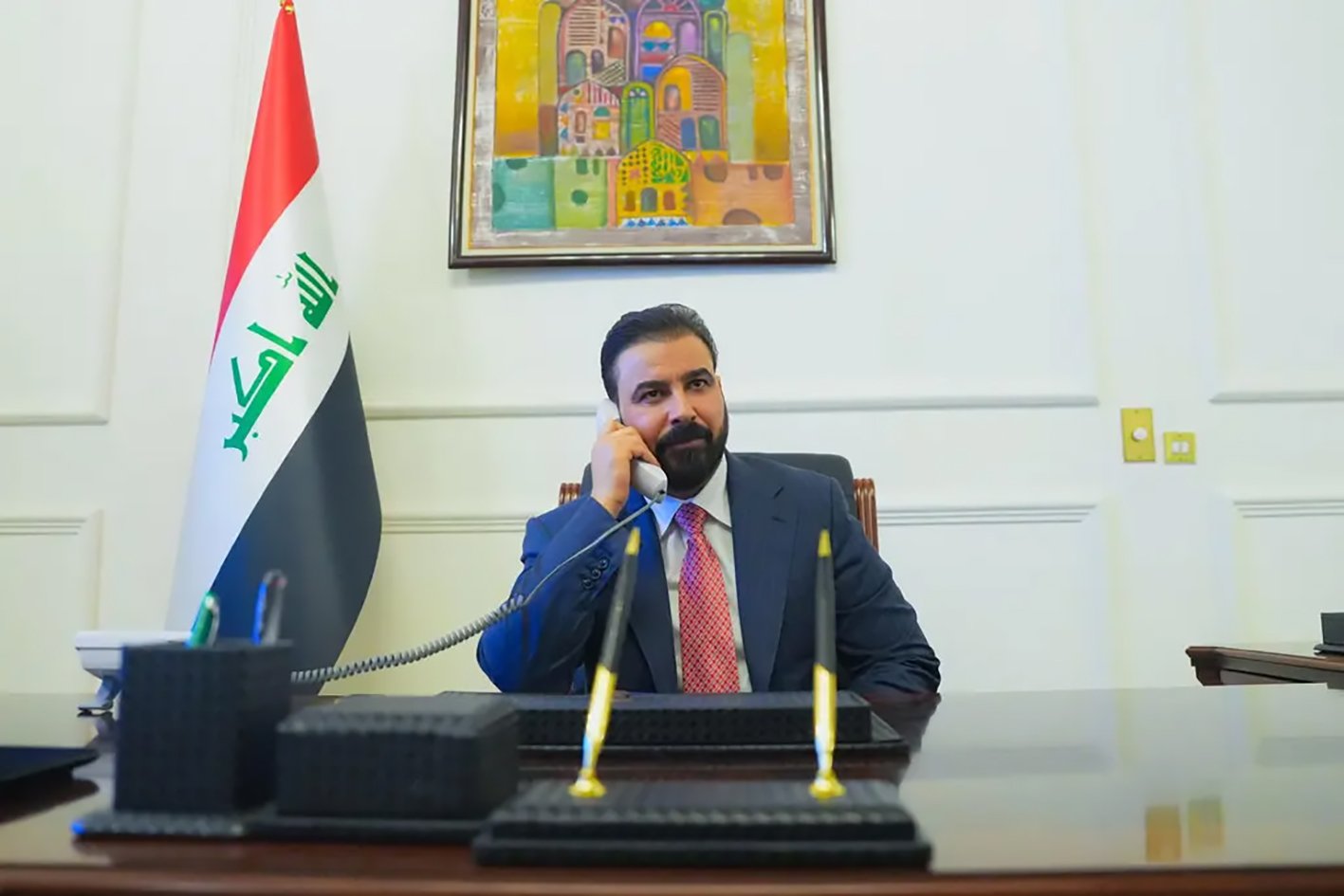
Iraq’s Coordination Framework on April 27 named businessman Ali al-Zaidi as prime minister-designate, and President Nizar Amede tasked him the same day with forming a government within the constitutional thirty-day window. Zaidi, the former chairman of South Bank and the owner of food-supply, retail and media businesses, has no party, no parliamentary bloc and no prior government office.
Context: The nomination came one week after Washington halted a five-hundred-million-dollar shipment of physical dollars to the Central Bank of Iraq from accounts at the New York Federal Reserve, and one day after the U.S. chargé d’affaires Joshua Harris circulated a letter to Framework leaders describing them as “our adversaries.” Two days after the tasking, on April 29, the U.S. embassy in Baghdad issued a brief statement extending its “best wishes” to Zaidi as he works to form a government, an early signal of at least conditional engagement.
Analysis: Ali al-Zaidi’s nomination as Iraq’s prime minister-designate is understood as the ruling system’s attempt to find a manager for a crisis it created and cannot openly defend.
His usefulness lies in what he is not. He is not Nouri al-Maliki, whose return would be too provocative for Washington. He is not a militia commander, whose nomination would expose the system too directly. He is not Mohammed Shia al-Sudani, whose second term could turn him into an independent pole inside the Shia order and whose coalition has also become more complicated for Washington. Just a day before Zaidi’s nomination, the U.S. letter to the Coordination Framework warned that Framework leaders supporting armed factions were subject to direct rejection and veto. On the same day, Washington placed a ten-million-dollar bounty on Haydar al-Ghrawi, a militia leader whose political wing, the Al-Awfiya Movement, holds three seats within Sudani’s coalition. Zaidi is also not a clean technocrat, because a clean technocrat would threaten the rent channels that hold the ruling coalition together.
This is why he fits the moment. The Coordination Framework is fragmented. No single Shia actor has the decisive numbers or authority to impose a prime minister without alarming the others. Maliki is too costly, Sudani too threatening, militia faces too exposed, and a real reformer too dangerous to the economic order. Zaidi offers a different formula: a businessman with no independent political base, acceptable to several power centres precisely because he cannot dominate any of them.
That makes him less a prime ministerial leader than a chief executive for a cartel under pressure.
The U.S. appears to have tentatively accepted Ali Zaidi’s nomination not because he is an ideal candidate, but because there are no clean or perfect options inside Iraq’s current political order. Iran’s networks are too deeply embedded for Washington to simply demand an outsider. Any viable nominee still has to emerge through the Coordination Framework, the largest bloc and the core vehicle of Iran-aligned power in Baghdad. From this perspective, Zaidi may be seen as the best available option: ambiguous enough to leave room for engagement, connected enough to pass through the system, but not so openly tied to Iran that accepting him becomes politically impossible.
That ambiguity is central to understanding him. Iran no longer needs to handpick every figure in Iraq, because it has built an ecosystem that gives it enormous structural influence. In that sense, Zaidi’s closeness to Iran may be less about a direct command relationship and more about the networks through which he rose. Just a week ago, IRGC Quds Force commander Esmail Qaani was in Baghdad, and it is difficult to imagine that his visit played no role behind closed doors in shaping the final choice. There is an Iranian footprint around Zaidi, especially through helping facilitate sanctions-busting, a function that may have been more useful to Iran than militia rhetoric or symbolic shows of force. At that stage, Iran needed financial channels, business cover and institutional access as much as it needs armed allies.
Zaidi’s rise also appears to have taken place through precisely this ecosystem. He is described as conservative and as having close relations with militia-linked political forces. His early business profile reportedly developed through the currency exchange market, where businessmen often work with the “economic committees” of political parties and armed factions. In practice, that usually means managing, investing or recycling capital connected to powerful actors. This later developed into the banking sector, and in Iraq, an Islamic bank is unlikely to receive a licence without serious political protection. His proximity to Iran, therefore, is not necessarily defined by one visible link. It is institutional, financial and network-based, which may make it more durable and harder to challenge.
This is also why Washington may find it difficult to reject him outright. Zaidi does not carry the same obvious liabilities as a militia commander or a known factional hardliner. His relationships are murkier, mediated through business, banking, party finance and elite networks. That ambiguity gives the U.S. some room to deal with him, while also giving Iran confidence that he emerged from a system it already dominates.
Domestically, Zaidi is useful because he sits at the intersection of several powerful networks. He is from Shatra, like Faiq Zaidan, the powerful head of Iraq’s judiciary, who likely played an important role in bringing him forward. He is also close to outgoing Prime Minister Mohammed Shia al-Sudani. Months ago, Zaidi bought Dijlah TV, which campaigned in favour of Sudani during the November elections. His brother is also an MP on Sudani’s list.
Although Zaidi was already a businessman, his profile rose more clearly during Mustafa al-Kadhimi’s premiership, when he was awarded highly lucrative and corruption-prone food ration contracts. Kadhimi is also from Shatra and was widely seen as close to Zaidan. This points to a broader Shatra-linked network connecting business, the judiciary and executive politics. Notably, the most prominent figures in this cluster are unelected, and its sudden rise appears to have become visible only over the past decade, as Zaidan consolidated power. Iraq’s current intelligence chief, Hamid al-Shatri, is also from the town, as is Hamid Naeem al-Ghazi, the current secretary-general of the Council of Ministers, one of the most important administrative posts inside the Iraqi executive.
Sudani’s relationship with Zaidi is also important. During Sudani’s time in office, Zaidi was awarded the cooperative hypermarket chain project, and it is also said that Zaidi increasingly became Sudani’s business partner via such projects. At the same time, Maliki does not appear to have placed a veto on him, possibly because their business interests have also overlapped. Zaidi is also said to have commercial ties with Sunni and Kurdish factions. This is what makes him politically interesting: he is not a factional outsider, but he is also not owned by a single camp. He is acceptable to several power centres because he is a product of the same informal economy that connects them.
That economy is the real story. Zaidi’s trajectory runs through exchange activity, banking, food supply, state contracts, retail, media and electoral utility. His company Al-Oweis sits in the world of food-basket supply and army feeding, two of the most politically sensitive procurement channels in Iraq. These are not normal commercial sectors. They connect state money, imports, public dependency, factional commissions and political protection. Whoever controls such channels is not merely a businessman; he becomes part of the machinery through which power is financed and distributed.
Zaidi is the candidate of a cartel that cannot agree on a boss, cannot risk a reformer, and cannot surrender the rent economy that sustains it.


