


Casualty Data Point to a Narrow Social Base for Iran’s Exiled Kurdish Parties
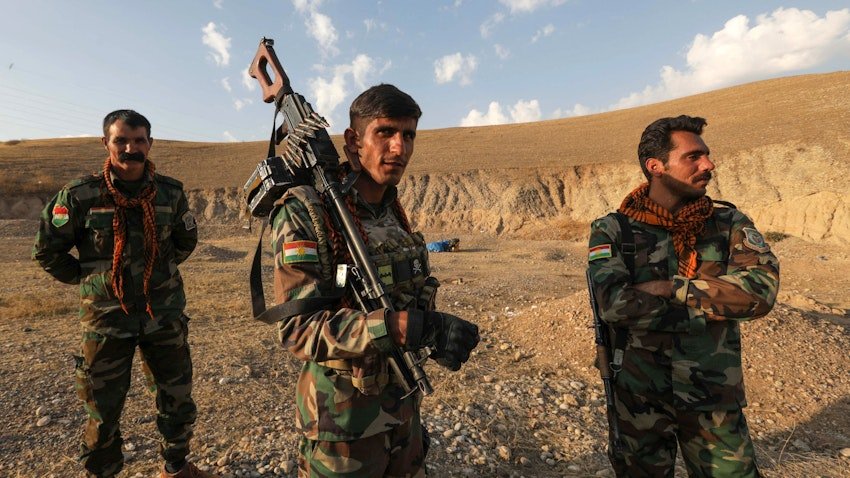
The exiled armed parties have built their strategy around merging with an internal Iranian uprising rather than sustaining a conventional insurgency. The recent casualty data show where that linkage could plausibly occur, and where it could not.
The war on Iran ultimately produced no Iranian Kurdish ground component. But according to Iranian Kurdish groups involved in the initial planning for operations inside Iranian Kurdish territory, such a campaign was never conceived as a long mountain insurgency launched from Iraq’s Kurdistan Region or as a conventional border push. The concept was always to wait for an internal uprising in Iran, help trigger it, and then merge with it, bringing organisation, arms and cadre to a mobilisation already underway across the frontier.
That model has obvious appeal for groups whose camp-based military infrastructure cannot sustain anything larger. But it also contains a fragility that is often glossed over. It depends entirely on local embeddedness inside Iran. Without that, there is nothing to merge with. With it, even a modest exile apparatus can carry real weight.
The question, then, is where that embeddedness actually exists. Reliable answers are hard to obtain. No party publishes usable membership data, serious fieldwork inside Iran is not possible under current conditions, and there is no publicly available polling of Iranian Kurds. What does exist, particularly after the recent wave of strikes and operations against party sites in Iraq’s Kurdistan Region, is a casualty record.
That record is analytically useful for reasons often left unstated. Fighters do not emerge from nowhere. They come through families, friendship networks, kinship ties and town-level political milieus. When a party repeatedly loses people from the same handful of places, it is not simply losing individuals. It is revealing where it has roots, where it recruits, where it is trusted, and where it can expect to find the relationships an internal-linkage strategy actually requires.
The analytical weight of the recent casualty layer rests on one further property, and it is the decisive one: of the available samples, it is the least controllable by the parties themselves. What we have, in effect, is a quasi-random casualty sample drawn from fighters and members of these organisations killed in Iraqi Kurdistan, especially in broad missile, drone, camp or exposure-related incidents in which those killed were not individually selected for their hometown or local background, but targeted more generally for belonging to Iranian Kurdish party structures.
That matters because it makes the dead fighters one of the best available proxies for the movements’ underlying grassroots social base. The sample was produced by Iranian targeting, not party curation. It therefore reflects where these movements actually have people embedded, rather than where they would prefer to appear present.
That property also addresses the obvious objection to a dataset of this size. A sample of thirteen would be methodologically fragile if it produced a mixed or ambiguous result, because the temptation to read pattern into noise would be strong. But the result here is not ambiguous. It is categorical. When a semi-random sample produces one hundred percent clustering within a single linguistic-sectarian zone, the inferential burden shifts. The question is no longer whether the concentration is real, but how broad the underlying corridor would have to be to plausibly produce a distribution this tight.
The second sample is a leadership sample, constructed separately from the casualty data. Leadership rosters are more controllable and can be balanced internally for dialect, region or factional representation. That makes them less probative on their own, but still analytically useful as a second layer. Here, the aim was to identify, where birthplace data was actually available, roughly the top three figures from each of the main organisations under study: KDPI, the three main Komala branches, PAK and Khabat.
Leadership is selected through a very different process from wartime casualty. The force of the argument lies in the fact that these two samples are generated in fundamentally different ways yet point to the same geographic conclusion. If only the leadership clustered in the same towns, one could argue that this merely reflected old elite entrenchment while the broader rank and file were more geographically diverse. If only the dead fighters clustered there, one could argue that the pattern was an artefact of where certain camps happened to be struck, or of short-term operational exposure. But when both the casualty sample and the leadership sample independently converge on the same narrow birthplace corridor, the inference becomes much stronger.
The most plausible explanation is that the movement is genuinely reproduced from that corridor. This is therefore not just a pattern of leadership origin, and not just a pattern of wartime exposure. It is a pattern of social reproduction.
The Data: What it shows is a sharply concentrated geography. Of thirteen recent fighter casualties, four are from Saqqez, meaning a single town accounts for nearly a third of the entire sample. Piranshahr adds two more. The remaining seven spread across Ravansar, Sanandaj, Tangisar, Divandarreh, the Jargay area of Javanrud, Mahabad and the Lilakh-Dehgolan area. By province, eight are from Kurdistan, three from West Azerbaijan and two from Kermanshah. The centre of gravity sits unmistakably in Saqqez and the central Kurdistan corridor adjoining it, with Piranshahr as a clear secondary node.
More striking than the town-level concentration is the social uniformity of the pool. All thirteen casualties come from the Sorani-speaking Sunni belt of Iranian Kurdistan. Not most. All. In a country whose Kurdish population includes Sorani, Kurmanji, Southern Kurdish and Hawrami speakers, and spans Sunni, Shia, Yarsani and other religious communities, thirteen from thirteen inside a single linguistic-sectarian zone is not a coincidence the data can carry. It is the signal the exercise was built to test for, and it appears without dilution. On the best available semi-random evidence, the exiled armed parties are drawing their fighting pool from one specific slice of Iranian Kurdish society, and effectively only from there.
The demographic weight of the finding: The arithmetic sharpens the point further. Iran’s Kurdish population is usually estimated at between 7 and 15 million, and within that range the Sunni Sorani core has been estimated at between 2 and 4 million. That core is therefore a plurality of Iranian Kurds, not a majority, and somewhere over a third of the Kurdish population, depending on which estimate one uses. Yet on the recent casualty evidence, it supplies the entirety of the fighter base of the exiled armed parties. Saqqez alone, a single county of roughly 230,000 people, produces close to a third of the sample. The ratio of political weight to demographic weight in this corridor is, by any standard, extreme, and it runs in only one direction. A movement genuinely drawing evenly from Iranian Kurds, in the sense implied by the parties’ own rhetoric, would produce casualties dispersed across the Kurdish map of Iran: it would show Kermanshahi Southern Kurdish speakers, Ilami Kurds, Shia and Yarsani Kurds, Kurmanji speakers from the north. The recent data show none of that. The base is one corridor, and a narrow one at that.
The supplementary layers harden the pattern rather than soften it. Leadership geography runs somewhat wider, as internal balancing predicts, but its centre of gravity sits on the same terrain. Bukan recurs as a constant, Saqqez returns repeatedly, and the rest of the leadership clusters through Marivan, Sanandaj, Naqadeh, Baneh, Paveh and Urmia. The broader fighter dataset accumulated from earlier years runs through the same corridor. Three samples, generated by three different selection mechanisms, two of them open to internal curation and one closer to semi-random, converge on the same map. That is the kind of triangulation that is difficult to explain away as a function of how any single list was built, and it is what makes the finding robust rather than incidental.
What this means for the linkage strategy: The consequences for the parties’ stated strategy follow directly. An uprising-plus-linkage doctrine can only deliver where the linking forces are embedded, and outside those areas it has no mechanism. In Saqqez and its immediate hinterland, that embeddedness is real and old enough to rely on, and the casualty data alone make it visible. In Piranshahr and the central Kurdistan corridor running through Sanandaj, Divandarreh and Dehgolan, it is present but thinner. Beyond the Sorani Sunni belt, the casualty and leadership data together do not support the claim of meaningful depth. Kermanshah beyond its northern Sunni edge, Ilam, and the Shia and Yarsani Kurdish zones contribute almost nothing to either layer. If an internal Iranian mobilisation emerged from those regions, the exiled armed parties would not have the local architecture to plug into it.
A movement whose effective cadre reservoir is this concentrated also carries built-in structural consequences that extend beyond the linkage question. It struggles to scale into a genuinely pan-Iranian Kurdish movement; it is easier for the state to map, target and contain, because the recruitment geography is small enough to surveil; and its leadership keeps circulating from the same towns and kinship networks, preserving identity but narrowing renewal. These are constraints the doctrine has to operate within rather than around.
The political geography of these movements is therefore narrower than the language in which they describe themselves. They are not the armed representatives of Iranian Kurds as a whole. They are the armed expression of a specific Sorani Sunni corridor, anchored on Saqqez and extending through a familiar handful of towns across Kurdistan Province, southern West Azerbaijan and the northern fringe of Kermanshah. That is the scale at which the parties’ own linkage doctrine can function, and that is the scale at which any assessment of their role in a future Iranian crisis needs to be made.


