


As the PKK Makes Peace with Turkey, It Is Quietly Building Up Along Iran’s Border
Despite the ongoing peace process with Turkey, under which it is expected to disarm and withdraw from its bases along Iraq’s border with Turkey, the PKK and its affiliates are quietly expanding their presence along the Iranian frontier, particularly in Iraq’s Suleimani province. Rather than disappearing, the movement appears to be concentrating its infrastructure further south, becoming the dominant armed actor along much of the Kurdistan Region’s border with Iran.
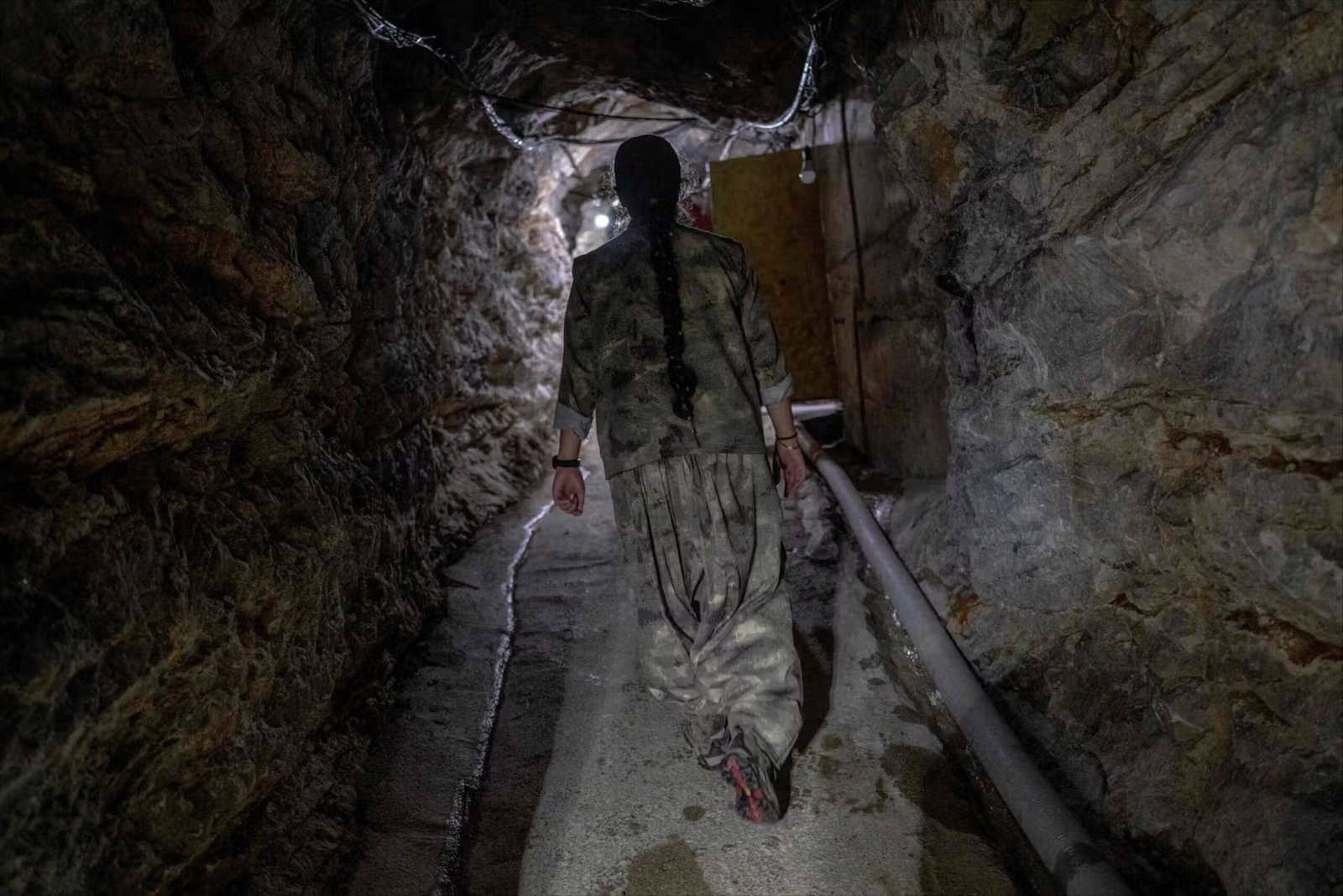
The latest indication comes from reports that the PKK is quietly digging new tunnels in the Halabja area, a border district directly adjacent to Iran’s Kurdish area of Paveh, which has recently seen armed activity against the IRGC. If confirmed, this marks the latest stage of a southward expansion that has unfolded over more than a decade.
That expansion has followed a clear geographical pattern. From its long-established stronghold in the Qandil Mountains, the PKK extended its infrastructure south into the Qaladze area, then into the Asos Mountains and Mawat district, now a major hub for PJAK, the PKK’s Iranian affiliate, and arguably its second most important base after Qandil. From there, the organisation expanded towards Penjwen, another strategic border district with Iran. Its presence has also been reported as far south as Said Sadiq, and now, according to recent reports, it is constructing tunnel networks around Halabja.
Although there are gaps between many of these positions, they are connected by a continuous mountainous chain stretching from Qandil southwards along the Iranian border. This terrain provides the PKK with a natural corridor, allowing relatively unrestricted movement despite the absence of permanent infrastructure across every section.
The shift is notable because the PKK’s expansion into the Suleimani area is relatively recent. When the organisation launched its insurgency against Turkey in the 1980s, its Iraqi bases were concentrated along the Turkish border, reflecting their role as staging grounds for operations inside Turkey. The movement established itself in the Haftanin area near Zakho, expanded eastwards into Amedi, then Khwakurk in Erbil province, before building permanent positions in the Gara Mountains and Qandil during the 1990s. Almost all of these areas lay within KDP-controlled territory.
Turkey’s increasingly aggressive military strategy gradually altered that geography. Rather than conducting temporary cross-border operations, Ankara began establishing permanent military positions inside northern Iraq, steadily pushing the PKK further south. The decisive turning point, however, appears to have come after the 2011 ceasefire between Iran and PJAK. While limited expansion had already begun, the PKK’s most significant southward movement accelerated from 2012 onwards.
That period also coincided with a major political transition inside the PUK. Following Jalal Talabani’s stroke and prolonged absence from politics, Lahur Sheikh Jangi gradually assumed control over much of the party’s security apparatus. It was during this period that PUK-PKK relations evolved into what increasingly resembled a strategic partnership, creating a far more permissive environment for the PKK’s expansion throughout PUK-controlled territory.
The locations identified above almost certainly represent a conservative estimate. Reports have periodically placed PKK elements further south around Kalar and as far west as Chamchamal. The systematic construction of tunnels and defensive infrastructure specifically along the Iranian frontier, however, is especially significant.
As the organisation moves towards peace with Turkey, its strategic orientation is changing. Rather than remaining a Turkey-facing insurgency, it increasingly resembles an Iran-facing one. Under the reported terms of the peace process, the PKK is expected to vacate all positions along the Turkish border. Many of those areas, including Haftanin, Amedi and much of Khwakurk, are already effectively under Turkish military control. Only a handful of major positions, such as the Gara Mountains and parts of Khwakurk, remain and are widely expected to be evacuated as the process advances.
If that occurs, the PKK’s military geography will have been fundamentally transformed. Its presence along the Turkish border would effectively disappear, while almost all of its remaining infrastructure would be concentrated along the Iranian frontier.
Equally striking is Turkey’s apparent silence regarding this southern expansion. Turkish reporting on the peace process has consistently focused on evacuating positions along the Turkish border, with no indication that Ankara is demanding the PKK withdraw from areas such as Asos, Mawat, Penjwen or Halabja. This may suggest that Turkey’s primary objective is not the complete removal of the PKK from Iraq, but securing its own border by replacing the PKK with permanent Turkish military control across the frontier zone.
Another notable development is the rapid improvement in relations between Turkey and the PUK, despite the latter’s continued close ties with the PKK. Turkey’s intelligence chief recently travelled to Suleimani to meet Bafel Talabani and Qubad Talabani, and the following day Qubad met Turkish Foreign Minister Hakan Fidan in Ankara. Reports now suggest that Bafel Talabani could even meet President Recep Tayyip Erdoğan as the peace process advances.
These contacts are unlikely to be occurring without the PKK’s knowledge. While the PUK and the PKK remain distinct organisations with different priorities, their interests continue to overlap. The recent diplomatic engagement appears more consistent with coordination, or at least mutual understanding, than with any breakdown in relations.
An equally important trend concerns Iran. Traditionally, both the PUK and the PKK have been regarded as relatively close to Tehran. Yet both have recently adopted noticeably more confrontational positions. PJAK has resumed violent clashes with the IRGC, while PUK leader Bafel Talabani has issued arguably his strongest criticism of Iran to date, directly accusing Tehran of aggression following recent Iranian strikes inside the Kurdistan Region.
Whether this represents a temporary tactical adjustment or the beginning of a broader strategic realignment remains unclear. The PUK and the PKK are, however, likely to remain broadly aligned in their approach to Iran. Although they are separate organisations with distinct interests, they influence one another and have increasingly coordinated their policies over the past decade. Their calculations should therefore be analysed separately from those of the KDP, which operates under a different set of strategic incentives.
There is little evidence that either the PUK or the PKK is positioning itself as part of a broader effort to overthrow the Iranian regime. Their posture instead resembles Turkey’s: they would likely welcome a weaker Iran, but not one whose weakening comes through becoming an instrument of Israel or a wider externally driven regime-change project. That distinguishes them, at least for now, from the more speculative claims that periodically surround Kurdish actors during periods of regional crisis.
Ironically, despite the KDP’s historically deeper ties with Israel, it too has been cautious about any direct confrontation with Iran. Rather than openly aligning with Israeli objectives, it has generally sought to avoid being drawn into the conflict. The differences between the Kurdish parties lie less in whether they favour confrontation and more in how they manage their relationships with the competing regional powers.
Beyond the implications for Iran, the peace process could fundamentally reshape the PKK’s long-term strategic position. Even if the organisation ultimately disarms inside Turkey and transforms into a legal political movement, it would not necessarily cease to be a regional actor. By relocating much of its remaining infrastructure to the Iranian frontier, the PKK would retain strategic depth outside Turkey while simultaneously becoming a legitimate participant in Turkish politics.
If the peace process succeeds, the PKK would no longer be simply an insurgent organisation or merely a parliamentary movement. It could evolve into a hybrid actor: a stakeholder in Turkey’s emerging political order while preserving extensive regional networks beyond its borders. That would allow the movement to avoid surrendering all of its strategic leverage and becoming entirely dependent on Ankara’s goodwill.
This could also benefit Turkey. If Ankara integrates the PKK into a stable political framework while tolerating its continued regional presence, it could transform a long-standing security threat into an actor whose interests become tied to regional stability. Rather than eliminating the PKK outright, Turkey would be incorporating it into a new strategic architecture, one in which the organisation gains legitimacy inside Turkey while Ankara gains indirect influence through a network of Kurdish actors whose interests become intertwined with its own.
If this interpretation proves correct, the peace process would represent far more than the end of an insurgency. It would mark a strategic reorganisation of Kurdish politics across the region, with the PKK shifting from a border-based guerrilla movement focused on Turkey into a transnational political actor whose centre of gravity lies along Iraq’s border with Iran while simultaneously becoming embedded within Turkey’s own political system.


