


Iraq’s Armed Factions Win the U.S. Withdrawal and Keep Their Weapons for Now
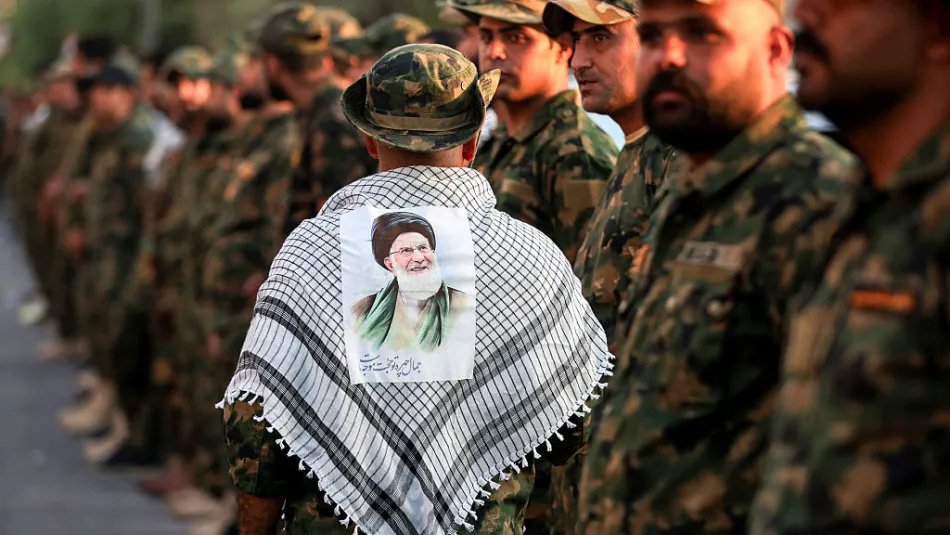
The last U.S. troops leave Iraq today, ending the mission of the American-led coalition against the Islamic State. For Iraq’s Iran-aligned Shia armed factions, the withdrawal is a major victory, and it comes after months in which they were on the defensive, facing American and Israeli strikes during the Iran war that began on 28 February, U.S. sanctions pressure and a government pledge to take away their weapons.
That pledge carried the same date. For most of this year, 30 September was presented in Baghdad as the point by which weapons outside official control would have to be handed over. The date has now passed with the U.S. exit completed and the weapons question moved into a phased process ending on 30 June 2027. Over the same months, the terms of the discussion have shifted away from dismantling the factions towards regulating, reorganising and integrating them into the Popular Mobilization Forces (PMF), the paramilitary umbrella that has formally been part of Iraq’s armed forces since 2016.
Today’s messaging reflects that shift. Government spokesman Haidar al-Aboudi announced that agreement on integration had been reached with the factions. Less than three hours later, the Islamic Resistance in Iraq, the umbrella label used by the hardline factions, rejected any government or political timetable. It said its four factions had signed a negotiating paper with the committee of the Coordination Framework, the alliance of Shia ruling parties, and had received no government response, and it reserved the right to retaliate against American or Israeli violations.
Context: The withdrawal completed today has its political origin in January 2020. On 3 January that year, a U.S. drone strike at Baghdad airport killed Qasem Soleimani, commander of Iran’s Quds Force, and Abu Mahdi al-Muhandis, deputy chairman of the PMF and founder of Kataib Hezbollah. Two days later, parliament passed a resolution requiring the government to end the foreign military presence and prevent foreign forces from using Iraqi land, waters or airspace. The same resolution also required exclusive state control of weapons, a clause that drew far less attention at the time.
The session was attended by around 170 of parliament’s 329 MPs and the resolution passed by a show of hands. Its backing came from the Shia blocs: Fatah, the alliance led by Badr Organisation chief Hadi al-Amiri that carried the militia-linked parties, including Sadiqoun, the political wing of Asaib Ahl al-Haq; Sairoon, the alliance of Shia cleric Muqtada al-Sadr; and MPs from former prime minister Nouri al-Maliki’s State of Law and Ammar al-Hakim’s Hikma. The Kurdish blocs boycotted the session, as did most Sunni MPs, who warned that a withdrawal could allow the Islamic State to return and hand ground to the armed factions. Only a handful of Sunni MPs attended.
The resolution was non-binding and set no timetable, but it remained the reference point for the withdrawal campaign. In February 2024, parliament called on the government to implement it, and that September Baghdad and Washington agreed to wind down the coalition mission in two phases: ending it in federal Iraq by September 2025, while allowing operations supporting the Syria mission to continue from Iraq, largely from the Kurdistan Region, until September 2026. The factions’ coordinating body welcomed the agreement as the fulfilment of a goal its members had made sacrifices for. The outcome required several governments and a negotiated settlement with Washington, so the factions cannot claim it as theirs alone. The demand they pushed through parliament in the days after Muhandis’s death has nevertheless now been realised.
The link between the withdrawal and the factions’ weapons was made explicit by Iraqi leaders after the coalition timetable was set. In November 2025, then prime minister Mohammed Shia al-Sudani pledged that weapons would come under state control once the coalition left, with faction members joining official security bodies or entering politics. Prime Minister Ali al-Zaidi went further. He told President Donald Trump at the White House in July that there would be no justification for armed factions after 30 September, and his spokesman had said in June that any weapons remaining after that date would be considered irregular. In August the State Administration Coalition, the governing alliance of Shia, Sunni and Kurdish parties, warned that armed activity outside official institutions after that date could be dealt with under the anti-terrorism law.
The retreat began in the second half of August and coincided with the visit of Mohammad Baqer Ghalibaf, speaker of Iran’s parliament, who arrived in Baghdad on 19 August for three days. According to Iraqi reporting based on three sources, he urged Coordination Framework leaders to leave the weapons with the factions or deposit them with the PMF, where they would remain available in an emergency, accepting exclusive state control in principle while arguing that current conditions did not allow it. On 21 August, while he was still in Baghdad, Aboudi was quoted saying that 30 September concerned the American withdrawal and was not the final date for faction weapons. The next day Deputy Speaker Adnan Fayhan said the weapons would be stored in PMF warehouses, and on 23 August National Security Adviser Qasim al-Araji described weapons control as a gradual process beginning after the coalition left. Reports at the time described a proposal under which factions would declare their weapons and premises to the government and freeze their activity for two years, in place of a handover.
The timing does not establish that Ghalibaf dictated the change, and integration through the PMF was already part of government planning in June. What changed around his visit was the firmness of the deadline and the growing space given to arrangements that would keep the weapons within reach of the factions. As TNC reported earlier this month, the softening also ran alongside expanded Iraqi access for oil exports through the Strait of Hormuz.
By 18 September, Araji was saying the weapons committee had no fixed period for completing its work. On 21 September, Zaidi met Secretary of State Marco Rubio in New York and presented a timetable ending on 30 June 2027. Tom Barrack, the U.S. envoy for Iraq and Syria, said afterwards that there was agreement that by the end of June only the state would hold military force, confirming Washington’s acceptance of the longer schedule.
Analysis: The extension matters because the content of the process has changed along with the date. The clearest public outline of the current proposal was set out on 22 September by Haidar al-Fouadi, political chief of Sudani’s coalition. It has five stages: announce the agreement alongside the withdrawal; hold a 90-day period in which the factions stop attacks, with assurances against U.S. strikes on them; begin a gradual weapons handover; end the factions’ independent armed existence, admitting their members as individuals into the PMF and other official bodies; and complete the process by 30 June 2027, after which independent armed groups would be unlawful. Fouadi described this as the basis for a future agreement, with negotiations continuing.
Beyond that outline, the mechanics remain contested. One account describes a new PMF directorate receiving weapons under government supervision from January 2027, with protection from prosecution and access to electoral politics for factions that commit to ending independent armed activity. Another places the handover of strategic weapons, meaning ballistic missiles, rockets and one-way attack drones, from March 2027, with faction brigades entering the PMF as units. The difference is significant, since admitting members as individuals would break faction command structures, while admitting brigades would carry those structures into the PMF intact.
The vocabulary has moved in the same direction. Ali al-Asadi, political chief of Harakat al-Nujaba, said on 9 September that the understanding with Framework negotiators had shifted from confining weapons to the state (hasr al-silah) to regulating them (tanzim al-silah), and described 30 September as the start of talks that could last months. Qais al-Khazali, leader of Asaib Ahl al-Haq, supports confining weapons to the state while opposing their surrender, and says his group’s weapons are already held within the PMF.
The PMF route allows the language of state control to be met at little cost to the factions. Under the 2016 PMF law, the force already reports to the commander-in-chief and its members are barred from political activity, yet the factions have operated within it for a decade. The storage compromise reported in August described depots registered with the government and open to surprise inspections, but managed in practice jointly by the factions and the PMF, whose chief of staff, Abu Fadak al-Mohammadawi, comes from Kataib Hezbollah. Moving weapons into PMF warehouses can therefore change their legal custodian while leaving practical control with the same networks. The transfers reported so far are small: in August, a source said Asaib’s brigades 41 and 42 in Yusufiya had handed over fewer than ten drones, all without munitions, and no missiles.
The PMF legislation adds a further layer. On 29 September, the cabinet approved a PMF bill for referral to parliament, reviving legislation Washington had opposed. Reported revisions removed a PMF staff college and the Muhandis General Company, the PMF’s commercial arm, from the organisational draft, which suggests the text was adjusted under American pressure. Negotiators are also reported to be close to giving the PMF chairman the rank of a minister without portfolio, and a separate Framework proposal would create a dedicated PMF drone formation to receive faction weapons. If passed without breaking faction command, these measures would give the factions’ capabilities official status, funding and legal cover.
The factions are entering this process from different positions. Asaib Ahl al-Haq, with ministers and MPs to protect, is incorporating itself, and Khazali today congratulated fighters and called for sovereignty celebrations. Kataib Sayyid al-Shuhada ties any discussion of weapons to a wider sovereignty package that includes Iraqi-controlled air defences, passage of the PMF laws, the departure of Turkish troops and fighters of the Kurdistan Workers’ Party (PKK), federal control of the Kurdistan Region’s borders and crossings, and the removal of Iranian opposition groups from Iraq. Kataib Hezbollah has claimed credit for expelling the Americans while threatening to monitor Iraqi airspace, and today disputed that the withdrawal was complete, alleging continued U.S. flights and personnel movements until 30 October without presenting evidence. Ashab al-Kahf said on 29 September that surrendering its weapons would require a written religious ruling.
These conditions reach well beyond the U.S. exit, so the departure of American troops meets only one of the demands the hardline factions attach to their weapons. As TNC has previously argued, the factions with the most to lose politically are moving towards the state, while those holding the capabilities Washington worries about most are keeping them.
The factions’ political weight has also shown outside the weapons file. After U.S. sanctions on Iran’s aviation sector halted flights between the two countries, Nujaba leader Akram al-Kaabi threatened sit-ins at airports and Basra MPs gave the government 48 hours to reverse course. On 28 September, the U.S. Treasury issued a licence allowing Iraqi Airways to fly Iranian pilgrims between Iran and Najaf until 28 October. Its terms are narrow. It covers Iraqi Airways only and Najaf only, bars bulk cash and militia-affiliated passengers, and can be revoked if Iraq fails to keep other Iranian flights out of its airspace. It remains a limited exception, granted in the same week Washington accepted the longer weapons timetable.
The additional time has its own strategic value. A politician close to the Coordination Framework told Iraqi media that delay gives Iran time to secure a favourable settlement with Washington, and the same reporting said Tehran wanted stored weapons to stay within the factions’ reach. Some Iraqi analysts argue the factions are also waiting for the U.S. midterm elections in November, which could weaken Trump’s position. Developments on either front could reshape the factions’ position well before June 2027, and until then their arsenals remain their main source of leverage.
The outcome will turn on who appoints PMF commanders, who controls access to the depots, who authorises launches and what happens when a faction refuses an order. For now, the public record shows a postponed deadline, small transfers of weapons and a government announcement of agreement that the hardline factions dispute. The factions have secured the U.S. exit they demanded in 2020, along with nine more months to negotiate the terms of their own integration, on terms that are moving in their favour.


