


Iraq’s Hardline Factions Refuse a Disarmament Others Have Accepted
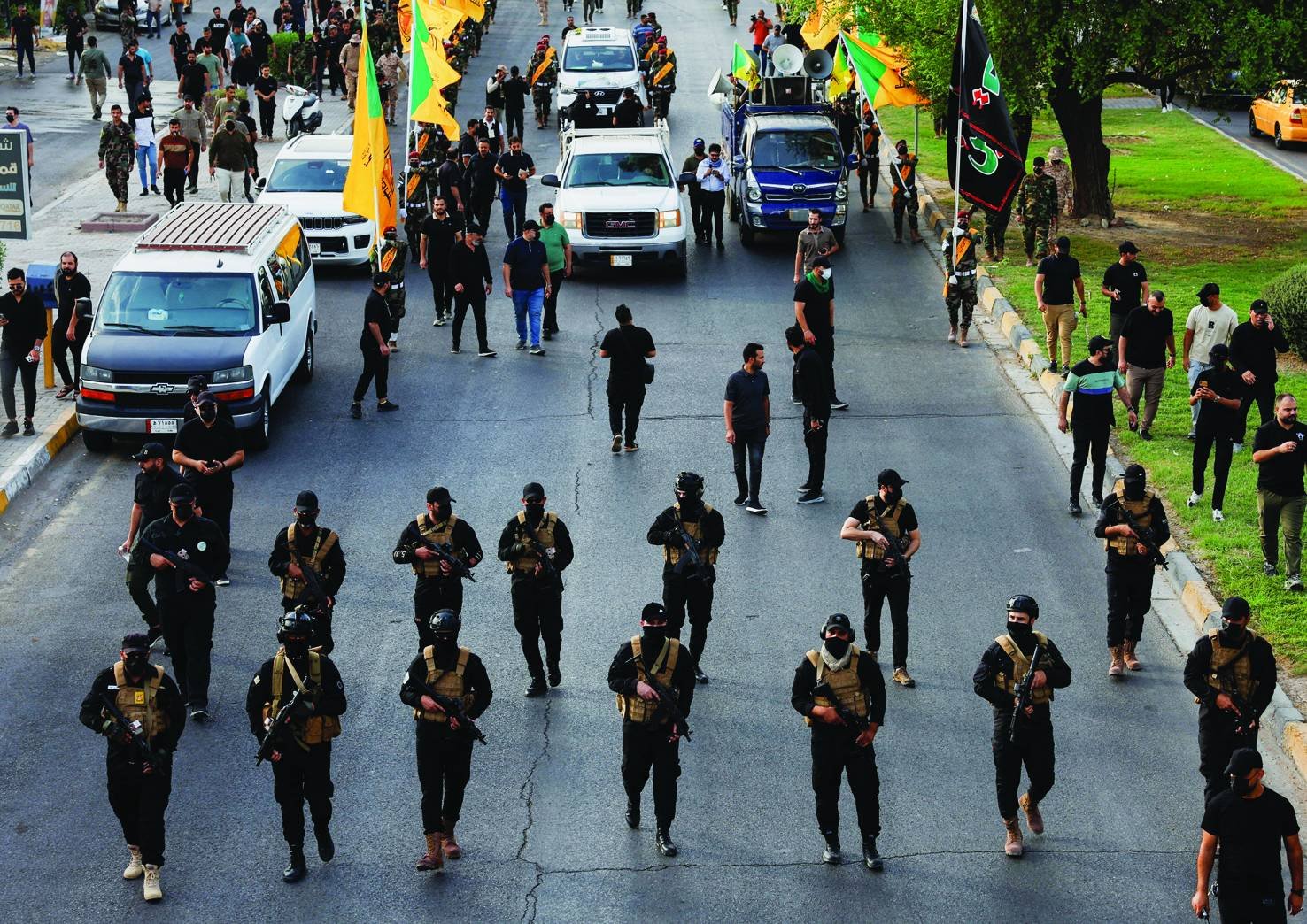
Iraq’s most powerful armed factions have begun responding to a renewed drive to bring all weapons under state authority. The political cover came from the Coordination Framework, which declared its support for “the monopoly of arms in the hands of the state”, and for separating the Popular Mobilization Forces from every political, party, and social framework. The Framework empowered Prime Minister Ali al-Zaidi, as commander-in-chief, to take the necessary measures, anchoring the move in the constitution, the 2016 PMF law, the government programme, and guidance from the powerful Shia marja’iyya.
Context: Implementation has passed to a three-man committee made up of Zaidi, former prime minister Mohammed Shia al-Sudani, and Badr leader Hadi al-Amiri. Its declared tasks read less like a disarmament order than a state-absorption checklist. The committee is to audit fighters, verify criminal records, count actual personnel, set a deadline for handing over weapons, distribute those personnel across ministries and security agencies, secure funding, and possibly create either a new security ministry for the PMF or an independent security body.
Three factions have publicly accepted the logic of delinking. Moqtada al-Sadr announced the separation of Saraya al-Salam from the Sadrist current and its attachment to the state, with its brigades to be folded into the Defence or Interior Ministry at the commander-in-chief’s discretion and their weapons handed to whichever body receives them. Asaib Ahl al-Haq followed on 2 June, declaring that it would sever its link to the PMF formations, confine its weapons to the state, and place itself under the commander-in-chief. It set up a central committee to inventory personnel, weapons, vehicles, and equipment before aligning with state institutions. Kataib al-Imam Ali moved the same day, creating three committees: one for the inventory and handover of weapons, one for the families of its dead and wounded, and one for reintegrating personnel into state bodies. Ammar al-Hakim publicly praised Sadr, Qais al-Khazali, and Shibl al-Zaidi for the steps.
The refusal camp is smaller. Kataib Hezbollah has rejected surrendering its weapons outright, and has gone further by offering to receive or buy the arms that other factions give up, with particular interest in drones, loitering munitions, cruise missiles, and anti-armour systems. Kataib Sayyid al-Shuhada has refused openly, its spokesman Kazim al-Fartousi describing the group’s weapons as a “trust and a religious duty”, drawing a line between resistance weapons and the administrative question of PMF affiliation, and accusing the government of dressing American conditions in the language of marja’iyya guidance. Harakat al-Nujaba had already escalated against the proposed Federal Security Ministry, with Hussein al-Saidi calling the merger an American project and insisting that resistance weapons cannot be bargained over.
The weapons drive does not stand on its own. Iraqi reporting ties it closely to American leverage, from Washington’s effective veto over cabinet formation to its control over dollar shipments and Iraq’s foreign reserves, and its refusal to let figures linked to the factions take ministries. Running in parallel is a financial and bureaucratic track: moves around the Baiji refinery, figures such as Adnan al-Jumaili, and alleged oil-smuggling networks, together with the possible removal of thousands of special-grade officials embedded across the ministries. Taken together, the measures reach well beyond weapons, into the money and patronage that have long underwritten faction power.
Analysis: The clearest way to read this process is by its effect, which registers more strongly in politics than on the ground. The line between the two camps runs between the factions with the most to lose politically and the factions whose strength still rests on their own weapons. The first group can afford to trade a visible armed presence for state protection. The second cannot, because the trade would cost them the very thing that makes them useful.
Asaib Ahl al-Haq sits firmly in the first group. It is no longer a militia with a political wing so much as a political movement with a residual militia. Its political arm, Sadiqoun, took 28 seats in the 2025 election, more than any other single Shia party once the broad coalitions are broken apart. For an organisation of that size, being treated as an illegal armed actor is far more costly than reclassifying a few PMF-linked brigades. For Asaib, in other words, this is not surrendering power but protecting its parliamentary, ministerial, and economic base by giving up the most exposed part of its armed file. Its social milieu is much like Sadr’s, the poorer and often less-educated Shia class, so preserving its patronage and economic networks is what protects and expands its voting base. It also keeps alive the longer ambition of one day claiming the premiership, a prize that would require a working relationship with, and acceptance from, the United States.
Badr’s position runs in the same direction but on older foundations. Its strength rests less on independent weaponry than on decades of penetration into the security ministries, the provinces, and the PMF system itself. Amiri’s seat on the implementing committee, together with the proposed Federal Security Ministry that would absorb the PMF as a state structure, points to a straightforward conclusion. If the institution survives, Badr has no need of a militia outside it, because its influence already runs through the state.
Sadr loses the least of all. Saraya al-Salam is only one source of his coercive power, and far from the most important. His real strength lies in a mass social base, a clerical network, and the ability to put followers on the street whenever he chooses. Handing the brigades to the state lets him look nationalist and state-minded while sacrificing little of what makes him formidable, and reporting on the Samarra formations suggests no significant change is expected there.
Kataib Hezbollah belongs to the other group entirely, and it is the most important actor in the whole process. It is the strongest single faction inside the PMF and the most deeply embedded in it, running the 45th, 46th, and 47th brigades and holding the force’s most sensitive departments, among them the chief of staff, security, intelligence, missiles, and anti-armour. Its operational leader, Abu Fadak al-Mohammadawi, doubles as the PMF’s day-to-day commander. The group has political cover through the Huqooq Movement, but it was never built as a parliamentary project. Its value lies in elite military capability, ideological discipline, proximity to the IRGC, and a covert infrastructure the other factions cannot match. Membership itself carries prestige among Shia fighters, precisely because it brings better training and tighter discipline. In effect, Kataib Hezbollah is becoming the closest Iraqi equivalent to Lebanese Hezbollah, without the mass political role, which is left to Shia actors who can plausibly present themselves as less tied to Tehran.
One layer sets it apart further still. Kataib Hezbollah does not only field fighters, weapons, and state penetration. It holds territory. Jurf al-Sakhar, renamed Jurf al-Nasr after the expulsion of ISIS and of its Sunni population, has functioned for close to a decade as a sealed, KH-dominated security zone south of Baghdad, closed to outsiders and beyond the government’s oversight. Reporting describes it as a main base for the group’s camps and a site tied to the development of missiles and drones with Iranian support, all against the backdrop of a displaced local population that has not been allowed to return. That gives Kataib Hezbollah something no other faction has: a rear base, logistical and training depth, and a defensible geography covering the approaches to Baghdad, Babil, and Karbala.
The decisive fact about this process is that the factions accepting delinking are not the ones that generate Iraq’s security problem with Washington. During the recent war between Iran, Israel, and the United States, the attacks on American forces came overwhelmingly from Kataib Hezbollah, with a smaller share from Nujaba and Kataib Sayyid al-Shuhada. The groups now forming inventory committees were, for the most part, not the ones firing. Their delinking therefore redraws the legal map of the PMF without altering the operational reality on the ground.
The Islamic Resistance in Iraq, Saraya Awliya al-Dam, Ashab al-Kahf/Kataib Sarkhat al-Quds, and Jaysh al-Ghadab have claimed almost all of the attacks. The evidence points to these labels functioning largely as fronts for this same small group of core militias that have rejected integration. The Islamic Resistance in Iraq is the broad umbrella; according to the US State Department’s own assessment, it includes Kataib Hezbollah, Harakat Hezbollah al-Nujaba, Kataib Sayyid al-Shuhada and Ansar Allah al-Awfiya. Saraya Awliya al-Dam is tied mainly to Kataib Sayyid al-Shuhada, in coordination with Kataib Hezbollah. Ashab al-Kahf and Kataib Sarkhat al-Quds sit within the facade ecosystem around Nujaba. Jaysh al-Ghadab appears to belong to the same resistance-brand architecture rather than to a separate militia command.
Seen this way, the moves by Asaib, Badr, and Sadr are not concessions so much as rational trades. Each gives up the part of its armed identity that has become a liability while keeping the source of power that actually matters to it, whether parliamentary weight, institutional penetration, or a mobilisable social base. None of them needs an autonomous militia to remain powerful, so handing one over costs little and buys the appearance of statesmanship.
There is also a practical upside that Shia insiders increasingly acknowledge: integration can strengthen rather than weaken the Shia hold on the security state. Badr is the precedent. Bringing its men inside the Interior Ministry years ago institutionalised their influence rather than ending it. The Hashd is treated by many of its supporters as an almost sacred force, which makes talk of dismantlement painful, but the establishment’s strategic argument is that a more state-led order can preserve Shia dominance while curbing the factional fragmentation that has turned the PMF into an arena of internal rivalry and, increasingly, a liability.
Set against the political and financial measures moving beside it, the weapons drive looks less like a single disarmament order than one track of a wider pressure campaign. The security track holds the inventories, the handovers, the delinking, and the proposed Federal Security Ministry. The political track holds the push to keep faction nominees out of the cabinet and steer the Framework toward independent technocrats. The financial track holds the corruption files, the oil-smuggling cases, the question of dollar access, and the officials tied to faction networks. Weapons are only its most visible front.
None of this will be clean. The process is contested and easy to reverse, above all if the region slides back into open Iran-Israel confrontation and the factions revive the logic of unity of arenas. The sharper dispute is over implementation: which state body can be trusted to take these capabilities and enforce the limits, when Washington distrusts the very institutions the factions have spent years penetrating. The timing compounds it, since moving on the weapons file while the premiership is still being negotiated ties disarmament to government formation and invites scapegoating.
On that front, the process may genuinely tidy the overlap between the parties and the PMF, but it should not be mistaken for strategic disarmament. What is taking shape is a selective delinking, in which the factions with their political survival at stake trade the appearance of armed autonomy for the protection of a state they help control, while the factions that actually hold the capabilities Washington worries about keep them. Whether it ends in real disarmament or only in the re-registration of some factions inside the state is unresolved, while harder-line groups such as Kataib Hezbollah, Nujaba, Kataib Sayyid al-Shuhada, Ashab al-Kahf, and Saraya Awliya al-Dam keep the category of resistance weapons outside it. That core may not even be decided in Baghdad. The weapons file of these refusers, Kataib Hezbollah’s in particular, is said to be tied to the wider US-Iran negotiations, which would put the decisive questions, and the eventual American response, beyond the reach of the Iraqi process.
The core story, then, is not a sudden embrace of state sovereignty. It is a forced strategic rebalancing presented as a sovereign choice: dismantle enough to survive the pressure, integrate enough to avoid a backlash from the Hashd’s base, preserve the Shia-led order, and recast a retreat from militia autonomy as state-building, before external threats and internal fragmentation close off a controlled outcome.


