


For the KDP, Mansour Barzani’s U.S. Bribery Case Comes at the Worst Possible Time
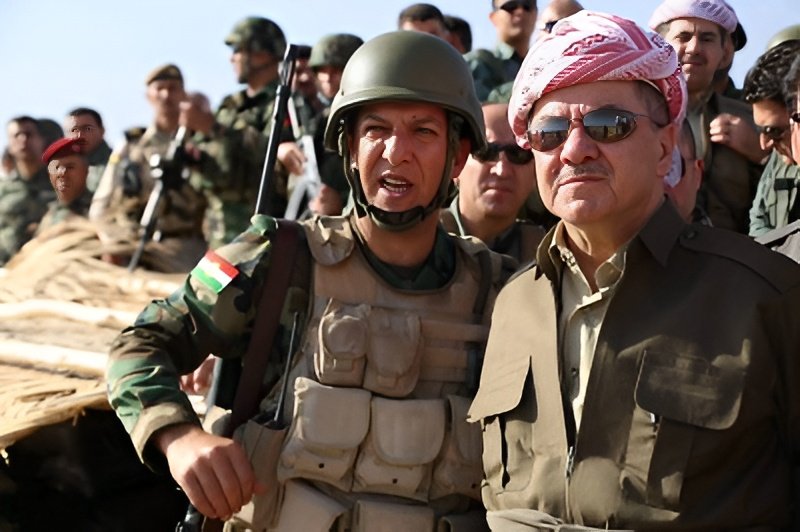
On April 22, the U.S. Justice Department filed a civil forfeiture complaint in the U.S. District Court for the Central District of California seeking to seize a Beverly Hills mansion reportedly purchased and renovated with roughly $30 million in proceeds from a scheme to defraud the U.S. Department of Defense’s Defense Logistics Agency, pay bribes to senior KDP commander Mansour Barzani, and violate U.S. money laundering laws. Barzani is alleged to be the beneficial owner of the property.
Context: According to the DOJ, from 2016 to 2020, a Virginia-based defense contractor and others obtained more than $700 million from DLA for fuel deliveries to the U.S. military during anti-ISIS operations. Erbil International Airport, where KDP security forces provided internal security and controlled access to the facility, was a critical fuel delivery point for U.S. operations in Iraq and Syria.
According to the complaint, which followed years of investigation by the FBI and other U.S. agencies, the contractor agreed to pay Mansour Barzani a bribe of $0.25 per liter in exchange for exclusive access to deliver jet fuel in Kurdistan to U.S. military and coalition forces. During the same period, competitors were allegedly blocked from accessing the airport, while DLA issued one-time-buy contracts to the contractor, often at noncompetitive and sharply inflated prices.
Analysis: The Justice Department press release is unusual because it explicitly names Mansour Barzani. More damaging, however, is the degree of confidence it signals in the allegations. These cases are notoriously difficult to prove, especially when ownership and financial flows are concealed through layers of corporate structures, trusts, and offshore arrangements.
The press release, combined with prior investigations, also provides a clearer picture of the alleged scheme and the broader modus operandi around U.S. military logistics in the Kurdistan Region. Contracts linked to U.S. troop deployments were already highly lucrative without bribery. What makes this case particularly notable is the scale of the alleged overpricing.
In theory, DLA could award contracts competitively to whichever company met the requirements. But at the time, two logistics firms, Varec and Strategic Social, which appear to have initially secured fuel-related contracts, were reportedly prevented by KDP authorities from making deliveries. This forced the Pentagon back to DGCI at even higher prices. The DOJ complaint now alleges that DGCI had bribed Mansour Barzani to secure exclusive access.
DGCI, whose director is Aziz Doraney, was reportedly a very small company when it began handling the Erbil fuel contract. Reports indicate that in 2015 its annual revenue was only about $2 million. By 2017, that figure had reportedly surged to $150 million, reflecting three-year revenue growth of 10,999 percent, despite the company reportedly having only around 10 employees at the time. That alone illustrates both the scale of the money involved and the extent of the alleged overpricing.
In a 2020 report, OCCRP cited a 2017 KRG memo that approved only DGCI, its Kurdish subcontractor Triple Arrow, and Rainfloods, a Kurdistan-based company, to deliver fuel to Erbil airport. With that access, DGCI was reportedly able to charge the U.S. government as much as $10 per gallon for jet fuel, while standard DOD jet-fuel guideline prices between 2016 and 2020 ranged from roughly $2.14 to $3.20 per gallon.
Triple Arrow appears to have been a joint venture involving DGCI and Zozik Group, which is owned by Kareem Khan Bradost, the head of the Bradost tribe and an influential figure closer to the PUK who has also been active in logistics business linked to U.S. troops. The other subcontractor, Rainfloods, is owned by Mansour Barzani. Rainfloods also owns Lanaz refinery, the largest oil refinery in the Kurdistan Region. Over time, Mansour Barzani has become an increasingly important player in the refinery-linked energy sector, from reported access to cheap Syrian oil to refining and onward sales through contracts such as the jet-fuel business and beyond.
The new Justice Department complaint, which connects the alleged bribery proceeds to the purchase of the Beverly Hills mansion, is equally significant. According to the press release, part of the money was wired to “NYJD Trust No.1,” a trust established in Virginia for the private benefit of Mansour Barzani. In other words, Barzani is alleged not only to have profited from anti-ISIS operations based in Erbil, operations that helped protect both Syrian and Iraqi Kurds from ISIS advances and elevated Erbil’s role as a political and military hub for U.S. forces, but also to have used those proceeds to purchase a luxury property in the United States.
What has appeared in the press release may only be one part of a broader investigation. The allegations also overlap with reporting by Zack Kopplin, who wrote in The New Republic in 2020 that Al Shimal Oil, the predecessor of Rainfloods and the Mansour Barzani-owned subcontractor in the alleged bribery scheme, had been blacklisted by the U.S. Defense Department in 2018 for selling sanctioned Iranian fuel. If that reporting is connected to the same investigative track, the potential scope may be broader and could implicate Barzani in more serious sanctions-related violations.
It is also worth noting that other dealings involving members of the Barzani family have faced scrutiny. For example, Mustafa Masoud Barzani’s Golden Eagle has been alleged in U.S. court filings to have been involved in oil contracts designed to circumvent U.S. sanctions on Iran. Those claims, however, remain allegations raised in legal proceedings.
The timing is especially damaging for the Barzani family, which has already been facing a series of political setbacks. In Iraq, the KDP boycotted the parliamentary session in which the PUK’s candidate was elected president, only for the U.S. ambassador to visit the newly elected president the following day in a clear signal of recognition and support for the process. The KDP also found itself increasingly isolated, as many of its Iraqi allies attended the presidential election session despite the boycott.
One of the KDP’s most important political assets in Baghdad has long been its claim to possess strong lobbying networks and privileged relations with the United States. That has been a key card in its negotiations with Iraqi parties. But Barzani’s strong backing of Nouri al-Maliki for prime minister, followed by a public U.S. veto of Maliki’s return, and now the explicit naming of Mansour Barzani in an official Justice Department press release, significantly weakens the KDP’s hand in Iraqi politics.


