


A Sanctioned Broker, an Iranian Intelligence Link, and the Barzani Company Between Them
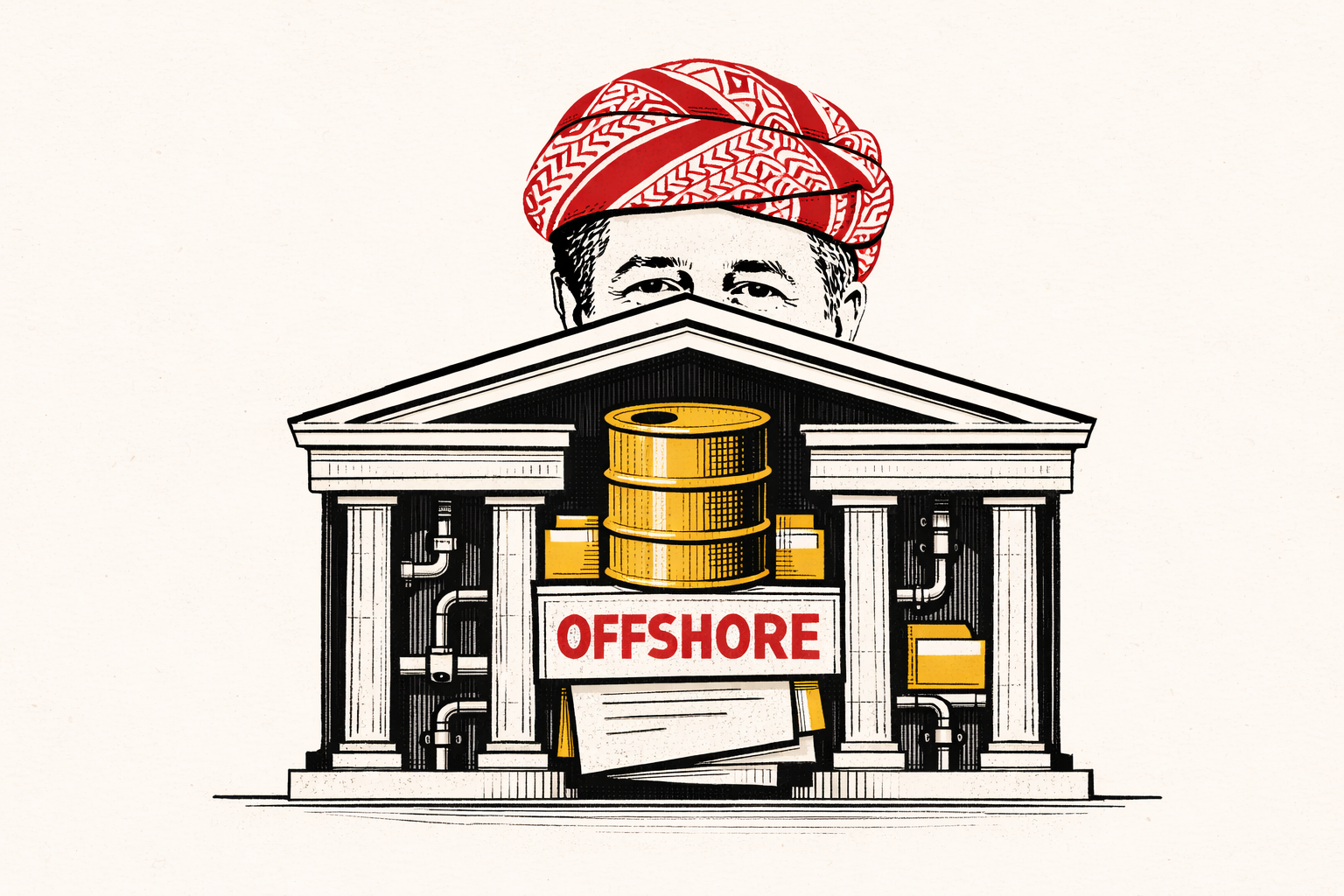
When the KRG needed someone to move its oil in 2014, it turned to Murtaza Lakhani. He was not new to the business. He had started his career at Glencore, where a UN investigation later found he had helped bust the oil embargo against Saddam Hussein’s Iraq. By the time the KRG came calling, he had spent years operating in the space between sanctioned governments and international oil markets.
The Financial Times described him as a key figure helping fuel the Kurdistan Region’s exports. Reuters reported that the KRG brought him in to find willing shipping companies, and Ashti Hawrami, the KRG’s then Minister of Natural Resources, said Lakhani “opened the doors.” Hawrami, who served as the architect of the KRG’s entire oil sector from 2006 until 2019 and died in London in October 2024, made that statement on the record to Reuters in 2015. Bloomberg, in a 2020 investigation by Jack Farchy and Javier Blas, described Lakhani as a billion-dollar broker whose operations spanned Venezuela, Iran, Iraq, and Russia. His company, Mercantile and Maritime Group, managed the KRG’s export process from 2014 to 2020.
In December 2025, both the United Kingdom and the European Union sanctioned him for enabling shipments of Russian oil from Rosneft. The FT covered the designation and noted his earlier role in Kurdistan. And new federal court filings in the United States now allege his role went further: that he acted as an intermediary between Barzani-controlled oil companies and Rosneft itself, the very entity whose oil shipments triggered his sanctioning.
That connection is not the only one the filings draw. Leaked corporate records and investigative reporting have documented a broader financial architecture connected to the Barzani family, one built systematically for concealment. Lakhani’s operations intersect with that architecture in ways that are now part of the public record. What they reveal is not just a story about one family. It is likely a blueprint for how ruling elites in resource-rich territories move wealth beyond scrutiny. And whether the strategic value Washington placed on the Kurdistan Region contributed to these structures going unexamined is a question the evidence now makes harder to avoid.
The System: The architecture became visible in October 2025, when the Organised Crime and Corruption Reporting Project, working with the Government Accountability Project, published findings from the leaked files of Jonathon Moore, a Delaware attorney who served as the Barzani family’s U.S. legal architect.
Between 2005 and 2019, holding companies owned by the five sons of Masoud Barzani acquired 31 properties across the United States worth over $100 million. The money came through two Kurdish conglomerates: Golden Eagle Global, which leaked documents suggest was controlled by Masrour Barzani’s brother Mustafa, and Ster Group, which a 2008 U.S. State Department cable described as having Masrour as its hidden majority shareholder. The OCCRP investigation published further evidence, including a December 2008 internal email in which a Golden Eagle executive referred to Ster Group as “Masrour Barzani’s overseas company,” and a separate email from Golden Eagle vice president Laura Geho acknowledging that “a lot of people know that GEG is wholly owned by a Barzani,” even though the formal ownership documents said otherwise. Ster Group’s lawyers dispute the characterisation of Masrour’s role but acknowledge the company transferred over $18 million toward Barzani family expenses in the United States.
Moore built the concealment structure. Each brother owned a British Virgin Islands company named after a character from the Pirates of the Caribbean films. Those offshore companies owned U.S. entities in Delaware and Virginia. The property deeds sat inside them with no public connection to the Barzani name. Moore wrote in internal correspondence that he was working to “keep their names off of the public records.” When a lender asked for background on one of the brothers, Moore warned that revealing the family’s political connections would trigger “a lengthy PEP due diligence,” the enhanced scrutiny banks apply to Politically Exposed Persons, the mechanism designed precisely for situations like this one.
A Washington-registered company called GEGI Management LLC served as the financial hub. An internal document described it as “formed for the sole purpose of maintaining an administrative bank account to receive Barzani family funds.” In practice, according to leaked records, it paid for American Express Black Card charges for multiple brothers, hospital bills, designer clothing, jewellery, a $340,000 Ferrari, and a $41,000 nanny placement bill. This was not a property management vehicle. It was the financial circulatory system of a ruling family’s American life, fed from Kurdistan through structures built to stop anyone seeing where the money came from.
The same logic governed the oil sector. A Belize-registered company called IMOCO was contracted to export Kurdish crude. Golden Eagle provided IMOCO with regulatory access and government connections in exchange for fees. Moore reviewed the contract in October 2013, when the KRG was building its pipeline to Turkey over Baghdad’s objections and the question of who was buying Kurdish crude was a live dispute in three capitals. Belize does not disclose company ownership. No one has identified who owned IMOCO. Moore himself noted the jurisdiction did not “exactly enhance confidence.” The choice of Belize was not unique to IMOCO. Bloomberg later reported that when Rosneft extended a $6 billion loan to the KRG to be repaid in crude, the money flowed through a Belize-registered company controlled by Lakhani, with a mailing address in Cyprus. The same opaque jurisdiction, serving the same function, in a different arrangement involving the same oil sector. IMOCO was dissolved in 2023, the same year the Iraq-Turkey pipeline was shut down after the ICC arbitration ruling in Baghdad’s favour. It existed for exactly as long as the KRG’s independent export infrastructure, and not a day longer.
KDP-aligned media, including Rudaw and K24, did not report on the OCCRP findings. Baghdad, which has spent years accusing the KRG of oil revenue opacity, said nothing. The National Context published its own investigation into the Barzani family’s U.S. financial operations in December 2025.
Golden Eagle, The Node: The company that appears across every layer of this story is Golden Eagle Global.
It is the entity leaked documents suggest was controlled by Mustafa Barzani. It provided government access to IMOCO. Barzani family wealth flowed through it into U.S. property. And it is the entity that now appears in federal court filings connected to both sides of a picture that raises serious questions.
On one side: Lakhani. A petition for writ of replevin filed in the U.S. District Court for Delaware on January 28, 2026, alleges he acted as an intermediary between Barzani-controlled oil companies and sanctioned entities including Rosneft and Vitol. The filing describes his sanctioning as undisputed by the defendants. The presence of Vitol, one of the world’s largest independent oil traders with its own deep history in the Kurdish crude market, suggests the intermediary network reached well beyond sanctioned Russian oil.
On the other side: the same filing alleges that a server held by a Wilmington law firm contains evidence of transactions involving Ehsan Sakhaei, described as the son-in-law of Mahmoud Alavi, Iran’s Minister of Intelligence from 2013 to 2021 and currently a special advisor to President Pezeshkian. The filing alleges Sakhaei was connected to Golden Eagle and to oil contracts negotiated in Switzerland to circumvent U.S. Iran sanctions.
The Golden Eagle connection has not been independently verified. The plaintiff, Mahtaub Moore, has not directly accessed the server and relies on third-party information and federal subpoenas. It remains an unresolved claim before the courts.
But Sakhaei himself is not an unknown figure. Iranian court proceedings and investigative reporting establish him independently. He was named in the Bank Mellat embezzlement case as an alleged “super-debtor.” One of his companies was involved in Iran’s oil swap deals, one of the primary mechanisms through which Tehran has historically moved oil outside normal channels. The court described him as having used “illegal and illegitimate methods to escape the law and rob the treasury.” He was never indicted, despite being publicly named, while others in the same case received sentences of up to 20 years. His father, Seyyed Baqer Sakhaei, is a former Iranian diplomat who served as envoy to Qatar and Tunisia. He is reported to be living in Switzerland, the same jurisdiction where the Delaware filing alleges the Golden Eagle oil contracts were negotiated.
The court filing’s allegation, in other words, points to a person whose independently documented profile is consistent with exactly the kind of intermediary role it describes: operational experience in Iranian oil swap mechanisms, connections to sanctioned Iranian banks, a family embedded in the intelligence and diplomatic establishment, and a reported base in the jurisdiction the filing names. If the Golden Eagle connection is substantiated, it would mean a Barzani-controlled entity’s commercial network extended to a figure whose entire profile represents precisely the kind of sanctions risk the architecture was built to avoid examining.
Whether that connection can be substantiated may depend on a physical server currently at the centre of contested legal proceedings in Delaware. The filing alleges the server, held by the law firm Halloran, Farkas, Kittila in Wilmington, contains the transactional records that would document or disprove the Sakhaei-Golden Eagle link. The server was subpoenaed in the Iraq Telecom case in the Southern District of New York, a $2 billion fraud, corruption, and embezzlement judgment against Korek Telecom and Sirwan Barzani, a member of the same family, upheld by the International Chamber of Commerce and confirmed by the U.S. District Court for the Eastern District of Pennsylvania. It is through that case that the server’s contents entered the federal legal record. The plaintiff alleges the law firm is resisting its return and is asking a federal court to place it in neutral custody to prevent destruction. The server’s fate will determine whether the most consequential allegations in these filings can be tested against actual evidence.
But the shape of what is already documented deserves stating clearly even without that verification. A sanctioned oil broker with independently confirmed ties to KRG exports on one side. An alleged connection to a figure with documented involvement in Iranian oil swap operations and family ties to Iran’s intelligence chief on the other. And Golden Eagle, a Barzani-controlled entity, sitting between them. The company performed the same function in each relationship: it was the gateway through which government access and commercial connections flowed outward through structures designed to prevent anyone from seeing who was at the other end.
The Oil Trade That Never Stopped: The architecture did not become irrelevant when the pipeline closed. After the ICC arbitration ruling shut down the Turkey route in March 2023, KRG oil production did not stop. Within months it had climbed back toward 300,000 barrels per day, approaching the 400,000 it had reached before the closure. The oil was sold to local buyers, many of them KDP and PUK-linked companies, refined locally or exported by truck to Iran and Turkey. None of the revenue entered the KRG treasury transparently. The families that controlled the export programme controlled the post-pipeline trade as well. The channel changed. The political economy did not.
Washington largely overlooked the tanker trade to Iran until the reimposition of maximum pressure sanctions, at which point it began pushing for formal Kurdish exports through Turkey to cut off any Iranian benefit. Exports restarted through SOMO in September 2025, with Baghdad’s marketing authority over Kurdish crude for the first time since 2003, a significant assertion of federal sovereignty.
The same system in which Barzani-connected entities controlled access to Kurdish crude and intermediary structures stayed opaque persisted across both periods. The pipeline closure did not dismantle the architecture. It rerouted it.
Why Washington Matters: Masrour Barzani holds a U.S. green card obtained in 2003, a year before he became the KDP’s intelligence chief. He is a U.S. permanent resident and head of a foreign government simultaneously. In May 2025 he met Secretary of State Rubio and announced gas deals with American companies.
The strategic value of the KRG to Washington is not in question. What is in question is whether that value has shielded a financial architecture from the scrutiny it would attract in any other context.
A sitting prime minister who is also a U.S. permanent resident. A family that routed tens of millions through anonymous offshore structures. Conglomerates that provided government access to opaquely owned oil intermediaries. An export programme operationally enabled by a broker now sanctioned in London and Brussels. In any other case, that combination would trigger enhanced financial scrutiny as a matter of course. Treasury imposed expansive sanctions on UAE companies tied to the Iranian regime on January 15, 2026, and increased pressure on Iran’s shadow oil fleet eight days later. Whether anyone examined the Barzani-adjacent structures during the same period is not publicly known.
This article does not establish that Masrour Barzani personally engaged in sanctionable conduct. What it establishes is that a system built for concealment, centred on Golden Eagle, connected a sanctioned broker on one side to alleged Iranian intelligence-linked interests on the other, with the Barzani family’s corporate world at the junction. The first half of that picture rests on the Financial Times, Reuters, Bloomberg, and UK and EU sanctions designations. The second half rests on court filings that await corroboration. Together, they amount to a set of questions that the available evidence makes increasingly difficult to set aside.
Barzani’s lawyers say he vehemently rejects any wrongdoing. They point to anti-corruption initiatives. They note that offshore property ownership is neither illegal nor uncommon. The courts will determine what the evidence supports. But the architecture is documented, the broker at its centre is sanctioned, the litigation is expanding across federal courts in New York, Washington, and Delaware, and the questions are now a matter of federal record.


