


Caught Between Trump and Tehran, the PUK Has Nowhere to Hide
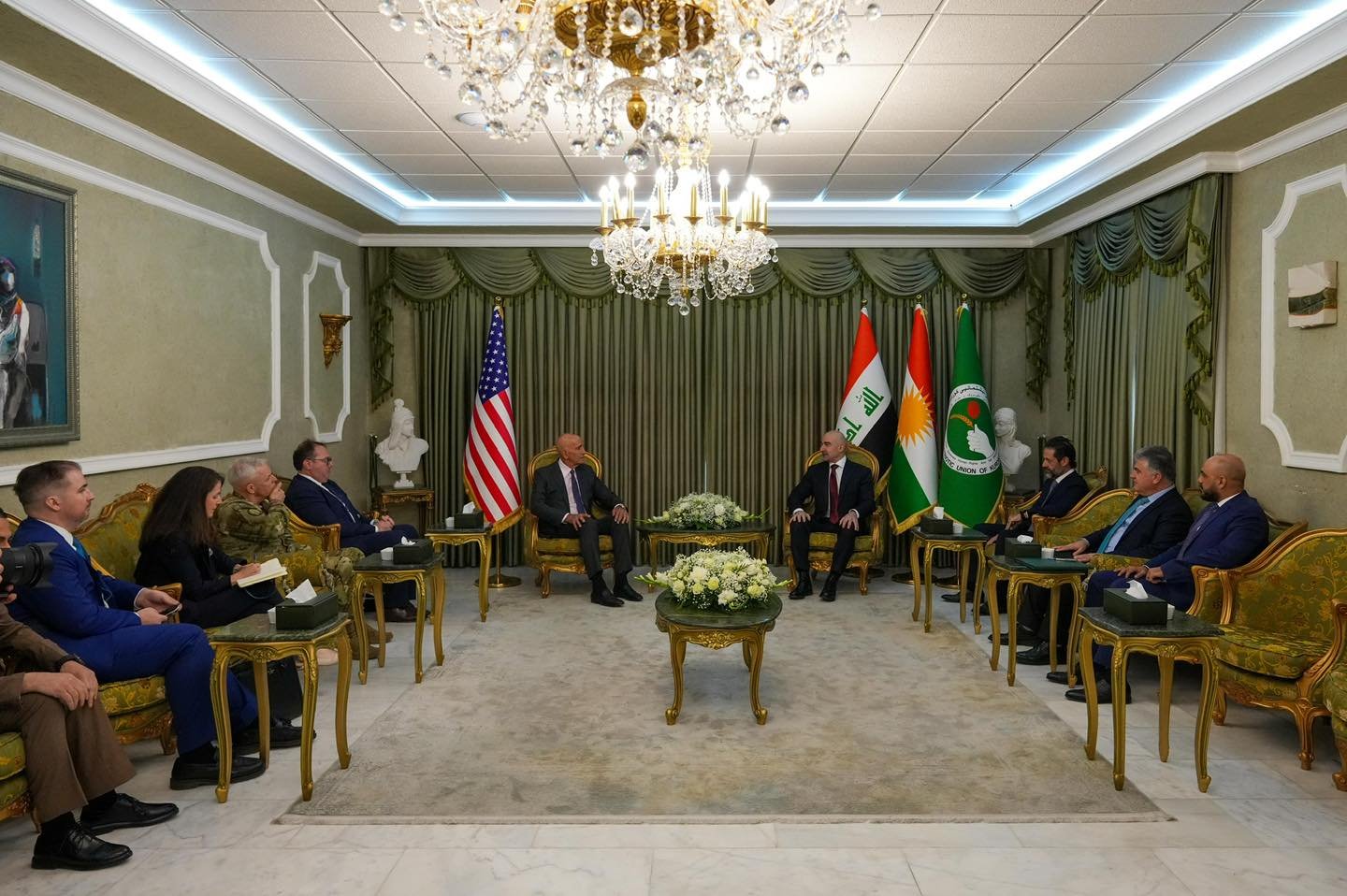
The PUK has emerged as a central player in the U.S.-Israel push to arm Iranian Kurdish groups and allow them to use the Kurdistan Region as a launching pad for a ground assault into Iran, but that role also makes it the most exposed actor in the Kurdistan Region and complicates the broader Kurdish landscape.
Bafel Talabani has held a call with the Iranian foreign minister to try to find a middle ground, and has been meeting with political party leaders in Sulaimani to coordinate, as the party faces mounting pressure from Washington to pick a side in the escalating confrontation with Tehran.
Context: The Kurdistan Region is divided into two zones, each controlled militarily by one of the two ruling parties. While the KDP’s zone shares a stretch of border with Iran, the vast majority of the KRG-controlled border with Iran falls under PUK control. The KDP’s border with Iran, already limited, has been shrinking. A portion in the Sidakan area, in the Iraq-Turkey-Iran triangle, is now controlled by Turkey. Another portion in the Choman district in the Qandil Mountains is controlled by the PKK. What remains is a narrow strip of KDP-held territory bordering Iran, including the Haji Omaran border crossing and a short stretch of land on either side. The PUK, by contrast, shares a vast border with Iran, one that is topographically more suitable for infiltration and for Kurdish guerrilla forces to establish control over a strip of land inside Iranian territory.
The PKK is equally important in this equation. It controls its own strip of land in the Kurdistan Region bordering Iran, including territory in the Qandil Mountains, the Penjwen area in Sulaimani province, and the Asos Mountains in between. Together, the PUK and PKK control the vast majority of the KRG’s border with Iran. The two are politically aligned. Although they have divergent interests and have clashed at times historically, over the past decades they have maintained a close alliance. PKK militants operate freely in Sulaimani today, and PJAK, the PKK’s Iranian Kurdish affiliate, moves exclusively within the PUK zone, not the KDP zone.
The strategy for the U.S. and Israel is to use the Kurdistan Region as a logistical base and Iranian Kurdish forces for cross-border infiltration. The role expected of the Iraqi Kurdish parties is, at minimum, not to block these operations. The most viable terrain for such infiltration lies overwhelmingly in PUK-controlled territory, not KDP-controlled territory.
Analysis: This is also why the pressure on the PUK is heavier. Trump’s reported message to Kurdish leaders, that they are either with Washington or with Iran and that neutrality is not really an option, hits the PUK harder than the KDP. The KDP has more room to preserve a semi-neutral posture. It is less exposed on the Iran front, hosts two U.S. bases at Erbil airport and Harir, and benefits from stronger air-defence coverage. That gives it more plausible cover to argue that it cannot realistically constrain U.S. activity in its areas. The PUK has far less room for that.
Complicating matters further, the PUK has forged close political alliances with certain pro-Iran Shia militias in Iraq to help balance against the KDP domestically. Its plan to secure the Iraqi presidency in parliament, for example, relied in part on support from pro-Iran factions. Cooperating with the U.S. push against Iran risks unravelling those alliances.
The PUK is also more geographically exposed. Its only international border is with Iran; it borders no other country. The KDP, by contrast, has a much larger border with Turkey and a smaller stretch with Syria, with a shrinking strip facing Iran. PUK-controlled areas are physically much closer to Iran, raising the stakes of any confrontation. Sulaimani’s relationship with Iran, moreover, predates both the PUK and the Islamic Republic. The city’s proximity and longstanding cultural ties make it more integrated into Iranian networks than any other part of the Kurdistan Region. This also means there are likely more Iranian sympathisers in Sulaimani, a dynamic visible on social media.
Bafel Talabani is culturally far more shaped by the West, is comfortable with the United States, and has shown admiration for Trump in interviews but the gamble for him is much bigger than it is for the KDP. The risks are higher, the exposure is greater, and the margin for error is smaller.
All of this leaves the PUK in an exceptionally difficult position. If Trump pushes ahead, the PUK may have little real choice but to go along to some degree. But it is still not clear how far Washington intends to go. U.S. officials have sent mixed signals, and this may still be, at least in part, a pressure strategy rather than a settled final course.
What is already clear, however, is that more is at stake for the PUK than for anyone else in the Kurdistan Region. For Bafel Talabani, this is not just another tactical balancing act. It may be the biggest test yet of a political style built around high-risk, high-reward decisions.


