


The Maverick Playbook: How Bafel Talabani Is Trying to Turn Kurdistan’s Math Against the KDP
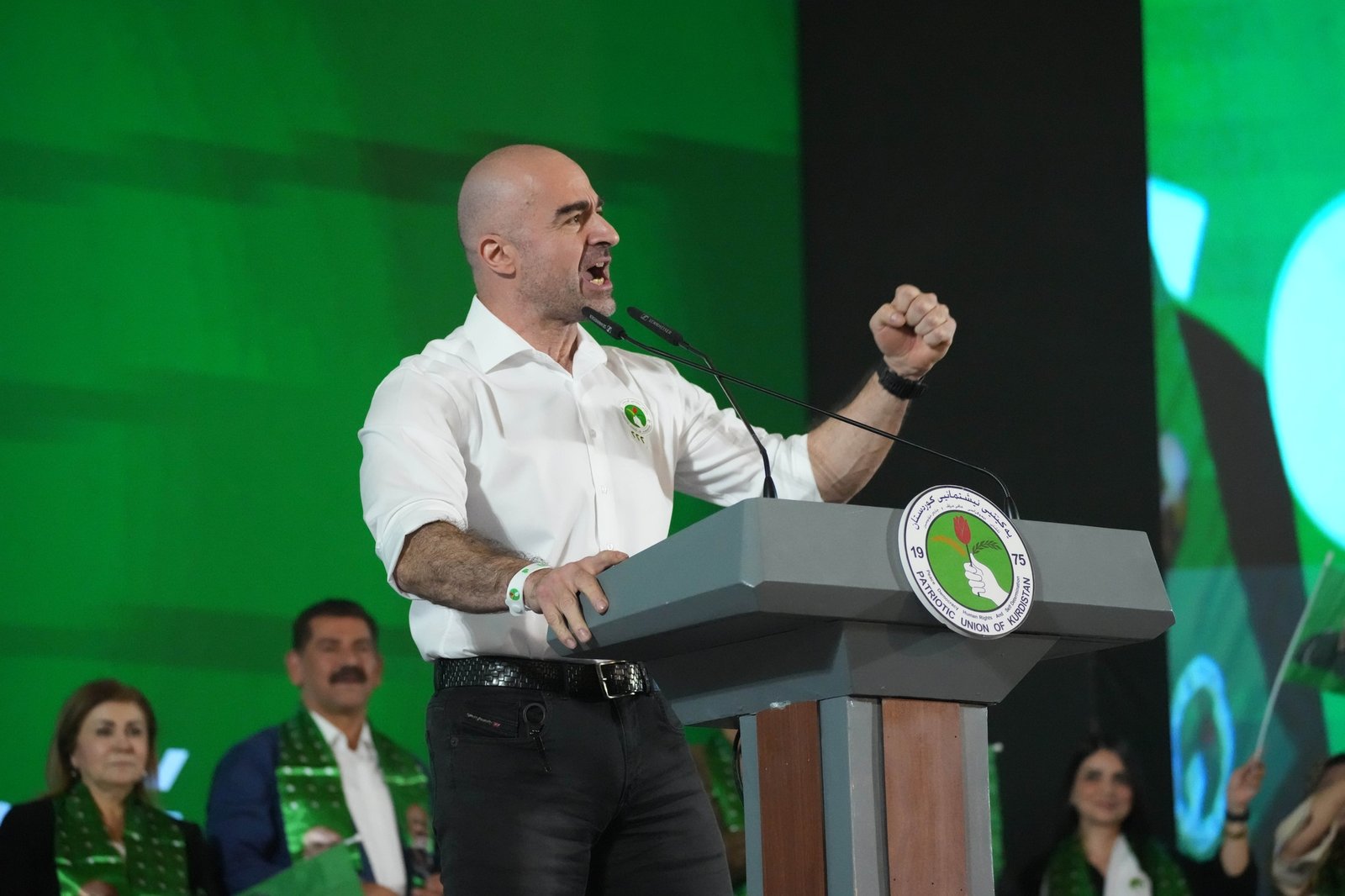
Bafel Talabani is running a two-front strategy against the KDP that has eliminated Masrour Barzani’s path to forming a government on his own terms. In the Kurdistan parliament, Bafel has flipped the key pivot party that the KDP needed for a coalition bypass. In Baghdad, he has assembled an alliance with rising Shia and Sunni blocs that is turning the Iraqi presidency into a second pressure point. The KDP now faces a squeeze it has not experienced in more than two decades, and more than 15 months after the October 2024 elections, the KRG cabinet remains unformed.
The generational contrast matters here. Masoud Barzani is the last major surviving figure of his generation in the Kurdistan Region. Jalal Talabani is dead. Bafel grew up abroad, and he approaches power with a different sensibility. Where Barzani operates through hierarchy, symbolism, and the careful maintenance of image and legacy, Bafel appears unbothered by the traditional markers of authority. He has purged the older PUK leaders who essentially advocated accepting the KDP’s domination, and he is playing a different game on multiple fronts at once.
The old dominance model
For years, the KDP held almost all the levers of power in the Kurdistan Region. The mechanics of that dominance were not merely electoral but structural.
The old electoral law, particularly its treatment of minority quota seats, worked heavily in the KDP’s favour. In the previous parliament of 111 seats, the KDP won 45 seats outright and effectively leveraged all 11 quota seats through aligned proxies. Those proxy candidates would win quota-designated seats and then vote with the KDP in nearly every instance. The quota seats were easy to capture: they required far fewer votes than general seats, and because the quota constituencies were concentrated in Erbil and Duhok, where the KDP dominates administratively and through its security apparatus, the outcomes were close to guaranteed.
This gave the KDP a built-in top-up mechanism. It could win its normal seats, add quota seats through aligned candidates, and arrive at or near a governing majority without depending on genuine coalition partners. When coalition arithmetic did matter, the KDP had another lever: it could recruit an opposition partner to govern without the PUK, then invite the PUK to join later on diminished terms. This is precisely what happened with the Gorran Movement, which held 12 seats, which joined the KDP-led cabinet, received ministries, and subsequently saw its electoral support collapse. In the most recent election, Gorran won a single seat.
The result was a power dynamic heavily lopsided in the KDP’s favour. The PUK could be bypassed, pressured, and ultimately forced into arrangements that did not meet its demands.
What Changed in 2024
The Kurdistan parliamentary elections finally took place in October 2024, roughly two years after their original scheduled date. The delay was itself a symptom of the power struggle between the KDP and PUK over the electoral framework, because the rules of the game would determine the outcome.
What made this election different was that it largely reflected what the PUK had been pushing for. The Federal Supreme Court of Iraq, responding to PUK-backed legal challenges, abolished the previous quota seat arrangement. That ruling triggered a crisis: the KDP threatened to boycott. Eventually, a compromise restored five quota seats, but with a crucial difference. The quotas were now divided by governorate, with seats allocated across Erbil, Sulaimani, and Duhok rather than pooled in KDP-friendly territory. The KDP won the quota seats in Erbil and Duhok (three seats), while the PUK won those in Sulaymaniyah (two seats).
The new seat distribution looks like this: KDP won 39 seats plus 3 quota-aligned MPs, for a total of 42. PUK won 23 seats plus 2 quota-aligned MPs, for a total of 25. The parliament was reduced to 100 seats, meaning the majority threshold for forming a cabinet is 51.
Even with its quota-aligned MPs, the KDP is nine seats short of a governing majority. That arithmetic changes everything.
The New Generation Pivot
With the quota mechanism neutered, the KDP’s path to government narrowed to two options: a deal with the PUK, or a deal with the New Generation Movement, which holds 15 seats and is the main opposition force in the parliament.
Other opposition parties, including the Kurdistan Islamic Union with 7 seats and the Halwest Movement with 4, signalled they would not participate in any government regardless of who leads it. That left the KDP with only two viable coalition routes.
New Generation mattered not as a governing partner in its own right but as leverage. As long as the KDP could credibly threaten to form a cabinet with New Generation instead of the PUK, it could pressure the PUK to reduce its demands. The message was clear: we have another route, so do not overreach.
The PUK, for its part, insisted on the Interior Ministry and being a pillar in the Kurdistan Security Council. Negotiations dragged on for over a year.
Then something unexpected happened. Shaswar Abdulwahid, the leader of New Generation, was arrested on earlier complaints and held for five months. One day after his release, he announced that New Generation would align with the PUK. Within hours, Bafel Talabani posted a video signalling his openness to the arrangement and travelled to meet him. The alliance was sealed.
The speed and sequencing of Shaswar Abdulwahid’s pivot raised questions in Kurdish political circles about what pressures or bargains were involved. Even before his arrest, Shaswar had floated the possibility of aligning with the PUK and other opposition to form a cabinet without the KDP. But this time the alignment became real, and it changed the numbers overnight.
With New Generation’s 15 seats, the PUK now commands 38 seats in effective alignment, only one seat fewer than the KDP’s 39. The KDP’s bypass route has collapsed. It can no longer credibly threaten to govern without the PUK, and the PUK’s bargaining position has strengthened accordingly.
The Baghdad Front
Bafel Talabani has not limited his manoeuvring to Erbil and Sulaimani. He has been building a parallel coalition in Baghdad, and this constitutes a second front in the power struggle with the KDP.
What makes this coalition interesting is that it is largely composed of second-generation Iraqi leaders, both Shia and Sunni, who have their own grievances with the KDP. Among the Sunnis, Mohammad al-Halbousi’s bloc won 35 seats in the November 2025 Iraqi parliamentary elections, the highest among Sunni factions, and Halbousi has positioned himself as one of the leading anti-Barzani voices in Iraqi politics. Halbousi is also opposed to Nouri al-Maliki, who belongs to the older generation of Iraqi leaders and has aligned more closely with Barzani in recent years.
Bafel has also cultivated ties with Qais al-Khazali, whose bloc holds nearly 30 seats and who belongs to the same generational cohort. Ammar al-Hakim and Muhammad Shia al-Sudani also said to be close to supporting the PUK’s candidate for the Iraqi presidency. The anti-KDP numbers in Baghdad are growing.
The KDP, by contrast, remains anchored to older blocs whose seat counts are shrinking. Maliki, Hadi al-Amiri among the Shia, and figures like Khamis Khanjar among the Sunnis do not command the parliamentary weight they once did. This makes the KDP’s Baghdad coalition narrower and more brittle in a presidential contest.
The Iraqi presidency matters for several reasons. It remains symbolically significant, and because the Kurdistan Region is a federal entity, its internal power balance is tied to its external relationships with Baghdad. The federal capital is not merely another political arena but a power centre that can function as leverage against whichever Kurdish party is weaker in that space.
There is also a deeper political memory at play. In 2017, Masoud Barzani led a referendum for Kurdish independence that fractured relations with Iraqi factions. Even though those relations were later mended, the residue remains. The PUK’s longstanding argument has been that Baghdad is a necessary anchor, that Kurdish interests are better served by building influence there rather than orienting primarily toward Ankara, Tehran, or Washington. That argument now has more traction, and Bafel has positioned the PUK to exploit it.
The result is a two front squeeze. The KDP faces pressure inside the Kurdistan Region, where it can no longer easily bypass the PUK in cabinet formation, and pressure in Baghdad, where the PUK is assembling numbers that could shape the next Iraqi president and the wider federal bargaining environment that follows.
The Balance of Power
The KDP retains formidable advantages that the PUK is trying to offset rather than overcome outright. Masoud Barzani’s role is not merely political but symbolic; as the last major surviving figure of his generation, he carries weight that transcends day-to-day coalition arithmetic. The KDP spends heavily on lobbying in the United States and elsewhere, strengthening its external positioning. It controls the main border crossing with Turkey, a critical chokepoint for trade and political leverage. And it continues to control key economic levers in the region, generating revenue that can be recycled into patronage, influence networks, and institutional entrenchment. The geography of resources has historically favoured the KDP as well: most of the Kurdistan Region’s oil is in KDP-controlled territory, and that has been a source of sustained economic and political power.
But the PUK is building counterweights. Natural gas, increasingly important in the regional energy picture, is concentrated in PUK areas, and the party is investing in infrastructure that positions it as an energy power centre in its own right. It is also building its own lobbying infrastructure in the United States. The PUK is also entrenching its presence beyond Sulaimani. Kirkuk, though militarily outside direct KRG control since 2017, remains a space where the PUK maintains significant influence, giving the party strategic geographic depth.
What Bafel Talabani has done is construct a two-front strategy that challenges the KDP’s long-established dominance. He has changed the arithmetic inside the Kurdistan parliament by helping to dismantle the quota mechanism and then flipping the key pivot party. He has built a Baghdad-facing coalition that turns the Iraqi presidency into a second pressure point. And he has done this while purging the older PUK leaders who had advocated for accommodation with the KDP.
But none of this guarantees success. The KDP retains deep institutional control in its core provinces, and Masoud Barzani has navigated crises before. The New Generation alignment could prove transactional, fracturing once ministries are allocated. Baghdad alliances are notoriously fluid, and the same blocs backing the PUK today could flip if the deal changes. The KRG cabinet remains unformed after more than a year of negotiations, and prolonged stalemate carries its own risks: governance by improvisation, eroding legitimacy, and the possibility that external actors or events reshape the board entirely.
What is clear is that the power struggle is no longer one-sided. Bafel has created pressure points that did not exist before, and the KDP can no longer dictate terms the way it once could. Whether that translates into a durable rebalancing of Kurdish politics or a temporary disruption remains to be seen. The contest is ongoing, and neither side has won.


