


ENKS Seeks Its Own Lane as Damascus Plays Kurdish Factions Against Each Other
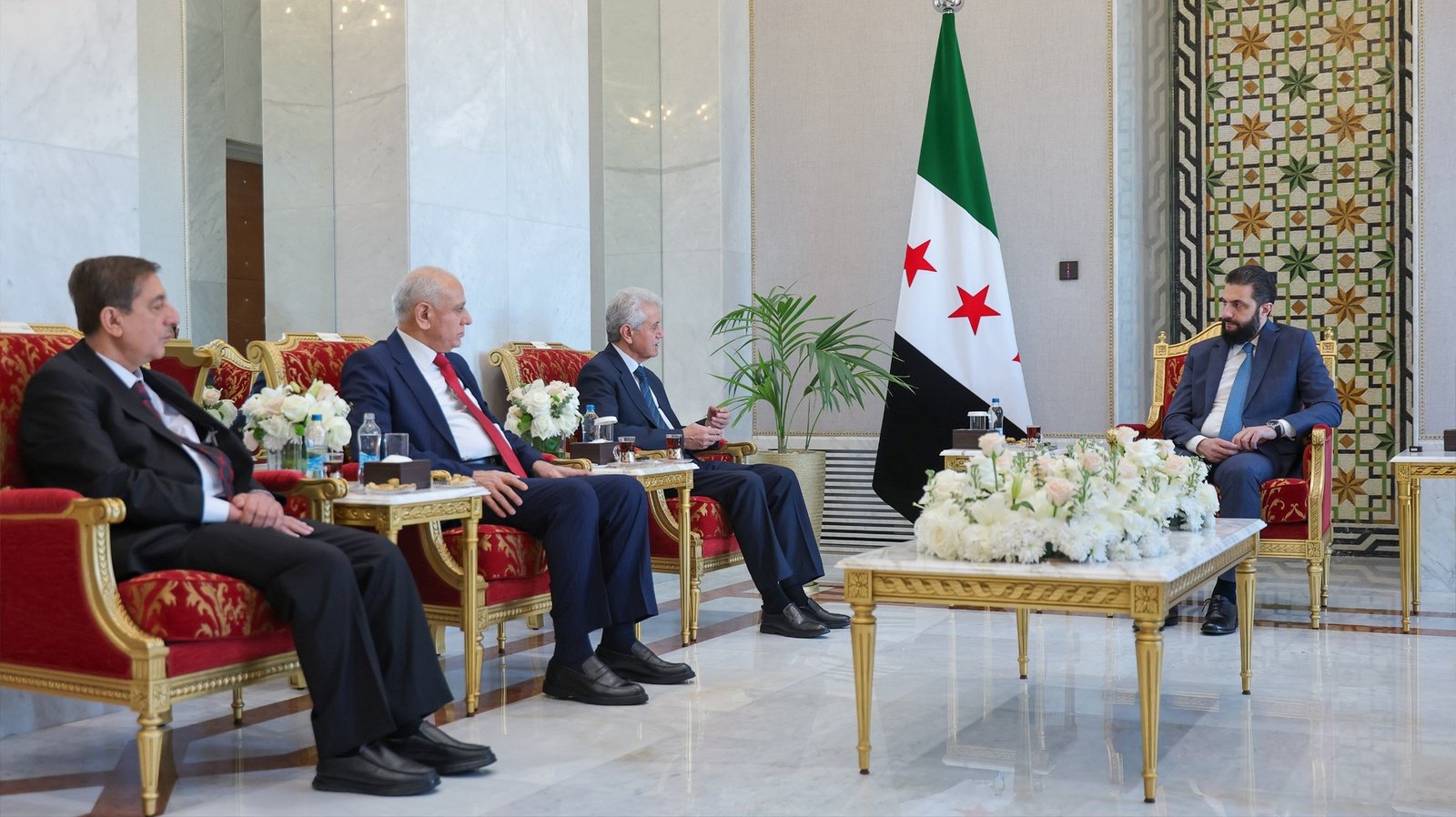
A delegation from the Syrian Kurdish National Council, known as ENKS, met with Syrian President Ahmad al-Shara and Foreign Minister Asad al-Shaybani in Damascus yesterday. The visit marks the first high-level meeting between the Barzani-aligned Kurdish bloc and the Syrian leadership since the fall of the Assad regime. The meeting had been anticipated since September, when ENKS announced it had received an invitation from Damascus, but the council insisted on meeting directly with al-Shara rather than lower-level officials.
Context: The meeting takes place just days after an agreement between the Syrian government and the Syrian Democratic Forces following a series of territorial losses by the SDF to Syrian government forces. The agreement, mediated by US envoy to Syria Tom Barrack with involvement from Masoud Barzani, appears to maintain an uneasy equilibrium between war and peace. Integration of SDF forces is expected, but there remains significant ambiguity about how deep this integration would be. Barzani’s involvement was notable for its sudden intensity, with at least five phone calls between him and al-Shara taking place within January alone.
Analysis: The SDF-Damascus confrontation appears to have now shifted from the military battlefield to the political arena. The agreement has frozen the territorial situation, but the contest over who shapes Kurdish political representation in the new Syria has only intensified. What will determine outcomes going forward may not be firepower but strategy and soft power.
For Damascus, the approach appears to be one of divide and conquer. A landmark all-Kurdish conference in April 2025 had endorsed federalism for Kurdish areas and created a joint delegation uniting ENKS and SDF-affiliated parties. Damascus rejected this unified framework and has instead engaged each side separately. First came the agreement with the SDF as a military force. Now comes political engagement with ENKS. The joint delegation, which went dormant after a single gathering, is now effectively dead, particularly after the unilateral SDF-Damascus deal and the clashes that preceded it. By maintaining multiple Kurdish interlocutors rather than facing a unified front, Damascus weakens Kurdish bargaining power and gives itself multiple levers.
For ENKS, the calculus is more complicated. The council is closely tied to Barzani appears to have now moved only after Barzani’s green-light. But its component parties are traditional Kurdish political organizations that have existed for decades, and they do not wish to be rendered politically irrelevant while the SDF negotiates the Kurdish future alone. Crucially, ENKS does not see itself as a purely territorial project confined to SDF-held areas. It views itself as representing broader Syrian Kurds, including those in Afrin, Aleppo, Damascus, and other areas outside SDF control. There are now likely as many Kurds living outside SDF territory as within it, and ENKS is seeking to build relationships with these communities and position itself as their representative. This gives the council a justification for pursuing its own political lane, even if doing so fractures unified Kurdish representation.
This creates a significant problem for the SDF, and the pressure comes not just from external military threats but from within its own social base. In Hasakah province, the Barzani-backed parties of ENKS retain considerable popularity, particularly among upper-class Kurds in such towns as Qamishli, Derbasiya, and Amouda. The leadership of ENKS is drawn almost entirely from these areas, reflecting a deep historical constituency. The SDF’s political model has not allowed much space for other Kurdish parties to operate freely. Damascus engaging directly with ENKS activates this rival current inside the very communities the SDF governs.
Barzani is also emerging as a soft-power competitor. Damascus may wish to reward him for his role in facilitating the recent agreement, which, despite giving the SDF some breathing room, largely reflected Syrian government preferences and even exceeded what Damascus had sought in pre-2026 negotiations. ENKS is now seeking to build on Barzani’s mediation role and on the visibility generated by the Barzani Charity Foundation’s aid distribution, not only in Qamishli and Hasakah but also in Afrin. The council is positioning itself as the pragmatic, connected, service-delivering Kurdish actor. In a post-clash political phase, this kind of image advantage matters.
The integration process itself may become another instrument of fragmentation. While significant ambiguity remains around what integration actually means, Damascus could use it to draw security personnel not just from the SDF but also from ENKS and from a third current of Kurds who are closer to the government. Combined with the incorporation of local Arabs in areas like Hasakah and Qamishli, this would ensure there is no single unified bloc controlling local security. Al-Shara’s military advance into Hasakah was halted by US and European pressure, but fragmentation through integration offers a way to dismantle the SDF’s autonomous project with minimal political cost. Damascus appears to be applying a similar approach with the Druze in the south, where time and competing factions have produced internal clashes between pro-government elements and various opposition currents. Patience and fragmentation, rather than frontal assault, may be the preferred method for the remaining SDF pockets.
The SDF, meanwhile, is attempting to regroup after territorial losses and a period in which its media narrative has been defensive. Its message to its constituency has been that everything remains under control, that its forces will remain in their current areas, and that integration will be largely nominal. The Syrian government clearly has different expectations.
This meeting between ENKS and Ahmad al-Shara signals the opening of a new phase. Damascus is attempting to restructure Kurdish politics by splitting representation. The SDF is trying to preserve its control and narrative under the umbrella of integration. The contest has not ended. It has simply moved to a battlefield where strategic maneuvering, political co-optation, and the fracturing of opponents will determine who prevails.


