


Turkey Returns to Kirkuk: From a 10% Royalty in 1926 to a 15% Stake in 2026
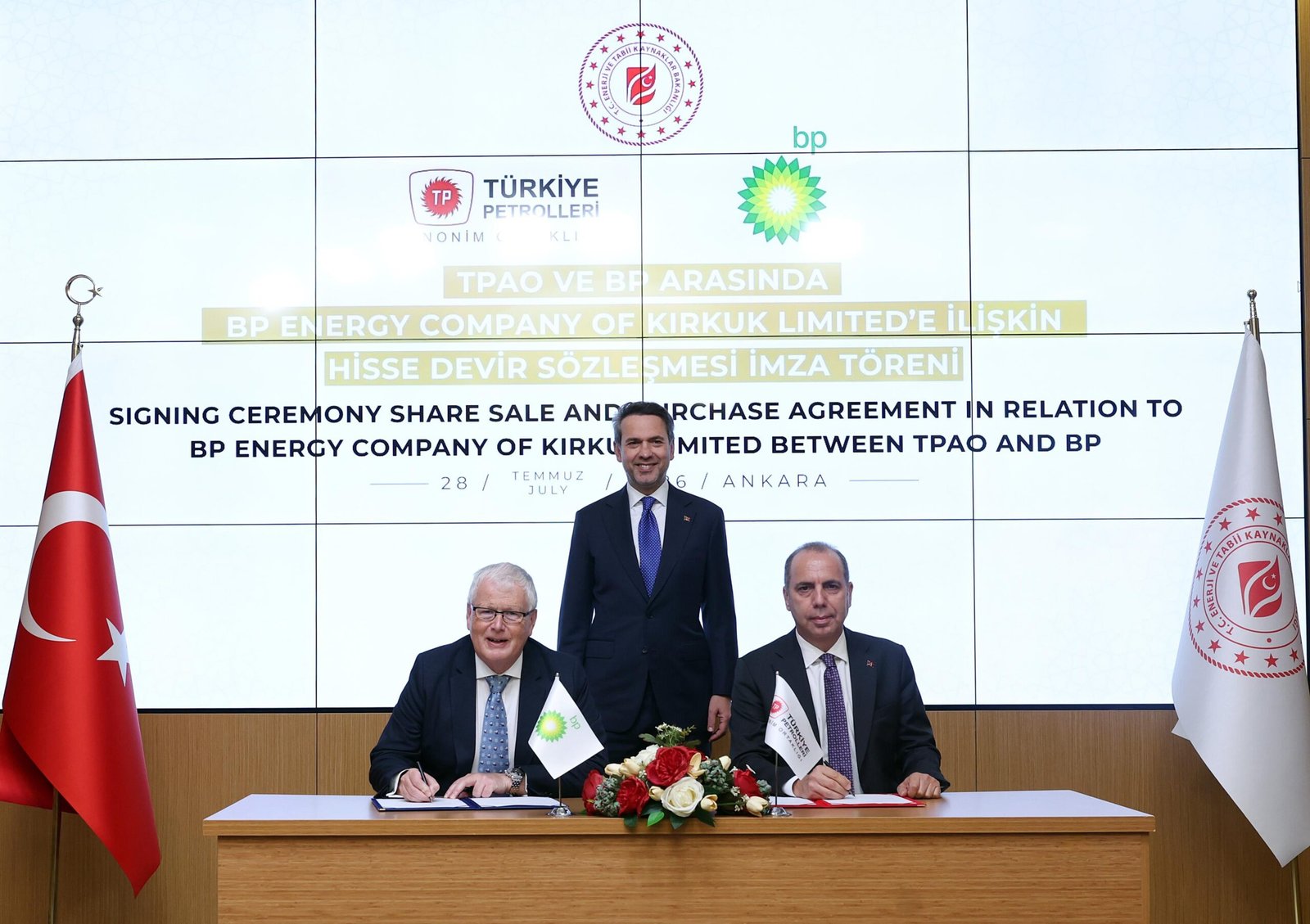
Turkey’s state oil company TPAO has acquired a 15% stake in BP Energy Company of Kirkuk Limited, the contractor vehicle for the redevelopment of the Kirkuk oil complex. The agreement was signed in Ankara by TPAO general manager Cem Erdem and BP upstream business development vice president Andrew McAuslan, in the presence of energy minister Alparslan Bayraktar, ahead of talks between President Erdogan and Iraqi Prime Minister Ali al-Zaidi. It follows ConocoPhillips’s agreement earlier this month to take a 42% interest in the same vehicle, concluded during al-Zaidi’s visit to Washington, and leaves BP with the remaining 43% and majority control.
The contract area covers the Baba and Avanah domes of the Kirkuk field together with Bai Hassan, Jambur and Khabbaz, with an initial gross recoverable resource above three billion barrels of oil equivalent. The transaction does not alter the contract framework: the fields remain Iraqi state property, North Oil Company and North Gas Company retain their operating roles, and the partners will book production and reserves according to the terms of the development and production contract. The signing came a day after the Iraq-Turkey crude oil pipeline agreement expired, with both governments stating that they now want a comprehensive energy cooperation agreement in its place.
Context: The last time Ankara held a formal economic interest in this geography, it was compensation for a lost territorial claim. Under the 1926 Ankara Treaty, Turkey accepted the Brussels Line that placed the former Mosul vilayet inside Iraq and received 10% of the oil royalties due to the Iraqi government for 25 years, with an option to capitalise the entitlement through a one-off payment of £500,000. The entitlement covered royalties alone rather than production, exports or profits, and it carried no ownership in the Turkish Petroleum Company, which was Turkish in name only.
Commercial payments began only after the Baba Gurgur discovery. The first transfer came in 1931, when Iraq received roughly £400,000 in royalties and forwarded about £40,000 to Ankara, and the calculated Turkish share rose to around £223,000 by 1939. Turkish budget records show that payments continued on the 10% formula until 1952, with a final smaller payment in 1954, which makes the frequently repeated claim that Turkey simply sold the right for £500,000 inaccurate or incomplete. The arithmetic also limits how much the entitlement was ever worth: a royalty share of 10% on a fraction of gross sales delivered Ankara something closer to 1% of the economic value of the oil. Lord Curzon’s instinct that the territory mattered was vindicated within a year of the settlement, when Kirkuk turned out to hold one of the largest fields in the world.
The wider context is the regional economy that the post-1918 borders divided. Sarah Shields’s study of nineteenth century Mosul shows a city whose merchants were oriented toward centuries-old relationships across a broad surrounding region rather than toward Europe or Istanbul, with commercial circles reaching Aleppo, Baghdad, Damascus and the Anatolian interior, and only a minority of trade by value leaving that regional economy. Aleppo connected the interior to Mediterranean shipping through Alexandretta, and the Baghdad Railway was an unfinished attempt to bind Anatolia, northern Syria and Mesopotamia through modern infrastructure. Kirkuk’s oil age began only in 1927, so today’s arrangements lay a petroleum economy over a geography that had previously been integrated through trade, caravans and railways.
Analysis: The TPAO stake is the clearest commercial expression to date of the architecture we have described as the Fulcrum Doctrine, in which Washington sets strategic direction across Iraq, Syria and Turkey and shifts the burden of execution onto regional partners through energy and infrastructure.
The diplomatic architecture points the same way. Tom Barrack serves simultaneously as US ambassador in Ankara and as special envoy for Syria and for Iraq, and he described the three countries on taking the expanded role as the strategic fulcrum on which regional stability rests, requiring a single consistent American point of contact. The bureaucratic detail matters: Syria and Iraq have been attached to the portfolio of the ambassador resident in Turkey rather than the reverse, which places Ankara at the administrative centre of Washington’s northern Middle East. The economic file matches the diplomatic one. The US-Iraq joint statement in June endorsed rehabilitation of the Kirkuk-Baniyas route to the Mediterranean, and the Iraq-Syria pipeline agreement signed in Washington this month places a US-led consortium in charge of the technical and financial work. The shared purpose of the northern and western corridors is to reduce Iraqi dependence on the Strait of Hormuz.
Within that architecture, the Kirkuk consortium distributes roles precisely. The United States provides the strategic umbrella, American and British companies supply capital and corporate organisation, Turkey supplies geography, infrastructure and regional access, and Iraq retains sovereignty and ownership of the resource. The 85% held jointly by BP and ConocoPhillips also defines the ceiling on Turkish participation. TPAO is being brought in because Turkish territory, ports and pipelines make Ankara the indispensable northern interface, and the share structure ensures that incorporation stops well short of control. This is consistent with our argument that Turkish power in the region operates through corridors, host geography and approval rights rather than through ownership of outcomes.
The comparison with 1926 should be handled with the same precision. A royalty share and corporate equity are different legal instruments, and the movement from 10% to 15% carries no direct financial meaning. What repeats is the structure. In 1926 a settlement designed in London converted Turkey’s territorial claim into a temporary entitlement outside the operating company, while sustained American pressure later won US firms a permanent 23.75% inside it. In 2026 the same three elements, Turkish state interest, British petroleum capital and Kirkuk oil, have been assembled in a single vehicle again, and BP presents the project as a return to the field its predecessor helped discover at Baba Gurgur. The decisive change is Turkey’s position relative to the consortium. In 1926 it received a fraction of Baghdad’s royalties from outside the company; in 2026 it holds shares inside the contractor, within an arrangement that remains Anglo-American in design and Iraqi in sovereignty. The borders drawn after 1918 are unchanged, while the energy, security and commercial systems that cross them increasingly operate as one connected space, with Turkey positioned as its northern hub.


