


The Perception Bubble: How an Echo Chamber Shaped the SDF’s Strategic Miscalculation
Following the SDF’s major territorial losses last month, much of the commentary has argued that the March 10 integration agreement stalled because PKK pressure from Qandil blocked pragmatic concessions. That may be part of the story, but it has likely played a less prominent role than is commonly perceived. This argument does not fully explain the more puzzling dimension of what happened: why so many people around the SDF, including plausibly senior decision-makers, entered January with expectations that were rising rather than narrowing.
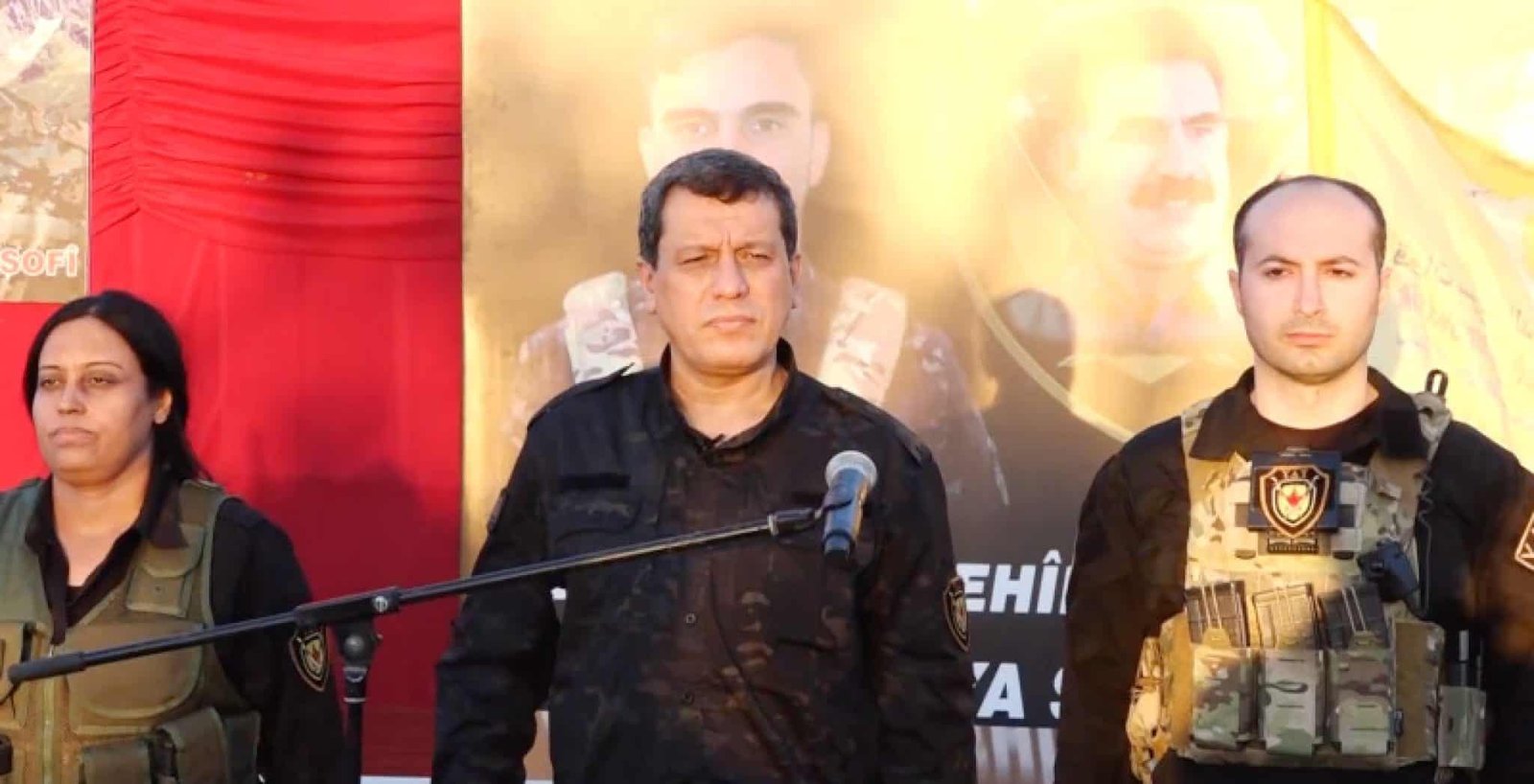
Take Mazloum Abdi. Commentators often claim he was prevented by “hardline” PKK figures from reaching a workable deal with Damascus. Yet in December, just three weeks before Damascus’s lightning advance from Aleppo to Hasakah, Abdi spoke of seeking a merger to jointly build a new “national army,” arguing that the SDF was comparable in size to the Damascus army. The subtext was not integration on subordinate terms, but a co-equal foundation for a reconstituted force. Going further, Abdi suggested that 2026 would be the year of the Kurds across the broader region. These were his most assertive statements to date, reflecting far higher expectations than his more reserved previous interviews.
In retrospect, the timing matters. This interview came around ten days before the supposed March 10 deadline and only weeks before the frontline collapse. This interview came just ten days before the supposed March 10 agreement deadline and three weeks before the collapse of the frontlines. There is now strong enough evidence that this confidence was based less on sound assessment of conditions on the ground and more on a set of perceptions and expectations that had directly shaped the SDF’s thinking. But how were those perceptions formed?
Policy is rarely crafted in a vacuum. It is built on the bedrock of perception: how leaders perceive their own strength, their enemy’s resolve, and their allies’ commitment. Throughout 2025, a specific circle of pundits, analysts, and media personalities, ranging from nationalist intellectuals to populist commentators, constructed a feedback loop that distorted these perceptions. They did not pull the triggers or sign the orders, but by feeding the SDF’s leadership a diet of confirmation bias, they helped harden a negotiating position that reality could no longer support.
The Architecture of a Bubble
Across 2025, a loosely connected network of Syrian Kurdish and pro-Kurdish analysts, operating from European capitals, Arab satellite studios, and YouTube channels, produced a remarkably consistent narrative about the SDF’s position. The details varied, but the core message barely changed: the SDF held the upper hand; the United States was deepening its commitment; the Syrian government was too weak to act militarily; Turkey was a paper tiger constrained by Israel; and if the March 10 agreement failed, it would fail because of the other side’s shortcomings, not because the SDF lacked leverage.
Consider Shirwan Ibrahim, a political analyst whose Arabic-language channel reached tens of thousands of viewers and who appeared on numerous prominent Arabic-language platforms. Throughout 2025, Ibrahim argued repeatedly that the SDF was not joining the Syrian army to be dissolved but to lead the counter-terrorism file for the entire country. He claimed that the SDF’s specialised anti-terror units would become the operational core for fighting ISIS across all Syrian territory. He went further, arguing that integration would actually increase American support for the SDF, because US backing would shift from supporting a militia to supporting a specialised unit of the Syrian state, allowing more advanced weapons and open training. The Syrian government, in his telling, “does not dare to attack” because of the American security umbrella. By the end of October, he was declaring that Israel was increasingly supporting the Kurds, that the US had increasingly limited and constrained Turkey’s role, and that in 2026 “the land would speak Kurdish”: a metaphorical emphasis on the favourable political state of the Kurds across the board.
This was a seductive analysis. It told the SDF’s base exactly what they wanted to hear: that they were indispensable and that the agreement was a vehicle for their ascension, not a concession born of necessity. What makes this especially puzzling is that America was becoming increasingly clear about its intentions, from rebuilding ties with Ahmad al-Sharaa to Syria joining the anti-ISIS coalition, to joint Syrian-American operations against ISIS, to clear statements from the US envoy Tom Barrack. Yet while these signals accumulated, this ecosystem was reaching its own conclusions based on “raw data” supplied by another member of the same ecosystem: the Syrian Observatory for Human Rights.
The Syrian Observatory for Human Rights provided the raw material that made this conflation feel empirical rather than wishful. Throughout the second half of 2025, SOHR published a relentless stream of reports on US military movements in northeast Syria, counting trucks, cataloguing convoys, detailing equipment transfers, and painting a picture of an America that was doubling down.
In September, SOHR reported 221 trucks of military and logistical equipment in a single month, presenting it as the Coalition “escalating its presence.” In November, reports described “advanced military vehicles,” including Bradleys and air defense systems arriving at bases in al-Hasakah and Deir ez-Zor, framed as “fortifying bases” against “potential attacks.” In early December, as the Aleppo crisis was building, SOHR reported five convoys entering northeast Syria in seven days, carrying “logistic materials, military equipment, and cement blocks” for new fortifications.
Stripped of context, convoy reporting does something subtle. It makes optimism feel empirical. It invites the reader to convert logistics into political intent. For an SDF commander weighing whether to accept unfavourable integration terms, reading that five fresh American convoys had arrived in a single week was a powerful signal. SOHR described these movements using terms like “intensifying support” and “strategic partnership,” language that framed routine logistical rotations as evidence of deepening American investment. Joint anti-ISIS raids against dormant cells were presented as proof of an unbreakable bond at the precise moment Washington was calculating how to manage its accommodation with the Syrian government.
This effect was compounded by coverage of the US defense budget for 2026, which included roughly $120 million allocated for SDF-linked counterterrorism structures. This was in fact misread not just by the pro-SDF ecosystem but also by some pro-Damascus media outlets. Stripped of context, the allocation might appear to be business as usual, but these outlets did not understand how US defence budgeting works, especially for critical areas like counter-terrorism. The National Context published an explainer at the time showing how these media were misreading the budget allocation, and how it represented a contingency plan standard in US budget planning rather than a political statement. SOHR, however, framed the allocation as a major political victory for the SDF, claiming it signalled that the strategic partnership would continue “at least until the end of 2026.” One of the particular dangers in all of this is that most SDF leaders do not speak English and thus rely on sympathetic Arabic-language coverage to inform their thinking.
Dismantling the Adversary
This overestimation of self was mirrored by a dangerous underestimation of the adversary.
Samir Matini, a Syrian Kurdish populist commentator with over two million followers on Facebook and more than half a million YouTube subscribers, is one of the largest pro-SDF voices in the Arabic-language media space. Matini spent much of 2025 using mockery as analysis. He leveraged what he framed as the SDF’s organisational superiority to relentlessly ridicule the Syrian government, framing al-Sharaa’s forces as chaotic “militias and gangs” and treating their factionalism as proof that they could not coordinate, hence fight the SDF. In an October 2025 video, he cited “American officials” to argue that if civil war broke out, the US would back the SDF because they were the only organised force and that the SDF is capable of reaching Damascus in mere three hours. He went further still, claiming that Abdi would meet Turkish officials, including Recep Tayyip Erdogan: a claim that only makes sense inside a world where Turkey has quietly accepted an enduring SDF zone.
This last claim illustrates how far the bubble extended. Adel Bakawan, an Iraqi Kurdish analyst who leads a research institute in Paris, also claimed that Mazloum Abdi and Erdogan would soon meet. More significantly, Amberin Zaman reported in Al-Monitor that there might be a meeting between Abdi and Turkish officials, suggesting this thinking had moved from populist commentary into the semi-serious “close to the SDF” reporting ecosystem. Zaman is widely understood to be plugged into SDF circles. If she reported a possibility like that, it was likely being fed from within or around the SDF environment. The bubble was not only external commentary misinforming the public. It was a story that the SDF’s own circles appeared willing to entertain, circulate, and perhaps believe.
Jian Omar, operating from Europe and appearing in numerous interviews on key Arabic channels, added raw political rhetoric to the mix. In his August 2025 appearance in a debate titled “David’s Corridor or Ottoman Caliphate?”, Omar dismissed Turkey as “all noise, no flour.” He argued that Turkey was militarily paralysed because “he who owns the sky controls the ground,” implying that Israel and, by extension, the US controlled the airspace over Syria, rendering Turkey incapable of a full-scale invasion. He dismissed Turkish threats as domestic electioneering. Omar leaned heavily into the theory of “David’s Corridor,” a proposed geopolitical project to link southern Syria (Druze- and US-backed) with northeastern Syria (SDF and Kurdish-controlled) in order to cut off Iran. By treating this corridor as a serious, active project backed by Israel and the United States, he validated the SDF’s belief that they were part of a grand regional architecture that would permanently secure their autonomy. He framed the SDF not as an isolated militia but as a key pillar in a new anti-Iran alliance that Damascus could not touch.
The Ivory Tower and the Phantom Shield
The paralysis was further deepened by the high-minded theoretical work of institutions like the (Syrian) Kurdish Center for Studies (NLKA) which is led by Newaf Khalil, which is a former PYD spokesperson. The centre produced work that was often far more serious than YouTube commentary, but it suffered from a different kind of distortion.
Farhad Hami of the center framed the negotiation not merely as a political survival deal but as a clash of civilisations: “Democratic Modernity” versus “Authoritarian Modernity.” His October 22 piece described the SDF as “the closest expression of the right to difference” and “a rare secular defensive force in an era of rising fundamentalisms.” He critiqued former US envoy James Jeffrey for prioritising stability over democracy and argued that the SDF’s very existence “exposes the fragility of the discourse that builds stability on the denial of difference.” By framing integration as a moral capitulation, such work raised the psychological cost of compromise. None of it was factually wrong. But when you are negotiating the survival of your territorial control with a government backed by Turkey and tolerated by Washington, the question is not whether your model is more philosophically coherent. It is whether you have the leverage to preserve it. When analysis repeatedly answers the justice question while evading the leverage question, it leaves a movement feeling morally correct and strategically exposed.
Shoresh Darwish, one of the centre’s senior analysts, published a series of articles in late 2025. His December 22 piece noted that Turkey was pressuring the Syrian government to demand the SDF’s dissolution rather than integration. He identified the split within the Turkish state between peace advocates and hawks. But Darwish embedded these observations in a framework that ultimately minimised the threat. He described Turkish military threats as “unconvincing” and likely a “bluff.” He argued that Washington was “insisting on proceeding with the implementation of the agreement” and was “indifferent to Turkish perceptions.” His December 14 piece argued that Turkey’s need to serve as an energy corridor for the United States meant Ankara could not afford a war that disrupted the US-backed economic vision.
Such readings suffer from serious flaws. The idea of a split within the Turkish state between peace advocates and hawks originated from a YouTube commentary by Yusuf Sharif, a prominent Arab-Turkish journalist. In an episode on his channel, Sharif claimed that a game-of-thrones dynamic was playing out inside the Erdogan camp over who would succeed the president. Within this theory, he claimed that Hakan Fidan was becoming increasingly hawkish on the SDF issue as part of an intra-Erdogan power struggle, while MIT chief Ibrahim Kalin and Erdogan’s immediate family supported a more dovish approach. Sharif’s analysis, however, has a mixed track record. It relies on rumours from Turkish opposition circles who have their own vested interest in inflating such differences. Sharif began gaining influence among pro-SDF audiences after a piece in February 2025 that claimed the PKK peace process inside Turkey implied Ankara had effectively traded confrontation for containment, allowing the SDF to keep its region in exchange for PKK dissolution.
Once that premise is accepted, it becomes easy to downgrade Turkish signalling as theatre. Then, when the same premise appears inside research output, it gains legitimacy. It stops sounding like cope. It starts sounding like analysis.
Dr. Tariq Hamo’s December 1 analysis of “Turkey’s Inability to Confront Israel’s Founding Doctrine” added another layer. His documentation of Israeli containment of Turkey might have had some truth: the bombing of Turkish-affiliated bases in Syria, the air patrols near Iskenderun, and the Nagel Committee’s designation of Turkey as a top threat. But within the SDF’s analytical ecosystem, this work was consumed not as a study of Israeli-Turkish rivalry but as evidence that the SDF had an indirect Israeli shield. The underlying logic was that Tel Aviv’s disdain for al-Sharaa’s Islamism would protect the secular Kurds. This was an ivory-tower abstraction that ignored the cold realities of the Levant. Israel was indeed checking Turkey in southern and central Syria, but it had no interest in saving the SDF. Israel’s containment of Turkey had no bearing on Turkey’s ability to facilitate a Syrian government offensive in the northeast. Reliance on this theoretical checkmate left the SDF’s leadership blind to the coordination between Ankara and Damascus that would eventually encircle them.
This rhetoric and analysis was further compounded and reinforced by hyperbolic statements from figures further afield, including the aforementioned Adel Bakawan. After meeting Masoud Barzani in Paris, Bakawan published a post, widely circulated by most Kurdish media, claiming that Barzani had said he would personally go to defend Rojava if the Arab tribes moved against the SDF. Bakawan, however, also has a history of misleading and exaggerating such statements.
The Blind Spots
The deeper problem with this ecosystem was not one single wrong prediction. It was a pattern of overestimating the SDF, underestimating Damascus, and exaggerating the constraints on Turkey imposed by Israel and the US. It also failed to engage the broader strategic context.
In fact, this ecosystem’s perceptions were becoming so internalised that even non-SDF-leaning media were increasingly picked up this view. For instance, even while the SDF was under attack in Maskanah by mid-January, just west of the Euphrates, many outlets, including the respectable “Syria In Transition,” claimed this was merely a signal of Syria’s participation, and that it was aimed only at the western Euphrates. They argued this was because an SDF statelet east of the Euphrates was being consolidated, coming just after the Israel–Syria talks in Paris, which were mediated by the US and attended in part by the Turkish foreign minister.
None of these analysts looked at the big picture. They did not examine how the international system was changing, and changing rapidly, as we covered in an earlier piece. They did not address how the US national security strategy had fundamentally shifted, or how those shifts were affecting Syria. They underestimated how central the SDF question was to Turkey as a matter of national security. And they underestimated how Turkey’s rising importance to the United States, driven not only by Trump’s personal inclinations but also by the changing global situation, was reshaping Washington’s calculus. Turkey was becoming increasingly important to the US in the Russia-Ukraine war, in the case of Gaza, in the confrontation with Iran, and more. The same applied to Europe’s national security calculations. For Trump especially, who is far more transactional than his predecessors, trading northern Syria, where he was never deeply invested, to deepen ties with Turkey was not a significant concession. But this was a blind spot the ecosystem never touched.
Finally, it underestimated Syrian agency. The framing that everything is “Turkey” and Damascus is merely a puppet is analytically lazy. The Syrian government had its own incentives to regain the northeast. Ankara mattered, but Damascus was not a passive actor. It wanted the territory, the sovereignty, and the political symbolism, and it had reasons independent of Turkey to move against an entrenched autonomous zone.
The Feedback Loop Closes
By December, as these perceptions became increasingly internalized, Abdi’s tone shifted. Compared with his more reserved posture earlier in the year, his December 2025 interviews were bolder. He moved from guarded language to co-equal merger framing, and then to expansive Kurdish aspirations across the region. January demonstrated how fragile those expectations were. The confidence was not primarily rooted in a realistic appraisal of the ground. It was amplified by an ecosystem that converted selective indicators into a story of rising leverage and guaranteed backing.
Now, as the Syrian Kurds enter a more fragile period in which political acumen, strategic thinking, and accurate assessments become far more consequential, a retrospective reckoning is urgently needed within the SDF leadership. Meanwhile, the echo chamber is moving on without questioning how wrong its assessments were, and without reckoning with how its misleading analysis influenced decision-making among the very people who could least afford to be misled.


