


Iraq’s Power Struggle Has Two New Wildcards: A U.S. Veto and a Weakened Iran
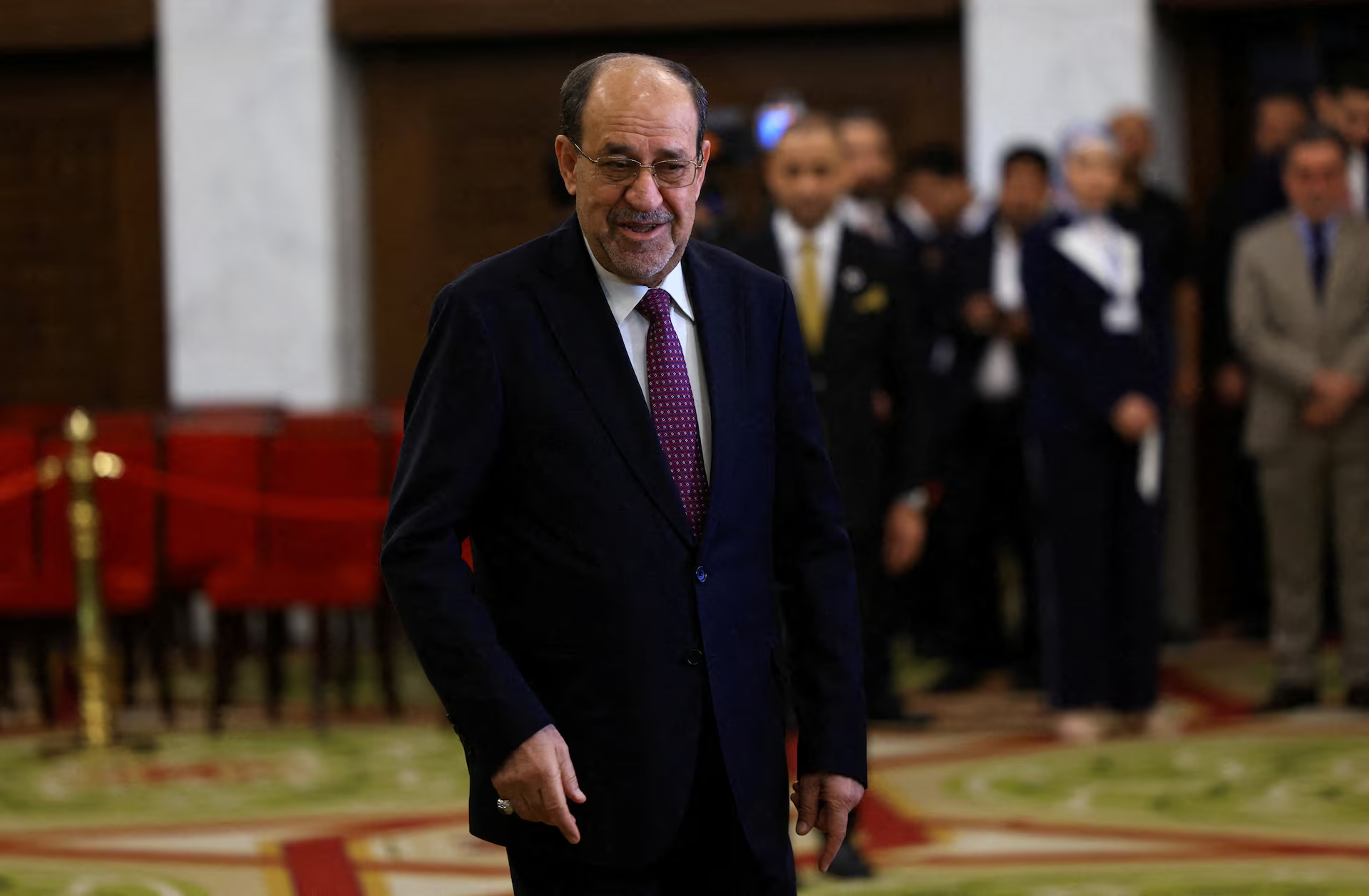
Three months after Iraq’s November 2025 parliamentary elections, the country remains without a government. The Coordination Framework — the umbrella alliance of Shia parties that holds the parliamentary majority — nominated former Prime Minister Nouri al-Maliki for a third term on January 24. But instead of clearing the path to government formation, the nomination has cracked the Shia political house wide open, set off a public confrontation with Washington, and exposed the limits of a system that has governed Iraq since 2003.
At the heart of the crisis is a structural reality that has held since the fall of Saddam Hussein: both the United States and Iran have had decisive influence over who becomes prime minister. Every premier since 2003 has been, in one form or another, a consensus figure acceptable to both. When either side signals a veto, that candidate’s path is effectively blocked. Today, with Washington openly rejecting Maliki and Tehran backing him, Iraq’s political class is caught between the two — and increasingly divided over how to navigate the impasse.
Context: The Shia political landscape is fractured into three broad camps within the Coordination Framework, which controls more than 170 of parliament’s 329 seats.
The pro-Maliki camp includes his State of Law Coalition (30 seats), the Badr Organization led by Hadi al-Amiri (19 seats), the Huquq Movement — the political wing of Kataib Hezbollah — and former deputy parliament speaker Mohsen al-Mandalawi. This camp has rallied behind the Framework’s formal nomination. In its telling, selecting the prime minister is a sovereign Iraqi matter, and retreat would set a precedent with no endpoint. Hamed al-Mousawi, a Badr Organization member, put it bluntly: if Maliki withdraws, “we will accept concessions with no end to them, including dissolving the Popular Mobilization Forces.” He relayed Hadi al-Amiri’s response to Trump’s rejection in equally unambiguous terms: “Let Trump bang his head against the wall.”
The anti-Maliki camp is led by Qais al-Khazali of Asaib Ahl al-Haq (whose Sadiqoun bloc holds 28 seats), Ammar al-Hakim of the National Wisdom Movement (18 seats), and Shibl al-Zaidi’s Services alliance (10 seats). Fahd al-Jubouri, a Wisdom Movement MP, stated that the anti-Maliki count currently stands at 56 lawmakers and is “liable to increase.” Their tactic is precise: they will attend the session to elect the prime minister to complete the quorum, but they will not vote. “Reality and logic say we do not have the capability to confront America,” al-Jubouri said. “Even Mr. al-Maliki, in his most recent meeting with an American figure, spoke in the same detail: that the relationship with the American side is important.”
Then there is Mohammed Shia al-Sudani, the caretaker prime minister, whose Reconstruction and Development Coalition won the largest share of seats with 46 — more than any other single bloc. Sudani formally withdrew his candidacy and backed Maliki in January. But his positioning since then has been deeply ambiguous, and — as reporting from Al-Alam Al-Jadeed suggests — he may have already pulled back his support and begun negotiations with the very blocs that oppose both Maliki and a second Sudani term.
Beyond the Shia Framework, the Kurdish and Sunni blocs are also divided. The Kurdistan Democratic Party and the Patriotic Union of Kurdistan have failed to agree on a presidential candidate, stalling the constitutional process. Among Sunni parties, Mohammed al-Halbousi, head of the Taqaddum Party and former parliament speaker, has emerged as one of the most vocal opponents of Maliki’s return, describing his previous tenure as one that left Iraq grappling with devastating consequences. “We want a Shia candidate who is open to partners and to Iraq’s Arab environment,” Halbousi told Dijlah television. “There are many capable candidates.”
Analysis: What makes this crisis fundamentally different from previous government formation struggles is twofold. First, for the first time since the post-2003 order was established, the United States has issued an explicit and public veto of the Coordination Framework’s nominee. President Trump posted on Truth Social on January 27 that Maliki’s return “should not be allowed,” claiming Iraq had “slid into poverty and chaos” during his tenure, and warning that Washington would halt support if the nomination proceeded. This was not a quiet diplomatic signal through back channels — it was a public ultimatum, and it has reshaped every calculation in Baghdad.
Second, this is the first Iraqi government formation to take place after the collapse of Iran’s regional axis of resistance. The chain of events set in motion by the October 7, 2023 attack on Israel has fundamentally reshaped the environment in which Iraq’s Shia establishment operates: Hezbollah has been severely weakened, the Assad regime has fallen — placing Iraq’s western flank under Sunni forces led by Ahmad al-Sharaa — and Iran itself, after its twelve-day war with Israel, faces existential threats, with the United States continuing to send military reinforcements to the region even as nuclear negotiations limp forward with little prospect of a breakthrough. Tehran is no longer the dominant regional power that could dictate terms in Baghdad with confidence. This convergence of an assertive American veto and a diminished Iran creates a set of pressures on Iraq’s Shia political class that is without precedent.
The opposition to Maliki within the Framework is often presented as a unified front, but beneath the shared conclusion — that Iraq cannot afford this fight — the actors are driven by fundamentally different calculations.
Qais al-Khazali and Ammar al-Hakim share the argument that provoking Washington at this moment risks an economic catastrophe. If the United States restricts Iraq’s access to oil revenues held at the New York Federal Reserve, or enforces broader sanctions, the consequences would cascade through an economy already under strain. The salary crisis offers a foretaste: as of mid-February, state employee salaries — including for the ministries of Interior and Education — have been delayed for nearly three weeks, and Al-Alam Al-Jadeed has reported that some actors believe the delays are being leveraged as a pressure tool to force Maliki’s hand, putting him “in direct confrontation with the public.” Whether or not that reading is accurate, the political function of the salary crisis is clear: it makes the abstract threat of economic retaliation tangible for millions of Iraqis, and it strengthens the hand of anyone arguing that the cost of persisting with Maliki is too high.
But Khazali and Hakim are not driven by the same ambitions. Khazali’s opposition to Maliki is inseparable from his own rising trajectory. Over the past decade, he has expanded from a single parliamentary seat in 2014 to 28 seats today, built influence across ministries and provincial governments, and positioned himself as a major Shia power in his own right. His famous phrase from early 2022 — “the prime minister is a director-general” — delivered just two months into Sudani’s tenure, signaled his view that the premiership should be subordinate to the collective Shia leadership, not a base for independent power. His moderation on the Maliki question reads as part of a longer game: by presenting himself as the voice of pragmatism who prevented a catastrophic collision with Washington, Khazali is building the profile of a future prime ministerial candidate.
Hakim’s opposition operates on a different plane. For more than a decade, he has pushed to institutionalize the Coordination Framework — transforming it from a loose coalition that fractures at every election into a formal governing structure with binding authority. Under this vision, any prime minister would consult the Framework “on every small and large matter, and on every internal or external issue,” as a Badr Organization leader told Al-Mada. A former two-term premier with deep personal networks and a documented history of ignoring commitments to allies is the antithesis of the Framework-subordinate premiership Hakim envisions. Forces within the Framework privately acknowledge that the conditions imposed on any nominee — conditions Maliki implicitly accepted when he put himself forward — “do not fit al-Maliki’s personality and his past experience.”
The origins of the current crisis are also more tangled than the official narrative suggests. Before the Sudani-Maliki pact became public, Khazali, Amiri, and Hakim had reportedly held secret meetings and agreed to nominate Bassem al-Badri, head of the Accountability and Justice Commission — a figure rejected by both Sudani and Maliki. It was this move, according to the reporting, that triggered the defensive alliance between the two men: a joint bloc of up to 85 MPs that would nominate Maliki for premier, with a fallback plan to nominate Sudani if Maliki could not be passed. The terms of that agreement are now at the center of the crisis. According to multiple reports, the deal stipulated that if Maliki failed to secure both internal and external support, he would in turn back Sudani. Some observers speculated from the outset that this was a trap: by nominating Maliki and letting the predictable US veto and internal opposition take their course, Sudani could emerge as the consensus alternative — crucially, with Maliki’s own endorsement. This would remove the one obstacle that had previously blocked a second Sudani term: Maliki’s hard veto against him.
If the trap theory is correct, it appears to be working. Al-Alam Al-Jadeed reported on February 8 that Sudani has effectively withdrawn his support for Maliki and opened parallel negotiations with Khazali and Hakim — the same forces that had originally tried to bypass both men with the al-Badri nomination. But Sudani’s ambitions differ sharply from Hakim’s institutionalization project. He does not want to return as a weakened figure implementing the Framework’s directives. His record — the construction boom, the balancing act between Washington and Tehran, the high personal approval ratings — has given him a sense of mandate. He wants to come back strong, with his rivals sidelined.
There are signs that Sudani’s maneuvering extends beyond the Shia house. Halbousi, who leads the largest Sunni bloc, is widely believed to be coordinating closely with him. In a recent interview, Halbousi rejected Maliki outright and dismissed Abadi as unacceptable, but when it came to Sudani, he softened: while Sudani had already served as prime minister, he had “a better record.” For a figure positioned as one of the most forceful opponents of a second-term premier, this was a remarkably calibrated signal.
Maliki himself is caught in a vicious cycle of his own making. To ease American opposition, he issued a statement on February 11 emphasizing “one army,” “weapons only with the state,” and “unifying the security decision” — language aimed squarely at reassuring Washington and nervous Sunni and Kurdish partners. It is clear that the shift in rhetoric is intended primarily to reassure the Americans, as well as other partners, especially the Sunnis. But the same rhetoric has triggered a backlash from the militia-linked forces Maliki needs. Asaib Ahl al-Haq republished an old statement by Khazali about the PMF remaining in place until the reappearance of the Mahdi — a theological assertion of permanence. State of Law counter-circulated an older Khazali interview in which he said the PMF’s continuation was temporary and linked to the existence of ISIS. The media war between the two camps over old quotes and symbolic positioning has become a proxy for a deeper dispute: not just who gets the office, but what the office will do to the armed order.
Khazali’s alleged visit to Tehran around February 9 adds another dimension. According to Al-Alam Al-Jadeed, he met with Ayatollah Khamenei and argued that continued Iranian support for Maliki is deepening the Framework’s split and complicating the political scene. One possible reason for Tehran backing Maliki’s nomination is that Tehran is treating the Maliki file as a political pressure card, usable depending on the trajectory of negotiations with Washington. If talks succeed, Iran may push Maliki to withdraw for a consensus candidate. If they fail, it may double down on him as a confrontational option for a phase of potential political and security escalation.
The current trajectory points toward a prolonged stalemate. Constitutional deadlines for electing a president have been missed in three consecutive sessions. The State of Law Coalition has warned that parliament could face dissolution. The most likely near-term outcome is some form of caretaker extension for Sudani — an option that, in a final irony, Al-Mada reports Maliki himself may now be backing, having become entangled in a nomination he cannot advance and cannot easily withdraw from. But the fundamental question remains: in a system built on dual US-Iranian consensus over the premiership, can Iraq’s political class produce a candidate when one pillar is actively vetoing and the other is too weakened to impose its will? The answer will determine not just who governs Iraq next, but whether the post-2003 political order can survive the pressures now bearing down on it from every direction.


