


Turkey’s PKK Peace Commission Adopts a Disarmament Framework and a Regional Doctrine
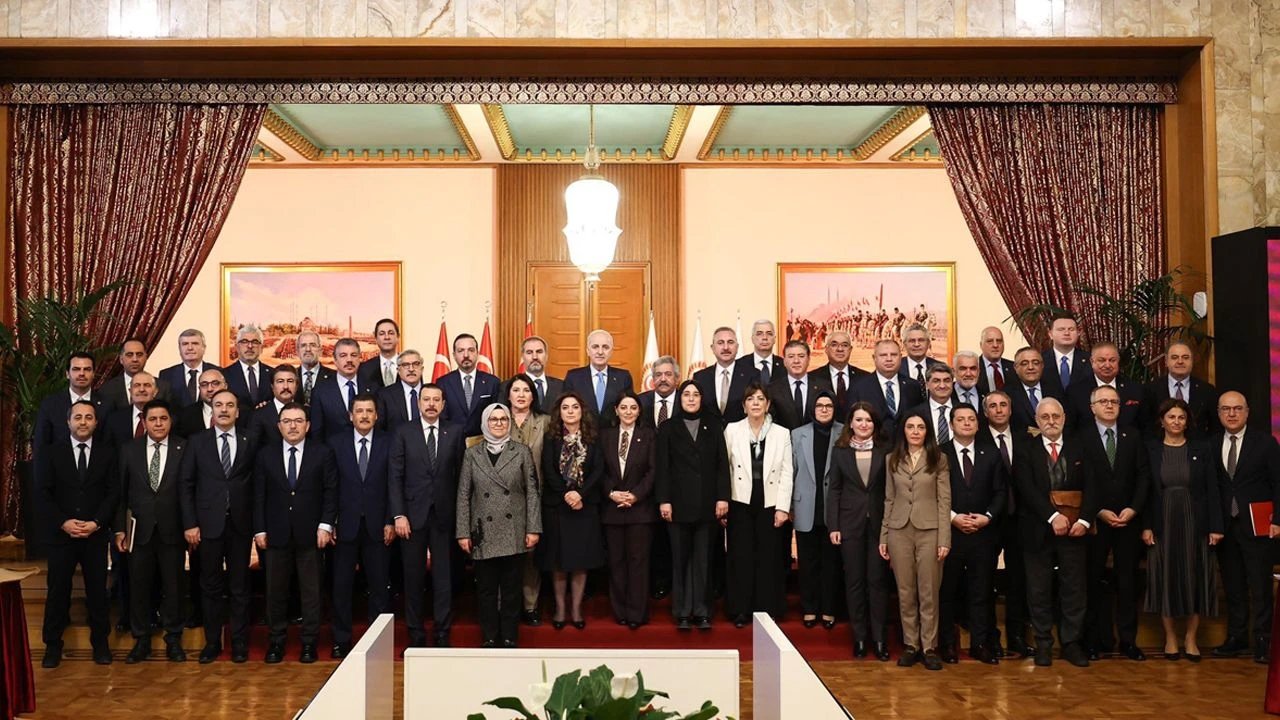
Turkey’s parliamentary peace commission, established to chart a political and legal path out of the decades-long conflict with the PKK, adopted its landmark report on 18 February 2026, laying out an architecture for disarmament verification, fighter reintegration, and democratic reform. But the document is also a strategic doctrine: it treats domestic settlement as the prerequisite for fortifying Turkey’s internal front and sustaining a cross-border security posture in a region the report portrays as increasingly shaped by proxy conflict and fragmentation scenarios.
Context: The commission today adopted the draft with 47 in favour, 2 against, and 1 abstention, after a process officials described as 20 meetings that heard from 137 institutions and individuals, producing 88 hours of deliberations and 4,199 pages of minutes. The “yes” camp included the main parliamentary blocs, including the ruling AK Parti, CHP, MHP, the pro-Kurdish DEM Parti, and the Yeni Yol Group, while the smaller left parties TİP and EMEP voted “no,” with one CHP member abstaining.
DEM Parti’s yes vote is the politically critical signal, but it is not a blank endorsement of the state’s framing. The party voted in favour while filing a formal dissent note, objecting to the report’s language and arguing that the Kurdish question should not be defined through “terror” terminology. That qualification matters: DEM supported the process architecture while contesting the ideological frame it is wrapped in.
The adopted text is a framework, not enacted law. It proposes a roadmap for legislation, but concrete change still requires separate bills, committee passage, and a full vote in parliament.
Analysis: The report operates on two levels simultaneously, and understanding it requires holding both in view.
At the domestic level, it proposes a tightly sequenced process architecture. The first and non-negotiable threshold is verification: Turkey’s security services must determine, through measurable and auditable criteria, that the PKK has laid down arms and dissolved itself across all elements, including structures outside Turkey’s borders. Verification is presented as the switch that activates the rest of the package. Nothing moves before it does.
That framing, however, needs to be read against what has already happened. The PKK side has been moving since February 2025: Ocalan called for dissolution from his Imrali prison cell in February, a unilateral ceasefire followed on 1 March, the PKK formally dissolved at its 12th Congress in May, a weapons burning ceremony was held in Iraqi Kurdistan in July, all forces were withdrawn from Turkish territory by 26 October, and the Zap region was vacated by mid-November with further base withdrawals, including Matina and expected to include Bradost, ongoing since. At the October withdrawal ceremony, senior PKK figure Sabri Ok said explicitly that “laws of freedom and democratic integration must be put in place without delay.” The commission was established in August 2025 and adopted its report in February 2026. The parliamentary process has been running behind the PKK’s own sequential steps, and today’s adoption is partly Turkey’s institutional response to sustained pressure from the PKK side to deliver the legal architecture it committed to.
Once the verification threshold is formally declared met, the report calls for a purpose-built, standalone, temporary law to govern the disarmament phase and the period after it. This law is designed to do three things: reintegrate individuals who renounce violence, permanently end armed activity, and shift the entire matter into the legal and political sphere. The report insists the law must not produce perceptions of impunity or blanket amnesty, and that all individuals concerned must undergo a judicial process. A supplementary set of criminal and enforcement-law provisions may also apply. A dedicated executive appointment to oversee implementation, alongside a monitoring mechanism reporting to parliament, is built into the architecture, with legal protections for officials and participants in the process.
The democratisation recommendations are framed as functional rather than decorative. The report proposes new election and political parties laws drafted by cross-party consensus, revisions to anti-terror legislation so that non-violent acts and freedom of expression are not criminalised as terror offences, and enforcement law reforms aligning detention and prison conditions with European Court of Human Rights standards. The anti-terror revisions carry significance well beyond the PKK file: narrowing terror definitions and related procedural safeguards has been repeatedly cited as unfinished business across Turkey’s EU visa liberalisation benchmarks and the broader stalled relationship with Brussels, where rule-of-law and freedom of expression concerns have accumulated across multiple policy areas and well beyond counterterrorism.
One recommendation carries particular political weight: ending the practice of replacing elected mayors with centrally appointed trustees, by requiring that if a mayor is removed for legally defined reasons, the successor should be selected through a vote of the municipal council rather than external appointment. In practical terms, that is a structural response to a mechanism that has repeatedly removed DEM-run local administrations from office, and it signals that the report’s authors understand Kurdish participation inside the system as an essential pillar of any durable settlement.
Underpinning these structural reforms is a citizenship question the report treats as foundational. The framework explicitly grounds the process in an “equal citizenship principle”, framing the Kurdish question as ultimately about the nature of the citizen-state relationship rather than a security problem with political side effects. Ocalan’s statement to his Imrali delegation, shared this week, pushes that framing considerably further. He proposed what he called “free citizenship”: a citizen-state bond explicitly decoupled from ethnicity, language, and faith, in which national identity can be expressed as freely as religious identity, and local self-governance is anchored in an expanded version of the European Charter of Local Self Government adapted to regional realities. He was equally explicit that this is not a demand for a separate state or region, but an architecture of “democratic integration” he described as “as important as the Republic’s founding.” The commission report and Ocalan’s formulation are not in contradiction, but they are not the same document. The report provides the legal and institutional architecture. Ocalan is describing the political philosophy he expects to fill it. Whether the legislation that follows closes that gap or deliberately leaves it open is one of the central unanswered questions the process faces.
But the report’s deeper significance lies at its second level, and the text does not bury it. The introduction frames the entire initiative not as a reconciliation gesture but as state strategy in an era of shifting power balances, proxy conflicts, and what the report calls imperial fragmentation scenarios. Internal consolidation is presented as Turkey’s core source of strength in that environment, the precondition for projecting stability outward rather than absorbing instability inward.
From that premise the report builds an explicit causal chain. It states that “Terror-Free Turkey” is in essence a vision of a terror-free region. It argues that Turkey’s security concept does not permit threatening structures to persist even in neighbouring arenas, and that a security approach confined to the border is insufficient. It then introduces a cross-border identity claim: Kurds living outside Turkey’s borders are presented as maintaining a bond of emotional attachment toward Turkey, with a shared future grounded in peace and mutual interest cast as the natural outcome of a shared civilisational claim spanning Anatolia and Mesopotamia.
This is where the report shifts from domestic peace process to regional order proposition. It advances a vision of a “natural alliance” of Turks, Kurds, Arabs, and “other brotherly peoples” as the antidote to external fragmentation scenarios, with Turkey explicitly cast as the integrating pole leading integrative policies against the designs of global imperial powers.
The logic is coherent and the sequencing deliberate. Dissolving the PKK removes the primary armed expression of a competing Kurdish political project. DEM Parti’s yes vote, dissent note notwithstanding, signals that the Kurdish political establishment inside Turkey has not rejected Turkey’s regional posture as the legitimate framework for Kurdish political futures. Domestically, widening democratic space is the mechanism through which the settlement is made durable, converting an armed-security problem into a governed political arena.
What remains unresolved are the hard parameters the report deliberately defers: eligibility criteria, sentence reductions, the treatment of senior commanders versus rank and file, and the formal evidentiary threshold for declaring dissolution complete. The outside-border question is no longer hypothetical. PKK base vacating inside the Kurdistan Region of Iraq is active and progressive, and the harder questions now concern what happens to the Qandil command structure once the remaining bases are cleared, and whether Turkey begins a reciprocal drawdown of its own military presence in the Kurdistan Region. Those bases were justified for decades by PKK activity, and their future is now directly tied to whether the process is declared complete.
Turkish parliament speaker framed the adopted report as a milestone rather than an endpoint, and raised the question of a new constitution as a looming necessity even while noting it falls outside the commission’s mandate. The report is the lock. Whoever drafts the actual bills holds the key. And the regional stakes attached to those bills extend well beyond Ankara.


