


After the Ceasefire, Iran’s Kurdish War Moves Inside
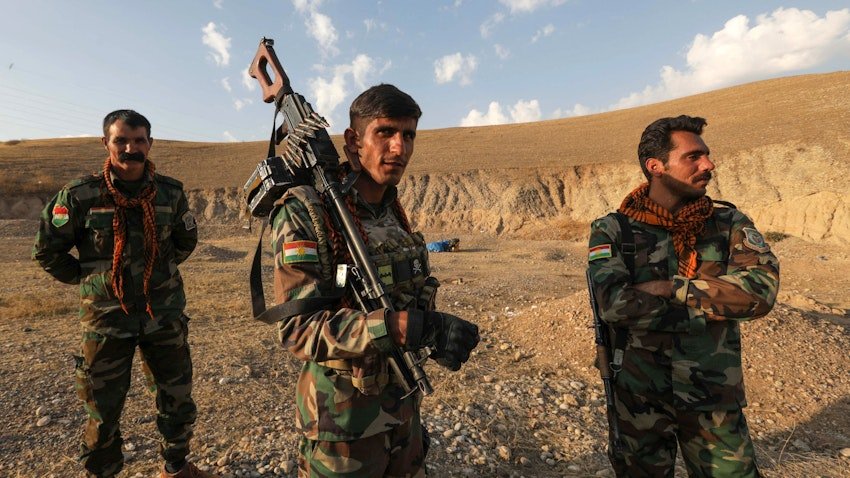
A two-week escalation across Iranian Kurdistan has killed at least 21 people. It is the deadliest confrontation between Tehran and the Kurdish armed parties in over a decade, and the first major test of the US-Iran understanding.
Nine armed incidents have been documented inside Iran between 29 May and 1 July 2026, seven of them producing confirmed deaths. The fighting spans three Iranian provinces, West Azerbaijan, Kurdistan and Kermanshah, with related drone attacks extending into Erbil Governorate in Iraq’s Kurdistan Region. The incidents have involved both principal coercive structures operating in the border region, FARAJA border and police forces and the IRGC Ground Force operating under the Hamza Sayyid al-Shuhada headquarters, alongside locally recruited auxiliaries.
The bloodiest phase came in the final week of June. On 26 June, fighters of the YRK, the armed wing associated with PKK’s Iranian offshoot PJAK, attacked a checkpoint on the Baneh-Saqqez road, killing three government personnel, including a Kurdish conscript from Saqqez, Mardin Ahmadi, and wounding at least two others and a civilian. From the night of 27 June, the IRGC conducted a multi-day operation with artillery, drones and heavy weapons against a YRK unit around Gagash village near Mahabad. The party confirmed four fighters killed, two women and two men, while the IRGC claimed six. On 29 June, a previously unknown group calling itself Khori Hiwa shot dead two locally recruited IRGC-linked personnel outside their homes in Paveh, its first claimed operation.
The escalation peaked on the night of 1 July. The IRGC ambushed one confirmed KDPI unit at Qezqapan, roughly three kilometres from Piranshahr, killing six peshmerga according to the party’s statement, which superseded initial reports of five. The party described the unit as being on a political and organisational mission. A second Kurdish unit was intercepted the same night near Musalan, in the Sardasht area, in a clash that later reports also identified as involving the KDPI; at least four members were killed, with later reports giving five, and neither names nor a final toll have been released. The same evening, Iranian drones struck the KDPI’s Digala camp and a PAK facility in Erbil Governorate, with no casualties reported. These followed a drone attack on the Zewe Spi camp near Koya on 16 June.
Using only deaths confirmed by official bodies, the parties themselves or multiple credible sources, the sequence has killed seven Iranian security personnel and at least 14 Kurdish fighters, a firm minimum of 21. The best current working total is 22, using the later five-person Musalan figure, and accepting Iran’s unverified claim of two additional Kurdish deaths at Chaldoran would raise it to 24. At least five wounded survivors are documented, including one civilian, though the real figure is certainly higher, since YRK claims unquantified IRGC casualties at Mariwan and Gagash that Tehran has not acknowledged.
Context: The surge is inseparable from the war that preceded it. When the United States and Israel attacked Iran on 28 February, Washington briefly explored using the Iranian Kurdish parties as a possible ground component of the campaign. Donald Trump spoke with Kurdish leaders, including KDPI leader Mustafa Hijri, in early March, and the CIA reportedly explored arming Kurdish forces to spark an uprising. The plan collapsed amid Iranian military pressure, inconsistent signals from Washington and strong Turkish opposition, and the parties never crossed the threshold into open participation.
Two separate diplomatic moments now structure the timeline. The first ceasefire, on 8 April, ended the six-week war. The memorandum of understanding signed on 17 June formalised the truce and opened a 60-day negotiating window. Iranian pressure on the parties has been continuous across both. During the war itself, Iran and allied forces launched hundreds of missiles and drones against the Kurdistan Region, nearly half of them targeting Iranian Kurdish parties or fighters. The strikes continued after the April ceasefire: on 17 April, drone and missile attacks on the Jazhnikan camp and a party site in Sidkan killed two female KDPI peshmerga and the 17-year-old son of another member, the KDPI reported a further drone attack on its facilities on 9 June, and on 16 June, one day before the memorandum was signed, a drone struck the Zewe Spi camp near Koya.
What changed after the June understanding is the geography and form of the killing. The lethal weight of the campaign shifted from bombardment of camps in Iraq to ground interceptions inside Iran, accelerating through the second half of June and culminating in the twin ambushes and the Erbil drone strikes of 1 July. The violence was not created by the ceasefire; the June memorandum changed where and how it is applied.
PJAK has made its own reading of that sequence explicit. In its 30 June statement confirming the Gagash deaths, the party said it observed a third-line policy throughout the war, supporting neither side and launching no attacks on Iran even at the state’s weakest moment. It then charged that following Iran’s recent agreements with the United States, the IRGC and intelligence services sharply intensified operations against Kurdish forces and the Kurdish population. The party warned that continued attacks would force it to adopt a different position, language that stops short of declaring a general campaign while signalling that its restraint is conditional.
Two further developments frame the fortnight. On 27 June, long-serving PAK member Soran Mohammadzadeh was found dead in an Erbil hotel, with the party alleging that he had been assassinated by Iran; the KRG investigation remains unresolved. And on Sunday 28 June, Iranian Foreign Minister Abbas Araghchi visited Baghdad and met the newly appointed Iraqi national security adviser, Qasim al-Aboudi, who affirmed that the Zaidi government will not allow Iraqi territory to be used against neighbouring states.
Analysis: Four features distinguish this sequence from the routine border violence of previous years.
The first is its breadth. The present wave is comparable in working death toll to the opening phase of the KDPI’s Rasan campaign in 2016, but it is more geographically dispersed and more organisationally diverse, involving YRK, the KDPI, a unit Iran attributes to the PKK and a newly announced group, while remaining far smaller than the 2011 Iran-PJAK war, which involved weeks of major IRGC offensives. The near-simultaneous ambushes at Qezqapan and Musalan, coinciding with drone strikes on KDPI and PAK facilities in Erbil the same evening, are strongly suggestive of a single operational cycle, though simultaneity alone does not prove unified planning. Nor is the Kurdish side one coordinated offensive. Three distinct dynamics are running in parallel: YRK’s cycle of retaliation and defensive battle, the interception of KDPI clandestine units, and Khori Hiwa’s targeted killing of local auxiliaries in Paveh. There is no evidence of a joint operations room or shared target selection. The absences are equally telling: Komala, PAK and Khabat, all members of the wartime coalition, appear nowhere in the inside-Iran ledger, whether through restraint, weaker internal networks or a decision not to expose cadres. Geographically, the heart of the campaign is the Mahabad-Piranshahr-Sardasht corridor; Chaldoran in the north and Paveh in the south may belong to the broader climate rather than to the same operational plan.
The second is the form of the lethal incidents. The KDPI’s losses came in prepared ambushes of units whose movement was evidently known in advance, while YRK’s came in a pitched multi-day battle initiated by an IRGC clearance operation against a located formation. Interception on this scale points to intelligence-led operations rather than chance border encounters. The source of that intelligence is unknown, and the candidates are many: penetration of the parties, local informants, signals interception, drone surveillance, captured couriers, knowledge of established crossing corridors, or security cooperation through the trilateral Baghdad-Tehran-Erbil track. Whether that track has contributed targeting information is a legitimate question, and it should remain a question; nothing currently allows it to be privileged over the other explanations. The difference between the KDPI ambushes and the prolonged YRK battle may reflect the IRGC’s uneven intelligence access to the parties’ internal networks, though on the basis of two ambushes and one battle no structural pattern can yet be established.
The third is the logic of timing. Reports from the early days of the war indicated that some party units moved toward or across the frontier in anticipation of the ground offensive that Washington encouraged and then abandoned, though the KRG and party officials denied any general incursion. The KDPI’s own statement confirms that a clandestine unit was inside Iran on an organisational assignment, without establishing when it entered. Some of the units now being intercepted may be remnants of the wartime preparations, while others may represent a renewed attempt to build internal networks before pressure on the parties’ Iraqi bases becomes intolerable. The 60-day negotiating window may have added urgency to the Iranian campaign, whether because Tehran fears renewed war and wants the Kurdish card destroyed before it can be played again, or because it wants the western border consolidated before a final settlement freezes the postwar order. A secondary motive should not be discounted: after visible wartime losses, the Kurdish theatre offers the IRGC a low-risk arena in which to restore deterrence, publicise tactical victories and reassert control over a region that was central to the January protests, all without directly violating the memorandum.
The fourth is that the military campaign runs in parallel with a diplomatic one aimed at the parties’ sanctuary. Beyond the Araghchi visit, Kurdish media reported that Iran’s foreign ministry has asked Iraq either to transfer the parties’ leaders, peshmerga and families back to Iran or to expel them from the country, and Press TV reported a message delivered through the Iraqi ambassador in Tehran offering Baghdad and Erbil two options: extradite the leaders and operatives to face trial in Iran, or facilitate their relocation to a third country within a set timeframe. Baghdad has denied receiving such a message. If confirmed, the demand would mark a major escalation beyond the 2023 security agreement, which sought disarmament and relocation away from the border. The precedent Tehran evidently has in mind is the MEK, whose last members left Iraq for Albania in 2016, though that relocation followed years of disarmament and a US- and UN-mediated process rather than an ultimatum.
Read together, the interceptions and the reported ultimatum suggest a pincer: military pressure on the parties’ networks inside Iran and diplomatic pressure on their external sanctuary in Iraq. Expulsion to a third country would sever the parties from the border and reduce them to diaspora organisations with little influence inside Iran. The two processes may therefore be producing a race, with Iran seeking to close the crossing routes while at least some parties attempt to preserve or expand networks inside Iran before their Iraqi sanctuary becomes less usable. The Qezqapan mission is consistent with that race without yet proving a coordinated relocation drive by all parties.
A final question is whether the rural campaign has an urban twin. The Mahabad killing and the protests and strike it triggered, the Paveh attack on locally recruited auxiliaries and the death of the conscript Mardin Ahmadi at Baneh all point to the intra-Kurdish dimension of this conflict: local jash and Basij networks as instruments of control, and as targets. Khori Hiwa itself remains an open analytical problem. It could be a new local clandestine organisation, a label adopted by existing cadres, a PJAK-adjacent structure or a flag of convenience for locally organised cells; its Paveh operation required local knowledge, and its condolence statement for the Musalan dead did not clearly claim them as its own members. If the ambushes in the border corridor are accompanied by intensified auxiliary activity, arrests and pressure on families in the cities, the campaign is better described as province-wide pacification than as border sealing alone.
Four scenarios now frame the coming weeks. In the first, Iranian consolidation, Baghdad and the KRG impose tighter controls, the parties reduce cross-border movement and the violence subsides after further interceptions. In the second, a race for internal depth, the KDPI and others accelerate political-organisational infiltration before relocation pressure closes their Iraqi bases, and the casualty lists lengthen along the routes the IRGC has already mapped. In the third, YRK acts on its warning of a different position and moves from limited retaliation to a sustained campaign, widening the conflict beyond the border corridors. In the fourth, the US-Iran understanding collapses, the Kurdish groups again become potential external partners, and Tehran expands its attacks on camps and leaderships inside Iraq.


