


Where Turkey’s PKK Framework Law Stands
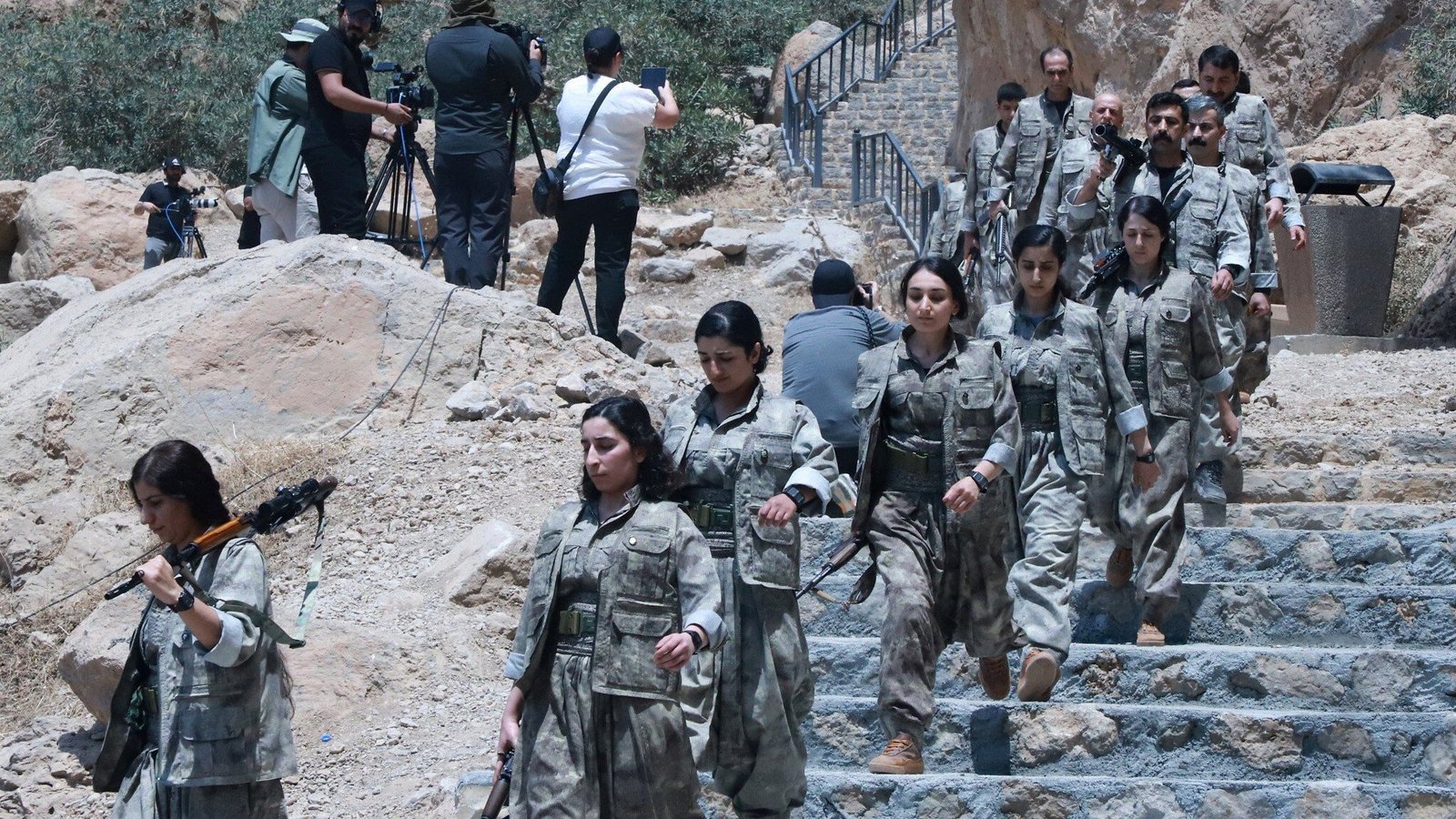
Negotiations over the legal framework for the PKK peace process have entered their final stage, with the ruling bloc aiming to pass the law before parliament rises for its summer recess. President Erdogan has instructed AKP lawmakers to complete passage before the recess, and DEM Party officials say a consensus has formed on bringing the bill to the floor before the end of July.
The sequencing dispute that stalled the process for months appears to have found a middle ground. Rather than settling whether disarmament or legislation should come first, the emerging formula passes the law now but makes its implementation conditional on the Turkish security establishment confirming that disarmament has reached a satisfactory level. According to reporting citing senior AKP sources, the National Intelligence Organisation (MIT) and the Turkish Armed Forces (TSK) would prepare a verification report on the situation on the ground and submit it to the National Security Council (MGK), which would then issue a confirmation decision that the PKK has dissolved and laid down its weapons. Only after that confirmation would the law’s provisions take effect.
Context: The conditional design is a concession from the Turkish side, because it guarantees a legal framework in advance. A central plank of the PKK’s argument for not moving further has been the absence of legal clarity: if fighters lay down arms and leave the mountains, there is no amnesty mechanism telling them where they can go or what awaits them in Turkey. A law on the books, even one held in suspension pending verification, gives the Kurdish side something concrete to measure the state’s commitments against. Ankara, in turn, retains its core principle that nothing is implemented before the security bureaucracy signs off.
Analysis: The harder disputes now concern what the legislation contains. Three issues stand out.
Categorisation of fighters. The PKK insists on a framework with no categorisation, because any sorting of fighters determines later who receives amnesty and who does not. Ankara opposes anything resembling a sweeping amnesty and wants the law tied specifically to the PKK, so that it cannot be extended to other groups it designates as terrorist organisations, above all the Gulenists. The PKK can live with the law naming the organisation explicitly. Its objection is to a text that covers some fighters and excludes others. Leaked drafts suggest exactly that structure: the first stage would apply to members assessed not to have taken part in separate criminal acts, with leaders, convicted members and those convicted of aiding the group handled on different tracks, alongside judicial supervision measures and a political activity restriction of around five years. Under that design, the experienced cadre, the fighters who have carried the organisation for decades, would receive no legal path back to Turkey or into politics. That outcome is likely unacceptable to the PKK, since reintegrating the cadre into legal politics is the point of the exercise from its perspective.
Ocalan’s status. Ocalan already holds a de facto status as the person the state has been negotiating with, but this has produced no legal easing of his situation. The PKK argues the arrangement is incoherent: he is the designated point of contact, yet there is no legal designation that allows the movement, or Kurdish political actors, to reach him with any regularity. MHP leader Devlet Bahceli, Erdogan’s closest ally in the process, has proposed resolving this by giving Ocalan a formal role as coordinator for the peace process and transition to politics, later elaborated as a social status that would preserve his conviction while allowing him to manage the dissolution and steer militants toward political participation. Current drafts reportedly exclude any change to his prison status, and the government has so far been tough on the question. The precedent suggests movement remains possible. The parliamentary commission’s meeting with Ocalan on Imrali was equally sensitive, and it happened only after Bahceli intervened, at a time when even the AKP was reluctant because of anticipated popular backlash and electoral considerations, with most of its MPs unwilling to be involved. Bahceli has repeatedly absorbed the political cost of steps the AKP could not initiate, and the status question may follow the same pattern.
The kayyum system. The removal of elected mayors by state-appointed trustees, applied overwhelmingly to Kurdish municipalities, is expected to be the most straightforward file. Ending the practice is framed across the negotiating parties as part of democratisation, and the parliamentary commission’s report already recommends its termination. A major dispute on this point is unlikely.
The verification formula resolves the sequencing question in a way both sides can present as a win, but it relocates the real power over the process to the MGK table. A passed law whose activation depends on a confirmation decision from the security establishment means the military and intelligence services, rather than parliament, decide when the peace process legally begins. For the PKK, that is tolerable only if the law it activates covers the whole organisation. This is why categorisation, more than Ocalan’s status or the trustees, is the issue on which the legislation could still fail. A framework that legalises the return of rank-and-file members while leaving the cadre in northern Iraq indefinitely would formalise a split between the movement’s body and its leadership, which is precisely the outcome the PKK has organised itself to avoid. The status question, by contrast, has a visible political mechanism for resolution in Bahceli, whose interventions have unlocked every previous impasse of this kind. If the bill reaches the floor before recess with the categorisation dispute unresolved, expect the PKK side to treat passage as the opening of negotiations on implementation rather than their conclusion.


