


Iran’s Kurdish Opposition Unveils a New Alliance, but Leaves the Hard Questions Unanswered
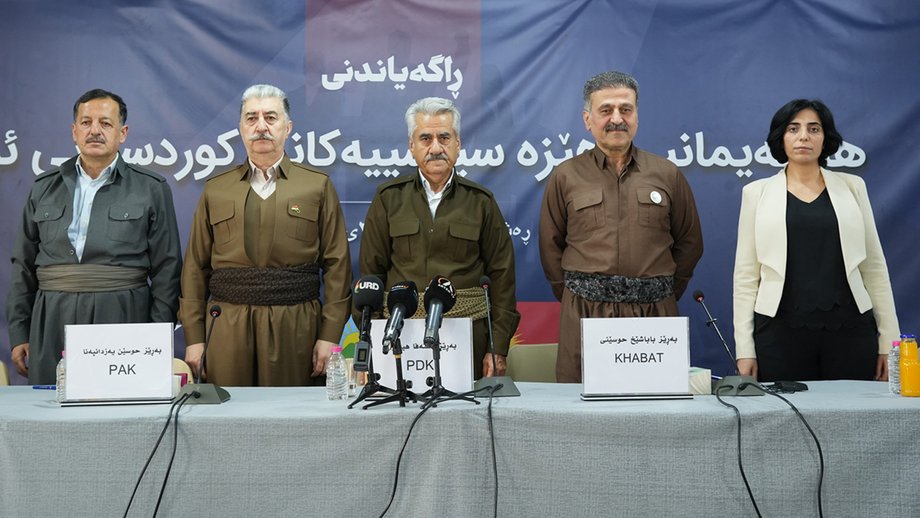
Five Iranian Kurdish opposition parties have announced what they call the “Kurdistan Alliance,” a new framework intended to coordinate decision-making for Iranian Kurdistan. The announcement was made in the Kurdistan Region, even though the location was not disclosed and the platform itself does not explicitly say where it was signed. That mattered immediately, because it drew a public response from the KRG’s Interior Ministry, which stressed it would not allow the region to become a source of threat to any neighboring country, a clear effort to distance the KRG from a platform that openly frames toppling the Iranian regime as a core objective.
Context: The five parties – the Kurdistan Freedom Party (PAK), the Kurdistan Free Life Party (PJAK), the Democratic Party of Iranian Kurdistan (PDKI), the Khabat Organization, and Komala (Zahmatkeshan) – issued a joint platform outlining principles ranging from Kurdish self-determination to the overthrow of the Islamic Republic and the establishment of a democratic, decentralized, and secular Iran.
The coalition emerged from an existing body known as the Centre for Dialogue and Cooperation, a seven-party advisory forum where Iranian Kurdish groups had been meeting for roughly eight to nine months. That body functioned essentially as a consultative space – parties would convene, occasionally issue joint statements, but it carried no decision-making authority. The new coalition represents an attempt to elevate this arrangement into something more politically binding.
Two of the original seven parties boycotted the transition. The Komala faction led by Abdullah Mohtadi, who is based in the US though its deputy leader operates from Sulaimani, declined to join. Mohtadi’s faction argued that the coalition amounts to broad, non-committal language and wishful thinking without any concrete action plans, making it functionally futile and likely to fail. This faction has also drawn criticism from segments of the Iranian Kurdish community for its engagement with Iranian monarchist opposition groups. The second party to boycott was the Komala Communist Party of Kurdistan, a separate faction, whose key objection centered on the coalition’s refusal to adopt either the Kurdish national anthem or the communist anthem as the alliance’s official anthem and also stated the Dialogue “center is not ready for an alliance, and up to now it has come close to collapsing and falling apart nearly three times”
The KRG Interior Ministry’s response is rooted in a binding security agreement between Iran and Iraq, to which the KRG is a party. The agreement prohibits political and military activity by Iranian Kurdish groups on KRG territory and requires such groups to remain confined to designated camps. However, with mounting pressure on Iran from the United States – which has been amassing military assets across the region – these parties may have felt emboldened to act more openly, and the KRG may have calculated that there is sufficient leeway to tolerate political activity that does not cross into military operations.
Analysis: The Alliance is, at least on paper, meant to be more than the Dialogue Center. A dialogue platform is, by design, a low-commitment space: meetings, messaging alignment, occasional joint statements. An alliance implies shared decision-making and joint action.
But the most striking feature of the Alliance document is that the “operationalizing” sections are precisely where binding commitments should appear, and yet they remain aspirational.
Article 9 is the most revealing. It calls for a joint Peshmerga and guerrilla command structure – something that, if realized, would be genuinely transformative. It would mean PDKI, Komala, PAK, Khabat, and PJAK subordinating their armed wings to a collective authority, surrendering real organizational sovereignty over their most valuable asset. But the platform does not establish this structure. It says the coalition should “work toward forming” one. That hedging language is doing enormous work. Each of these parties maintains its own armed wing as its core organizational power base. No leader willingly dilutes that, and the platform does not require them to.
Article 8 calls for a political and diplomatic committee but says nothing about the questions that actually matter: decision-making authority within the committee, proportional representation, who speaks externally on behalf of the coalition, or what happens when parties disagree on diplomatic positioning – for instance, regarding relations with the KDP in Erbil versus the PUK in Sulaimani, or how to engage with broader Iranian opposition figures. These are not secondary details. They are the substance of any functional coalition, and they are entirely absent.
Articles 10 through 14 outline what amounts to a constitutional framework for a post-revolutionary Kurdistan that does not exist. It is easy to agree to hold elections within a year and to respect their outcome when the scenario is entirely hypothetical. The hard questions – who controls territory, who administers services, whose cadres staff the interim authority, how seats are allocated – are all deferred. As the saying goes, the devil is in the details, and this is precisely where disagreements among these parties would surface. Given the deep ideological and organizational differences between parties like PJAK, PAK, PDKI, and the others, it is difficult to see how they would reconcile on any of these concrete operational matters.
The most generous reading of this document, and perhaps the most accurate one, is that it is less about internal operational integration and more about diplomatic positioning. With the United States amassing military capabilities across the region and a potential confrontation with Iran on the horizon, presenting a unified front to external actors – Western governments, broader Iranian opposition groups, Gulf states – has clear strategic value. Having a single address for external powers to engage with is useful, regardless of how deep the actual integration behind it runs.
If that is the logic, then the vagueness of the operational articles is not a failure of negotiation. It is a feature. The parties do not need to resolve questions of command structure, seat allocation, or territorial administration to achieve the immediate diplomatic goal. They need a platform document, a name, and a signal of unity.
But if this is the case, it makes the coalition functionally not very different from the Dialogue Centre it replaced – just with a grander title and a more polished statement.
There is a more fundamental issue with what these parties represent, one that the platform’s language of national representation cannot paper over. With the partial exception of PJAK, all of the coalition’s member parties draw their leadership and core support base from a narrow geographic and demographic slice of Iranian Kurdistan: the Sorani-speaking, Sunni towns of the border region.
Of the five leaders who announced this coalition, four are from a tight cluster of towns that are all Sorani-speaking and Sunni: KDPI’s Mustafa Hijri is from Nagadeh, PAK’s Hussein Yazdanpanah is from Bukan, Khabat’s Baba Sheikh Hosseini is from Baneh, and Komala’s Reza Kaabi is from Saqqez. These are neighbouring towns in a compact area of Kurdistan Province and West Azerbaijan Province. Only PJAK’s co-leader Peyman Viyan, who was present at the announcement, is from outside this belt – a Kurmanji speaker from the town of Mako in the far northwest of Iran.
This matters because Iranian Kurdistan is far larger and more diverse than this belt. Large Kurdish populations in Kermanshahan are predominantly Shia and speak Southern Kurdish dialects. Kurdish-populated areas in Ilam Province are likewise Shia. The Kurmanji-speaking populations in the northern reaches of West Azerbaijan Province have distinct linguistic and cultural identities.
Mathematically, even if one generously assumes these parties fully represent the Sorani-Sunni heartland they originate from – which is itself questionable – that demographic accounts for roughly 25 to 35 percent of Iranian Kurds, or 3 to 4 million people out of a total Kurdish population estimated at 10 to 12 million, a figure that includes the roughly 1.5 million Kurmanji-speaking, Shia Kurds in Khorasan and the half million Kurds in Tehran where none of these parties have any presence. The remaining 65 to 75 percent – the Shia populations of Kermanshah and Ilam, the Kurmanji speakers of the northwest and Khorasan, the Yarsan communities, the Kurdish diaspora in Tehran – have little to no representation in this coalition.
Among the coalition’s members, only PJAK has meaningful organizational presence beyond this narrow geography. Beyond Viyan’s Kurmanji-speaking background, the party’s senior leadership includes figures from Shia Kurdish areas like Ilam – for instance, the party figure Revan Abadan originates from the Ilam region. None of the other four parties have anything comparable. Their leadership, cadres, and social base all draw from the same small cluster of Sorani-Sunni towns, meaning they compete for support within the same limited population rather than expanding the coalition’s geographic reach.
A coalition claiming to represent the political forces of Iranian Kurdistan while drawing almost exclusively from one demographic and geographic corner of it faces a legitimacy challenge that no platform document, however well-drafted, can resolve.


