


What happens to PKK strongholds in the Kurdistan Region after the PKK vacates them?
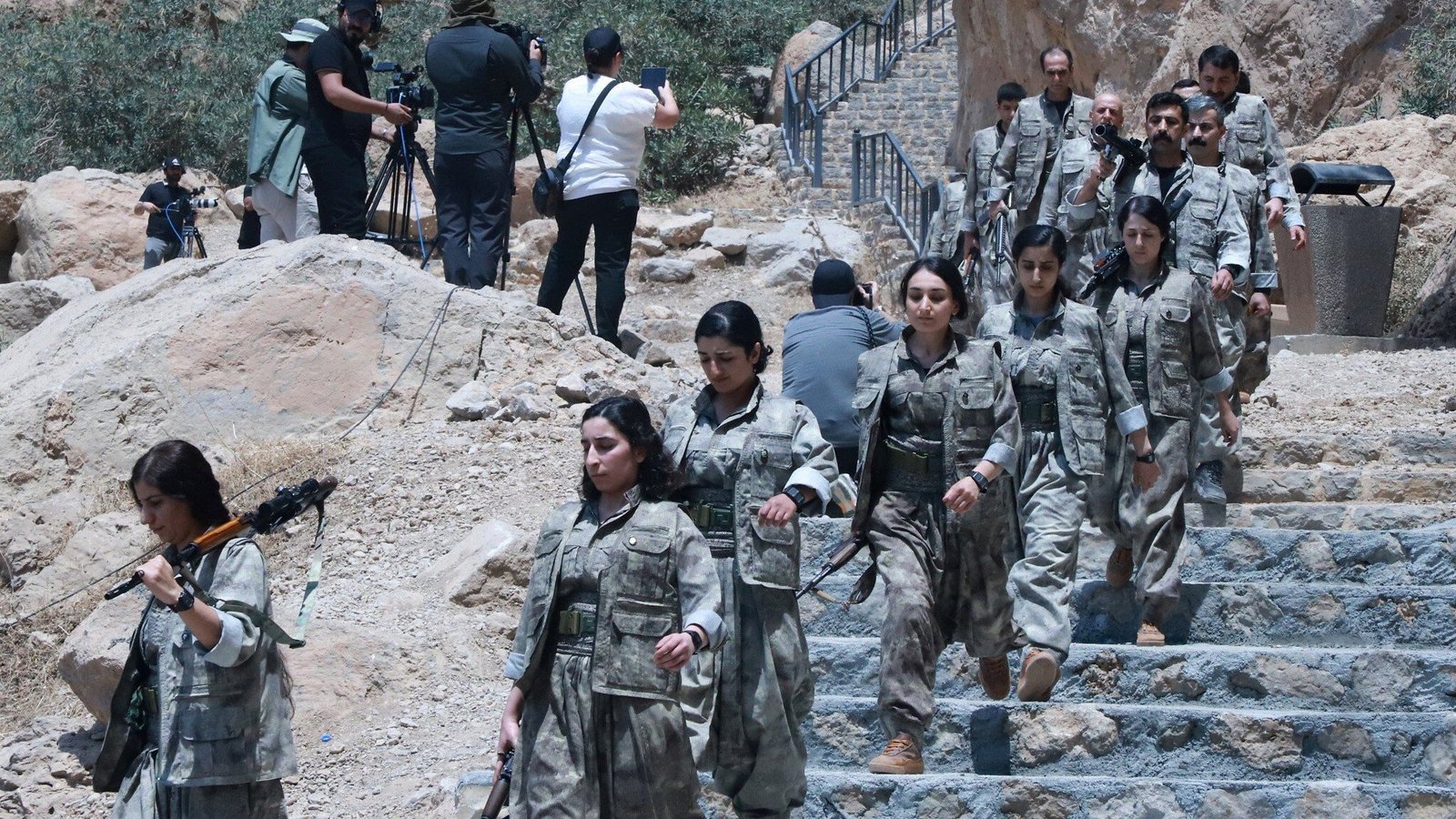
One year after Abdullah Ocalan’s call to the PKK to disarm, the peace process has entered a phase in which the Kurdistan Region of Iraq is the physical stage on which its viability is being tested. The PKK has vacated caves in Zap and Metina, withdrawn forces from Turkey, and announced further evacuations from the Medya Defence Zones. Turkey’s parliamentary commission has completed its work, and legislative steps are expected to follow once MIT and the TSK verify the PKK’s departure from its remaining positions.
Context: On 18 February 2026, Turkey’s parliamentary commission approved its final report by qualified majority. The report conditions legislative reform, including potential amnesties and reintegration frameworks for PKK members, on field verification by Turkish intelligence and the military that PKK evacuations have reached “a certain stage.” Turkish security sources have identified the clearance of the Metina, Hakurk, and Gara zones, the core PKK areas in the Kurdistan Region, as the benchmark. If confirmed by the end of March, legislative drafting could begin in April.
Details: The PKK’s evacuation sequence has proceeded through several phases: four caves in Zap and two in Metina were confirmed emptied by late November 2025, with weapons logged and destroyed. But the timeline has slipped. December reporting set the end of February for full clearance of Zap and Metina; by late February, this had quietly shifted to the end of March for the broader Metina-Hakurk-Gara zone amid the January PKK-Damascus crisis in Syria. Turkish pro-government Daily Sabah reported on 22 February that 2,500 PKK members had relocated to Qandil rather than demobilising, that weapons were being buried in evacuated caves rather than handed over, and that the evacuation had been suspended in some areas due to developments in Syria. But now that the vacation movement has reportedly restarted, what happens to the vacated strongholds?
The evidence from the ground, compiled from multiple independent sources over the past three months, documents a comprehensive Turkish military construction programme across the areas from which the PKK has withdrawn or is in the process of withdrawing. The pattern is consistent across every zone examined.
A report published by Community Peacemaker Teams (CPT) on 26 February 2026 documents the most significant infrastructure development: over the past three months, Turkish forces have connected all their military bases in Zap, Avashin, Matina, and Berwary Bala, all areas in central northern Kurdistan Region close to the Turkish border, through newly constructed roads. The road network, centred on the Amedi district, has been built to establish what CPT describes as a “buffer zone” in which Turkish military movements no longer depend on public roads to access any installation in the region.
The main entry point for this network has been established through Gali Rashava valley in the Deraluk subdistrict of Duhok governorate. From Gali Rashava, to the north of Gara mountains, all Turkish military bases in the region are now accessible through internal military roads. To construct the road to this entry point, Turkish soldiers brought construction equipment to the valley on 6 February and positioned artillery on the surrounding ridgelines before detonating explosive ordnance to clear terrain. Significant forest cover in the valley was destroyed. On 7 February, military helicopters conducted exercises over the area in coordination with newly established facilities, releasing flares and firing artillery rounds into the mountains. The construction damaged two historical landmarks, including a bridge whose construction dates to the Abbasid period.
This road network represents a qualitative shift. Prior to 2026, Turkey’s 136 bases in the Kurdistan Region, documented by The National Context through satellite imagery analysis, were connected by approximately 660 kilometres of military roads but still relied in part on public roads for access. The new construction eliminates that dependency entirely within the Amedi-Zap-Matina corridor, the same zone from which the PKK has been evacuating its caves.
CPT reports that three new military compounds have been established in the mountains of the Amedi district. These are not standard outposts. They include a field hospital, a military training centre, and artillery positions. The inclusion of a hospital and training facilities indicates garrison-level infrastructure: these are not forward operating posts designed to support temporary operations, but permanent installations capable of sustaining long-term troop presence, casualty treatment, and force generation.
The compounds have been constructed in conjunction with the road network, ensuring they are integrated into the broader logistics grid. Their location in the mountains of Amedi district places them at the heart of the former PKK operational zone, the same terrain that the Claw-Lock operation targeted from 2022 onwards.
The Turkish military has also reported constructing concrete perimeter walls around Turkish military positions in the Heftanin and Nihêlî areas, close to Zakho in the northwest Kurdistan Region. The shift from earthen berms and sandbag positions to poured concrete walls is significant. It signals a transition from expeditionary posture to permanent garrison infrastructure. The construction has continued without interruption throughout the peace process.
Heftanin was the target of some of the earliest Claw-series operations, beginning in 2019. Turkey declared the area cleared at the time, but the ongoing construction of concrete fortifications six years later demonstrates that what Ankara describes as counterterrorism operations function in practice as territorial consolidation.
The Turkish military has also started the construction of helicopter landing sites at 12 military bases and outposts across the Badinan region. CPT monitoring organisation confirmed these installations. The construction of residential compounds alongside the helipads at several sites has also been documented.
Helipads transform the operational capability of isolated hilltop positions. They convert static outposts into nodes in a rapid-deployment and logistics network, enabling troop rotation, casualty evacuation, and resupply without dependence on ground routes. Combined with the new road connections, Turkey’s military presence in the Kurdistan Region is evolving from a constellation of isolated posts into a fully connected operational grid capable of projecting force across the Badinan region and beyond.
Turkish forces have occupied approximately 25 square kilometres of the Snin highlands, a summer pasture area historically used by Kurdish herding communities in northeast Erbil. The occupation has severed the road between Sidekan and Kelashin, an area in northeast Erbil that connects the Iraq-Turkey-Iran border, forcing civilian traffic onto the significantly longer Barbazin border crossing route.
The strategic significance is direct. Snin is the gateway corridor to the Hakurk zone, whose evacuation by the PKK is scheduled for spring 2026. By occupying and fortifying the Snin highlands before the Hakurk evacuation takes place, Turkey is pre-positioning to ensure that once the PKK departs, the access routes are permanently sealed. The seizure of civilian pasture land in the process underscores that the military calculus operates independently of any civilian peace dividend.


