


Trump Finds His Scapegoat for a Failed Iran Strategy: the Kurds
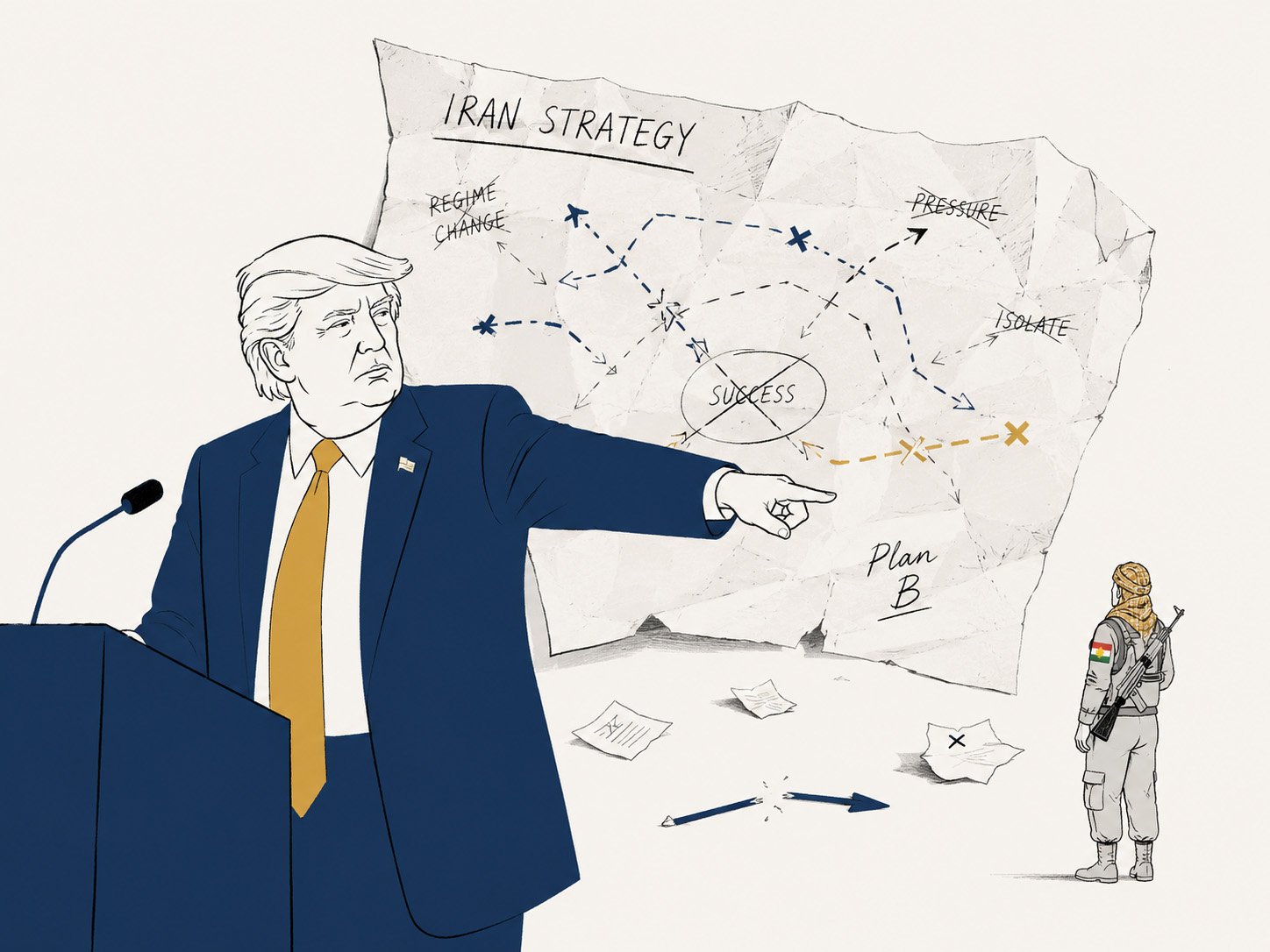
The US President Donald Trump accused “the Kurds” of diverting weapons he says were intended for Iranian anti-government protesters, claiming Washington had sent guns and ammunition through Kurdish intermediaries for delivery to protesters inside Iran, only for those intermediaries to retain the shipments. Trump first raised the allegation in early April and has repeated it several times since. Iranian Kurdish opposition groups and Kurdish officials have denied receiving or withholding any such shipments. The accusation is not new, but its persistence is telling: it points to the wreckage of a broader strategy and to a White House in search of someone to blame for its failure.
Context: The claim sits at the intersection of two crises. The first was the major protest wave that began in late December 2025 and spread through Iran in January, drawing a severe crackdown and renewed American and Israeli interest in arming the opposition. The second was the war that began on 28 February 2026, when the United States and Israel launched strikes on Iran. In the war’s opening days, reporting pointed to Washington and Jerusalem actively cultivating Iranian Kurdish factions based in Iraqi Kurdistan as a ground front against Tehran, a sustained Israeli airstrike campaign to degrade IRGC, police, border, and intelligence infrastructure across the Kurdish west, with weapons channels, air cover, and direct pressure on Iraqi Kurdish leaders to permit or facilitate cross-border movement into Iran.
Analysis: Trump’s accusation against “the Kurds” cannot be understood outside the wider failure of the regime-change strategy against Iran. The Kurdish channel was one element of a broader plan, conceived primarily in Israel and partially adopted in Washington, that sought to bring down the Iranian government through a combination of airstrikes, decapitation operations, infrastructure targeting, and the activation of internal pressure points that would multiply the cost of the war for Tehran until the political system fractured. Of those pressure points, the Kurdish front was the most developed and the only one that came close to actual execution.
The plan emerged from Israeli rather than American thinking. Mossad had spent the previous year reversing its earlier assessment that fomenting armed rebellion inside Iran was a waste of resources, and the approach was subsequently presented to both Netanyahu and senior Trump administration officials. Inside the administration, however, the reception was uneven. Senior US defence officials were sceptical from the outset, doubting both the Iranian opposition’s capacity for mass mobilisation under bombardment and the military viability of using Iranian Kurdish factions as a ground force. Trump initially leaned toward the Israeli position, but pulled back as the risks became clearer and as Turkish diplomatic pressure entered the picture. The Jerusalem Post has reported that it was Trump himself who vetoed deploying Iranian Kurdish groups as a ground force. Israeli journalist Amit Segal, known to be close to Prime Minister Netanyahu, reported that Erdogan phoned Trump directly and persuaded him to halt the planned offensive. Reuters had earlier reported that Turkish Foreign Minister Hakan Fidan called Marco Rubio to urge against using Iranian Kurdish armed groups in any cross-border operation.
That intervention is now the subject of open recrimination between Washington and Jerusalem. When a strategy fails, the question of who owns that failure becomes politically urgent, and Trump’s repeated accusation about diverted weapons is doing precisely that political work: converting a strategic failure into a logistical complaint and finding a scapegoat among actors least positioned to push back.
The accusation also rests on a contested account of what actually happened. Sources close to the Iranian Kurdish factions told The National Context that some weapons were indeed received, but not for distribution to civilian protesters. They were intended to equip the factions for an armed operation inside Iran. That distinction is not trivial. If the weapons were meant for protesters, the allegation is one of diversion; if they were meant for armed groups preparing to cross the border, then Trump’s framing fundamentally misrepresents the nature of the operation and what Washington itself authorised.
The supply chain raises further questions. Support for the operation does not appear to have been limited to direct weapons transfers; according to people familiar with the procurement side, it also included financial support channelled into local arms purchases from Iraqi markets, some of which moved through black-market networks with links to Hashd al-Shaabi. That meant the operation was running through a deeply compromised procurement environment where militia-linked brokers and armed networks routinely overlap. Once the plan became visible, that same supply chain likely made it far easier for hostile actors, including Iranian intelligence, to track what was being assembled and treat the entire effort as a foreign-backed armed operation staged from Iraqi territory.
The third and most fundamental problem was capacity. The plan assumed that Iranian Kurdish factions could field a far larger deployable force than any of them actually had, an assumption that was always questionable given the longstanding incentive these parties have to inflate their numbers when dealing with foreign sponsors. More fighters means more money, more weapons, and more political relevance. In practice, PAK could realistically mobilise between 200 and 300 fighters; Komala’s active combat capacity was likely below 500; and KDPI, though somewhat stronger, was still well short of 1,000 fighters ready for deployment. Taken together, the real combined force was a fraction of what had been presented to outside backers. The problem was compounded by PJAK’s decision not to participate. As the PKK‘s Iranian branch, PJAK holds the deepest guerrilla infrastructure, the most battle-hardened cadres, and the largest pool of experienced fighters among all Iranian Kurdish armed groups. Without it, the operation rested on weaker, more fragmented parties whose paper strength far exceeded their operational reality.
There was genuine movement. Forces had gathered in the Haj Omran area, which had become the central staging theatre; vehicles were being procured; border corridors were active; and Reuters reported that the factions’ objective was to launch an attack on Piranshahr and the nearby Oshnaviyeh area, directly across the border from Haji Omran. However, as the moment of execution approached, the compounding weaknesses could no longer be papered over. The factions were underprepared and PJAK had declined to join. Iran had directly warned both KDP and PUK leaders that if Iranian Kurdish groups used the Kurdistan Region as a launching pad, Tehran would retaliate against their leadership and infrastructure directly. Turkey was lobbying against the operation at the highest levels of the American government. Crucially, it was in part the Iraqi Kurdish leaders themselves who had phoned and urged that Turkish intervention, having concluded that the operation was existential for the region and that Ankara was their most effective lever for stopping it.
That is the real context for Trump’s repeated allegation. He is not merely disputing a missing weapons shipment. He is pointing, crudely and inaccurately, to the failure of an operation that drew in weapons, money, and compromised procurement networks, and that ultimately could not assemble a viable ground front from the fragmented forces of Iranian Kurdish armed politics. The Kurdish front failed not because the Kurds pocketed the guns, but because the strategy that deployed them was built on assumptions that did not survive contact with reality.


