


Airstrikes in Iran’s West Target Police Stations and Border Posts, Hinting at a Ground Strategy Built Around the Kurds
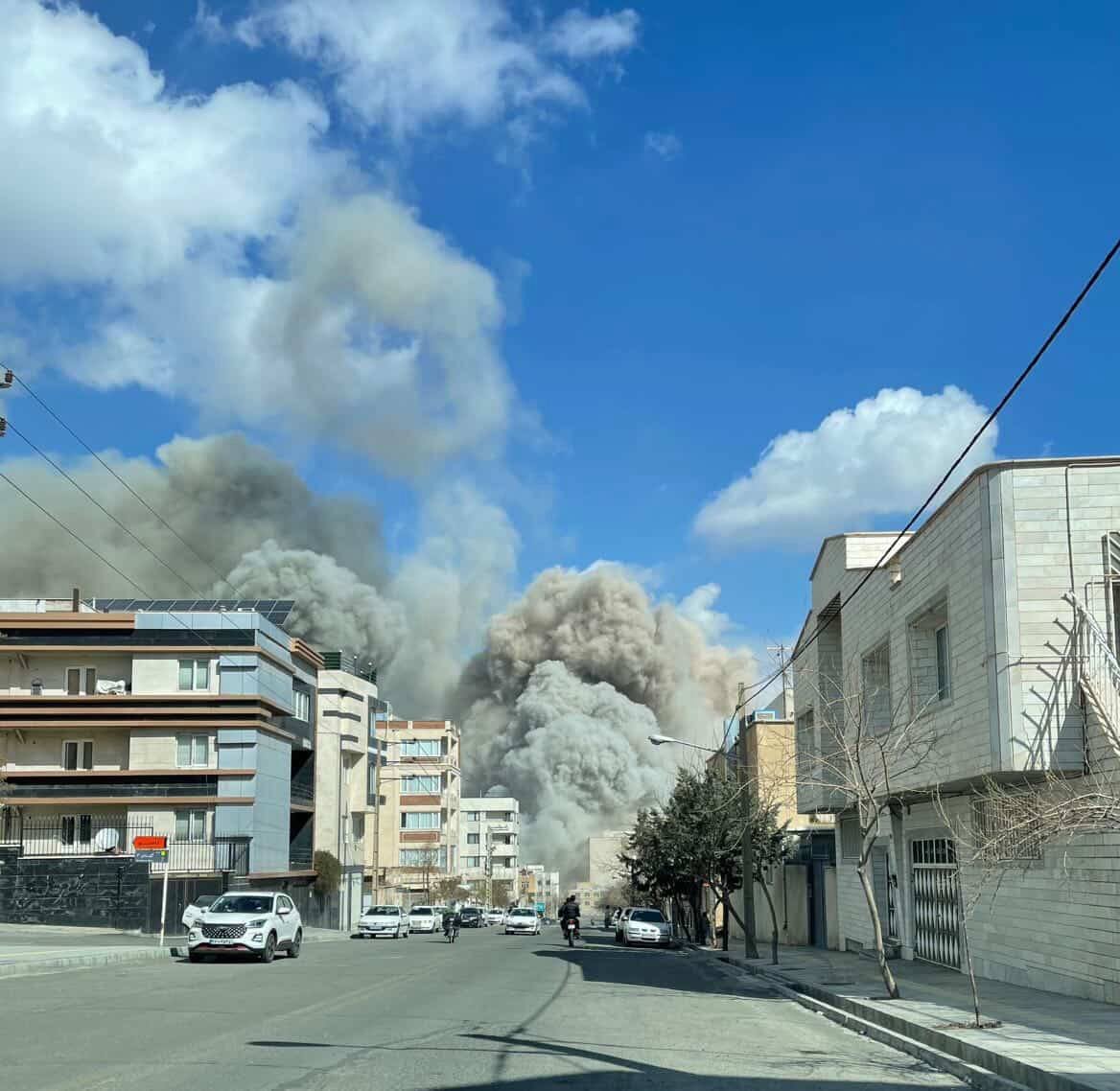
Tehran remains the main centre of strikes, but the more revealing pattern is unfolding in the west. The war now looks less like a single-front assault and more like a campaign unfolding along three distinct axes: a decapitation effort against command, security, and state infrastructure in Tehran; a naval and drone-disruption campaign along the Gulf coast; and a sustained effort to degrade IRGC, police, border, and intelligence infrastructure across the Kurdish west.
It is this third axis, the corridor running from northern Kermanshah through Kurdistan Province into southern Urmia, that has emerged as the war’s most important secondary front. The target profile there differs sharply from that seen elsewhere. The difference is not only geographic. It is functional.
Context: Across the rest of Iran, the coalition is destroying the state’s external power projection and conventional warfighting capabilities. In Tehran: Khamenei’s residence compound, the Ministry of Intelligence, the Ministry of Defence, Parchin, Khatam al-Anbia, Mehrabad Airport, the Aerospace Industries Organization, IRIB broadcasting facilities, and Pasteur Street, the nerve centre housing the President’s Office, the IRGC central command, and the Supreme National Security Council. The metro belt around the capital is being degraded too: military bases in Malard, police headquarters in Shahriar, the Fashafuyeh power station and industrial zone in Ray. In the northwest, the Tabriz airbase lost multiple F-5 and F-4 fighter jets on the tarmac. In Isfahan: the 8th Air Force base and air-defence nodes near the nuclear facility. A strike on a base in Kashan killed at least a dozen IRGC personnel including senior commanders. Natanz was confirmed struck by updated IAEA assessment. Along the Gulf coast: the IRGC Region Three base in Bandar Mahshahr, missile bases and an ammunition depot in Khuzestan, a drone-production complex near Abadan, naval facilities from Bandar Abbas to Kish Island, and the energy corridor at Kharg Island, Asaluyeh, and Kangan.
These are strategic military, nuclear, naval, and command-and-control targets. The target list along the Kurdistan Region border is categorically different.
Analysis: Based on confirmed reporting from local sources compiled by The National Context, the strikes in Kermanshah, Kurdistan, and Urmia overwhelmingly hit internal security infrastructure. Notably, the Kermanshah strikes are concentrated in the northern, predominantly Sunni Kurdish districts – Javanrud, Ravansar, and Paveh – which historically serve as epicentres of Kurdish rebellion.
In police and law enforcement: Police Station No. 11 in Kamyaran, Police Station No. 11 in Marivan near the city prison, Police Station No. 15 in Sanandaj near the 28th Infantry Division barracks, the Shilan neighbourhood police station in Mahabad, the main police command centre in Piranshahr, the aghahi investigation centre and police headquarters in Marivan, and the Police Special Unit building in Arak. In border guard infrastructure: the Kurdistan Province Border Guard Command in Sanandaj, the Marivan border guard command, the Mehran border regiment headquarters, and the West Azerbaijan Provincial Border Guard base in Urmia where four FARAJA personnel were confirmed killed. In intelligence: the main provincial headquarters in Sanandaj, the Marivan intelligence building, and the central intelligence headquarters in Mahabad — hit on both Day 1 and Day 3.
The IRGC and Basij target list runs deeper: the Beit al-Moqaddas Corps at the Imam Ali base and the Shahramfar headquarters in Sanandaj, the Sanandaj airfield, the Mohammad Rasulallah Basij base in Mahabad, the IRGC headquarters in Ravansar, the Ansar al-Rasul Brigade in Javanrud, three IRGC positions in Shno including the command headquarters on Moallem Boulevard, the Vali Asr barracks in Naqadeh, the Al-Mahdi base area in Urmia’s Qasemiyeh district, the Abuzar military base in Sarpol-e Zahab, the Basij base in Ta’avon Township and the Imam Ali missile base in Kermanshah, heavy strikes in Divandarreh, IRGC missile positions near Kamyaran, army barracks in Baneh, confirmed strikes in Kangavar and Paveh, and the 84th Division command headquarters in Khorramabad.
A police station in Marivan has no relevance to Iran’s retaliatory strike capability. A border guard checkpoint in Shno threatens no American aircraft carrier. An aghahi interrogation centre plays no role in Iran’s nuclear programme. This is a target set designed to collapse the regime’s internal security grid along one specific border and let a localised insurgency breathe.
The institutions destroyed along this corridor perform three functions distinct from conventional military operations.
The first is border interdiction. The border guard commands at Sanandaj, Marivan, Mehran, and Urmia monitor and interdict cross-border movement by Iranian Kurdish opposition groups headquartered in the Kurdistan Region of Iraq. These groups have waged campaigns from the Zagros mountain chain for decades. Destroying the border commands removes the surveillance and interdiction layer covering approximately 400 kilometres of frontier.
The second is intelligence and surveillance. The intelligence buildings in Mahabad, Sanandaj, and Marivan track Kurdish political networks, manage informant chains, coordinate with Tehran’s Ministry of Intelligence, and monitor activist movements. Without them, the regime loses its primary eyes in the provinces most likely to experience political upheaval.
The third is repression capacity. These exact police stations, Basij bases, and IRGC garrisons fired live ammunition at Kurdish protesters during the January 2026 protests. The aghahi centres interrogated detainees. The Basij bases coordinated paramilitary mobilisation against civilians. Kermanshah and Kurdistan provinces recorded the highest military casualty figures from the current strikes, according to Hengaw, and had experienced the fiercest crackdown in January.
Iran Anticipated This Exactly: Iran did not experience this campaign as a surprise. The June 2025 twelve-day war served as a dress rehearsal. The IRGC had eight months to prepare. The US spent weeks visibly massing forces before February 28.
The physical proof is the border wall. According to Community Peacemaker Teams (CPT), the IRGC began construction of a three-metre-tall “smart” barrier fitted with sensors and early-warning devices immediately after the twelve-day war ended on 24 June 2025. The project runs nearly 600 kilometres, from Mount Kelashin near Sidakan in northeast Erbil to Cham Cheqal on the Garmian frontier in southern Sulaimani. It extends 2 kilometres deep. Multiple segments have been completed. Construction continues daily.
CPT also reports that Iran maintains 151 military outposts inside the Kurdistan Region’s side of the border — forward-deployed into Iraqi territory. A de facto Iranian-occupied zone along the frontier, built while Netanyahu was lobbying Washington.
The Paradox of Regime Adaptation: The destruction of buildings does not necessarily equate to the destruction of the personnel who operate them.
Hengaw-linked reporting confirms IRGC forces had evacuated military facilities and moved into schools and mosques before many strikes hit. This is not improvisation. It is a rehearsed adaptation refined over successive waves of unrest. During the 2009 Green Movement, the 2019 fuel protests, the 2022 Mahsa Amini uprising, and the January 2026 demonstrations, the IRGC relied on “motorcycle swarms” — armed two-man teams redeploying across urban centres faster than armoured vehicles. Leaked IRGC documents published by United Against Nuclear Iran revealed that each security unit deploys three teams of ten motorbikes with two personnel each, producing sixty motorcycle riders per unit. Visual evidence from the ground already shows Basij units operating out of camouflaged street tents and relying on these formations rather than central garrisons.
Precision munitions can flatten Police Station No. 11 in Kamyaran, but if the Basij militia evacuated to a tent three streets away days before the strike, the regime’s suppression capacity remains functionally intact. The state is trading infrastructure for the survival of its enforcers. The IRGC had eight months to move critical archives, duplicate communications equipment, relocate informant databases, and establish parallel command networks. The officer in a school in Sanandaj has lost his building — the question is whether he lost his institutional capacity or merely his address.
The evacuation into civilian cover also serves a second function: the human-shield calculus. The IRGC is daring the coalition to follow them into civilian infrastructure. The school strike in Minab, which killed an estimated 158 students according to Iranian officials, is already the dominant civilian casualty narrative. The relocation into civilian sites invites more such incidents — information warfare through the deliberate manufacture of conditions for civilian harm.
Yet the mobile posture introduces its own vulnerability. By decentralising into small, isolated pockets on motorcycles and in street tents, security forces become acutely exposed to ground-level attack. If the coalition’s dismantlement of the security grid enables armed insurgencies in regions where Kurdish fighters know the terrain, these dispersed units will find themselves cut off from centralised command, logistics, and reinforcement. Two-man motorcycle crews are precisely the soft targets that guerrilla ambushes exploit. In hiding from the sky, the regime has made its forces vulnerable on the ground — exactly where a Kurdish insurgency would fight.
Furthermore, Hengaw reported that individuals wearing peshmerga uniforms were seen moving openly through Kamyaran in Saipa vehicles along the road toward the village of Taravarez. Hengaw’s investigation determined they were IRGC members in disguise. Hengaw warned similar operations are likely planned for other towns.
The Israeli and US’s strikes along the Kurdish border have destroyed the visible nodes of regime authority. The psychological signal – the physical erasure of buildings that represented state coercion – is real. But the operational picture is more ambiguous than the strike map suggests.


