


Turkey Nears Certifying the PKK Dissolved as PJAK Expands Along the Iranian Frontier
Turkey’s parliament passed the Law called ‘Strengthening National Solidarity and Social Integration’ in early August, the framework governing the return and legal reintegration of PKK members. However, for the law to be triggered, the Turkish National Security Council (MGK) has to verify that the PKK, but more importantly all groups under the KCK umbrella and every formation connected to the KCK, have given up their arms and reached an irreversible stage of disarmament. The certification is a central requirement for the law to be legally considered active, and it is the gate through which the six-month application window opens.
According to well-connected Turkish sources, the verification is already in advanced stages, with journalist Yildiray Ogur, one of the most connected journalists on the PKK-related process, reporting that the national intelligence service (MIT) and the armed forces (TSK) are expected to verify PKK disarmament and camp evacuation across August and September, after which their assessment goes to Erdogan and the MGK; this reporting has been further corroborated by journalist Ozgur Cebe, another well-connected journalist, who reports that the goal is for the certification to happen by October. If the timetable holds, the MGK could declare the PKK formally dissolved in October, after which the declaration would be the reference point for everything that follows, including the return mechanism of the fighters, which begins its six-month period for allowing application from those who wish to return and have their legal cases cleared.
The certification is said to be in motion amid reports that the physical dismantling of the PKK in Iraq and Turkey, and the parallel integration of the Syrian Democratic Forces (SDF) into the Syrian state, are close to completion. However, the one key element of the wider PKK-linked armed system that shows no equivalent movement is PJAK, the PKK’s Iranian-Kurdish affiliate, which is increasingly digging along the border with Iran.
Context: The case for certification rests on a specific threshold expected by the Turkish security establishment. Turkish reporting puts roughly 3,800 active armed PKK members across 18 camps in northern Iraq’s Kurdistan Region, in addition to 2,500 who have severed ties with the PKK and live a civilian life but remain in Iraq’s Kurdistan, and then another 1,500 who are mostly pro-PKK, non-armed people with finalised Turkish prison sentences or convictions but live in Iraq’s Kurdistan. However, not all of the 3,800 would be covered by the law; among these, some 900 fighters, including 230 senior figures, are unlikely to be covered and are expected to remain outside Turkey. However, the law itself likely covers a far larger population if those in prison in Turkey, those in Europe and those in refugee camps such as Makhmour in northern Iraq are included.
The weapons handover is being consolidated at five collection areas: Binare Qendil, Kortek, Zergele, Lewce and Bole. Four of these sit within the western Qandil region, which indicates that weapons are being gathered locally around Qandil rather than fighters being moved to distant surrender centres. Turkish security reporting has described an arsenal held across 35 underground storage sites. The reported manifest ranges across AT4 and LAW anti-armour systems, RPG-7s, M4, M16 and AK-47 rifles, Dragunov and other sniper rifles, laser designators and night-vision equipment, 60mm and 82mm mortars, recoilless guns, SA-7, Strela, Stinger and Igla shoulder-fired air-defence missiles, Konkurs and Milan anti-tank missiles, DShK heavy machine guns, PKM machine guns, Katyusha rockets, grenades and grenade launchers, and explosive drones of the type used in earlier attacks.
On the evacuation side of the process, Turkish reporting describes the PKK vacating dozens of positions in Gara, Metina, Zap, Avasin, Haftanin and other areas next the Turkish border which Turkish media claimed that the evacuations have been verified through intelligence, physical inspection and satellite and coordinate-based monitoring. In much of the Turkey-facing terrain, Turkish forces have reportedly moved into the vacated positions after clearing them. This feeds directly into the corridor of caves and fortified positions running from the Turkish border toward Qandil that TNC has tracked as the state’s verification file. The northern belt is therefore not being left as an open vacuum. It is being inspected, cleared and secured by the Turkish military. The Syrian track runs in parallel: the SDF and its core, the People’s Protection Units (YPG), are being folded into the Syrian military and state, which removes the autonomous armed structure but with integrating the personnel which has Erdogan framed it to give them a “share” in Syrian state building.
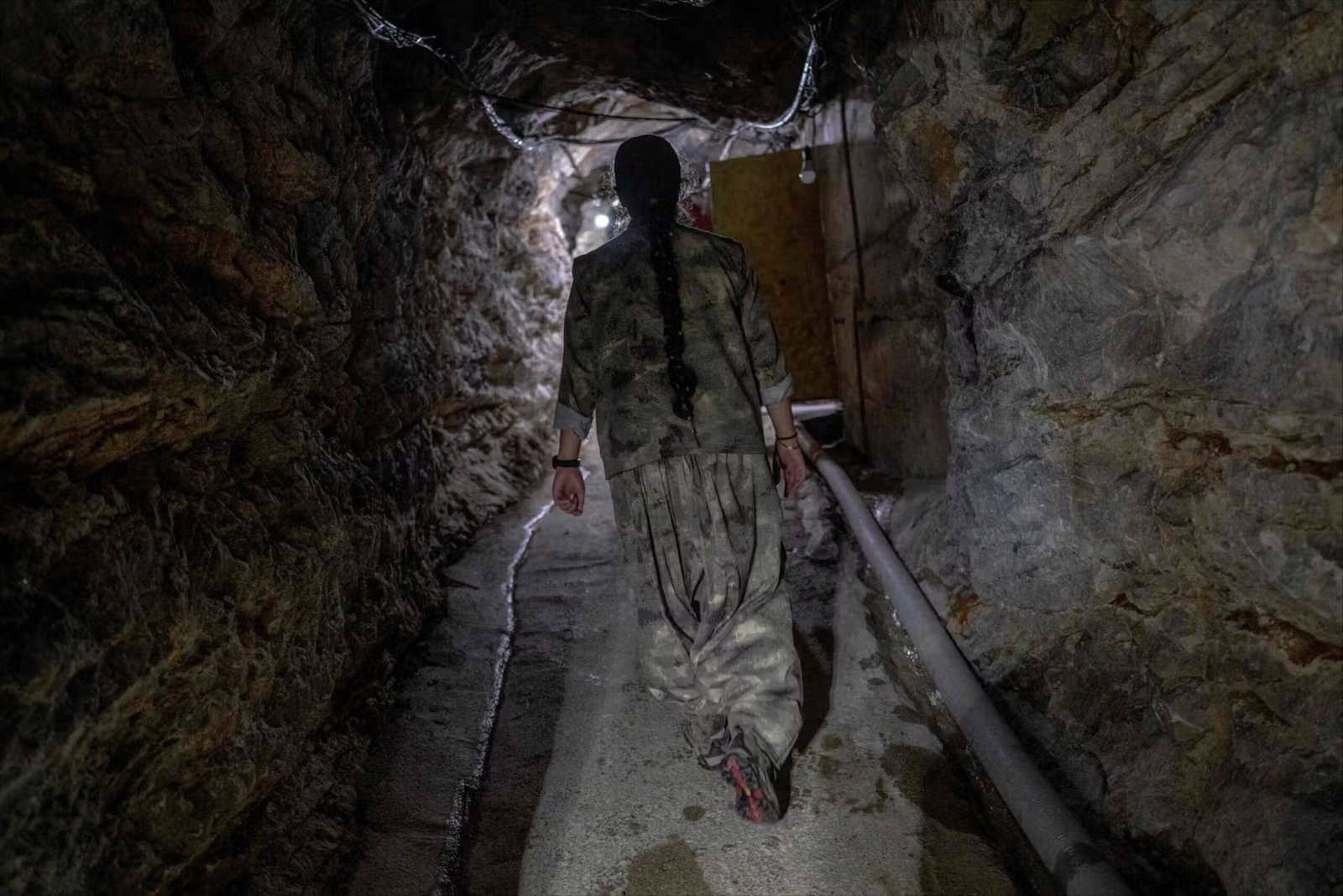
However, the one big question remains is over the future of PJAK which is not involved in any similar process and in fact its infrastructure along the border has if anything been extended rather than wound down. Estimates of its manpower run from roughly 1,000 to 3,000 fighters in its armed wing, the East Kurdistan Units (YRK), a count that appears organisationally separate from the 3,800 PKK cadres in the Iraq dissolution process, though the boundary is porous given shared Qandil geography and a common organisational history. Ironically, PJAK is now more active than it has been in over a decade, with sustained clashes on the Iranian side of the border through mid-2026. Its forces are embedded in caves and tunnel networks along the Qandil belt. Residents around Boyin in Halabja have reported new bases, tunnel digging, well drilling and heavy machinery in their area, identifying the force as PKK. Further reporting has described trench construction, road engineering and the movement of heavy machinery along axes running from Qandil to the Iranian border, from Qandil to Asos, from Qandil toward Bradost, Choman and Sidakan, and south toward Penjwin, Halabja and Hawraman.
The contrast extends to how Iran has treated these groups. Across 2026, Iran has run an extensive strike and ambush campaign against the other Iranian Kurdish opposition parties sheltering in the Kurdistan Region, including the KDPI, PAK, Komala factions and Khabat, with casualties concentrated in the Sorani-Sunni border belt. PJAK, which is geographically closer to Iran, militarily organised and embedded along the Qandil and Penjwin axes, has not faced the same systematic campaign against its Iraq-based infrastructure, an asymmetry TNC has flagged as one of the clearest signs that Tehran governs the PKK-PJAK file through a different logic. PJAK has not been left entirely untouched, and Iran has struck it inside Iranian territory, but the asymmetry on the Iraqi side of the border is difficult to miss.
Analysis: Turkey has separated the Iranian file from the disarmament requirements it is imposing on the PKK in Iraq and the SDF in Syria. PJAK is being retained, for now, as a controlled Iran-facing structure while Iran’s political future remains unsettled. The framework law appears to make this separation possible by design. Its wording reaches the PKK, the KCK and every formation connected with it and speaks of peace throughout the entire geography, yet it never names PJAK, never defines what ending actual existence means for a connected formation, and never sets a test for one. It leaves those judgements to the security institutions and the MGK, which is precisely the discretion needed to press the affiliates on an open-ended timeline while certifying the core as complete.
The reasons PJAK cannot be dissolved on the same schedule are concrete. Most of its cadres are Iranian citizens who cannot safely return to Iran, and Iran offers no reconciliation framework comparable to Turkey’s law. Placing these fighters in exposed camps would turn them into targets, and the regime whose future would determine their fate is itself unsettled by a US-Iran war that remains unresolved. Dissolving PJAK now would also empty a stretch of frontier that Ankara has strong reasons not to leave open.
Ankara’s central concern on this border is the prospect of an Israeli or US-backed Iranian Kurdish military front forming there, and that concern operates largely independently of its rivalry with Iran itself. During the February 2026 war, interest emerged in mobilising Iranian Kurdish armed groups against Tehran, and some of them, PAK most openly, were receptive. Hakan Fidan and other Turkish officials warned publicly against Israel making use of Kurdish actors in the region. A frontier held by PJAK is a frontier that the KDPI, Komala or PAK cannot dominate, and PJAK is the actor over which Ankara has the most potential influence through Ocalan and the new peace architecture. Its value lies in occupying the ground and constraining the rivals, and it does not need to be turned into an anti-Iran proxy to deliver that.
PJAK is also more manageable to both Ankara and Tehran than the parties whose central goal is the overthrow of the Islamic Republic. The PKK and PJAK have a long transactional history with Iran that runs through confrontation, ceasefires, tacit coexistence and periods of restraint, including PJAK’s 2011 ceasefire with Tehran. During the 2026 war PJAK’s stance was ambiguous. It joined the Iranian Kurdish coalition and some fighters said they were ready to fight, yet its parent movement opposed the war and it avoided the open alignment with US and Israeli plans that PAK embraced. That relative restraint makes PJAK a more predictable presence on the border than groups openly seeking foreign sponsorship for a war of regime change.
Ocalan’s own position points the same way. In a roughly five-hour meeting with a pro-Kurdish DEM Party delegation on Imrali on 20 July, the imprisoned PKK founder argued that Iran could not be left in its current condition and, according to accounts of the session, called for an initiative to transform PJAK rather than dissolve it outright. He named Nechirvan Barzani, the KRG President from the KDP, and Bafel Talabani, the PUK leader, as participants, said Turkey should play a positive role, and specified that this should proceed without reliance on the United States or Britain. The remarks read as an argument to Ankara that Ocalan’s usefulness extends beyond the Turkey-based PKK and into the Iranian file, and as recognition that neither Kurdish power centre in Erbil or Sulaimani can be excluded from any serious arrangement on the frontier.
The PUK dimension gives the arrangement its geography. Much of the Iran-facing belt lies within or next to the PUK sphere, senior PKK cadres may end up in the Sulaimani zone, and Ocalan named Bafel directly. A 2016 report in the KDP-linked Gulan magazine alleged an Iran-PUK understanding to shift PKK and PJAK elements toward the Iranian frontier around Penjwin, Bashmakh and the Halabja-Hawraman axis, partly to keep other Iranian Kurdish groups from penetrating Iran. That report carried heavy partisan framing and should be treated with care, yet the geography it described is the same geography now being reinforced.
None of this proves a formal Turkey-Iran-PUK agreement, and it should not be presented as one. Non-targeting by Iran and compartmentalisation by Turkey are consistent with a negotiated understanding, and they are equally consistent with a convergence of separate interests that produces the same outcome without a deal. What the evidence supports is the narrower proposition: PJAK is being treated as a temporary and useful exception because the Iranian theatre is unresolved, and because Turkey, Iran and Ocalan each have their own reason to keep the Iran-facing Kurdish armed space out of the hands of actors more willing to align with Israel.
The clearest test is the October certification itself. If the MGK certifies the PKK and KCK dissolution as complete and irreversible while PJAK remains armed, its tunnels and positions on the Iranian frontier intact or expanding, and no PJAK disarmament mechanism has appeared, that will be strong evidence that Ankara has deliberately carved the Iranian file out of the disarmament standard it applied everywhere else. The certification is written to require that the connected formations have ended their existence. PJAK’s visible expansion is the fact that the certification will have to explain or quietly pass over.


