


Tehran’s Quiet Campaign on the Kurdistan Border
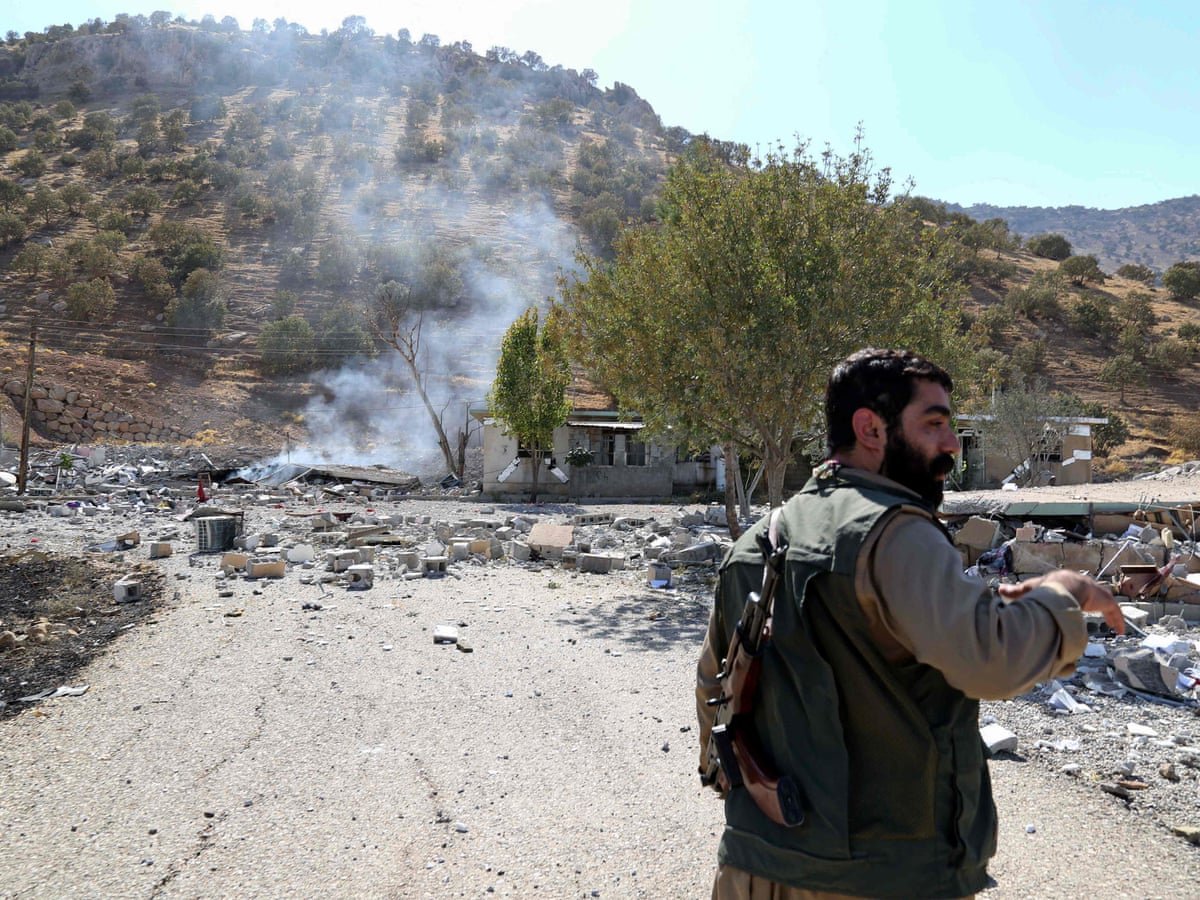
At least nine Iranian Kurdish fighters from the Komala movement were killed today in an Iranian attack in Sulaimani province. The strike caps a violent stretch inside Iran’s majority Kurdish northwest, where at least nine armed incidents were documented in June, killing more than 20 Iranian Kurdish militants. Most of the significant engagements were initiated by the IRGC through ambushes and intelligence-driven operations.
The spike in incidents has coincided with a reported buildup of Iranian forces and special operations units in the same areas where the clashes occurred. On 14 July, Alhurra quoted senior Iranian Kurdish opposition figures describing an Iranian deployment along the frontier of roughly 3,000 Saberin special forces personnel, arriving in waves of approximately 1,000, alongside IRGC Ground Forces units, Aerospace Force elements, artillery, rocket launchers, armour and drones. Ali Khoshnamak, a senior figure in the Komala Revolutionary Organization of the Toilers of Kurdistan, told the channel these were trained and trusted regime forces whose scale and composition indicated preparation for possible ground warfare. The same sources described daily drone reconnaissance over the frontier and approaches to the Kurdistan Region, along with electronic warfare systems for jamming and satellite disruption.
These force figures are opposition intelligence claims, and no outside party has verified the inventory. What Iranian official sources have confirmed independently is the operational reality beneath them: armed Kurdish units moving through the border hinterland, and Iranian forces hunting them with ambushes, patrols and drones. The dispute between the two accounts concerns scale and geography. It no longer concerns whether a low-intensity border war is underway.
Context: The pattern extends back to the earliest days of the year, and its rhythm tracks the wider war almost exactly. On 14 January, Reuters reported, citing three informed sources, that armed Iranian Kurdish groups had attempted to cross from the Kurdistan Region into Iran during Iran’s internal crisis. That report established that infiltration was an operational possibility for Tehran to plan against, whatever its scale.
Through March, the contours of a potential Kurdish front became public. On 6 March, Reuters reported, citing two Iranian Kurdish sources and one Israeli source, that Israel was supporting Iranian Kurdish planning to seize border areas around Oshnavieh and Piranshahr, with thousands of fighters gathering on the Iraqi side and opposition strength estimated between 5,000 and 8,000. The parties wanted air support and political guarantees before committing. They never received them. Turkey, Reuters reported in May, opposed and helped suppress the offensive proposal, fearing it would strengthen PKK-linked networks and derail Ankara’s own process with the PKK. The KRG, for its part, had no interest in becoming the staging ground for a war against its neighbour.
The chronology of the wider war frames everything that followed. The United States initiated the campaign against Iran on 28 February. By early April the attempt to collapse the regime had visibly failed, and a ceasefire took hold, later formalised in a June memorandum of understanding, with Washington betting that talks would extract the compromise that bombing had failed to produce. That bet also failed, and the arrangement collapsed publicly on 8 July. The two months of ceasefire functioned as a preparation period for both sides. For Iran, one of the clearest priorities of that period is now visible on its western frontier.
Analysis: The logic of the Iranian campaign is to make the Kurdish front option completely untenable. Every element of the reported activity serves that single aim: the ambushes that have broken up infiltration teams, the Saberin deployments, the village-level surveillance, the daily drone coverage, and the strikes on party facilities inside the Kurdistan Region, including today’s attack in Sulaimani. The clashes of June and July were mostly initiated by the IRGC itself, and their character, intelligence-driven ambushes against small teams in the border hinterland, indicates a deliberate effort to destroy the cells that managed to infiltrate during the early days of the war, before they could mature into networks. Tehran is using the interval between rounds of the wider war to strip out a capability that was built to be used against it.
Understanding why Iran prices this frontier so highly requires an honest accounting of the war so far, and that accounting is less flattering to American air power than much of the commentary allows. After the April ceasefire, US media reporting, including in the New York Times, indicated that Washington gradually recognised most of Iran’s weapons stocks and production facilities had survived, with estimates that around 70 percent remained intact. Three months have passed since then, and there is no public accounting of how much Iran has produced or dispersed in the interim. Real damage has been done to Iran, and Iran has imposed real damage on the United States and its regional allies in return. The honest summary of the February to April round is that it demonstrated the limits of air power as an instrument of regime change. A ground invasion, the instrument that could in principle go further, is close to unusable: Iran is vast, its topography is punishing, the costs would be enormous, and a president who campaigned on ending forever wars faces congressional elections in November.
This is the strategic position in which the Kurdish card acquires its full value. Without a credible ground threat, American leverage in any negotiation shrinks dramatically. Washington can bomb and blockade, and Tehran has now had a full round of war to measure what that costs and to conclude that it is survivable. The one realistic instrument for putting ground pressure on the Iranian state, short of an American invasion that is politically and militarily prohibitive, is the Iranian Kurdish opposition operating from the Kurdistan Region. That was the concept Israel had been developing for months before February, and it is the concept that surfaced in the March reporting around Oshnavieh and Piranshahr. It failed in its first iteration, through Turkish opposition, KRG refusal and the parties’ own insistence on guarantees that never came. It remained available for a second iteration. Iran’s current campaign is designed to remove it from the board entirely. If Tehran seals this frontier, it strips Washington of its only ground lever, and without a ground lever the capitulation-style agreement Trump has envisioned becomes very hard to reach. The disproportion between the modest strength of the Kurdish parties and the scale of the reported Iranian response makes sense once the frontier is understood as a likely hinge of the American theory of victory.
The comparison with Iran’s other peripheries confirms the point. The Baloch armed networks are sometimes proposed as an alternative instrument. However, Baloch capacity is limited to begin with. Balochistan sits behind a vast desert, disconnected from Iran’s power centres and in practical terms more connected to Pakistan than to the Iranian interior. Pakistan is unlikely to permit its territory to be used for such a campaign, partly because its own Shia population constrains it. The Baloch groups also lack the long relationship with Israel that the Kurdish parties have built, and relationships of that kind take years to establish. The Kurdish areas differ on every one of these dimensions. They are mountainous terrain suited to insurgency, they sit far closer to Tehran and to the centres of Iranian power, and they adjoin the Kurdistan Region, a grey zone where camps, logistics and external contact are possible in ways Pakistan would never allow. The Kurdish front is the only ground option that was ever realistic, which is why Iran treats its closure as a first-order wartime task while devoting far less to the southeast.
With the uprising scenario stalled and the ground options closing, the question becomes what strategy remains available to Washington, and the recent pattern of leaks suggests an answer. The most plausible current American approach is to bank on a split within the Iranian elite. The signs are circumstantial and should be labelled as such: the publicised story around Ahmadinejad and factional manoeuvring, a series of leaks describing disagreements inside the system over the war and negotiations, and Trump’s own public references to divisions in Tehran. Stretching the confrontation out over time serves this approach, since prolonged pressure gives internal disagreements room to widen. In regimes of this type, elite division is the most dangerous failure mode, more dangerous than protest, because it can decompose the security institutions on which everything else rests. The necessary caveat is that the Iranian elite is a black box. Outside observers, and probably most insiders, cannot reliably distinguish genuine fracture from managed disagreement, and any analysis built on leaks is built on material that some actor chose to release.
One recent episode suggests Tehran itself takes the threat seriously. When the Ahmadinejad story became widely publicised, the system produced him at a public meeting the following day, in what functioned as a refutation. The speed and visibility of that response are informative. A leadership indifferent to perceptions of defection would have ignored the story. Instead the regime moved within a day to display cohesion and to signal that the individuals being named in foreign reporting had been neither detached from the system nor recruited against it. Cohesion signalling of this kind has become part of the war itself, which is precisely what one would expect if both sides now regard elite unity as the decisive terrain.
The frontier campaign and the cohesion signalling are two faces of a single Iranian defensive design. Tehran is working to deny Washington each pathway to a decision in sequence: the uprising pathway through internal control, the ground pathway through the sealing of the Kurdish frontier, and the elite-split pathway through the aggressive management of any appearance of division. The American response, on present evidence, is to keep the pressure extended in time and to work on the third pathway, the one Iran can least verifiably close. The indicators worth watching follow directly. On the frontier: the tempo and geography of clashes, and any Iranian ground movement across the border, however limited, which would mark the shift from interdiction to buffer-zone execution. In the politics: Turkey’s position, which has so far been the single most effective barrier to a Kurdish front, and the frequency and sourcing of elite-division leaks, which will show how hard the third pathway is being worked. The war has become a contest over which side runs out of usable options first, and on the Kurdish frontier Iran is spending like a state determined to settle at least one of those questions before the next round begins.


