


The Iranian Kurdish front that reached the border and stopped
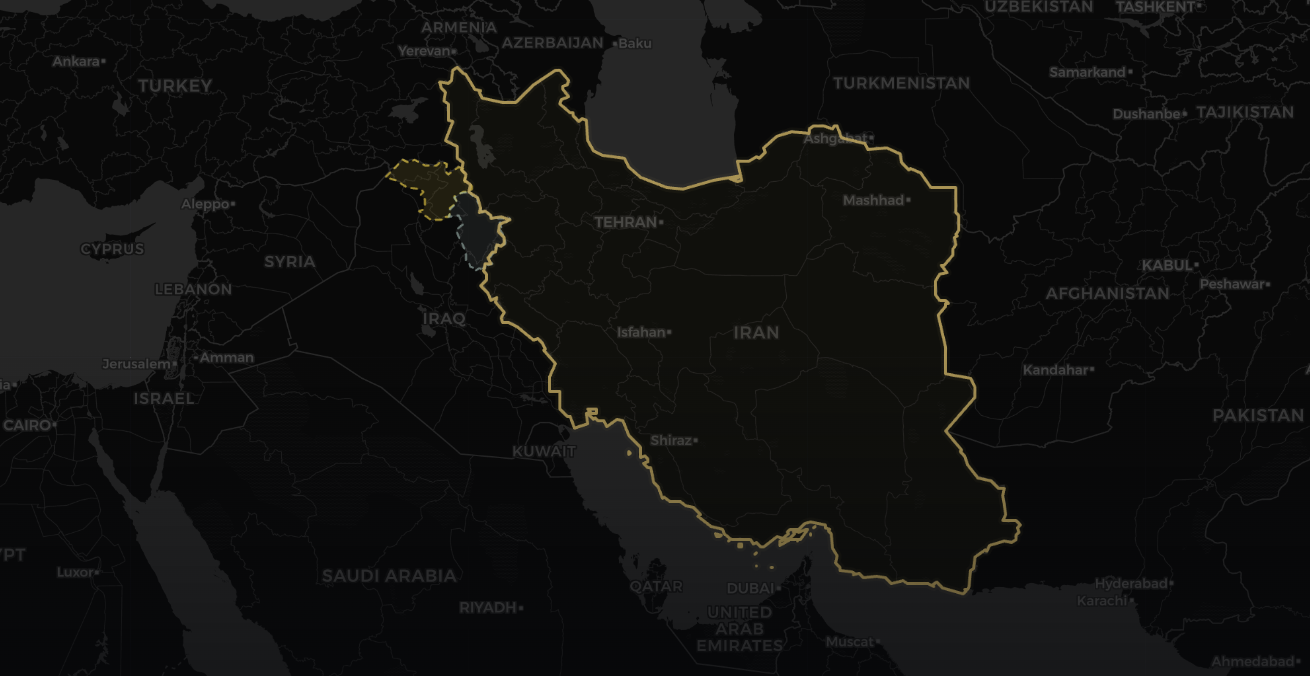
A United States and Israeli plan to open a Kurdish ground front inside Iran moved through months of preparation to forward deployment at Haj Omran in the first week of March. It was halted before the main force crossed. This is what the physical record now shows, and what remains unproven.
In the opening days of the 2026 war on Iran, the United States and Israel prepared to open a second front. The design was a Kurdish ground advance from northern Iraq into the west of Iran, moving under continuous air cover after several days of strikes. By the first week of March the plan had reached forward deployment. Iranian Kurdish factions were assembled near the frontier, advance elements had crossed, a corridor was being bombed clear, and a loyalist KDP Peshmerga force had moved up to the border at Haj Omran.
The main formations did not cross. According to Israeli reporting, the crossing was stopped within hours of execution after President Trump withheld authorisation, following direct pressure from Turkey. The shaping strikes continued; the ground element did not move.
The account here draws on Israeli investigative reporting, field observation from the border, and the public record of the disclosures that surrounded the operation. The plan’s existence is no longer in question. What remains contested is how close it came, who exposed it, and why so much of it appeared in the press before any order to advance.
Context: The ground component sat inside a wider regime-change concept that Mossad director David Barnea presented to Prime Minister Netanyahu and, by video link, to Trump in the White House Situation Room on 11 February. The design assumed that after an intense air campaign degraded Iran’s leadership and internal-security apparatus, Kurdish forces would enter from Iraq, other minority forces would move in parallel, and an opposition rising amplified by Israeli-backed messaging would follow. Air power would protect the advance.
The following day, senior US officials including Vice President JD Vance, Secretary of State Marco Rubio and CIA director John Ratcliffe registered objections, with Ratcliffe reportedly describing the outline as unworkable. Trump decided to proceed on 26 February. Strikes began on 28 February.
On 22 February, five Iranian Kurdish parties announced a unified front, the Coalition of Political Forces of Iranian Kurdistan. A sixth party joined days later. The grouping brought together the Kurdistan Freedom Party (PAK), the Free Life Party of Kurdistan (PJAK), the PDKI, Khabat, and Komala formations. Its purpose was to set a common position, prevent factions being recruited separately, divide sectors of operation, and coordinate with Erbil, Washington and Israel. A joint operations room was still being assembled when the war began, which left the alliance politically agreed but not militarily integrated.
The concept ran in stages: roughly 100 hours of air operations to clear the route, then the ground phase. With strikes beginning on 28 February, that placed the intended crossing in the first days of March. It is the same window in which the Haj Omran mobilisation was observed, on 4 March, and in which the disclosures broke.
Analysis: The most useful way to see how far the operation went is to follow it as a physical sequence, from long-term groundwork to the moment the order did not come.
For months before the war, Iranian Kurdish parties maintained clandestine networks in the west of the country, tracking the movements of the IRGC, police and border guards and running routes across the frontier through smugglers and sympathetic border personnel. Starlink terminals were reportedly moved in before the strikes began, and Kurdish networks supplied targeting information on security installations to Israel and the United States. This meant the operation did not depend on moving every fighter through one crossing on one night. Reconnaissance teams, local contacts and communications were already in place well before February.
The force that would eventually move had three layers. Small clandestine cadres were already inside Iran. The main cross-border element was the Iranian Kurdish factions based in Iraq, lightly equipped and reliant on pickups and mountain routes. Behind them, KDP and KRG Peshmerga would hold the Iraqi rear, securing roads, border villages, supply lines and medical facilities. Estimates put the combined Iranian Kurdish exile forces at roughly 3,000 to 8,000, of which only a portion could have joined a first wave. In the weeks before the war began, hundreds of Iranian Kurdish personnel reportedly moved from camps in Iraq towards the frontier. A Turkish account, later carried by Israeli media, put the figure at around 500; however, a reliable source on the ground told The National Context that the number was closer to 1000 and they were well trained. This is consistent with reconnaissance parties and fighters moving into concealed mountain positions rather than a mass advance. It is a different scale from the later claim that thousands had launched an offensive, which would have produced visible and sustained combat.
When strikes began on 28 February, they concentrated on the institutions Tehran would use to detect an incursion and suppress a rising: IRGC garrisons, Basij bases, police and intelligence buildings, border-guard commands, communications nodes and air-defence positions. A later Reuters reconstruction counted at least 20 early strikes on a dozen local security sites and around 140 strikes across Kurdish-dominated north-western Iran by the end of March. The intended axis ran from Haj Omran on the Iraqi side through Tamarchin to Piranshahr and then to Oshnavieh, a town with a strong Kurdish population near routes towards Urmia. Sources identified these as the initial objectives. Holding that ground would create a border enclave supplied from Iraq, while other factions operated further south around Baneh and Marivan. Israeli reporting indicates the air effort assigned to clearing this specific route fell well short of plan, with one account suggesting only a small fraction of those targets were actually struck.
The clearest physical evidence of how far the operation progressed comes from a field report by a correspondent for The Economist at Haj Omran on 4 March. It recorded armoured columns on the border road, hundreds of Peshmerga arriving in unmarked white buses, fighters dispersing into nearby villages, commanders watching the Iranian side, and a hospital converted into a barracks overnight. The likely tasks were to secure the road and the crossing, screen the rear against infiltration, protect assembly areas and supply routes, and receive casualties. Converting a hospital to a barracks overnight indicates preparation for more than a short patrol. The posture was deliberately dual-use: if the advance proceeded it secured the launch corridor; if cancelled, it could be described as border defence.
Foreign journalists were also brought forward. Israeli reporting states that journalists interviewed commanders and fighters who had joined the intended invasion formation, and at least one embedded contact was told the crossing would come within days. Footage of the crossing, captured border posts, defections and civilians receiving the fighters was intended to generate momentum and signal to the wider Iranian population that the state was losing control. The press element was part of the plan.
Iran was not strategically surprised by any of this. It restricted crossings, reinforced Kurdish areas, dispersed security personnel into civilian buildings, moved IRGC units to the frontier and threatened the KRG directly. Iranian intelligence reportedly detected the mobilisation and passed it to Turkish intelligence. The sheer size of the effort, six factions, hundreds of fighters, buses, journalists and local recruits, produced a signature that could not be concealed.
In the same window, the operation surfaced in the press in rapid succession. Axios reported Trump’s calls to Kurdish leaders. Further reporting described a CIA effort to arm Kurdish forces, fighters moving to the border and awaiting orders, and promised American air cover. Fox then reported, incorrectly, that large numbers had already crossed. That last report changed the political situation by converting covert preparation into a claimed cross-border attack launched from Iraqi soil, which forced every actor to respond publicly. Turkey already held intelligence on the buildup independently of the media disclosures. Foreign minister Hakan Fidan spoke with Nechirvan Barzani on 3 March and with Masrour Barzani on 4 March, with both Kurdish leaders publicly stressing stability. Turkey warned the Barzani and Talabani networks against participation, and Erdogan then raised the operation directly with Trump, arguing that a Kurdish advance threatened Turkish security and risked a wider conflict.
At the point the veto came, the corridor was under fire, the factions were assembled near the frontier, advance elements were inside Iran, and the Peshmerga held the Iraqi rear. The formations were waiting on air-cover guarantees and the order to move. According to Israeli reporting, the crossing was stopped within hours of execution. Trump withheld authorisation, the full air-support package was not provided, and the main force did not cross. The Peshmerga withdrew from forward positions, the Iranian Kurdish units dispersed into camps and mountain positions, and the KRG described its deployment as a measure against infiltration. Iran and aligned militias then intensified strikes on Iranian Kurdish bases inside Iraq, and the fighters shifted from preparing an offensive to surviving drone and missile attacks.
A conventional special operation would not have produced this volume of disclosure before a single main-force soldier crossed. The pattern points to a contest inside Washington, and possibly inside Erbil, fought partly through leaks. Some disclosures plausibly came from officials seeking to stop the operation by triggering the Turkish, Iraqi and Iranian reactions that exposure would bring. Others may have come from supporters trying to make the operation irreversible, calculating that reports of fighters already inside Iran would pressure Washington to provide air cover rather than abandon them. The identity of Fox’s source has not been disclosed, so intent cannot be established, but the false report of a crossing arrived at the most politically vulnerable moment and removed any remaining deniability.
Israeli intelligence sources, carried first in Maariv and then elsewhere, alleged that White House officials, with several pointing specifically to Vance, passed the plan to Erdogan so that he could reach Trump before the operation launched. Vance’s press secretary, Luke Schroeder, called the report categorically false. Three claims here need to be separated. That Vance opposed the plan is well supported. That a leak helped Turkey intervene in time is supported by Israeli retrospective reporting. That Vance personally passed the plan to Erdogan is alleged and unproven, and in any case Erdogan did not need him: Iranian intelligence had already detected the buildup and shared it with Ankara, and Turkey had its own direct channels to the Barzani and Talabani leaderships.
The deployment of a loyalist KDP force during Masrour Barzani’s premiership, set against Nechirvan Barzani’s diplomatic emphasis on stability, has prompted suggestions of a split between the two. Nechirvan spoke with Fidan on 3 March, before the Fox report, which indicates that Turkey and Erbil were already managing the situation rather than being alerted by it. A division within the KDP leadership is plausible but on this issue appear unlikely. What can be said is that part of the KDP apparatus moved forces forward while the presidency pressed publicly for restraint.
The physical record supports a clear conclusion. Networks and advance elements were inside Iran, the factions were assembled, the corridor was being bombed, a loyalist Peshmerga force held the Iraqi rear, a hospital had been militarised, and journalists were positioned to document a crossing. The most accurate description of where the operation stood is forward-deployed and supported, with shaping strikes underway and advance elements across, but awaiting guaranteed air cover and a political order that did not come. Beyond that point the record thins. The claim that the crossing was halted within hours rests mainly on Israeli reporting and the account of an embedded journalist. The central role of Turkish pressure is well supported. The proposition that a leak was intended to kill the operation is reasonable but unproven, and the specific charge against Vance is denied and unestablished. Fox’s report can be read as error or as deliberate pressure, and on the available evidence neither can be ruled out. What is no longer in doubt is that a developed operation existed, that it reached the border, and that it was stopped at the threshold by a decision in Washington.


