


Iraq Picked an Outsider to Tame Its Militias. He May End Up Strengthening the System That Created Them.
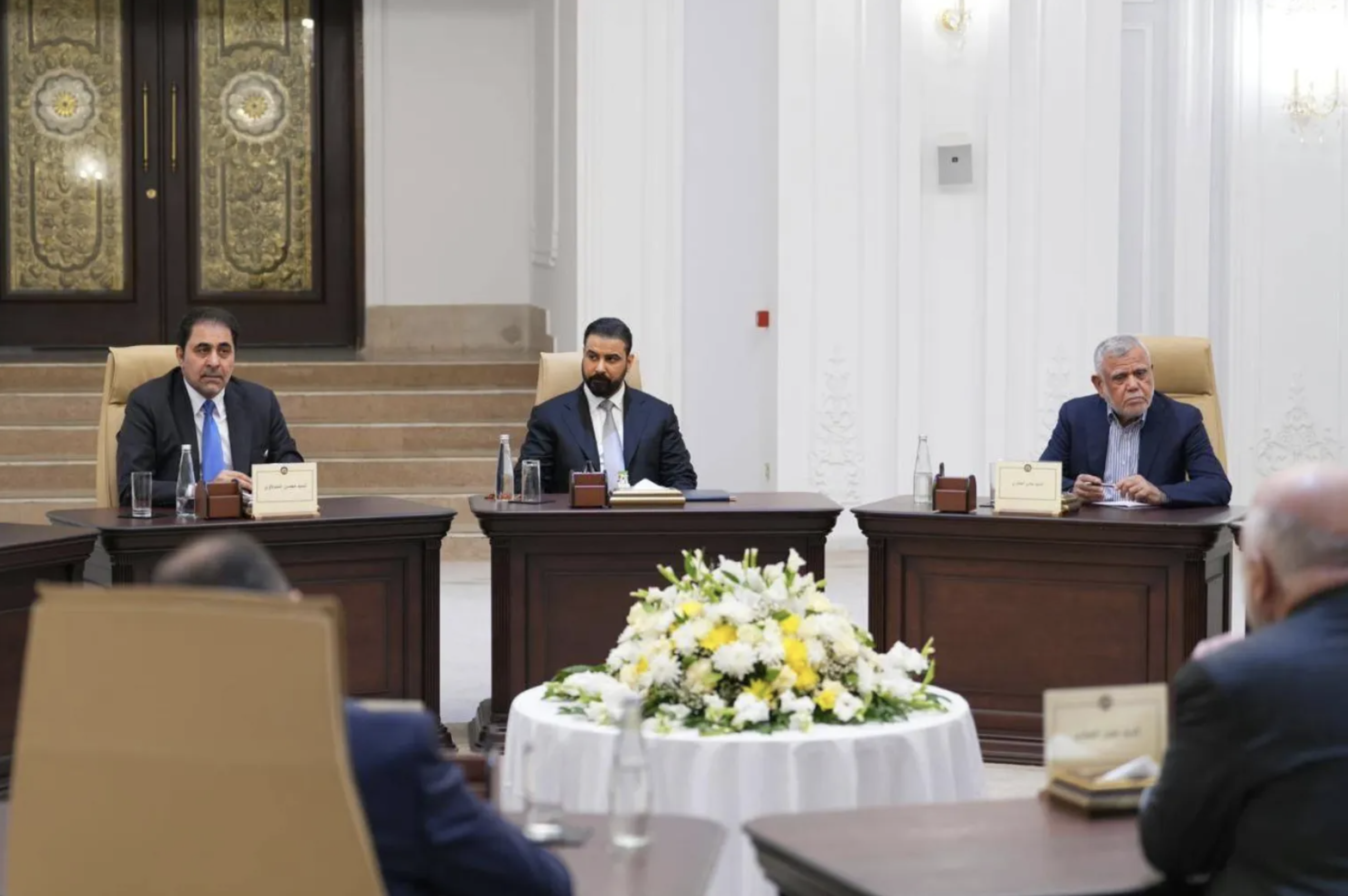
A sweeping reshuffle of Iraq’s security, financial and border institutions, paired with the slow and partial integration of the Shia armed factions, is rearranging the Coordination Framework’s order from within. The prime minister’s lack of a political base of his own may be precisely what makes it possible.
Ali al-Zaidi has spent his first weeks in office replacing the people who run Iraq’s security and financial institutions. The head of the National Security Service, Abdul Karim al-Basri, better known as Abu Ali al-Basri, was removed in favour of Basim al-Badri, with Zaidi overseeing the handover himself. The national security adviser, Qasim al-Araji, was replaced by Qasim al-Aboudi. Nizar Nasser, who previously ran Iraq’s anti-money-laundering office, took charge of the Central Bank and began work on 22 June, and Adel al-Yasiri replaced Haider Makiya at the National Investment Commission. Further changes have been reported at senior security and provincial posts. All of it has come without a complete government: parliament has confirmed only 14 of 23 ministers, and the two portfolios most central to any reckoning with the armed groups, Interior and Defence, are still unfilled.
The personnel changes sit alongside a broader push. The government issued five directives reorganising the border crossings, closing unofficial routes and widening the role of the intelligence services there, and the Border Crossings Authority rotated 1,905 of its officers and staff within 48 hours. Zaidi cancelled two large projects inherited from Mohammed Shia al-Sudani, a $764 million development at Baghdad airport and a railway scheme. His anti-corruption drive, run through a new Supreme Sovereign Council for Integrity that he chairs, has produced the most prominent arrests of his tenure, beginning with the deputy oil minister for refining affairs, Adnan al-Jumaili, in a case in which the judiciary says it has recovered more than $85 million, some of it cash buried underground. On the armed factions, Muqtada al-Sadr announced the separation of Saraya al-Salam from his movement, Asaib Ahl al-Haq followed with its own disengagement, and Kataib Imam Ali after it, each transferring personnel lists and weapons records to government committees. The two factions widely seen as closest to Iran, Kataib Hezbollah and Harakat al-Nujaba, have refused, describing their weapons as non-negotiable, and the process has stalled at that point.
Around these moves sits a clear external pressure. Iraq was placed on the Financial Action Task Force grey list on 19 June. The US envoy Tom Barrack visited Baghdad and tied Washington’s disarmament demands to a large economic and investment package, and Zaidi is expected at the White House in mid-July. The changes touch money, intelligence, the borders and the senior security command at once and within weeks of one another, which is what marks them out from ordinary rotation.
Context: Zaidi arrived in office as an unusual figure. He is a businessman from Shatra, in Dhi Qar, with no party, no parliamentary bloc and no prior government post, and his rise ran through the economy that finances Iraq’s ruling coalition rather than through its politics. The Coordination Framework settled on him after Washington vetoed a return for Nouri al-Maliki and turned against a second term for Sudani. He was acceptable to its members precisely because he is tied to none of them and cannot dominate any of them. He came in on conditions: distance from Tehran, and, by the terms of his selection, no party of his own and no run at the next election. The Framework now works around him much like a council, meeting regularly and briefed on the major decisions, which means he governs with the bloc rather than over it.
The figures leaving and arriving tell their own story. Abu Ali al-Basri managed Iraq’s most sensitive intelligence and counterterrorism files for years and was regarded as close to the Badr Organisation under Hadi al-Amiri and to Kataib Hezbollah under Ahmad al-Hamidawi; he was a pillar of the old accommodation between the state and the factions. Araji had long served as a broker among the state, the Iran-aligned groups, Washington and the regional capitals. Their replacements come from elsewhere in the same establishment. Aboudi has a judicial and electoral-administration background and is drawn from the institutional world around Zaidan. Badri is publicly associated with Maliki and the Dawa party but is reported to be closer in practice to Zaidan. Nasser is the compliance figure acceptable to American regulators, his value lying in the link between Baghdad and the international financial system. None of them is an outsider to the system; they are its existing personnel, moved into new places.
The American conditions that frame all this are specific. Washington is reported to have set five: restricting where Popular Mobilisation fighters deploy and returning positions to the army, transferring heavy weapons and drones to the army, curbing the economic reach of the PMF-owned Al-Muhandis Company, keeping the armed groups out of security appointments, and legislating against weapons outside state control. The same pressure produced the claimed exclusion of six armed factions, Kataib Hezbollah, Nujaba, Kataib Sayyid al-Shuhada, Asaib, Ansar Allah al-Awfiya and Kataib Imam Ali, from the first round of cabinet appointments, despite their holding roughly 80 of the Framework’s seats. Behind the demands lie real instruments: control over dollar transfers, technical support for Iraq’s F-16 fleet, and the financial isolation the grey-list designation threatens.
Analysis: The first thing to notice is that nobody has been brought in from outside. Every official moved out and every official moved in belongs to the same establishment, and the new appointees orient toward a coordinating centre in the judiciary and the premiership rather than toward the factions. That is why this reads as a reordering of the Shia political order and not a challenge to it. The pieces are being rearranged on the board rather than swept off it, and the question worth asking is whether the order ends up weaker when the rearrangement settles, or simply better organised.
The answer turns on a paradox in Zaidi’s position. The Coordination Framework is divided, with no single actor strong enough to impose itself, which is usually read as a recipe for paralysis. In a body where each member can block the others, though, the practical choice narrows to two outcomes: the factions agree on broad terms and let the prime minister act, or nothing moves at all. A premier without a bloc suits that logic rather than working against it. Because Zaidi owes his seat to none of the factions, none of them can capture him, and because he is not protecting a vote, he can set them against one another and take the painful economic decisions that a premier with the next election in mind would avoid. That last point carries more weight than it first appears. The bloc had been deadlocked in part because the measures the financial crisis demanded were exactly the kind no re-election-minded prime minister would adopt, and a government that cannot act is the surest path to the collapse in which the factions, as the main beneficiaries of the state, would be the first to lose. Zaidi resolves part of that problem. He can absorb the political cost of reforms the parties want carried out but cannot afford to be seen carrying out themselves, while they keep the option of sheltering behind him when those reforms bite. The feature read as his weakness, the absence of a base, is therefore also what makes him useful to the bloc as a whole: a manager able to discipline its members and do its unpopular work without threatening to replace any of them.
The same logic runs through the handling of the armed factions, and it points in a direction the language of disarmament obscures. The mechanism on offer is absorption rather than dissolution: formations, fighters and weapons records folded into state institutions, salaries drawn from the treasury, legal standing as part of the security forces. A faction that enters the state on those terms does not disappear; its presence inside the official apparatus grows. Taken across the bloc, integration concentrates rather than scatters. The Shia armed-political class gives up a measure of independent military latitude and receives in return a larger and legally protected footprint within the state, so that its collective weight increases even as the autonomy of any single group is trimmed.
That process has also stopped where it would matter most. Kataib Hezbollah and Harakat al-Nujaba have refused to hand over anything, and their file runs more directly to Tehran than to Baghdad. The factions willing to move are the adaptable ones; the irreconcilable ones have stayed put. A disarmament that proceeds with the flexible groups and halts at the hardline core is, on its face, an exercise in reorganising the relationship between the state and the factions rather than ending it.
Even a fuller integration would leave Iran with a more direct instrument. Reuters has reported that the Revolutionary Guards built three or four small cells of around 10 fighters each, operating outside the militia structure and answering directly to the IRGC, and has linked them to a series of drone attacks on Kuwait, Saudi Arabia and the United Arab Emirates between April and May. These cells stand to gain indirect cover from the very integration now under way, because a security state in which the absorbed militias carry more weight is a more permissive environment for deniable assets. The large factions can become respectable components of the state while the most sensitive operations move to networks no committee will ever inventory, and a strengthened Shia security presence shelters them further.
The anti-corruption drive shows the same selectivity, and it is the clearest test of what the reordering is for. Its most prominent targets so far have been Sunni figures. Adnan al-Jumaili, the deputy oil minister whose arrest opened the campaign, was detained in Salaheddin, the Sunni-majority province where he had run the North Refineries Company, and his interrogation led to the arrest of a former Salaheddin governor, Raed al-Jubouri, now the province’s health director, and of Alaa al-Jubouri, the head of a regional electricity company. Corruption on this scale is real, and the point is not that these men are innocent; the discretion lies in which files are opened and which are left to rest. The Communications Minister has publicly accused Jumaili of financing political parties and selling posts inside the Oil Ministry, and the inquiry is reported to be examining whether the scheme operated on behalf of a wider network and under the protection of more powerful figures. Those figures have not been named or touched, and the Shia networks that dominate the country’s principal financial and contracting channels have not so far faced comparable prosecution. The former speaker Mohammed al-Halbousi’s bid to take control of the National Intelligence Service was blocked, separately, by a rare alignment of otherwise hostile Shia actors. If enforcement keeps falling on the Sunni side while the protectors above the Jumaili case remain in place, corruption becomes another instrument of the same rearrangement, and the open question is whether Zaidi will ever turn it on the networks closest to the coalition that installed him.
Set in sequence, the moves trace a single trajectory, even though no one actor controls all of it. Zaidi was chosen to carry the ruling coalition through American pressure and its own post-election deadlock, acceptable because he could dominate none of its members. In office, he has turned that same pressure back against parts of the coalition, and the pressure doubles as cover: a step that would otherwise look like one Shia faction weakening another can be presented as an unavoidable demand from Washington and the international financial system. He is now assembling an executive, security and financial centre around himself and Faiq Zaidan, staffed by people drawn from inside the establishment. The integration of the armed factions, if it proceeds as designed, converts their military power into power lodged within the state. And the selective use of prosecution weakens competing Sunni centres while the networks protected by the major Shia parties remain in place. Each step points the same way. The factions give up some independent latitude, and the Shia order, taken together, ends up more organised and more firmly in command of the state.
What will distinguish durable consolidation from a change of labels is observable over the coming weeks. The clearest markers are who finally receives Interior, Defence and the chairmanship of the Popular Mobilisation Commission, where an Asaib-aligned successor to Faleh al-Fayyadh, whose position is reported to be under review, would signal redistribution among the factions rather than control by the centre; whether the heavy weapons come under a single, verifiable chain of authorisation; whether the National Security Service can identify and prosecute the operatives Iran runs outside the formal structures; and whether the anti-corruption drive ever reaches the financial networks of the major Shia parties rather than only Sunni ones. Zaidi also has little margin for error, since he is being asked to remake the security system while the public finances are under strain and Muqtada al-Sadr retains the ability to put people on the street if the government produces nothing. The man chosen for what he lacks may yet be the one who reorganises the order that chose him, and to its collective advantage.


