


For Iraq, Hormuz Is a Boomerang
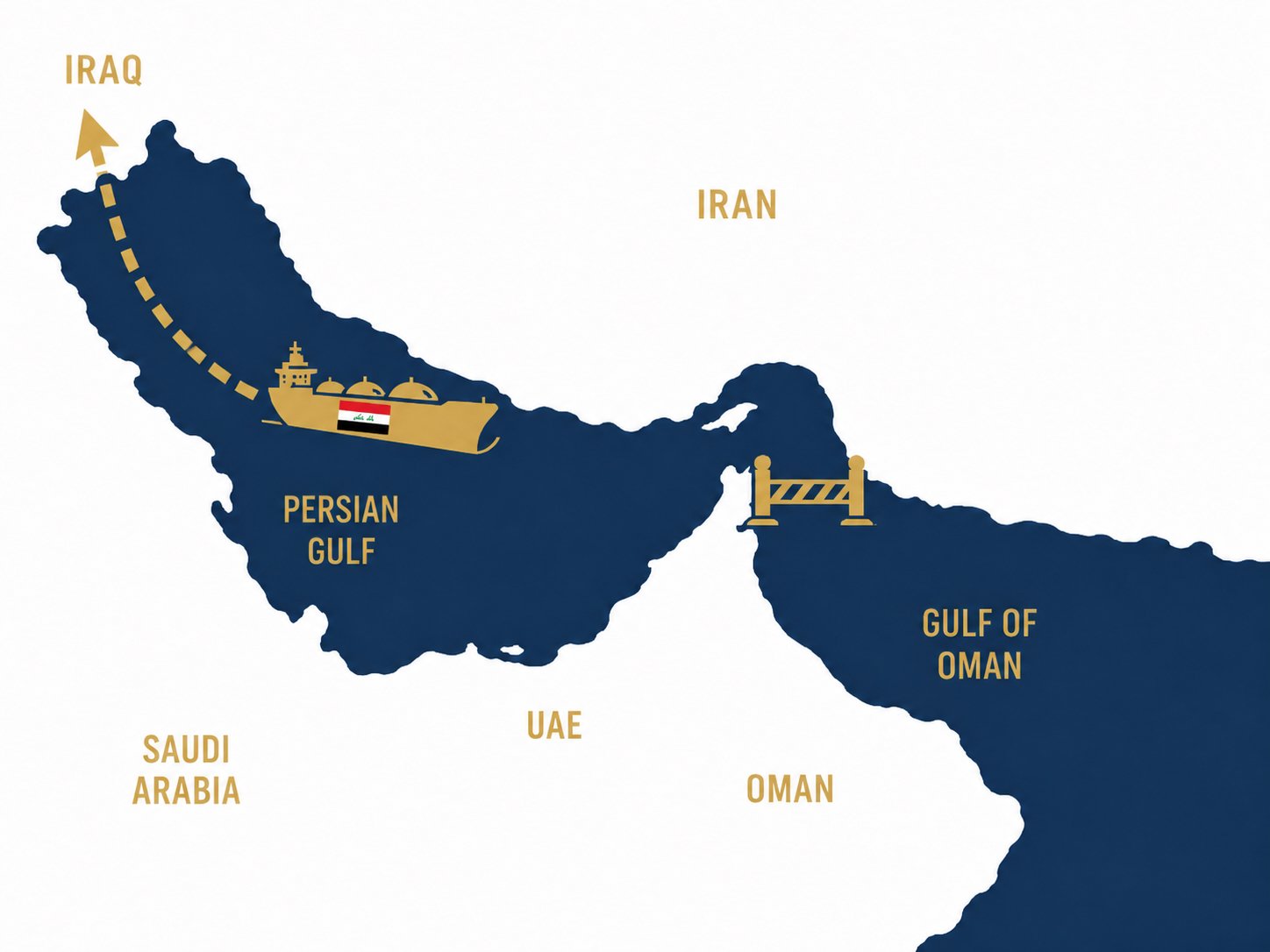
Iraq’s oil output dropped from approximately 4.3 million barrels per day before February’s Hormuz closure to around 1.3 to 1.4 million barrels, almost entirely for domestic consumption, with exports through the southern Basra terminals falling to near zero. Basra province alone, where almost all of Iraq’s crude is produced, saw output at the Zubair field fall from around 400,000 barrels per day to roughly 250,000. The northern Kirkuk-Ceyhan route, which Iraq scrambled to reopen in March, is moving around 220,000 barrels per day, against a pre-crisis export average of 3.45 million. Iraq’s cabinet approved plans this week to push that figure toward 770,000 barrels per day, a goal that depends on infrastructure that is still being rehabilitated and on a pipeline treaty with Turkey that expires on 27 July.
The fiscal consequence is direct. Oil accounts for around 91 percent of Iraq’s federal revenue, a figure that has barely shifted across years of stated reform commitments. Iraq’s Foreign Minister Fuad Hussein warned in late May that the government may be unable to pay public salaries the following month. He confirmed that roughly 25 trillion dinars had already been printed to cover the shortfall, raising currency in circulation to around 125 trillion dinars. The salary, pension, and welfare obligations the state carries run to more than 16 billion dollars every three months. The oil revenues those months generated were a fraction of that.
Context: Iran’s decision to close the Strait of Hormuz was designed as a pressure instrument against Washington and its partners, and the costs of that decision have fallen with structural precision on Baghdad. The closure gives Tehran leverage over the world’s oil markets; it gives Turkey, Syria, and the United States leverage over Iraq. That inversion is the strategic core of what is happening, and it threatens to unravel the influence Iran has spent two decades cultivating inside its most important Arab ally.
The salary machine is the social contract. It is the mechanism through which the post-2003 political settlement distributes enough material benefit to hold together communities whose other ties to Baghdad are thin. Sunni areas reconciled themselves to a Shia-led federal government after the defeat of the Islamic State in significant part because the salary transfers kept coming. The Kurdistan Region’s relationship with Baghdad, persistently strained over oil revenues, budget shares, and territory, has held together and remained a working federal relationship for the same reason. When the foreign minister says salaries may not be paid, he is describing a potential unravelling of the terms under which Iraq coheres.
The structural exposure runs deeper than a single closure. Iraq is a rentier state that never diversified its revenue base and never built a tax system capable of sustaining the state independently of oil. The Shia-led order that emerged after 2003 layered militia-linked commercial networks, political patronage chains, and state capture over that foundation. The arrangement functions tolerably when oil revenues are abundant and becomes acutely dangerous when they collapse, because the same networks that extracted from the state in good times continue extracting in bad ones, while the fiscal machine is no longer large enough to absorb the cost.
Analysis: The Hormuz closure is a boomerang because it activated four distinct structural pressures against Iraq simultaneously, each serious in isolation and compounding when combined.
The first is the pipeline deadline with Turkey. The existing Iraq-Turkey pipeline agreement expires on 27 July. Baghdad’s goal in these negotiations was shaped by its 2023 Paris arbitration victory: close the loopholes through which the Kurdistan Regional Government had historically asserted independent export rights and ensure every barrel moves through SOMO, the federal marketing organisation. The Hormuz closure has fundamentally altered that negotiating geometry. Turkey now controls the only functioning export corridor at any meaningful scale. Baghdad is currently running around 220,000 barrels per day through Ceyhan against a pre-crisis average of 3.45 million, and its own cabinet target of 770,000 barrels per day depends on infrastructure whose rehabilitation is still incomplete. Turkey has already signalled dissatisfaction with the existing terms and cited Iraq’s consistent failure to deliver the minimum volumes the 1973 agreement required. An agreement reached under this pressure will reflect Ankara’s position. The KRG, watching from the side, understands that Turkey’s renewed centrality partially restores the structural leverage Erbil lost in 2023.
The second pressure runs in a different direction entirely. Baghdad’s emergency oil trucking through Syrian territory and the corridor toward Baniyas are generating hard currency flows and transit revenues into Damascus. For Ahmad al-Sharaa’s government, which is trying simultaneously to consolidate authority over a fragmented country, rebuild basic state functions, and establish international credibility, those flows carry real weight. Iraqi oil money passing through Syria is materially strengthening the government that replaced the Assad-era order on which the Iran-aligned bloc in Baghdad depended for its regional depth. Baghdad is, in effect, being pushed by Iranian policy to provide material support to a government Iran regards as an adversary.
The third pressure is American leverage, and this is where the boomerang logic becomes sharpest. Iraq’s oil revenues flow through accounts linked to the US Federal Reserve system, and Washington has already demonstrated its willingness to use that channel as a coercive instrument: during the current crisis it halted a roughly $500 million cash shipment to Baghdad and suspended parts of security cooperation to pressure Iraq over militia activity. Under normal fiscal conditions, Baghdad could absorb that kind of pressure, weighing the political cost of compliance against the cost of confrontation. The Hormuz closure has removed that margin entirely. With oil revenues collapsed, the dinar under pressure, import prices rising, and salaries at risk, any further squeeze on dollar access or any hint of sanctions carries consequences Baghdad cannot manage. The Trump administration’s campaign to force Baghdad to dismantle the PMF’s operational and commercial networks predates the Hormuz closure, but the fiscal crisis has given Washington far more coercive leverage than it held before February. The central irony is precise: Hormuz was Iran’s weapon against the United States, and it has handed the US a more powerful lever over Iran’s most important Arab client than Washington had before the war began.
The fourth pressure is internal, and it explains why the other three cannot be absorbed through elite bargaining as previous Iraqi crises have been. The PMF is a set of fluid, overlapping networks linked to state power across security, political, and commercial arenas, each with its own leadership, revenue streams, and political patrons. In normal times, these networks function as Iran’s strategic assets inside the Iraqi state. The fiscal crisis is converting them into liabilities: factions that once extended Iranian influence are now extracting from the same fiscal machine their own order depends on, accelerating its collapse. Each faction can attribute the crisis entirely to external forces: the war, American pressure, Turkish opportunism, KRG obstruction. Because responsibility is this diffuse, no single actor feels the full weight of what all of them are doing collectively. The governing logic is a rational calculation under mutual distrust: if I do not capture this rent now, another faction will, and if the system deteriorates further, at least I will have extracted my share. Each faction can profit from the emergency while together they drain the fiscal machine that provides their salaries, contracts, legal cover, and political legitimacy.
The summer adds a compounding variable. Iraq’s electricity infrastructure has never performed adequately in peak heat, with temperatures in the south regularly exceeding 50 degrees Celsius. Iran turned Hormuz into a weapon, but Iraq is the hostage closest to the blast radius, and a population facing delayed salaries, a weakening dinar, rising import prices, and failed power grids in July heat will not be looking to Washington for someone to blame. A government managing fiscal emergency, militia resistance, an expiring pipeline treaty, and sustained American pressure simultaneously is poorly positioned to absorb a summer on the streets. The Tishreen uprising of 2019 started from a smaller provocation than this.
The Hormuz closure was Iran’s response to an existential military confrontation, and the structure of Iraqi dependency translated that decision into four simultaneous pressures against a state that had no capacity to absorb any of them. The political consequence inside Iraq is already visible in how the crisis is being read on the street: many Iraqis are asking why a country that has paid the price of political alignment with Tehran is now being economically devastated by Tehran’s own escalation. That question, spreading through a population facing delayed salaries, rising prices, and a summer without electricity, is the most damaging thing the Hormuz closure has produced for Iranian influence in Iraq, and it was entirely self-inflicted.


