


The Pipeline Card: Why the KRG’s Strongest Lever May Be Its Most Dangerous
Iraq’s oil minister said today that Kirkuk crude would be re-exported within a week through the old federal Kirkuk-Ceyhan pipeline “without passing through the Kurdistan Region,” after the KRG refused to allow Baghdad to use its pipeline without conditions. The move escalates a dispute that is no longer just about barrels. With Iraq’s southern exports shut down by the closure of the Strait of Hormuz, Baghdad is under severe economic pressure, and the KRG’s conditions have triggered a political backlash that now threatens to pull the two governments into a broader confrontation over sovereignty, borders, and federal control.
Context: Iraq has been forced to halt the export of 3.4 million barrels per day from its southern ports and cut production to around 1.4 million bpd for domestic consumption. The oil minister said there are currently no quantities of crude oil or petroleum products available for export. Baghdad’s plan is to push 300,000 bpd of Kirkuk crude and another 200,000 bpd from KRG-area fields through the Kurdistan Region’s pipeline to Turkey, for a total of 500,000 bpd. The KRG has blocked this. Baghdad says the KRG pipeline can carry up to 900,000 bpd and that the continued suspension has caused major financial losses. As a temporary alternative, Baghdad is planning to truck Basra crude from the Zubair 1 depot by tanker to the Syrian ports of Baniyas and Tartus and to Jordan’s port of Aqaba, with total trucked exports expected to reach around 150,000 bpd. The gap between what Iraq has lost and what it can currently move tells the story: 3.4 million bpd shut off, 150,000 bpd by road as the best Baghdad can plan for in the short term, and 500,000 bpd through the KRG pipeline still blocked by conditions.
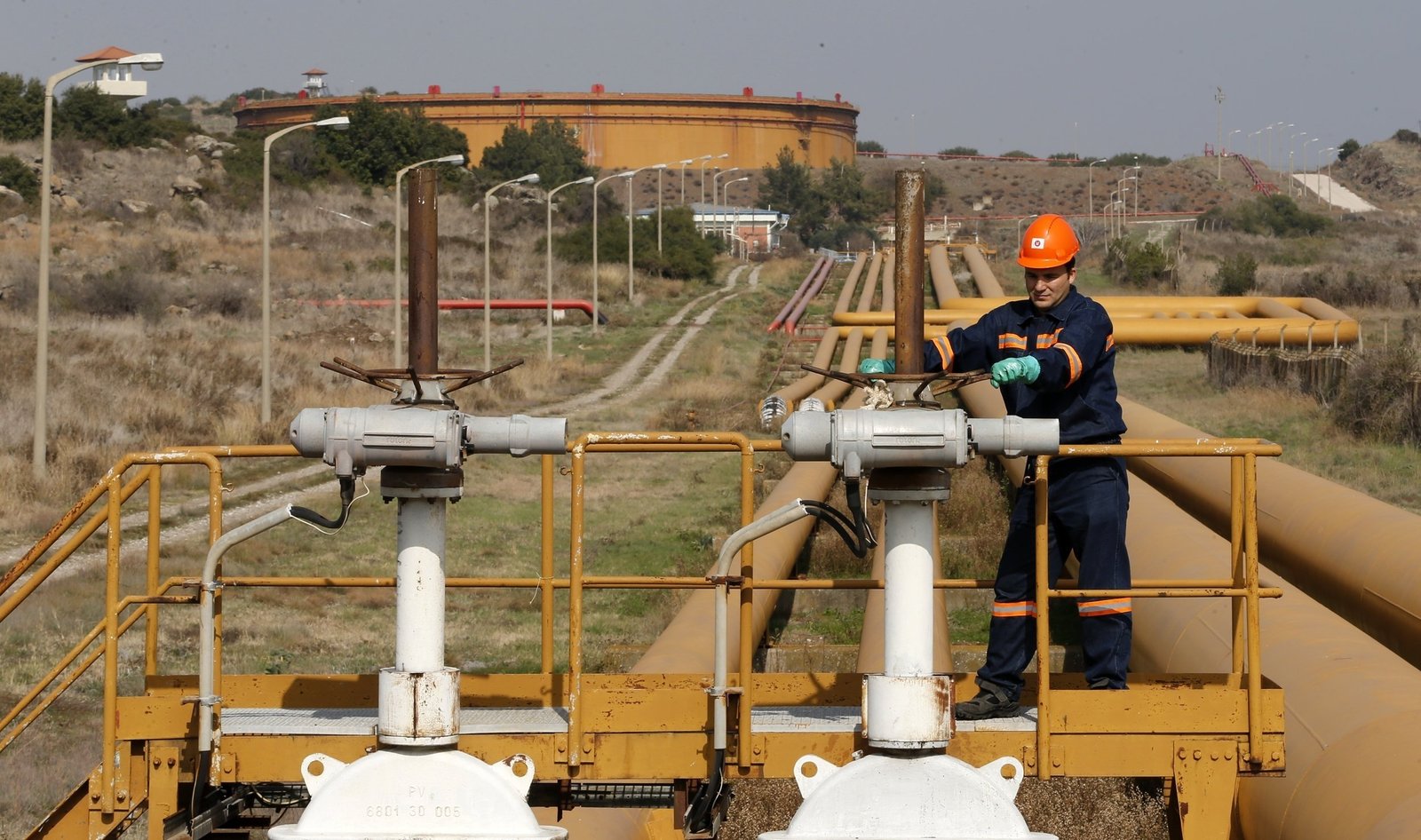
The line Baghdad now wants to revive is the old federal pipeline, which runs from the K1 oilfield in Kirkuk through Salahaddin and Nineveh provinces to the Fishkhabur border crossing into Turkey. It consists of two lines, one 40 inches and the other 46 inches in diameter, with a combined design capacity of 1.6 million bpd. The pipeline was badly damaged during the ISIS war in 2014 but is now roughly 80 percent rehabilitated. The oil minister said only a 100-kilometre section remains to be inspected, and that once complete the line could carry 200,000 to 250,000 bpd of Kirkuk crude. Rehabilitation efforts have been under way since at least April 2024.
The route’s history explains why the KRG pipeline became the default. On June 17, 2014, Ashti Hawrami, then the KRG’s minister of natural resources, announced that the Kirkuk oilfields had been connected to the Region’s new export pipeline. ISIS had advanced, the Iraqi army had withdrawn, and Peshmerga forces had filled the vacuum. Kirkuk crude began flowing to Ceyhan through KRG infrastructure. Baghdad opposed the move, and on July 11, 2014, Iraq’s oil minister accused the Peshmerga of seizing two of Kirkuk’s main oilfields. Despite that, Kirkuk oil continued to move through the KRG pipeline at around 90,000 bpd until KRG exports were suspended following the 2023 Paris arbitration ruling, which accepted Iraq’s argument that Turkey had violated the 1973 pipeline agreement by allowing Kurdish exports without Baghdad’s consent.
Analysis: The conditions the KRG has attached go well beyond oil. The Oil Ministry accused Erbil of imposing demands “unrelated to the issue of oil,” including suspending implementation of the ASYCUDA customs system and lifting what the KRG describes as a dollar embargo on the Region’s traders. On ASYCUDA, the KRG has said it is willing to adopt the system but only under KRG Finance Ministry oversight rather than federal control, and with a nine-month grace period rather than immediate rollout. KRG Prime Minister Masrour Barzani sent a proposal to Sudani on March 6, offering to implement the system in exchange for lifting the “embargo” and removing internal checkpoints between the Region and federal Iraq. Sudani has not agreed, insisting that ASYCUDA must be under federal control. On the dollar question, the KRG says Baghdad has since January prevented dollars from reaching the Region’s traders through the new customs framework, effectively halting commercial activity. Trade with Turkey, the KRG’s biggest trading partner, has collapsed from around 3,000 trucks crossing the border daily to roughly 300.
However, the anger in Baghdad is not confined to the Oil Ministry. Sudani’s Reconstruction and Development Coalition called the KRG’s position “irresponsible” and “intended to cause confusion.” Asaib Ahl al-Haq and Taqaddum, two key Sunni and Shia factions, have both rejected Erbil’s conditions. Public opinion in Baghdad frames the KRG as exploiting Iraq’s vulnerability during a national emergency. The political space for compromise is narrowing on the federal side.
The KRG sees it differently. KRG officials argue that Baghdad has repeatedly used shifts in the geopolitical environment to weaken the Region, and that the ASYCUDA rollout and the dollar restrictions are the latest example. In Erbil’s framing, centralising customs revenue collection is not a technical reform but an attempt to dismantle the economic pillars of the KRG’s federalism project. The prepaid customs model Baghdad has proposed would route duties through federal bank accounts, effectively pulling revenue out of Erbil’s system and reducing KRG border crossings to inspection points. For the KRG, the oil crisis is the one moment when it has enough leverage to demand that these structural issues be addressed rather than deferred.
The oil minister’s statement that Kirkuk crude can move “without passing through the Kurdistan Region” is technically true for most of the route. The old federal line runs through Salahaddin and Nineveh, not through Erbil, Sulaimani, or the main KRG-administered areas. But in its final stretch the pipeline has to reach Fishkhabur, the border crossing into Turkey, which is administratively part of Duhok province in the Kurdistan Region. It is at Fishkhabur that the federal pipeline and the KRG pipeline converge before crossing into Turkish territory.
Legally, Baghdad has the stronger case. The Iraq-Turkey pipeline framework is a sovereign state-to-state arrangement predating the KRG pipeline entirely. Iraq’s constitution gives the federal government exclusive authority over treaties, sovereign economic policy, and border security. The Federal Supreme Court’s 2022 ruling declared the KRG oil and gas law unconstitutional, and the 2023 Paris arbitration reinforced Baghdad’s position. The KRG does not appear to have a clean legal veto over the use of a federal treaty pipeline. There is, however, a ticking clock on that legal basis: Turkey has terminated the 1973 pipeline agreement effective July 27, 2026, giving Baghdad roughly four months before the treaty architecture its entire case rests on ceases to exist. That deadline adds urgency to the northern export diversification toward Baniyas and is itself another reason Baghdad cannot afford a prolonged standoff with Erbil.
But legal standing is not operational control. The constitution also gives regional governments responsibility over internal security. If the final kilometres, access roads, valve infrastructure, or border interface sit in KRG-administered territory, Erbil can withhold security coordination, deny access for crews, and block tie-in operations until there is an understanding. That is a de facto choke point, not a legal veto, and it is this practical leverage that gives the KRG its bargaining position. However, over-investing in this card could backfire. What begins as leverage over one pipeline segment risks reviving the broader federal campaign over borders, customs, and sovereignty that followed 2017.
That backlash is already spreading beyond oil. On March 15, Adnan Fayhan al-Dulaimi, the first deputy speaker of parliament, called for Iraq’s Development Road, an $18 billion flagship infrastructure project, to be redesigned away from Erbil’s influence. He described the KRG’s decision to block oil exports via Ceyhan pending conditions as “a dangerous precedent” and argued that Baghdad should not be left vulnerable to future political or economic blackmail on any strategic project that passes through the Kurdistan Region.
The political backlash is one response. The infrastructure planning is another. The oil minister referred to what he called a “major strategic project” to establish a unified northern oil export system: a new pipeline from Basra to Haditha connecting to both the export route to Syria’s port of Baniyas and the Iraq-Turkey line to Ceyhan, with a capacity of 2.25 million bpd. If built, this would permanently reroute Iraq’s export geography. Southern crude would no longer depend exclusively on the Strait of Hormuz, and northern exports would no longer depend on the KRG pipeline. The old federal line rehabilitation is the short-term pressure tactic. The Basra-to-Haditha system is the long-term exit strategy. For the KRG, that is the real strategic threat buried in this interview: Baghdad is not just trying to bypass Erbil for the duration of this crisis. It is building the infrastructure that would eliminate the KRG’s pipeline leverage permanently.
Masoud Barzani’s call today for Baghdad and Erbil to convene and resolve their disputes is an acknowledgement that the situation is approaching that threshold. His warning against “opportunistic individuals who intend to further deepen these crises” signals concern that actors on both sides are pushing the dispute beyond what the KRG can manage. But the pressure is not only political. The KRG’s leverage rests on pipeline infrastructure that is itself under physical threat.
KRG oil exports of around 200,000 bpd under the Baghdad deal had largely stopped before this dispute began, after production was halted as a precautionary measure amid the war. The Tawke oilfield near Fishkhabur, the second largest production site feeding the KRG pipeline, was attacked days ago. The Lanaz refinery in Erbil, one of only three licensed refineries in the Kurdistan Region, was hit by drones on consecutive days with major material damage. The groups carrying out these attacks are extensions of the same Iran-aligned armed factions whose political wings sit in Baghdad’s governing coalition and are demanding that Erbil open the pipeline unconditionally.
Yet it is this very dynamic that also explains why the KRG is pressing now rather than deferring. Erbil’s calculation is not only about ASYCUDA and dollar access. It is also shaped by a reading of the broader war. The Iran-aligned militias that constitute the core military pressure on the Kurdistan Region are themselves being hit daily by intensifying US-Israeli airstrikes across the disputed territories from which most of the drone attacks on the KRG originate. The KRG is banking on the possibility that the war is degrading the capacity of the groups that threaten it most, and that the broader geopolitical trajectory, continued US military engagement, Tehran under direct military pressure, and the militia infrastructure being systematically struck, may be shifting the balance in ways that give Erbil more room than it has had in years. In this reading, the pipeline card is not just leverage over a customs dispute. It is an attempt to lock in structural concessions while the forces that would normally punish the KRG for asserting itself are weakened and distracted. But that reading carries its own risk. There is no guarantee that the airstrikes will degrade the militias in any meaningful or lasting way. Groups like Asaib Ahl al-Haq and Kata’ib Hezbollah have survived previous rounds of military pressure and reconstituted. The strikes may just as easily harden them, and if the war does not produce the outcome Erbil is banking on, the militias that emerge from it may direct their anger not at Washington or Tel Aviv but at the Kurdish region that visibly leveraged the crisis while they were under fire. The KRG is betting on a trajectory it does not control, and if that trajectory reverses, it will have spent its leverage and gained new enemies in the process.
But the pipeline dispute, for all the political energy it is absorbing, is a symptom of something larger. Even if it is resolved tomorrow and 500,000 bpd flows north, that replaces barely a fraction of the 3.4 million bpd lost from the south. The northern route, whether through the KRG pipeline or the rehabilitated federal line, cannot substitute for the Strait of Hormuz. These are not equivalent problems. The KRG’s blocking of the pipeline is a deliberate political decision by a domestic actor pursuing specific conditions. The closure of the Strait is a war-driven international crisis that no Iraqi actor chose and no Iraqi actor can resolve alone. But that distinction is precisely what makes the silence around the Strait so conspicuous.
Iran’s closure of the Strait has cut off the lifeblood of the Iraqi budget. Yet Iran is not applying the blockade uniformly. Reports indicate that Tehran is coordinating selective passage through the Strait for certain countries, granting safe transit or negotiating ship movements on a case-by-case basis. Iraq, whose governing coalition is built around the factions closest to Tehran, has received no such accommodation. The armed groups and political movements that form the backbone of the Coordination Framework, Asaib Ahl al-Haq, Kata’ib Hezbollah, Badr, and the broader PMF political apparatus, present themselves as the bridge between Baghdad and Tehran. But in this crisis the bridge runs in one direction. Iran gets strategic depth, proxy reach, and political cover inside Iraqi institutions. Iraq gets its southern exports shut down, its Kurdish north struck by Iranian missiles and proxy drones, and no visible effort from Tehran to exempt its most important regional ally from the economic consequences of the Hormuz closure.
This leaves only two possible readings, and neither flatters the factions in question. Either they have pressed Tehran for an Iraqi exemption and been refused, which means their influence in the Islamic Republic is far less than they claim. Or they have not pressed, which means they are prioritising the relationship with Tehran over the survival of the state that funds their salaries, their institutions, and their armed wings. In either case, the structural emptiness of the claim that Iran’s Iraqi allies serve Iraqi interests is now visible in a way it has never been before. The factions loudest in attacking the KRG for obstructing 500,000 bpd have said almost nothing about the patron that has shut off 3.4 million.
That asymmetry is also what makes the KRG’s leverage play so delicate. The pressure card Erbil is using is real, but the thing it is leveraging is not a commercial asset or a political favour. It is the foundational stability mechanism of the Iraqi state: public salaries. Iraq’s social contract since 2003 has been almost entirely transactional. The state pays roughly seven million public sector employees across every province, and in return the population tolerates a dysfunctional political system, endemic corruption, and the absence of meaningful public services. If the Hormuz closure and the pipeline dispute together prevent enough oil from flowing to fund the budget, that contract breaks. The KRG is calculating that Baghdad needs the oil badly enough to concede on ASYCUDA and dollar access before the fiscal damage becomes irreversible. But if salaries stop or are visibly delayed and the blame attaches to the KRG, the backlash becomes a genuinely popular grievance that crosses sectarian and ethnic lines. At that point, Erbil stops being seen as a tough negotiator and starts being seen as the actor that broke the social contract for the entire country.
The KRG is therefore walking a knife edge. Its conditions on ASYCUDA and dollar access are not irrational. The customs centralisation drive and the dollar embargo represent a genuine threat to the Region’s economic autonomy, and the current crisis is the one moment when Erbil has enough leverage to force the issue. But that window is narrowing from multiple directions. The salary pressure is building on a timeline Erbil does not control. The old federal pipeline could be operational within days. Baghdad is planning the export infrastructure that would make the KRG’s pipeline leverage disappear permanently. And senior parliamentary figures are already calling for Iraq’s largest strategic project, the Development Road, to be rerouted away from the Region entirely. If Erbil miscalculates the window, if the salary pressure reaches the point where it turns the Iraqi public against the Region, the very card it played to protect its federalism project becomes the justification for dismantling it. That perception would hand Baghdad the popular mandate for a far more aggressive centralisation push than anything attempted since 2017, when the post-referendum backlash was driven primarily by elite and institutional anger. A salary crisis would add a mass public dimension that 2017 did not have. And the Iran dimension makes the exposure worse. If the KRG absorbs all the political cost of the export crisis while the factions with actual access to Tehran absorb none of it, Erbil’s position becomes doubly untenable.
The oil minister’s one-week timeline on the federal pipeline inspection is the short-term signal. The 2.25-million-bpd northern export system is the long-term one. Together they tell the KRG that Baghdad is preparing to make Erbil’s pipeline leverage temporary rather than structural. But the deeper question is not whether Baghdad or Erbil blinks first on pipeline access. It is why the Iraqi factions with the closest ties to Tehran have been unable or unwilling to secure the one thing that would actually prevent economic collapse: an Iraqi exemption from the Hormuz blockade. The pipeline dispute is absorbing the oxygen. The Strait is the crisis.


