


How a Cross-Sectarian Bloc Led by Iraq’s Next Generation Is Reshaping the Country
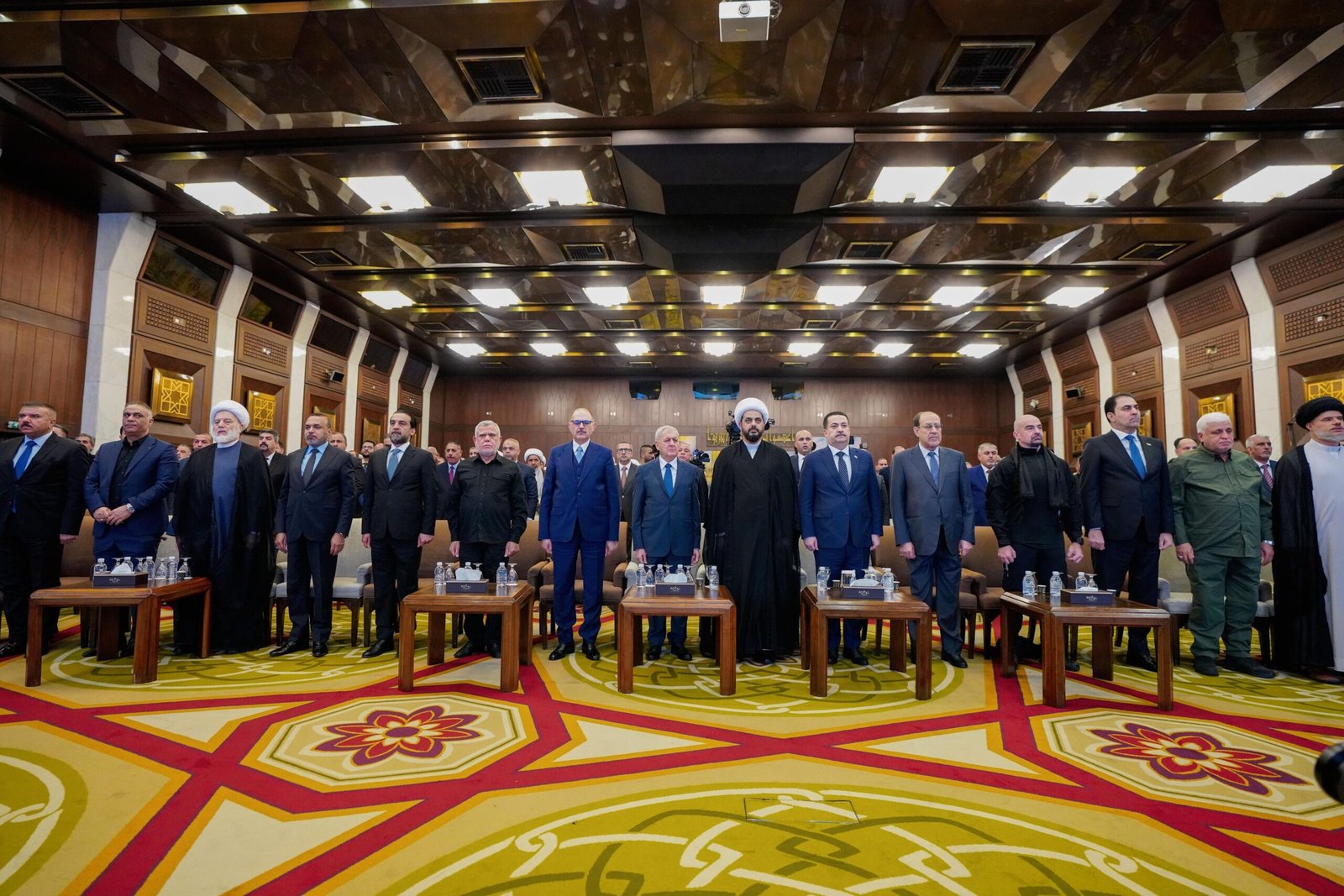
Across-sectarian bloc led by five of Iraq’s next-generation political leaders has pushed a presidential vote through despite a boycott by Masoud Barzani and Nouri al-Maliki, and is now positioned to deliver Mohammed Shia al-Sudani a second term. The episode marks the opening of a new era in the country’s political arrangement.
On 11 April 2026, the Iraqi parliament pressed ahead with the session to elect the country’s president and assembled the more than two-thirds quorum the vote required, doing so despite a boycott by Masoud Barzani and Nouri al-Maliki, the two most established power centres in Iraqi politics. The session seated Nizar Amedi of the PUK in Baghdad’s top ceremonial office. More importantly, it marked the beginning of a new phase, one in which the old veto centres can no longer structure outcomes on their own.
What the parliament session revealed was the consolidation of a cross-sectarian bloc whose five principal figures, Bafel Talabani of the PUK, Qais al-Khazali of Asaib Ahl al-Haq, Mohammed al-Halbousi on the Sunni side, Ammar al-Hakim of Hikma, and Prime Minister Mohammed Shia al-Sudani himself, together represent a distinct next-generation tier of Iraqi political leadership. Each commands a sizeable parliamentary bloc, and over the past two years all five have found greater advantage in coordination than in remaining confined within the older structures of Iraqi politics. By the accounts now circulating inside the system, the presidential vote was also the first half of an explicit two-part bargain: Amedi to the presidency, Sudani back to the premiership. The second half, which the same alignment is now positioned to deliver, would return Sudani to office for a second term, again over the objections of Maliki and Barzani.
This emerging bloc is already much more than a narrow convergence around Sudani’s renewal. Local power-sharing in Kirkuk and Salahuddin, positioning across parliament’s upper offices, the convergence against Maliki both inside and outside the Coordination Framework, and the presidential vote itself together point to a new organising axis in Iraqi politics. That axis now operates simultaneously at the level of parliamentary arithmetic, provincial administration, institutional control, and external relationships. The older centres of power have not disappeared, and this is not yet a finished formation. Even so, it has already crossed the threshold that matters in Iraq: it can repeatedly shape outcomes over those centres’ objections.
The implications therefore reach well beyond the composition of the next cabinet. If Sudani’s second term is now decided through this bloc’s parliamentary and institutional weight rather than through prior consensus inside the Coordination Framework, then one of the core pillars of the post-2003 Shia-led order will have been breached. That is what makes this moment larger than a premiership contest. It points not simply to a change of government, but to a change in the architecture through which power has been managed in Iraq for more than two decades.
Why the session was decisive: The presidency requires a two-thirds quorum in parliament, meaning at least 220 MPs present, before a vote can take place at all. The premiership, by contrast, requires only a simple majority of fifty percent plus one. Because it is the president who tasks a candidate with forming the government, the presidential vote is normally choreographed in advance, with broad consensus, precisely because it sets the terms for everything that follows.
Pushing the session through despite the Barzani-Maliki boycott therefore did more than seat Amedi. It demonstrated that the anti-Sudani camp could not block even the higher bar. If they failed to stop the harder vote, their chances of stopping the easier one are plainly worse. That asymmetry is why Sudani’s second term is now regarded inside the system as close to settled.
In the days before the session, smaller parliamentary groupings that had been aligned with the anti-session camp peeled away and joined the side willing to proceed, a sign that the boycott was losing its grip as a strategy. By the time the vote was called, both the numerical and political conditions for a successful session were in place.
The origins of the bloc: The bloc’s earliest nucleus was an understanding among Bafel Talabani, who had consolidated control of the PUK by ousting his cousin Lahur Sheikh Jangi, Qais al-Khazali of Asaib Ahl al-Haq, and Rayan al-Kildani of the Babylon Movement. The arrangement had several anchors from the start, with Khazali in particular bringing Shia weight that the PUK alone could not have supplied. Its scope was modest at first, but it provided the scaffolding for what came next.
The bloc acquired institutional weight during the formation of the local government in Kirkuk, when Mohammed al-Halbousi brought the Sunni component into the equation, following Halbousi’s own growing relations with Qais al-Khazali. The headline negotiation there was between Talabani and Halbousi, reflecting the composition of the new local government, which was built largely from Sunni Arab figures close to Halbousi and Kurdish figures close to the PUK. Yet the agreement also drew in Khazali and Kildani as guarantors. The Kirkuk deal included a rotational arrangement for the governorship, with the post going first to a PUK candidate before transferring later. Rotational pacts in Iraq are notoriously fragile, since there is seldom any practical guarantee that whoever holds the office first will actually step aside when the time comes. Naming Khazali and Kildani as guarantors raised the political cost of any future reneging. The same coalition then reproduced itself in Salahuddin, turning Kirkuk from a one-off arrangement into a transferable method.
Halbousi’s calculus was not driven only by the opportunity Kirkuk presented. His move toward Talabani and the others was reinforced by the collapse of his relationship with the KDP and the Barzanis, which had previously been one of the more reliable axes in Sunni-Kurdish politics. With that channel closed, the alternative offered by this emerging bloc became both more attractive and more strategic.
In Salahuddin, the bloc moved against Mustafa al-Samarrai of the Azm movement and stripped his allies of the governorship. This was the moment Sudani himself joined, and with his weight added to the original quartet of Talabani, Khazali, Halbousi and Kildani, the bloc carried the day. Halbousi used the momentum to draw the three-seat Jamahir faction into his orbit, which is why his Sunni orbit now stands at roughly forty seats rather than the headline figure from the elections.
Ammar al-Hakim arrived by a different path. When the Coordination Framework leaned toward Maliki’s return some months ago, Khazali and Hakim both broke ranks publicly to oppose the move. That shared opposition drew them closer to each other and, by extension, into the broader bloc. Side agreements have reinforced the convergence: Hakim’s faction is in line for the oil ministry, while Asaib Ahl al-Haq, unable to hold a ministry directly because of US sanctions, is positioning to back a technocrat at finance. The PUK has already collected the presidency.
The bloc is therefore doing two things at once. Across sectarian lines, it is building a working arrangement linking Halbousi, the PUK and the Babylon Movement to key Shia actors. Within the Shia arena itself, it is mounting a structural challenge to Maliki’s style of dominance, one that has drawn most of the post-Maliki Shia weight-bearers onto the same side. That dual character is what makes the alignment politically distinctive: a shift away from the bargaining reflexes of the old guard toward a more transactional, more distributed, and more cross-cutting mode of power.
The numbers: The arithmetic confirms the picture. Sudani’s own bloc, which won 46 seats in the elections, has grown to around 51 with subsequent additions. Halbousi commands roughly 40. Khazali brings 28, Hakim 18, the PUK 17, and other non-PUK Kurdish factions an additional 13, putting the Kurdish contribution at around 30 seats overall. Several smaller groupings are likely to follow. The combined total sits comfortably above the threshold for the premiership, with room to spare.
Sudani’s willingness to forgo every major ministry his bloc could otherwise have claimed has made this arithmetic possible. By signalling early that he would settle for the premiership alone, he removed the most obvious source of friction with his allies and gave each of them a concrete reason to remain inside the tent. The prospect of holding senior portfolios is one of the central reasons several factions agreed to back him in the first place.
Yet the larger significance of that arithmetic lies in where it may now be tested. If the Framework cannot produce a Shia consensus because Maliki continues to veto while Sudani presses ahead, then the decisive arena will shift from the Framework into parliament. That would mean the Shia-led order is no longer reproducing itself through its own internal mechanism. It would be forced into open adjudication in the state’s institutions, exactly what the Framework was meant to prevent.
Surrounding the institutions: Numbers alone do not explain the bloc’s strength. Its components are now positioned at most of the points through which power moves inside the Iraqi state. The speakership of parliament sits with Halbousi’s bloc. The first deputy speakership sits with Sadiqun, the political wing of Khazali’s Asaib Ahl al-Haq. The second deputy went to the KDP, which is not part of this bloc, but the contest there was so close that the result hung on a last-minute intervention, and in any case two of the three top parliamentary posts are held by figures inside the broader axis. The presidency now sits with the PUK. The judiciary, under Faiq Zaidan, is at minimum not obstructing the trend. Sudani himself is positioned at the centre of executive continuity.
The speakership and first deputy speakership were also not consensus appointments. They were contested, and the Maliki-Barzani camp ran their own candidates against the bloc’s. Their rivals were not minor figures. The candidate against the speaker collected somewhere above sixty votes, and the candidate against the first deputy came close to a hundred. Yet both still lost. The bloc was already imposing outcomes over the objections of the older centres long before the presidency. The April session was the most visible demonstration of that capacity, but it was not the first. The pattern had surfaced often enough in earlier institutional contests to read as something more than coincidence.
The institutional surround was also the mechanism through which the more recent breakthroughs were achieved. The presidential session itself could not have been pushed onto the agenda against the Barzani-Maliki boycott without a speaker willing to schedule it and a first deputy willing to back the move.
How Maliki’s bid collapsed: The struggle over the premiership had, for a time, reached a deadlock. Sudani was determined to secure a second term, while Maliki was equally determined either to reclaim the post himself or at minimum block Sudani from returning. In practice, Maliki’s own entry into the race was less a straightforward bid for office than a pressure tactic aimed at forcing both men out of contention together and creating room for a compromise alternative. That was the balance he was trying to impose.
Sudani then broke that balance in a way that appears to have caught almost everyone off guard, including Maliki himself. Rather than continue resisting Maliki’s move in a frontal way, he cleared the path for Maliki’s nomination inside the Framework and allowed him to step fully into the race. On the surface, that looked like a concession. In practice, it was a calculated move. Sudani appears to have understood that once Maliki moved from being a blocking figure to being the actual candidate, the full weight of the opposition to him, internal and external alike, would be forced into the open. In other words, Sudani shifted Maliki from the shadows of veto politics into the spotlight of an unwinnable candidacy.
That is exactly what happened. Inside the Shia arena, two of the heaviest figures after Maliki, Khazali and Hakim, opposed his return. That alone was significant, because it showed that Maliki could no longer rely on the Shia house to close ranks around him even at the moment of decision. Beyond that, the Sunni front was no less damaging. Halbousi, the largest Sunni leader in parliament, opposed Maliki’s return in clear and forceful terms and made plain that his bloc would not join a government formed under him. Most of the other major Sunni groupings then followed the same line, leaving Maliki with a shrinking path even before the outside factor arrived.
That outside factor was decisive. Trump’s Truth Social post effectively vetoed Maliki’s return and closed whatever external manageability his candidacy still retained. By that stage, however, the ground beneath him was already eroding. The post did not create Maliki’s weakness from nothing. It sealed it. What it did change was to make unmistakable that Maliki was not only struggling to assemble a governing coalition inside Iraq, but had also become externally too costly to reinstall.
That is why Sudani’s earlier manoeuvre was to defeat Maliki by allowing him to become the nominee and forcing the system to react to him in the open. Once that happened, the anti-Maliki coalition, inside the Framework, across the Sunni camp, and then internationally, could align around a single outcome.
Maliki’s camp now appears to suspect that the final American intervention was not entirely spontaneous. In his circles, there is growing suspicion that Sudani and Halbousi, both of whom have regional ties and channels into the Trump orbit, helped shape the lobbying environment that produced that outcome. Whether that can be demonstrated publicly or not, the fact that such suspicions exist is itself revealing. It shows how this bloc is now seen not merely as a parliamentary formation, but as one with wider reach.
After what has just happened, Maliki’s veto carries little procedural weight. The condition he has set is no longer a condition. It is a position.
Maliki’s reported demand, that he will only withdraw inside the Coordination Framework if Sudani is denied a second term, with Basim al-Badri proposed as the alternative, runs against this backdrop. Even without his consent, the bloc can now press ahead lawfully and install its candidate.
The deeper problem for the Framework is that Maliki’s veto now points toward outcomes that are mutually destructive. If he yields, he concedes that the Framework can no longer impose his preference. If he refuses, he risks forcing the question out of the Framework and onto the floor of parliament, where the bloc appears better placed to win. Either way, the mechanism through which the post-2003 Shia order has usually contained succession struggles begins to break down.
How the bloc is reshaping its own members: Membership in the bloc is also reshaping its participants. The actors inside it are visibly moderating one another, and the influence runs in more than one direction.
Halbousi is the clearest case on the Sunni side. His stance toward the major Shia parties has perceptibly softened. Those same Shia parties were the principal force behind his removal from the speakership of parliament. He is now cooperating closely with several of them rather than carrying the episode forward as a permanent grievance, which suggests that the bloc has changed his political instincts as well as his alignments.
Khazali offers the mirror image. Asaib Ahl al-Haq has long been among the most ideologically committed Iran-aligned formations in Iraq, second only to Kataib Hezbollah in the closeness of its ties to the IRGC. Over the past two years, however, his rhetoric and conduct have visibly moderated, and the clearest demonstration came during the Iran war. Of all the Iran-aligned factions in Iraq, Asaib was conspicuously among the least active in the drone campaign against US targets, with only one or two reported American airstrikes against its positions over the course of the conflict. For a group that only a few years ago would have been near the front of any such mobilisation, that restraint points to where the gravitational pull now lies.
The same applies more broadly. This bloc is not simply redistributing power among pre-existing actors. It is also altering the incentives under which those actors behave. That is one reason it may become more durable than a transactional bargain alone.
The new map: Two structural consequences flow from that trajectory. The first is that the Coordination Framework, one of the central pillars of the post-2003 Shia-led order, is now moving toward fracture. For years, its function was not merely to coordinate Shia parties, but to contain their rivalries, impose an internal settlement, and ensure that the question of who governs was resolved inside the Shia house before it spilled into state institutions. That mechanism is now breaking down. With the Framework’s 12 leading figures now split, and with Khazali, Hakim and Sudani all positioned inside the new axis, it no longer operates as the arena in which decisive Shia choices are made. If Sudani presses ahead while Maliki continues to veto, the Framework may simply fail to produce the consensus it was built to enforce. In that case, Sudani’s second term would be decided in parliament, much as the presidency was. That would not merely weaken the Framework. It would push it toward a split, and potentially toward collapse, because once the Shia house can no longer settle its own succession internally, one of the core mechanisms of the post-2003 order ceases to function.
The second is that the KDP-PUK balance, the equivalent organising container on the Kurdish side, is eroding in parallel. The presidency was ultimately decided in parliament rather than through prior Kurdish consensus, and that outcome deepened rather than resolved the KDP-PUK divide. The PUK is no longer behaving as the junior partner in a binary Kurdish equation. It has assembled an independent national role through its alliances inside the bloc and is gradually building external relationships that were once mediated through Erbil. If the premiership now follows the same path on the Shia side, then Iraq’s two main post-2003 political containers, one Shia and one Kurdish, will both have been breached by the same underlying shift.
Neither container will disappear overnight. The KDP retains deep structural ties with both Ankara and Washington, and Maliki retains a real political base. The field, however, is no longer being structured by them in the way it once was. In their place stands a cross-sectarian arrangement that has learned, in stages, how to cooperate first, govern together locally, surround the institutions that decide outcomes, and convert that accumulated habit of cooperation into national and regional leverage. That is something genuinely new in the post-2003 system.
Sudani’s likely second term is not the cause of this realignment. It is its clearest expression so far. The deeper story is the emergence of an axis that no longer waits for the consent of older veto centres and has begun, slowly but unmistakably, to reorganise Iraqi politics around itself. If that process now pushes the Coordination Framework, one of the main pillars of the post-2003 order, toward fracture or collapse, then this is not simply a change of government. It is a change in the architecture through which power in Iraq has been managed for more than two decades.


