


Why Syria’s Political Geography Looks Nothing Like Iraq’s
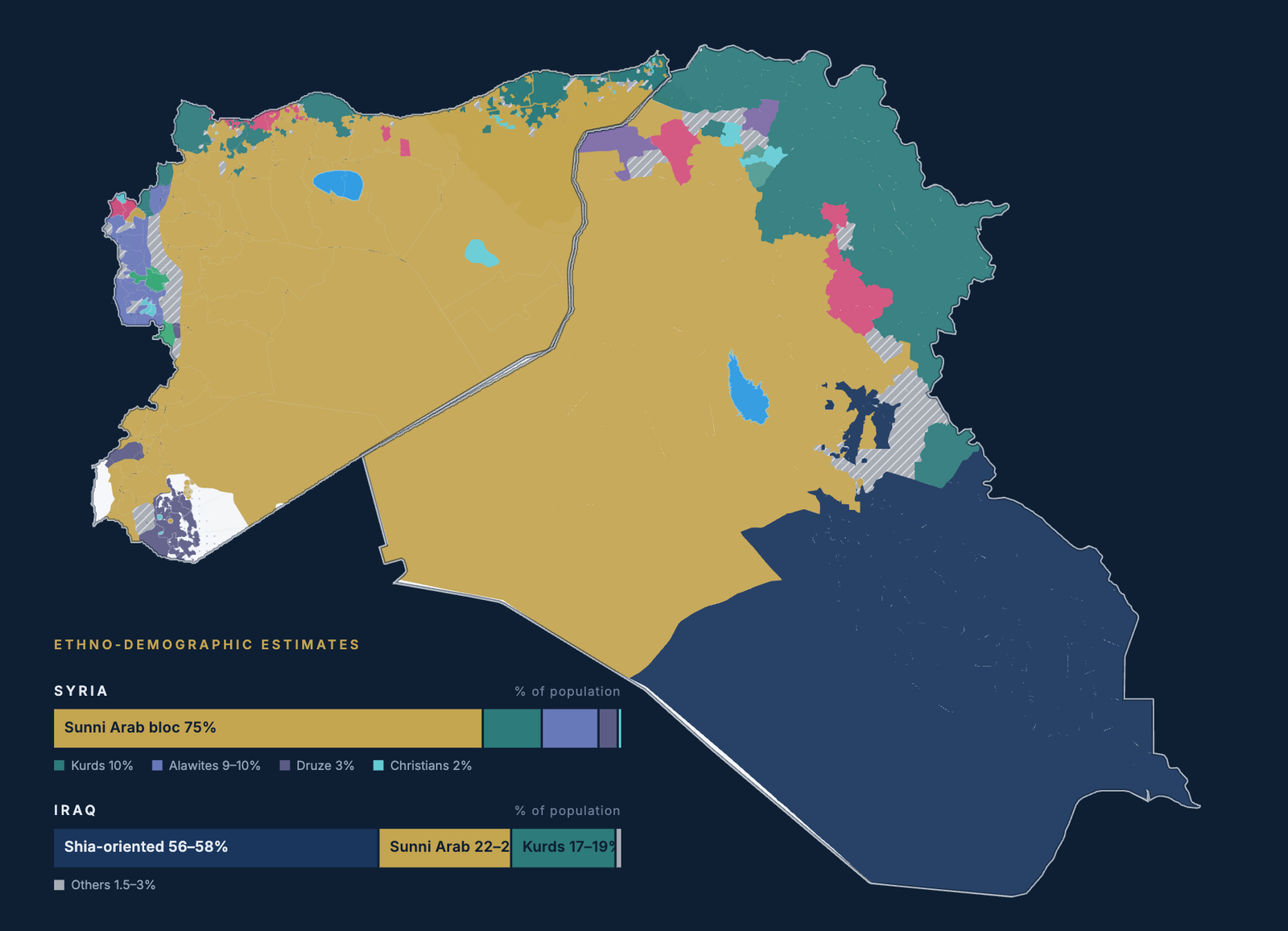
Comparisons between Syria and Iraq usually start from a shared premise: that both are weak states trying to govern populations divided among large ethnic and religious communities. The demographic and territorial structures of the two countries diverge sharply, and that divergence explains why federalism, communal power-sharing and territorial autonomy took root in Iraq, and why the bargaining position of Syria’s minorities is so much weaker.
Iraq rests on three large political-demographic blocs. Shi’a Arabs and smaller Shi’a-aligned communities account for roughly 56 to 58 percent of the population, Sunni Arabs and associated Sunni communities for around 22 to 24 percent, and Kurds for roughly 18 percent. These figures are inferences. Iraq’s 2024 census excluded questions on sect and ethnicity, so the shares have to be reconstructed from provincial totals, electoral representation and older demographic work. The 2025 parliamentary election reaches similar ground from an independent direction: Shi’a-led lists took a little over half of the 329 seats, Sunni Arab lists around 23 percent and Kurdish parties 17 percent, with nine seats reserved for minorities. Party blocs are a rough proxy for identity, though the alignment is close enough to work with.
What matters more than the size of these communities is that each holds a clear territorial base. The Shi’a population is concentrated across the south and much of the centre. Sunni Arabs dominate Anbar and Salah al-Din and large parts of Nineveh, with substantial populations in Baghdad and Diyala. The Kurdish population sits in the northeast, principally in the Kurdistan Region and the adjoining disputed territories. The result is a form of territorialised pluralism in which the largest community holds a majority that falls well short of dominance, while the two other blocs together account for around 40 percent of the population and occupy large, relatively contiguous regions of their own. Their geography also lowers the cost of coordination. The Sunni Arab and Kurdish regions meet across much of northern Iraq, from Nineveh through Kirkuk toward Diyala. The two have clashed repeatedly over the disputed territories, and each still holds its own institutions, economic networks and territorial base, so when their interests converge they can jointly constrain the federal centre.
Syria is built differently. A broad Sunni Arab-centred political bloc accounts for roughly three quarters of the population, taking in the Sunni Arab majority along with smaller Sunni communities such as many Turkmen and Circassians who remain ethnically distinct while sitting inside the same national constituency. The remainder is small and divided: Kurds at around 10 percent, Alawites at 9 to 10 percent, Druze at about 3 percent, Christians at around 2 percent, and several smaller communities beyond them.
The Kurdish figure needs qualification in a political comparison. The 10 percent estimate covers ethnic Kurds in Damascus, Aleppo, Homs and Hama alongside the concentrated Kurdish settlement system in the north, and much of that dispersed population is heavily integrated into Arabic-speaking Sunni society. The demographic base available to a specifically Kurdish territorial project is therefore smaller than the ethnic total. Iraq presents the same problem in far weaker form, since Kurdish ethnicity, Kurdish political identification and residence inside the Kurdish geographic system overlap closely there.
Territorial concentration sharpens the contrast. The Kurdistan Region holds 14 percent of Iraq’s total population and roughly seven in ten of the country’s Kurds, and most of the remainder live directly against its edges in Kirkuk, parts of Nineveh and Khanaqin. The overwhelming majority of Iraqi Kurds therefore live either inside the Region or in territory attached to it, which makes their demographic space closer to a single macro-region than the administrative boundary suggests. Syria’s Kurds are spread more thinly. Before the Kurdish-led Syrian Democratic Forces dissolved and merged into the Syrian state on 25 August 2026, their remaining core in northern Hasakah and Kobani probably held around two-fifths of Syria’s Kurds, or roughly 4 percent of the national population. Afrin formed another major concentration and large Kurdish communities lived in Aleppo, but both sat apart from the northeastern belt, separated by territory the majority controlled. Syria has never had a Kurdish region spanning several governorates.
Alawites do hold a contiguous heartland along the coastal mountains, a point often lost in accounts that treat all Syrian minorities as scattered. What that heartland lacks is a city to match it. Latakia, its principal urban centre, has historically been estimated at roughly half Alawite and 40 percent Sunni, with a smaller Christian population. Jableh and Baniyas are similarly mixed, and Tartous, though more heavily Alawite, is considerably smaller. Sunni, Christian, Turkmen and Ismaili pockets break up what appears on a national map as one solid block. The Druze are the clearest exception to the pattern. Suwayda and Jabal al-Arab form a compact, mountainous and strongly Druze unit with its own provincial capital, and much of the governorate has operated outside Damascus’s control under local authorities. The Druze account for around 3 percent of Syria’s population, so the territorial unit is clean and the weight behind it is slight.
Urban structure follows the same divide, and cities carry disproportionate weight here because they house what a political project runs on: universities, bureaucracies, businesses, media, hospitals, professional classes and administrative capacity. A community with a large rural population and no major urban centre has a much thinner basis for building and sustaining an autonomous system. In Syria, almost the entire upper tier of the urban hierarchy belongs to the majority. Damascus is probably around four-fifths Sunni Arab. Aleppo is also predominantly Sunni Arab, with an important Kurdish population and a historically larger Christian community. Homs is Sunni-majority and Hama overwhelmingly so. Latakia, the strongest case for a city tied to a minority, remains split between Alawites and Sunnis. Syria has no equivalent of an Erbil or a Basra among its largest cities, meaning a major national urban centre dominated by one of the principal minorities.
Iraq’s urban map runs the other way. Baghdad is Shi’a-majority while retaining a Sunni population of roughly a third. Mosul is overwhelmingly Sunni Arab, Basra overwhelmingly Shi’a Arab, Erbil overwhelmingly Kurdish, and Kirkuk a major mixed city in which Kurds, Arabs and Turkmen all carry demographic weight. Each of Iraq’s principal communities therefore holds both a territorial heartland and at least one major city: the Kurds have Erbil and Sulaimani, Sunni Arabs have Mosul and a substantial presence in Baghdad, and the Shi’a have Baghdad, Basra, Najaf and Karbala. That urban weight translates into institutional depth. The Kurdistan Region is more than a Kurdish-majority collection of towns and villages, holding large cities, universities, airports, banks, media organisations, ministries, courts and a substantial professional and administrative class.
Institutional history compounds the gap. The Kurdish parties began building autonomous institutions after 1991, more than a decade before Saddam Hussein fell, and the post-2003 constitution then recognised the Kurdistan Region and the authorities already operating inside it. By the time the modern Iraqi system was assembled, Erbil held its own administration, security forces and political institutions, so when Baghdad weakens it has decades of accumulated statecraft to fall back on. Syria’s Autonomous Administration built serious institutions after 2012, over barely a decade, in wartime, without constitutional recognition, and across territory containing very large Arab populations. The Alawite case inverts the problem. Under Bashar al-Assad, Alawite elites gained enormous influence inside the central state, particularly in the military and security apparatus, and that influence was exercised through Damascus rather than through a coastal administration. The system produced Alawite power over Syria and no Alawite region. When it collapsed, nothing on the coast resembled the Kurdistan Regional Government, with its established parliament, ministries, security forces and fiscal institutions, capable of assuming regional authority.
Economic geography pushed in the same direction. The Kurdistan Region’s demographic heartland broadly overlaps with the territory holding its principal cities, border crossings and oil and gas resources, which has allowed its institutions to run a functioning regional economy even while remaining dependent on Baghdad and neighbouring states. The SDF faced the reverse arrangement. Much of what made its administration economically significant lay outside the Kurdish heartland, with major oil fields, dams and agricultural land concentrated in predominantly Arab parts of Deir ez-Zor, Raqqa and southern Hasakah. As the force expanded, the population under its control became steadily more Arab, so the territory needed to make the administration viable was always larger than the territory that could plausibly be called Kurdish-majority. That tension surfaced once Damascus retook the Arab-majority areas in January 2026. The remaining core was more heavily Kurdish, and it was also smaller, less economically self-sufficient and reduced to a small share of Syria’s total population.
Terrain reinforces both positions. Erbil, Sulaimani and Duhok sit behind extensive mountain systems running toward Iran and Turkey, geography that has repeatedly allowed Kurdish armed movements to outlast campaigns by far stronger central governments. The principal Syrian Kurdish areas are exposed by comparison. The Jazira is largely flat and lies directly beneath the Turkish border, Kobani is similarly open, and Afrin holds better ground while sitting cut off from the northeastern Kurdish population. The Alawite coastal mountains are defensible, though their demographic and economic geography is far less self-contained, with mixed coastal cities and interspersed Sunni and Christian pockets.
All of this shapes what coalitions are possible. In Iraq, the Shi’a majority is large enough to lead national politics and small enough that the other two blocs remain unavoidable, since Sunni Arabs and Kurds together account for around 40 percent of the country and each holds a region, major cities and established political organisations. The result is a workable bargaining structure among three large actors. Syria’s remaining quarter cannot function the same way. Its components sit in separate corners of the country, with the Kurdish population in the north and northeast, the Alawite heartland on the western coast and the Druze concentration in the far south, and large Sunni-majority areas lying between them. Their political priorities also diverge. Kurdish parties have pressed for language rights, local administration and security arrangements. Druze actors have prioritised local security and limits on central intervention. Alawite communities have focused on physical security and political protection since the fall of the Assad system. Christians have generally sought protection and equal citizenship rather than territory. Shared unease about centralisation does not, on its own, convert those aims into a common constitutional project, which leaves Damascus free to settle with each community separately: one arrangement with Kurdish actors, another with Druze leaders, a third understanding with coastal notables.
There is a further distinction between a majority and a hegemonic majority. A community at 56 to 58 percent cannot govern as though the other 44 percent barely register, particularly when those communities hold Mosul, Erbil, Sulaimani, Anbar and much of the north and west. A bloc approaching three quarters can present itself as the national mainstream, which changes the politics of centralisation. It becomes far easier for a government drawn from that bloc to frame a unitary state as ordinary national administration rather than the rule of one community over the rest.
Regional geography works in the same direction. Syria’s Sunni core sits inside a broadly Sunni environment, with Turkey to the north and Jordan to the south, and the Iraqi territories directly adjoining Syria predominantly Sunni Arab, Kurdish or mixed rather than part of Iraq’s Shi’a south. Iraq’s external orientation splits three ways. Its Shi’a political centre holds a long strategic connection to Iran, the Kurdish north borders both Turkey and Iran, and the Sunni west opens toward Syria, Jordan and Saudi Arabia. Each Iraqi bloc has a distinct external relationship alongside its own internal territorial base, while Syria’s majority enjoys a regional continuity its minorities cannot match.
Lebanon offers a third model worth separating from both. Its communities are not organised into large territorial regions in the Iraqi manner, and the country is in fact geographically quite mixed. What distinguishes it is that communal plurality is written into the state itself, with the presidency, premiership, parliamentary speakership and parliamentary representation distributed through an explicitly communal framework. Iraq runs on territorial and federal communal pluralism, Lebanon on constitutional and confessional communal pluralism, and Syria on neither.
The central difference between the two cases lies in the relationship among six things: demographic weight, territorial concentration, urban centres, institutions, economic geography and the capacity to form political counterweights. On nearly all of them, Iraq’s principal communities function as relatively complete political-geographic units, each holding substantial demographic weight, territorial depth and important cities, with two of the three able to combine and constrain the largest when their interests overlap. Syria holds one much larger demographic core alongside several smaller minorities whose territories are more fragmented, whose urban bases are weaker and whose political interests diverge. Even taken together, they form no geographically coherent counterweight to the Sunni Arab-centred majority. That is why the Iraqi model is a poor template for reading Syria: both states are diverse, and the structure of that diversity, along with the bargaining structure it produces, is fundamentally different.


