


Has the Kurdish Moment in Iran Passed?
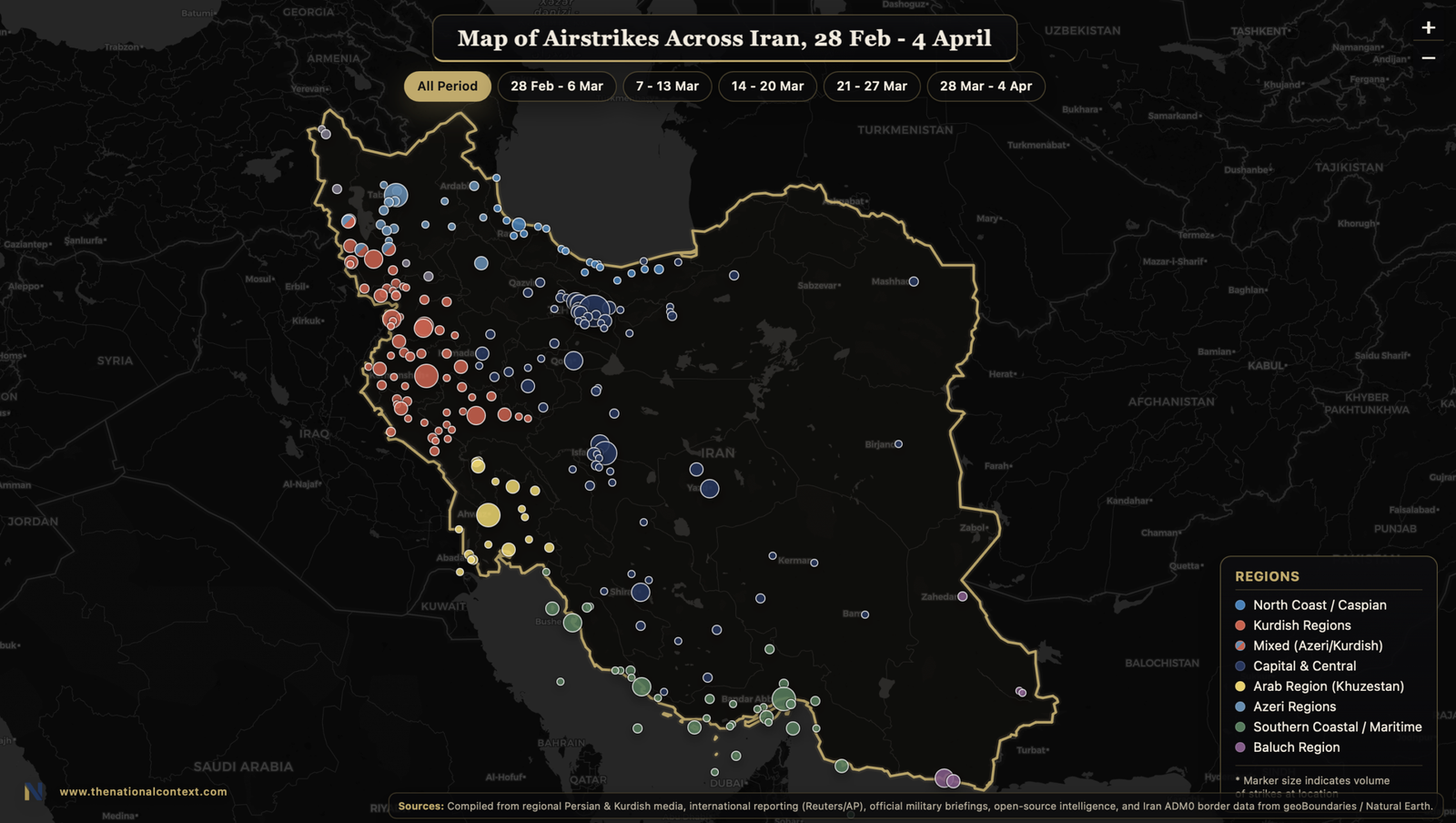
In the early days of the Iran war, there was serious discussion about deploying Iranian Kurdish armed groups as a ground force alongside the air campaign. That discussion coincided with an intense bombing effort against the Islamic Republic’s internal-security infrastructure across the Kurdish belt in northwest Iran. As the ground-force project fell apart, the airstrikes in the same belt dropped sharply.
In the first week of the war (28 February to 6 March), Kurdish areas accounted for 51.2% of all active strike locations, not all individual airstrikes but all areas bombed at least once within that week. That share fell to 37.6% in Week 2, 24.7% in Week 3, and collapsed to 5.9% in Week 4, with just 3 locations recording dated activity out of 51 nationwide. Kurdish date mentions in our tracker, a rough proxy for intensity, dropped from 56 to 2 over the same span.
Capital and Central Iran filled the vacuum. Its share rose from 22.6% in Week 1 to 60.8% in Week 4, when 31 of 51 active locations fell across the Tehran belt, Isfahan, Qom, Kashan, Mashhad, and Yazd. The campaign was not broadening. It was concentrating on the central plateau.
The key shift has been from security-infrastructure targeting to strategic and industrial targeting. IRGC and Basij targets fell from 41 active locations in Week 1 to 18 in Week 4. Police targets dropped from 29 to 12. Intelligence targets from 17 to 3. Border-guard targets from 9 to 1. These categories were overwhelmingly concentrated in Kurdistan.
Infrastructure and industrial targeting moved the other way: 8 active locations in Week 1, rising to 14 in Weeks 2 and 5, expanding from Tehran and Isfahan to include Mobarakeh Steel, Sefid Dasht Steel in Borujen, Khuzestan Steel, Mashhad fuel depots, the Mahshahr Petrochemical Special Zone, and South Pars. Nuclear targeting peaked in Week 4 at 6 locations, the week Khondab’s heavy-water plant was rendered non-operational and the IDF claimed a strike on the Arak reactor. Missile and weapons-site targeting held consistently high throughout at 13 to 19 locations per week, independent of other shifts.
New theaters also opened late. The Caspian coast barely existed before Week 3 (1 location in Week 1, zero in Week 2), then grew to 7 by Week 5 after the 19 March Bandar Anzali naval strike opened the theater. Khuzestan followed a similar arc, rising from 2 locations in Week 1 to 14 in Week 5 (15.6%), driven by the petrochemical, steel, and port strikes that define the campaign’s late economic-warfare phase.
Two factors likely explain the collapse of airstrike intensity in the Kurdish belt. First, most recognisable and targetable security and regime-linked sites have already been flattened; even though the regime had evacuated most facilities and dispersed personnel beforehand, the physical infrastructure is largely destroyed. Second, the plan to use Kurdish ground forces, which Israel pushed for, appears to have been shelved. Given that the airstrikes in the Kurdish regions have also largely been attributed to Israel rather than the United States, the Israeli strategy appears to have shifted significantly as the likelihood of regime collapse, per Israeli assessments, became untenable. The pivot toward economic and strategic infrastructure targeting, visible in the data from Week 3 onward, reflects that recalibration.


