


Bombed by Both Sides, Iraq Faces a War That Could Unravel It From Within
The map of Iraq since February 28 shows three overlapping wartime geographies layered inside one state. Anti-PMF strikes have spread across Anbar, Nineveh, Kirkuk, Salah al-Din, Baghdad and Babil. Iranian and Iran-aligned retaliation has hit the Kurdistan Region repeatedly. And across the Shia south and center, a different kind of wartime activity has taken shape: donation drives, tribal solidarity pledges, and pro-Iran mobilization that functions less as combat than as a rear support belt.
No other country in this war is being struck by both sides at once. Iraq is absorbing American and Israeli airstrikes against PMF positions while simultaneously absorbing Iranian and militia retaliation against the Kurdistan Region, US-linked targets, and state infrastructure in Baghdad. Beyond that dual exposure, each of the country’s three main political communities is formally inside the post-2003 order while also containing powerful forces working against it.
Three zones, three wars: The densest anti-PMF strikes have fallen on the northern, western and disputed belt where militia infrastructure is most exposed and where the post-2003 order has always been most militarized and least socially rooted. These are not simply “Sunni areas” in a neat demographic sense; Kirkuk, the Nineveh Plain and the Tuz corridor are mixed, layered and contested. But they are the frontier where the PMF projects power forward, and that forward positioning is precisely what has made them vulnerable to targeting. The anti-PMF war is concentrated in the belt where militia power is furthest from its deepest social base, well away from the Shia heartlands of Najaf or Karbala.
The Kurdistan Region, meanwhile, has absorbed the brunt of retaliation. Erbil, Sulaimani and Duhok have been hit by drones and missiles in repeated waves. The northern theatre is simultaneously a target zone and a space tied to conflicts well beyond Iraq’s borders. Iranian Kurdish opposition groups based in the Kurdistan Region have discussed with the United States whether and how they might act against Iranian security forces in western Iran. The same Kurdish space that is formally part of Iraq’s constitutional order doubles as a potential launchpad for operations against a neighbouring state, a duality that the war has made increasingly difficult to manage quietly.
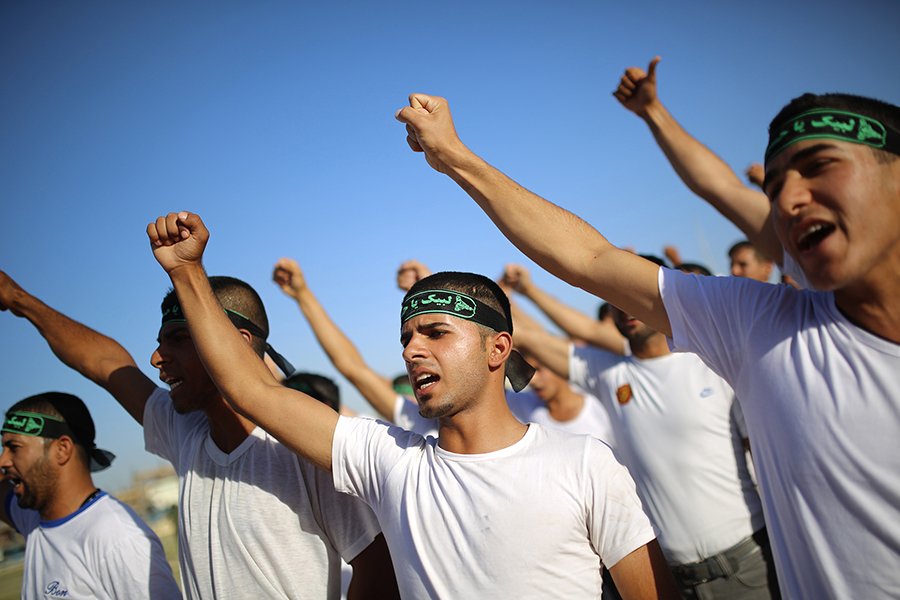
The Shia south and center has experienced the war differently, functioning increasingly as a mobilization and support zone rather than a front line, with donation campaigns, tribal solidarity and pro-Iran sentiment running through Basra, Karbala, Najaf, Maysan and parts of Babil and Baghdad. The wartime role of the south is real, but it takes the form of rear-area mobilization rather than direct combat.
One leg in, one leg out: The geographic pattern matters because it maps onto something deeper. Each of Iraq’s main political communities now has one foot inside the state and another tied to armed actors, external patrons, or regional alignments that work against it.
The Kurdish leadership is embedded in Baghdad’s order: bargaining over the presidency, the budget, oil revenues and cabinet formation like indispensable shareholders. Yet the Kurdistan Region also gains leverage when Baghdad is weak, distracted or dependent. Kurdish autonomy thrives on Iraqi dysfunction even as it depends on continued participation in the Iraqi system. The war has sharpened that tension without resolving it.
The Sunni and disputed belt was formally reintegrated after the defeat of ISIS, but it remains a frontier zone shaped by weak central control, residual grievance, and the forward presence of militias that much of the local population views with hostility. Sunni political actors have been accused for years of maintaining one foot in the government and another in relationships with external Sunni states or in quiet sympathy with forces that resist the current order. The anti-PMF strike belt tracks almost exactly onto this territory, giving old tensions new spatial expression.
What makes this moment structurally different from previous rounds of instability is the Syrian border. For the first time in decades, Iraq’s Sunni west faces a Sunni-led state on the other side. Iraqi Shia militias are already attacking Syrian army positions from Iraqi soil, Kataib Hezbollah has openly called Sharaa a traitor and declared that the battlefield in Syria is now open, and Syrian security forces have dismantled PMF cells operating inside Deir ez-Zor. If that cross-border escalation deepens, it risks activating a sectarian solidarity dynamic along Iraq’s western frontier that has been dormant since the fall of ISIS. The Sunni belt would no longer function only as the geography where anti-PMF strikes land. It could become a mobilization corridor where Iraqi Sunnis face growing pressure to align with a neighbouring Sunni order under attack by the same militia forces they already resent. The conditions for that are assembling faster than at any point since 2014, and the Iraqi state has no obvious mechanism to prevent it if the Syrian border becomes an active front between Shia militias and a Sunni-led Damascus.
The Shia camp presents the deepest paradox. The prime minister, the parliamentary majority and the security apparatus are all drawn primarily from Shia political networks, yet the same community also contains the militias that accuse the Iraqi government of serving American interests, fire on US-linked targets in Baghdad, launch drones and rockets at the Kurdistan Region, and pressure the state from within. The PMF is formally part of the Iraqi security structure while several of its factions are operationally at war with Iraq’s own allies. A state core that contains its own insurgent logic cannot anchor a stable national order indefinitely.
The disputed territories add a further layer. In places like Kirkuk and the Nineveh Plain, the violence also involves Turkmen and Shabak militias with their own grievances, their own targeting patterns, and their own retaliatory strikes against Kurdistan Region interests. These areas are where all three Iraqs physically overlap, and where the war’s meaning becomes most difficult to read through any single lens.
A fragile holding pattern: What has kept Iraq from fracturing openly so far is the nature of the war itself.
As long as the conflict remains mostly aerial, Iraq’s factions can continue operating in parallel without forcing a decisive internal reckoning. Drones, missiles and targeted airstrikes allow all sides to keep one foot inside the formal order while acting outside it. Kurdish leaders can remain in Baghdad while northern Iraq is drawn toward a conflict with Iran. PMF factions can remain nominally part of the state while attacking targets that implicate the state. Baghdad can denounce violations of sovereignty while depending on actors whose loyalties are plainly divided. The aerial character of the war is what makes this coexistence possible, suspending Iraq’s contradictions in place rather than resolving them.
That fragile holding pattern could break under three pressure vectors already in motion.
The first is a wider ground phase against Iran. If the war shifts from air and missile campaigns to ground operations, the pressure on Iraq’s internal contradictions intensifies immediately. Iranian Kurdish armed groups in northern Iraq would face a decision about direct involvement. PMF factions would face escalating demands from Tehran. The Kurdistan Region would become a potential staging area. A ground war compresses the space for ambiguity, and ambiguity is what has allowed Iraq’s factions to avoid confronting one another directly.
The second is border spillover, already underway. The cross-border attacks between Iraqi militias and Syrian territory described above are not isolated incidents. They are early signs of a dynamic in which Iraq’s internal militia war merges with the regional contest over Syria’s future. Ahmed al-Sharaa’s trajectory from al-Qaeda in Iraq commander to Syrian president makes him uniquely polarizing for Iraqi Shia factions, and the same militias that fought alongside Assad to preserve Syria’s old order now treat his successor as an enemy. If that hostility hardens into sustained cross-border operations, it would create a second active front for Iraq’s war, one that runs along sectarian rather than purely strategic lines. Reports of an attack against a Turkish military base in Duhok, if confirmed, would add a third axis of entanglement, drawing Turkey deeper into Iraq’s northern theatre at a moment when Ankara is already managing its own Kurdish and Syrian calculations. Each new border incident pulls Iraq’s crisis further beyond its own borders and deeper into a regional entanglement that Baghdad has no capacity to control.
The third, and potentially most destabilizing, is economic. Iraq derives roughly 90 percent of state revenue from oil exports. The closure of the Strait of Hormuz has slashed those exports drastically, with production falling from above four million barrels per day to a fraction of that. Baghdad has scrambled for workarounds through trucking via Turkey, Syria and Jordan, a partial resumption of Kirkuk exports via the Ceyhan pipeline, and new contracts for fuel oil shipments through Syria, but none of this replaces the scale of Gulf exports.
The salary state is one of the last mechanisms that binds Shia, Sunni and Kurdish constituencies to the same national order. Iraq’s social contract runs through fiscal transfers as much as through constitutional arrangements. Public-sector salaries, pensions and transfers flow from oil revenue through Baghdad to every province, and that flow is one of the few things that gives all three communities a material stake in the state’s survival. If the war drags on for months and export revenues remain suppressed, the capacity to maintain that flow comes under real strain, and with it the financial foundation that has underwritten Iraq’s fragile political compromises since 2003.
The test: Iraq’s political class has survived worse shocks through a combination of institutional inertia, patronage distribution and the sheer difficulty of agreeing on any alternative to the current order. But the Iran war is applying pressure to every load-bearing element at once: the aerial containment that keeps factions from colliding, the geographic containment that keeps Iraq’s crisis from merging with Syria’s and Turkey’s, and the oil revenues that keep the salary state functioning.
Iraq has always been divided. What the war is exposing is that the country’s three main political arenas are held together less by a shared national identity than by a set of practical buffers: containment, patronage, and a central state that none of its constituent communities fully trusts but all of them need. A longer war, a ground phase, a wider border conflict, or a sustained collapse in oil revenue would not need to break Iraq all at once. It would only need to break enough of the holding pattern to let the country’s internal contradictions, already visible on the map, begin to move. At that point, what has so far remained a managed coexistence of three wartime geographies within one state risks becoming something closer to the simultaneous unravelling of a national order from within and a regional order from without.


