


One Year After Assad: How Post-Assad Syria Is Reshaping Iraq’s Shia House
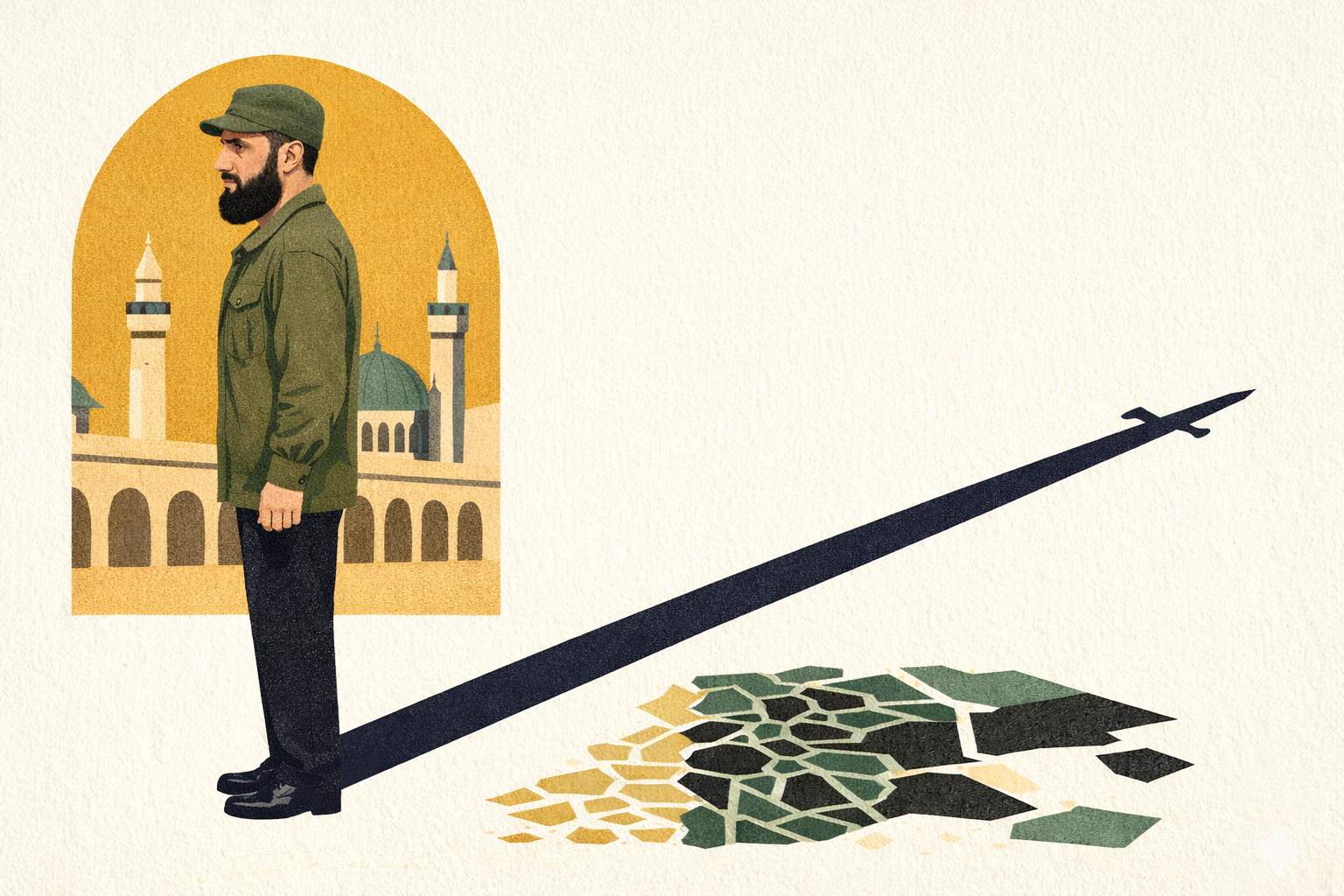
More than a year after Bashar al-Assad’s fall, the real story is no longer the collapse of the old Syrian regime itself. It is the political and ideological crisis that post-Assad Syria has opened inside Iraq’s Shia power structure.
For more than a decade, Syria functioned as the central arena of Iran’s regional axis: a corridor for militias, a theatre for “shrine protection,” and a shared project linking Tehran, Iraqi armed factions, Hezbollah, and Russia. Its collapse stripped that axis of one of its core pillars. For Iraq’s Shia factions, this was not just the loss of an ally. It was the loss of a strategic worldview.
This explainer examines how the new Syria under Ahmad al-Sharaa is reshaping Iraq’s Shia politics, from militia legitimacy and intra-Shia divisions to the deeper historical and theological anxieties now surfacing around Damascus and what it represents.
The New Syria: Who Stands Behind Ahmad al-Sharaa and What They Want
Ahmad al-Sharaa’s government has sought legitimacy through the language of national liberation. But the realities surrounding his rise tell a more layered story. Post-Assad Syria, freed from Iranian and Russian hegemony, has moved rapidly under a new umbrella: Washington, Ankara, and the Gulf states, with Israeli security requirements factored in throughout.
The signals have been unmistakable. Donald Trump’s public framing of his engagement with al-Sharaa, the stringent conditions attached by Gulf states, and the regional understandings brokered on Damascus’s behalf by Turkish Foreign Minister Hakan Fidan all point in the same direction. The “new Syria” is not an independent project. It is a component of a broader, multilateral effort to dismantle Iran’s regional axis and deepen the crisis of the Shia camp.
What has followed bears this out. Historic American sanctions have been lifted. Billions in Gulf and European reconstruction pledges have materialised. Syria has been admitted into the newly emerging anti-ISIS coalition, at a time when the very leaders now governing Damascus were previously designated as terrorists.
Diplomatic visits from Washington, Ankara, and Riyadh have intensified. Strategic agreements have been negotiated. U.S. forces have coordinated handovers of bases to Syria’s new security forces, some of whose members served in jihadist groups as recently as last year. Taken together, these developments signal a wholesale reordering of the regional balance of power, not merely a change of government in Damascus.
For Iraq’s Shia factions, the cost has been immediate and severe. The Iran-Russia bloc that once undergirded their regional project has fractured. After fifteen years of deploying the slogan of “protecting the shrines” to justify militia presence in Syria, Iran’s position there is heading toward total collapse. Iraqi armed groups did not merely suffer the political fallout. Their human losses reportedly exceeded three thousand killed. And they have now lost every political and military foothold they once held on Syrian soil.
Damascus today acts not as a partner or even a neutral neighbour to the Shia project, but as a formidable adversary aligned against the Iranian front. This is not simply a shift in government. It is the reinforcement of a powerful ideological struggle between the Sunni-Salafi current now in power and the armed, doctrinaire Shia forces that had for years treated Syria as a forward operating base.
The Sufyani Question: Why Half of Iraq’s Shia Leadership Views al-Sharaa Through an Apocalyptic Lens
One of the most striking and underreported dimensions of this crisis plays out not in the language of geopolitics but in the vocabulary of Shia eschatology.
Within trusted Shia heritage texts and religious narratives, there is extensive discussion of a figure known as the “Sufyani,” a leader who seizes control of the Levant, unifies it, and then marches into Iraqi territory. According to these traditions, the Sufyani, after fighting the “Battle of the Turks,” engages Shia forces in the Hijaz and Palestine in major confrontations under the banner of the Twelfth Imam. The texts specify that this figure descends from the Umayyad lineage, emerges from near Damascus or the southern city of Daraa, rules initially for only fifteen months, and appears before the coming of the Mahdi.
The debate inside Shia scholarly circles is not over whether the Sufyani narrative is relevant. It is over whether current events in Syria match its specific conditions.
Some religious authorities argue that the signs cannot yet be identified in Ahmad al-Sharaa, since the figure described in the texts begins with “killing and violence” in Damascus and wages the Battle of the Turks before turning against the Shia. Current developments, they note, have not taken that course. Others are less restrained. Sunni takfiri groups in Syria are already widely referred to in Shia discourse as “Sufyani,” on the grounds that they seek the annihilation of all who differ from them ideologically, with Shia placed at the very top of the list.
But the most consequential detail, reported by figures close to the centres of Shia decision-making in Iraq, is this: roughly half of the leaders within the Shia Coordination Framework believe that Ahmad al-Sharaa is the Sufyani character described in the texts.
This is not a fringe position. It is a view held at the heart of Iraq’s governing coalition, and it shapes how these leaders assess al-Sharaa: as a formidable sectarian adversary with whom military and political confrontation is not a possibility but an inevitability. It breeds a posture of permanent suspicion.
For outside observers, this may seem like an obscure theological footnote. Inside Iraq’s Shia political establishment, it is a factor that actively shapes strategic calculations and coalition dynamics.
The Umayyad Revival: Why Damascus’s New Identity Strikes at the Heart of Shia Historical Memory
To grasp the depth of the anxiety this moment has produced inside Iraq’s Shia house, one needs to understand what the Umayyad name means in the Shia historical imagination.
Syria, despite more than five decades under Alawite rule allied with Iran, has throughout history been recognised as one of the most important bastions of Sunni Islam. It is home to a rich Umayyad heritage, the shrines and tombs of Saladin al-Ayyubi and Ibn Taymiyyah, and the legacies of the Zengid, Ayyubid, Mamluk, and Ottoman periods. The most prominent landmark in its capital, and the greatest historic mosque of the state, bears the Umayyad name.
On the day the Assad regime collapsed, Ahmad al-Sharaa delivered his first address at the Great Umayyad Mosque, built by al-Walid ibn Abd al-Malik between 705 and 715 CE. That mosque has since become the primary venue for state and public occasions under the new government. In the political literature and official rhetoric of the new regime, a clear orientation toward celebrating the Umayyad heritage is already visible, one that recalls the year 661 CE, when Damascus became the capital of the Umayyad state under Muawiya ibn Abi Sufyan.
That state, in the span of nearly a century, administered an empire stretching from Spain to the frontiers of modern-day China, the broadest geographical expanse ever recorded in the history of Islam.
Al-Sharaa’s government has leaned into this inheritance. He has led congregational prayers at the Umayyad Mosque, paid particular attention to Muawiya’s tomb, ordered the removal of Shia flags and slogans from the Sayyida Zainab shrine, and presided over effusive celebrations of the Umayyad legacy across digital platforms. Jihadist anthems circulating in Syria openly celebrate the Umayyad identity and glorify Arab Islamic civilisation while attacking “Magian Iranian tyranny.” Supporters have bestowed upon al-Sharaa the epithet “Conqueror of the Umayyads.”
Advocates have framed this “Umayyad-ism” as culture and civilisational outlook rather than narrow religious doctrine, and al-Sharaa himself has on occasion insisted on nuanced historical positions. But this framing does little to calm nerves in Baghdad and Najaf. Some Shia research centres argue openly that the “new Syria” project is an extension of the ISIS project: the absorption of Iraq and Syria into a grand Sunni framework with Damascus as its capital, designed to counterbalance Shia power in Iraq.
The reason this resonates so powerfully is that the Umayyad name carries a specific and deeply painful meaning in Shia collective memory. In the Shia narrative, the Umayyads are the executioners of Karbala, responsible for the killing of more than seventy members of the Ahl al-Bayt including Imam Hussein, and for the enslavement of women from the Prophet’s household. They are charged with betraying Imam Hassan and poisoning him. Damascus, in Shia literature, has always been “the capital of the tyrants’ rule,” a city bound to atrocity: the carrying of Imam Hussein’s severed head through its streets, the imprisonment of the Prophet’s descendants.
The wounds are not only ancient. Since 2011, a series of provocative incidents on the Shia front in Syria reopened them: Shia gatherings performing mourning rituals at the Umayyad Mosque, the desecration of Muawiya’s tomb, the destruction of the Umayyad Mosque of Aleppo, and the demolition in 2020 of the tomb of the revered Umayyad Caliph Umar ibn Abd al-Aziz near Idlib, an act that provoked enormous outrage across the Arab world. These events, alongside the new regime’s Umayyad posture, form the backdrop against which Shia Iraq now reads the Syrian transformation.
Historical Syria and historical Iraq have, in fact, always existed in fierce rivalry. Muawiya versus Imam Ali. The Umayyads versus the Abbasids. Even the Iraqi Baath versus the Syrian Baath.
Only after 2003, with the fall of the Baath regime in Iraq, did Shia forces warm relations with Damascus. Then, from 2011, in defence of Assad, some twenty Shia armed groups from Iraq, Pakistan, Afghanistan, and Lebanon deployed to Syria. During that period, celebration of the Umayyad heritage was suppressed. With Assad gone, it has come roaring back.
What Comes Next: The Scenarios Facing Shia Iraq
The rise of a fundamentally Sunni regime in Damascus, consolidated under an external, anti-Shia umbrella of support, has cracked open deep fissures inside the Iraqi Shia house. The ideology of “resistance” (muqawama) now faces existential questioning. The narrative of “protecting the holy shrines,” which for years served as the raison d’être of Shia armed groups, has been rendered hollow by the scale of defeat.
State actors have moved to adapt. Prime Minister Muhammad Shia’a al-Sudani has adopted a pragmatic orientation and opened channels to the new Damascus. Muqtada al-Sadr initially engaged positively with the changes in Syria. But these accommodations have generated sharp tension between the pro-government camp and the pro-militia, non-state Shia factions.
A painful question, long suppressed, has surfaced inside the Shia political body: what was the value of all those enormous human and financial sacrifices in Syria, if the end result is defeat and retreat on this scale?
The armed groups that have withdrawn from Syria and returned to Iraq now possess vast quantities of weapons and equipment with no external theatre of deployment, creating an enormous security burden for the Iraqi state.
The deeper question, however, is one of identity. Is Shia Iraq a cross-border sectarian entity, or a national entity operating within the framework of Iraq’s modern state borders? This struggle between regional sectarianism and Iraqi nationalism has reached its peak. If these groups once derived legitimacy from the Syrian war, now that the borders have been closed against them, the risk is that their weapons and forces will turn inward, becoming instruments of domestic political contestation, particularly in the absence of a strong central state vision capable of channelling them.
The Sunni encirclement
One of the gravest challenges is structural. Shia Iraq now finds itself encircled within a Sunni ring: to the north, a Turkey whose military and bases have become a formidable presence on Iraqi soil; to the west, the new Syria; to the south, the Gulf states. These shifts come precisely as Iran, the principal backer, is under the most intense pressure of its modern history.
Any degree of coordination between Turkey and Syria on the Iraq file could create lethal problems for the Shia order. The Gulf states’ persistent emphasis on “balance of governance” in Iraq represents an indirect threat to the political gains Shia forces have secured since 2003. These Gulf states may not match Turkey or al-Sharaa’s Syria in military aggression, but they wield enormous soft power in diplomacy, finance, and media, all of which can reshape Iraq’s political landscape.
Where this leaves Shia Iraq
The most immediate path forward is also the most difficult: a genuine transition from cross-border sectarian power toward a domestic, national identity. This remains the only viable framework for long-term Shia political survival under the umbrella of the Iraqi state. But it requires something the Shia establishment has never fully committed to, which is the abandonment of the regional militia project as a source of political legitimacy.
The alternative is grim. If Iran’s axis continues to unravel, Shia Iraq risks facing the same trajectory now confronting the Houthis in Yemen and Hezbollah in Lebanon: strategic overextension followed by isolation. The neighbourhood offers little comfort. A Sunni regime bearing an Umayyad identity in Syria, ideologically opposed to Shia hegemony, has closed off what was once a corridor of influence. The room for diplomatic manoeuvre has narrowed sharply.
Whether Shia forces can meet this moment depends in large part on whether they can overcome their own deep structural divisions. The fracture between the pro-government pragmatists and the pro-militia factions is real and widening. Presenting a unified front in the face of regional realignment requires a degree of internal discipline that the Shia camp has not demonstrated since the early post-2003 period.
There is, however, one axis of complexity that could work in Shia Iraq’s favour: the divisions within the Sunni camp itself. The Turkey-Qatar axis, which backs armed Islamist forces and is fiercely anti-Shia, operates on fundamentally different logic from the Saudi-Egypt-Jordan axis and the UAE, which maintain strategic relations with global powers and even Israel. These are not natural allies, and careful Iraqi diplomacy could exploit the space between them. But it demands sophistication and patience, neither of which has been abundant in Baghdad’s recent foreign policy.
The prospect of an outright regional confrontation between “Shia Iraq,” backed by Iran, and “Umayyad Syria,” backed by the Sunni front, remains among the enduring political risks. It is not the most likely scenario, but it is one that neither side has done enough to foreclose, and it continues to shape planning on both sides of the border.
Perhaps the most consequential scenario for Iraq’s internal balance, however, concerns the Kurdish question. The new Syrian dynamics and the formation of a Sunni perimeter around Iraq increase the likelihood that Shia forces will be compelled to rebuild their relationships with the Kurdish component and the Kurdistan Region. A Kurdish realignment would serve as a mechanism for deflecting external threats and constructing an internal balancing front. It demands that the Shia decision-making centre relax the political, legal, and economic pressures imposed against the Kurdistan Region since the events of 2017. The logic is straightforward: in a neighbourhood that has turned hostile, internal confrontation is a luxury Iraq’s Shia establishment can no longer afford. The question is whether Baghdad’s political class recognises that in time.


