


Amedspor and the Kurdish Question’s New Public Arena
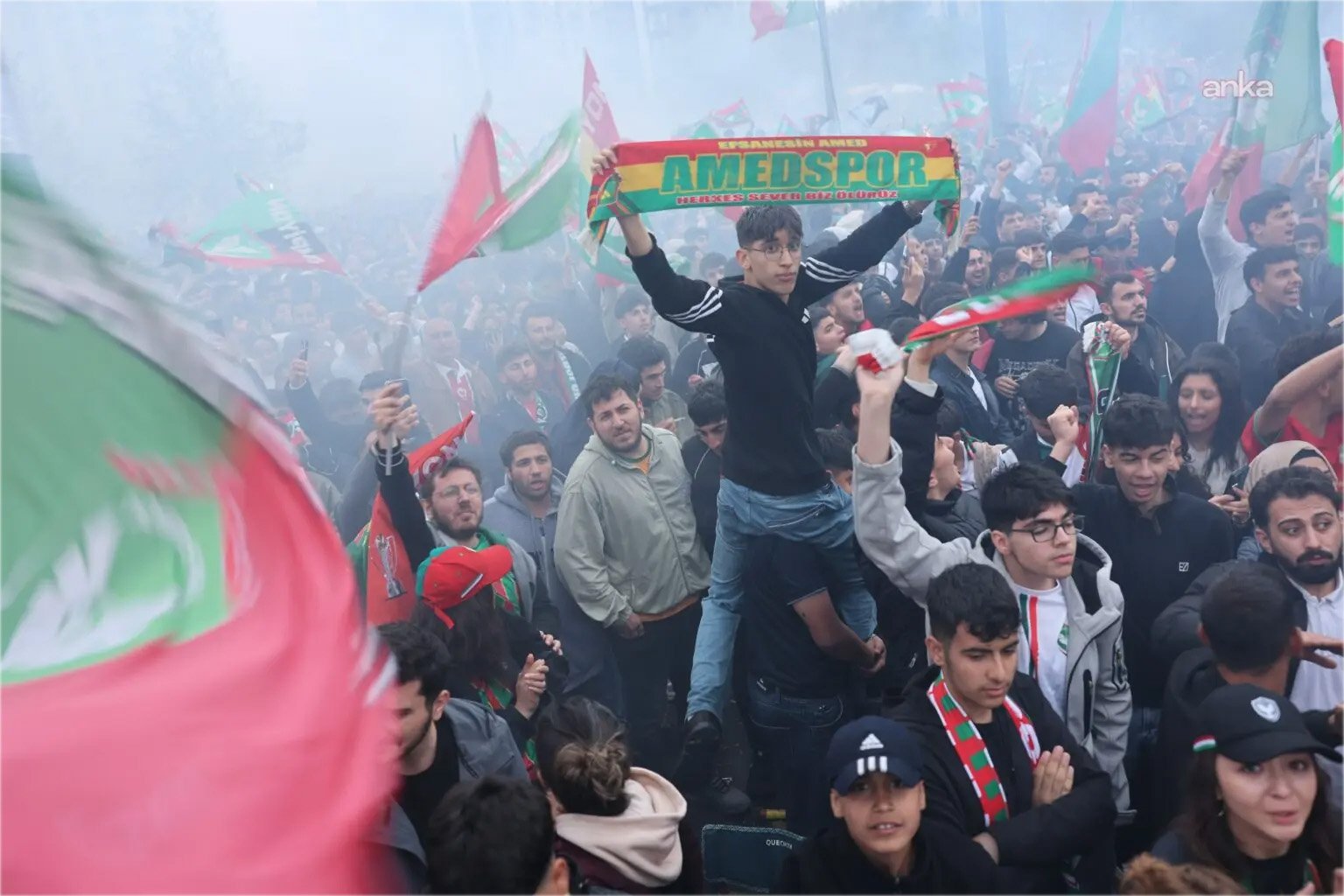
For the first time in their history, Amedspor will play in Turkey’s top division. The promotion is a football story, but only barely. It is a social and political event that brings Kurdish identity into one of Turkey’s most visible national arenas, at a time when the formal Kurdish political space is constrained, fragmented and caught between several competing centers of gravity.
Context: Amedspor’s promotion to the Süper Lig did not come easily, and for several weeks it looked like it might not come at all. After a run of poor results in the final stretch of the season, the club found itself depending not only on its own performance but on its closest rival dropping points at the right moment. Istanbul Erokspor obliged, hitting the same rough patch at the same time, and when the final calculations resolved, Amedspor had finished second, promoted though not technically top of the table. Yet the promotion was received in Diyarbakir and across much of the southeast as something larger than a club reaching a higher division. It was celebrated as a championship in the social sense. People gathered in public squares, watched on large screens and treated the result as a moment of collective pride.
Analysis: The club spent decades as a provincial municipal institution, passing through successive reorganizations and name changes (Diyarbakir Belediyespor, Buyuksehir Belediyespor, DISKI Spor) before emerging in its current form. The decisive moment was not a promotion or a cup run. It was an extraordinary congress in October 2014 that voted to rename the club Amed Sportif Faaliyetler Kulubu, adopting a new emblem drawn from the double-headed eagle on Diyarbakir’s ancient walls. What had been a municipal sports institution became, with that decision, something quite different.
The name Amed is not a PKK invention or a name conjured by modern Kurdish nationalism. It comes from the older Amid/Amida layer of the city’s history, predating both the Turkish republic and the Kurdish nationalist movement. In premodern usage the distinction was geographical: Amid referred to the city itself, while Diyarbekir referred more broadly to the surrounding region and its administrative geography. Sharaf Khan Bidlisi, the 16th-century Kurdish historian whose Sharafnama is the most important Ottoman-era Kurdish chronicle, captures this precisely, using Diyarbekir as a regional-political frame and Amad when he means the city. Ottoman-era Kurdish writers and intellectuals often used Diyarbekir themselves, without experiencing it as a Turkish-national erasure-name, because the modern binary did not yet exist. What hardened the opposition between Amed as a Kurdish recognition claim and Diyarbakir as the official state name was the republican period: the 1937 Turkification of the city’s name, followed by the PKK conflict, mass displacement and the rise of pro-Kurdish municipal politics from the 1990s onward.
This is why Amedspor should be understood as a modern Kurdish political symbol built on an older historical name. The pro-Kurdish movement, legally organized through successive parties but socially rooted in the broader Kurdish nationalist current in which the PKK has been the central force, helped turn Amed from a historical or local name into a public claim of recognition. That movement has dominated Diyarbakir’s municipal politics since HADEP (the People’s Democracy Party) won the city’s 1999 local elections, interrupted by trustee rule but not electorally displaced. The current DEM (Peoples’ Equality and Democracy Party) co-mayoralty, won back in 2024 after eight years of state-appointed rule, stands in the same lineage. Bilingual signs, Kurdish-language public communications, cultural programming and the consistent public use of Amed over Diyarbakir have all been part of how those administrations asserted the city’s identity. The 2014 name change did not invent that politics, but it gave it a national platform through football.
That is the weight the 2014 congress placed on a football club’s identity, and the response came quickly. Within months, the Professional Football Disciplinary Board fined Amedspor for using a name different from its registered TFF (Turkish Football Federation) identity. The federation did not approve the rename until August 2015. After the elected co-mayors were removed and a trustee was installed in 2016, the state-appointed administration reportedly conditioned municipal support to the club on dropping the name; the club refused. When MHP (Nationalist Movement Party) leader Devlet Bahceli responded to an opposition politician’s casual use of “Amed” in 2021 with the words “Amed degil Diyarbakir diyeceksin” (you will say Diyarbakir, not Amed), he was drawing a line that had been contested, in different arenas, since at least 2014. The name on the shirt has never been only a name.
What the Süper Lig promotion does is carry all of this into Turkey’s most watched national sporting arena, at a scale and visibility the lower divisions could never produce. Away fixtures will take Amedspor into stadiums in Istanbul, Ankara, Trabzon and Bursa. The club’s identity, its name, its fan culture and how Turkey’s institutions respond to all of the above will play out in front of a national broadcast audience, every week, for a full season. That is a fundamentally different exposure from anything the club has faced before.
The past record is not reassuring. The most serious incidents around Amedspor’s matches have not been ordinary football rivalry. When Bursaspor supporters displayed banners evoking the white Toros cars, the vehicles associated with enforced disappearances and extrajudicial killings in the 1990s Kurdish conflict, alongside imagery linked to “Yesil,” one of the figures most identified with that period’s unsolved violence, this was not fan hostility of the ordinary kind. It was a deliberate invocation of counterinsurgency memory: a reminder of a time when the state’s response to Kurdish political activity was physical elimination, and when those responsible faced no consequences. The most recent season produced further incidents, including at the away fixture in Igdir, a city in northeastern Turkey with a large Kurdish population, where sections of the crowd directed hostility and symbols at Amedspor supporters. The impulse, in all these cases, has nothing to do with football.
The Süper Lig will test these patterns at a new scale and with a new audience. Every away match becomes, in effect, a practical assessment of whether Turkish institutions can handle Kurdish visibility consistently: whether police protect the team and fans rather than treating them as a security problem to be contained, whether the federation acts on threatening and racist symbolism as it would for other clubs, whether broadcasters say “Amed” without editorial hesitation, and whether rival clubs take responsibility for what happens in their own stadiums. These are observable, falsifiable criteria. Their presence or absence across a full season will reveal considerably more about where Turkey actually stands on the Kurdish question than any formal declaration of goodwill.
Amedspor itself is worth understanding clearly, because the club is not simply a vehicle for the Kurdish political movement in the way that framing might suggest. It operates under association governance with its own elected congress, and its current president, Nahit Eren, is a former Diyarbakir Bar Association chair. The coalition around the club, bar associations, the chamber of commerce, civil society and supporter groups, reflects something more durable than a party structure: a Kurdish civic institution with deep roots in the city’s professional class, capable of sustaining itself through trustee interruptions and political pressures. Its supporter culture reinforces the point. Groups such as Barikat, Mor Barikat, Direnis and UltrAmed have organized around anti-fascism, women’s visibility and social solidarity, and their reach extends well beyond Diyarbakir, drawing in Kurds across Turkey and the diaspora who have adopted the club as a point of identification in a national arena that has offered them no equivalent before. When Amedspor plays, it is not representing a city in the ordinary sense.
Turkey is currently in the middle of a peace process between the state and the PKK (Kurdistan Workers’ Party), which has waged an armed insurgency against the Turkish state since 1984. What is known publicly is that Abdullah Ocalan, the PKK’s imprisoned founder who has been held on Imrali Island off Istanbul since 1999, has called on the PKK to disarm and dissolve, that PKK-linked structures have signaled engagement, and that Erdogan’s government has offered cautious encouragement, while the legal and political terms of any settlement remain almost entirely unresolved. Whether the process is genuinely advancing, being managed at a pace that suits the government’s domestic needs, or quietly stalling is not yet clear from the outside.
Amedspor’s promotion creates something that the top-down process, by its nature, cannot produce: a mass, popular, emotionally visible test of the Kurdish question that plays out in public. The negotiations between the state, Imrali and Qandil (the mountain range in northern Iraq where the PKK leadership is based) and the pro-Kurdish DEM Party involve a very small number of actors, happen in conditions of opacity, and generate communiques that both sides interpret according to their own needs. Amedspor is the opposite. Its results are broadcast to tens of millions of people. The way the club is treated in away stadiums, by commentators, by the federation and by political figures will be visible to everyone, and it will be difficult to manage the optics of a stadium displaying banners of 1990s killers or a broadcaster stumbling over whether to say “Amed.” In that sense, the Süper Lig season ahead is a more demanding and more legible test of where Turkey is on the Kurdish question than anything currently emerging from the formal process.
This matters because the Kurdish question has never been only about weapons or legal status, even if those dimensions remain central and unresolved. Running alongside them is a recognition question – whether Kurdish identity is permitted to exist visibly, collectively and publicly in Turkey’s national mainstream without being treated as a threat – and that question has its own logic, its own timeline and its own requirements that elite negotiations cannot fully address. A peace process can produce a ceasefire and eventually a political framework. It cannot, by itself, determine whether a broadcaster says “Amed” without anxiety, whether a stadium treats visiting Kurdish supporters as football fans, or whether the federation holds rival clubs to account for what happens in their stands. Those outcomes depend on a much broader set of institutional habits and social reflexes, and Amedspor is now forcing Turkey to reveal what those actually are.
The Kurdish political movement’s current constraints make this all the more significant. Caught between DEM’s restricted legal space, the opacity of Imrali, the distance of Qandil and an opposition with nothing credible to offer on the Kurdish question, formal Kurdish politics is not generating the kind of mass mobilization the moment might otherwise call for. Amedspor has done something the parties currently cannot: it has mobilized Kurds in a register that cuts across political affiliations, geographies and internal distinctions, emotional, civic, cultural and national at once. The celebrations in Diyarbakir were not organized by anyone. They happened because people cared, which is precisely the point.
The immediate signs after the promotion were cautiously positive. Erdogan congratulated the club. Fenerbahce and Galatasaray quoted Amedspor’s own Kurdish-language announcement, a small thing understood as a small thing, but not nothing. Symbolic recognition has always been one of the central axes of the Kurdish question, and the gesture acknowledged that Amedspor and what it represents have some place in Turkish public life. Whether that acknowledgment survives a full season of football is the question. Tokenism is easy; normalization is considerably harder. Normalization looks like Amedspor being treated as a football club with a distinct Kurdish identity, consistently and without crisis, week after week, in away stadiums across the country. That has not happened before, and there is no guarantee it happens now.
It is worth being clear about where the weight of responsibility sits. There are things Amedspor’s supporters and Kurdish political actors should be mindful of — deliberate attempts to turn every fixture into a confrontation serve nobody’s interests and provide easy cover for those who want to securitize the club’s presence. But the structural responsibility is not symmetrical. The state, the federation, broadcasters, security services, local authorities and major clubs hold far more power over whether Amedspor’s Süper Lig season becomes ordinary civic life or a recurring crisis. That asymmetry should not be obscured behind a call for balance on all sides.
What the Amedspor story reveals, in the end, is something that the formal peace process negotiations tend to obscure: that the Kurdish question in Turkey does not live only in back-channels, security frameworks and constitutional negotiating rooms. It also lives in names, stadiums, songs, broadcasts, and in the emotional lives of millions of ordinary people — and that dimension has its own tests, its own pace and its own verdicts. Turkey’s response to Amedspor in the Süper Lig will be one of those verdicts, arrived at in real time, in front of everyone. The club cannot resolve the Kurdish question. But it has placed the recognition question somewhere it will be impossible to ignore: on a pitch, in front of the whole country, every week for a full season.


