


Deterrence, Division, and Decay: How Iran Politically Contains Iranian Kurdish Armed Groups
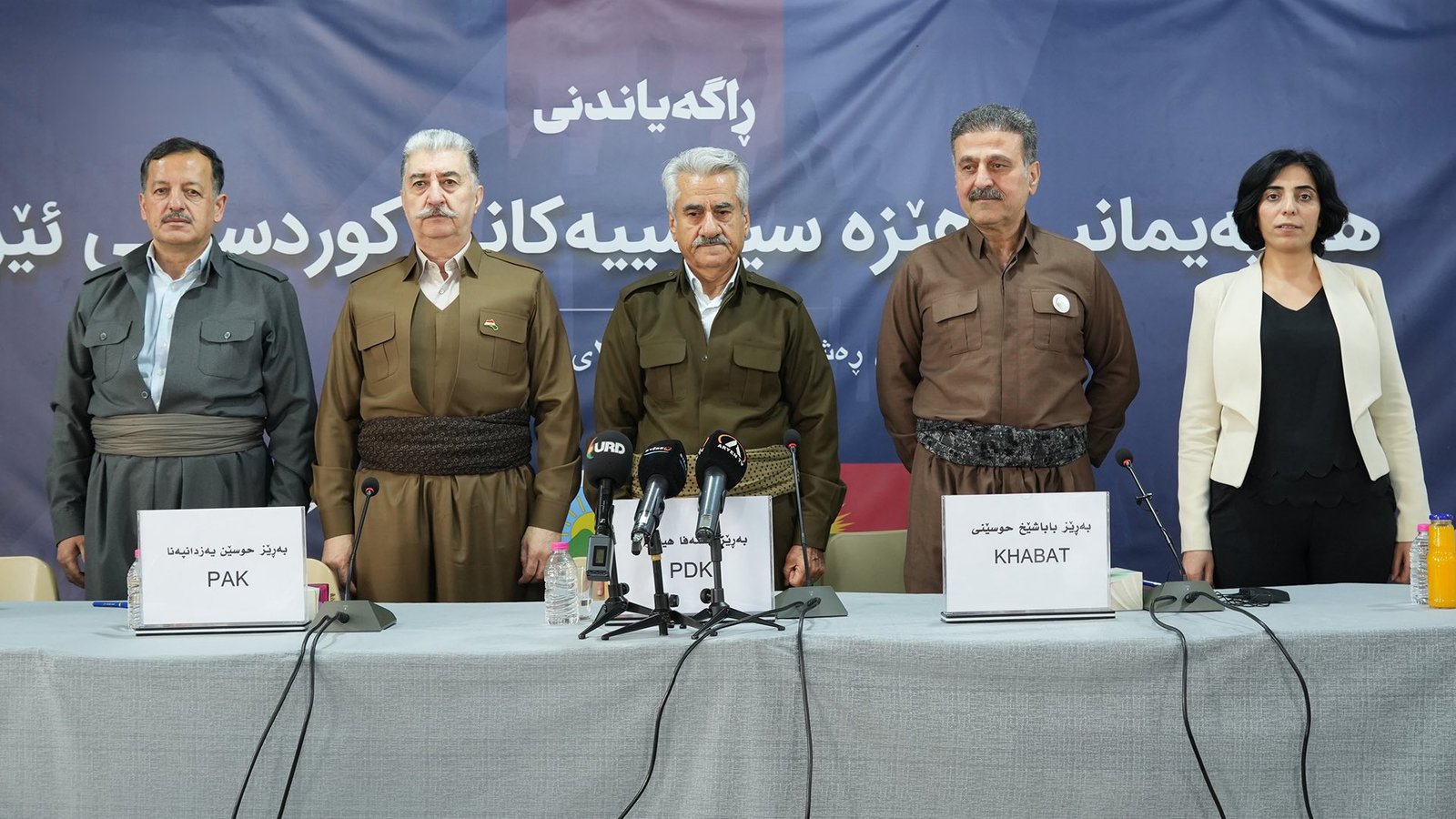
Iran’s strategy toward Iranian Kurdish armed groups is not built around concessions. It is built around political deterrence, selective differentiation, and the exploitation of organizational weakness. This political layer sat on top of the wider military and security preparations Tehran made in its western border belt, which The National Context has previously reported on, but it operats through its own distinct logic.
1. Deterrence Through the KDP and PUK
The first and most important pillar of Iran’s political strategy runs through the Iraqi Kurdish leadership. The main non-PKK Iranian Kurdish parties have been based in Iraq’s Kurdistan Region since the 1980s. They depend on that territory for organizational survival, logistics, and political space. That dependency gave Tehran leverage without requiring direct engagement on equal terms.
Iran’s clearest message is not addressed to the groups themselves. It has been addressed to the KDP and PUK. Tehran has explicitly told both parties directly that if any of these groups launched attacks into Iran, or crossed the border with the knowledge or tolerance of the Iraqi Kurdish leadership, then the KDP and PUK leadership themselves would be held responsible and targeted directly. The National Context reported this firsthand at the time. The message was the most direct and explicit warning by Iran to the two parties to date. It shifted the cost of escalation upward, away from the armed group and onto the political authorities who provide the group’s operating environment.
That threat was reinforced by physical exposure. The bases of these parties inside Iraq’s Kurdistan Region are known, surveilled, and already under daily pressure from both Iran and Iran-linked actors inside Iraq. Any attempt by the KDP or PUK to allow their territory to become an active staging ground would invite retaliation not only from Iran but from its Iraqi proxies as well. Tehran did not need to shut every route itself. It needed only to make the host environment too costly and too dangerous for meaningful escalation.
There has also been a broader geopolitical constraint. Neither the KDP nor the PUK has reason to assume that any outside backer would absorb the consequences of turning Iraq’s Kurdistan Region into a launchpad for operations against Iran. Washington under Trump is seen as unreliable. Whatever limited support Mossad or the CIA may have provided to some of these groups, as reported by the New York Times, it has not been sufficient to transform them into a serious offensive force or to guarantee protection for the Iraqi Kurdish parties that would bear the political fallout.
2. The PKK Track Is Separate
Iran does not treat the PKK-linked current the same way it treats the traditional Iranian Kurdish parties. The PKK and its Iranian affiliate operate according to a different political logic, maintain a different support geography, and make calculations that extend well beyond the Iran file alone.
The PKK’s activity in areas such as Urmia requires it to weigh not only its position inside Iran but also its wider confrontation with Turkey, its organizational interests across the region, and its relationship with constituencies whose political orientation differs from the Sunni Kurdish party milieu. In particular, its presence overlaps with the Shia Kurdish belts of Ilam and Kermanshah, populations whose relationship to the Iranian state is structured differently and whose political instincts on questions of armed opposition diverge from those of the smaller Sunni Kurdish organizations such as KDPI, Komala, and others.
Tehran’s handling of the PKK-linked file has reflected this separation. The relationship between the PKK and Iran has included periods of tactical coexistence and practical coordination, shaped by overlapping border realities, shared adversaries, and mutual utility. It has never been a relationship of deep strategic trust, but it has held when both sides saw reason to hold it. Qandil Press, an Iranian Kurdish outlet, reported that PKK and Iranian officials met prior to the current war, during which the PKK urged Tehran to negotiate a settlement with its Iranian affiliate PJAK. Iranian officials reportedly declined, though both sides agreed to continue the dialogue. It is unclear how accurate this account is, but it is consistent with the broader PKK posture. Abdullah Ocalan himself, according to PKK media, has said that PJAK should pursue a settlement with Iran along the lines of the process the PKK is now pursuing with Turkey.
The effect of this differentiation is also structural. It prevents the emergence of a unified Kurdish anti-Iranian front. Tehran des not need full alignment with the PKK. It needed only enough separation between the PKK-linked current and the other Iranian Kurdish groups to keep the field fragmented. The PKK’s own preference for a negotiated track with Tehran, rather than armed confrontation, reinforces that fragmentation from the other side. This is less partnership than divide and contain.
3. Exile, Exposure, and the Hollowing Out of the Parties
The third factor in Iran’s favour is the condition of the non-PKK groups themselves. Decades of exile in Iraq’s Kurdistan Region have transformed these organizations. Their cadres are no longer structured primarily as mobile insurgent forces. Many have married, raise families, built businesses, and developed social and economic interests that make high-risk military action far less attractive. Figures such as Hossein Yazdanpanah of the Kurdistan Freedom Party (PAK) and their extended families now hold business ventures in Erbil. The organizations remain politically active, but the social base that would sustain sustained armed confrontation has eroded.
Recruitment has stagnated. Organizational discipline has weakened. And it is highly likely that years of proximity and exposure have left parts of these groups penetrated by Iranian intelligence to varying degrees. Even where infiltration cannot be mapped precisely, the suspicion of it alone corrodes trust, slows coordination, and increases hesitation at exactly the moments when operational secrecy would matter most. Tehran’s strategy has not only constrained these groups from the outside. It benefited from the fact that they were already weakened from within.
Taken together, Iran’s political strategy toward Iranian Kurdish armed groups rested on two active tracks and one enabling condition. The first track is deterrence through the KDP and PUK, centred on the threat that the Iraqi Kurdish leadership itself would pay the price if its territory became a staging ground. The second is a differentiated approach to the PKK-linked current, aimed at keeping that file politically distinct and strategically non-unified with the rest. The enabling condition is the weakness of the remaining groups: militarily limited, socially assimilated into Iraq’s Kurdistan Region, economically entangled, and likely penetrated.
The Iranian regime’s strategy is not to try to solve the Iranian Kurdish file through compromise. It has sought to freeze it by tightening the environment around the groups, deterring their hosts, fragmenting the field, and waiting for the structural decay already under way to do the rest.


