


Mazloum Abdi at Munich: What It Was, and What It Was Not
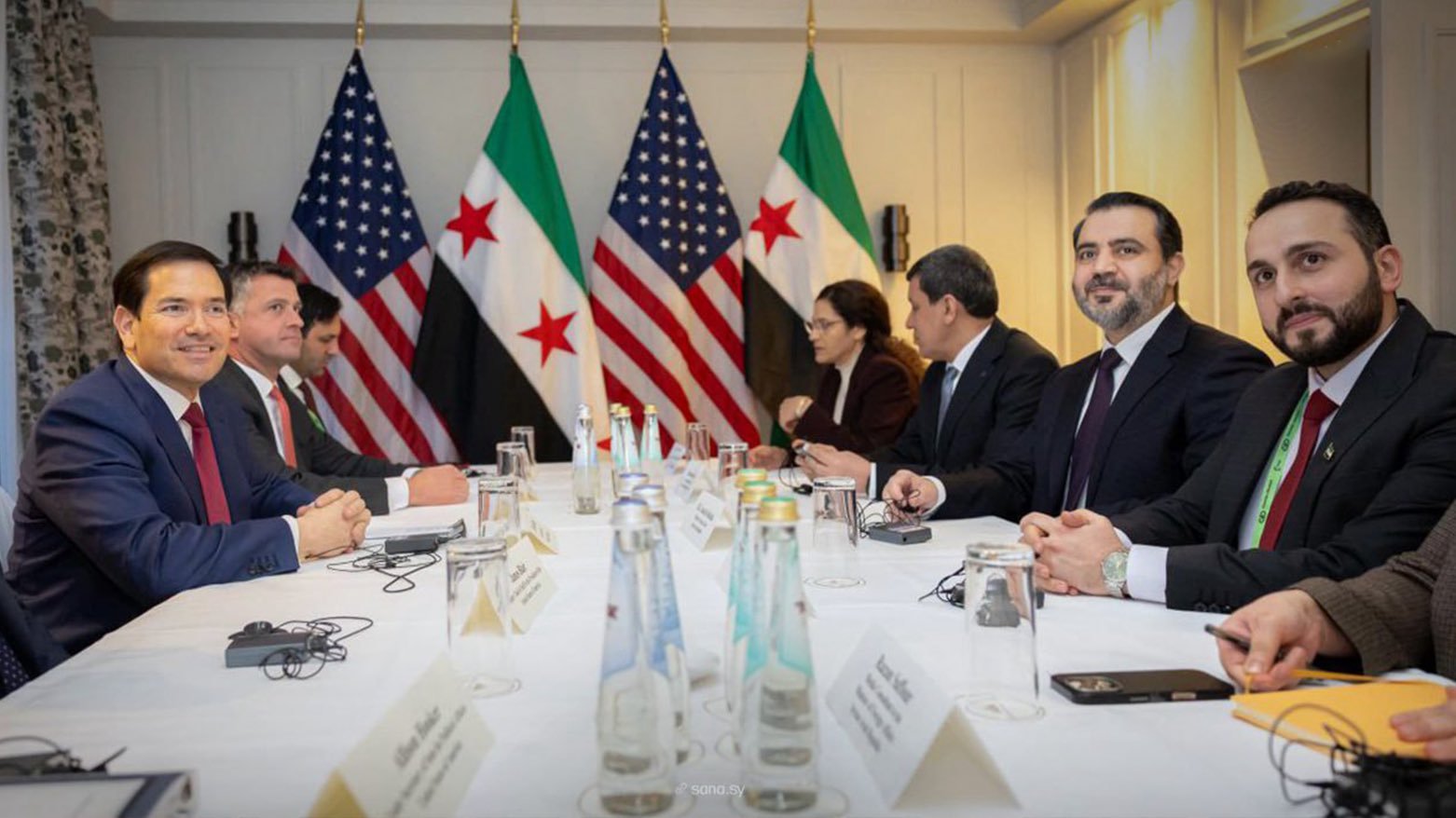
Mazloum Abdi’s participation in the Munich Security Conference mattered, but it must be understood within its proper context. Inflating its significance risks pushing expectations beyond what the conference, or the political dynamics behind it, can actually deliver.
Abdi attended as SDF commander, not as part of the Syrian foreign ministry delegation, and appears to have traveled through Erbil with Nechirvan Barzani. Reports indicate his invitation and travel were coordinated through U.S. envoy Tom Barrack and the Syrian government, meaning Damascus was briefed and consented. That detail is important for two reasons. It undercuts the Syrian government’s subsequent claim that Abdi was simply part of Foreign Minister Asaad al-Shaibani’s delegation; if that were the case, separate U.S.-brokered coordination would not have been necessary. As one source close to the Syrian government told Asharq Al-Awsat, “the Foreign Minister attended the Munich Conference alone as a representative of the Ministry of Foreign Affairs, while both Abdi and Elham Ahmed attended separately.” And it establishes that both Washington and Damascus had a stake in Abdi being seen at the conference, which raises the question of what purpose his presence served for each.
The timing points toward an answer. Abdi was never invited to Munich when the SDF controlled Deir ez-Zor, Raqqa, and parts of Aleppo and held a far stronger hand. He was invited after losing roughly 80 percent of that territory, while al-Sharaa has been on the offensive. If the invitation were about Abdi’s strength, it would have come earlier. U.S. Congressman Marlin Stutzman, in a recent interview, was notably direct about the mechanics: “We’re back to making sure that General Mazloum has a visa or a passport and is traveling with the foreign minister.” This is the language of facilitation, not observation. It suggests the United States actively arranged Abdi’s attendance, with Damascus’s knowledge, to produce a specific set of visuals.
And those visuals were carefully directed. Abdi’s joint appearances with the Syrian foreign minister were concentrated in the meetings that carried the most political weight: with Secretary of State Marco Rubio, with a bipartisan Senate delegation led by SFRC ranking member Jeanne Shaheen, and with the Saudi foreign minister. The staging was designed to project one message: the SDF and Damascus are moving together on integration. The question is who that message was primarily intended for.
The optics served multiple audiences, but the evidence is consistent with Congress being a primary target. The Trump administration is aligned with al-Sharaa and is actively drawing down U.S. forces in Syria. Congress, however, particularly Democratic members and bipartisan committee leadership, has been more sympathetic to the SDF and increasingly uneasy with the pace of Damascus’s military advances. The administration therefore has a clear interest in preventing that unease from crystallizing into a coalition that complicates the withdrawal. Showing Abdi seated alongside the Syrian foreign minister in front of senior senators communicated that integration is on track and intervention is unnecessary. Shaheen’s own readout of the meeting reinforced exactly that framing, casting it in terms of supporting the recent agreement and national reconciliation.
This congressional dynamic is also why the Shaheen delegation was more consequential than the much-discussed Graham meeting. Graham met Abdi separately, with a different group of senators; the Syrian foreign minister did not meet Graham at all, signaling tension or a deliberate choice by Damascus to avoid that channel. But Graham, for all the headlines around the Save the Kurds Act, is a close Trump ally the administration can manage. The real domestic risk lies elsewhere: with bipartisan committee leadership that shapes oversight and sets the terms of policy debate. The administration already has its Republicans in line. What it needed from Munich was for Democrats to see progress, not abandonment.
Understanding this dynamic is essential for assessing the Save the Kurds Act, which has become a source of reassurance in Kurdish circles but whose political foundations are weak. The bill was introduced by Graham and Richard Blumenthal (D-CT) and has no White House backing. To appreciate how slim those prospects are, consider that Graham’s Russia bill has Trump’s support and 84 cosponsors, and it remains stuck months after introduction. If a bill with that level of backing has no clear path, the outlook for one with a single cosponsor is far worse. This is compounded by the broader trajectory: sanctions on Syria were lifted without preconditions just one month ago. Washington is moving toward accommodation with Damascus, not toward new punitive tools. The bill retains value as rhetorical leverage, but Turkey and Damascus have capable diplomats who understand the difference between a talking point and an enforcement mechanism.
None of this made Munich meaningless for Abdi. After weeks of retreat, any high-level international platform registers as a significant shift. The conference opened channels and boosted morale. The celebratory framing in Kurdish circles is not irrational either: publicly casting Munich as an autonomy milestone sets expectations upward ahead of negotiations, and communities under sustained pressure naturally amplify recognition moments to sustain cohesion and support advocacy. These are rational political behaviors. But the conference was likely equally useful to the administration as a tool for easing congressional scrutiny of al-Sharaa’s gains and creating space for the trajectory Washington actually wants.
It is in the gap between that celebratory framing and what the evidence actually supports that the risk of strategic miscalculation lies. Recent Reuters reporting indicates U.S. officials urged al-Sharaa to allow “a degree of autonomy for Kurds” but said this was “desirable as long as it does not threaten the core need for central authority in Damascus.” That is not a robust autonomous entity. It is not a KRG-style arrangement. It is administrative decentralization within a unified state, which is closer to what al-Sharaa himself has been offering than to the maximalist Kurdish interpretation. The same reporting flags what remains unresolved: heavy weapons, the Iraq border crossing, the oil fields, and Qamishli airport. These material questions, not conference appearances, will define the real boundaries of any self-rule. Washington wants a workable formula for Kurdish self-administration inside a unified Syria as part of a stabilization model, not a commitment to underwrite open-ended autonomy.
This limited scope of U.S. ambition becomes even clearer when set against the broader geopolitical context. Abdi met informally with European leaders at Munich as well, but European engagement on this file, however well-intentioned, carries little practical weight. Europe has no hard-power leverage over outcomes in northeast Syria. The actors with real capacity to shape what happens are the SDF itself, the United States, and Turkey. And the relationship between the latter two has shifted in ways that matter directly for the SDF’s prospects. The geopolitical reality of 2026 is not the unipolar moment when Washington could dictate terms to regional partners. Turkey now plays a larger role in shaping its neighborhood, and the U.S. needs Ankara across multiple files more than it once did. That dependency makes Washington far less willing to strain the alliance for the SDF’s sake. Under Trump, no meaningful sanctions have been imposed on any state for human rights abuses or attacks on minorities, which tells its own story about where Washington’s priorities lie. The practical implication for the SDF is straightforward: if it wants to survive in any meaningful form, it needs to develop a channel to Ankara, not rely solely on Western audiences and Western stages.
Against this backdrop, the most consequential signal from the Munich period came not from the conference floor but from Rubio’s press conference, and what he said deserves closer attention than it has received. Rubio stated the U.S. urged al-Sharaa to halt attacks on the SDF to allow two things: the relocation of remaining ISIS detainees and the implementation of the integration agreement. The logic is sequential and conditional. If integration advances, the pause holds and a political settlement takes shape. If it stalls, Washington has effectively signaled it will not stand in the way of renewed military pressure. That is conditional restraint, not a security guarantee, and the distinction matters enormously for how the SDF should calibrate its next moves.
The conditionality carries even more weight given how much the SDF’s position has eroded. Its major territorial holdings are gone. Most U.S. bases are being vacated. The ISIS detainee and camp files are nearly spent as sources of international leverage. What the SDF retains sits largely within 20 kilometers of the Turkish border, which makes Ankara’s role not just important but decisive, and renders any arrangement that ignores Turkey structurally unviable. This geographical reality also constrains the SDF’s negotiating posture: pushing maximalist demands in mixed areas like Hasakah, Qamishli, and Tal Tamr risks alienating the Arab tribal and Christian communities whose consent any local governance arrangement would require. The SDF cannot afford to treat this as a bilateral contest with Damascus. There are far more actors and interests at play.
Given this eroded position, the trajectory of events on the ground becomes critical. After recapturing roughly 80 percent of formerly SDF-held territory, most of it Arab-majority, it is strategically rational for al-Sharaa to pause, absorb what he has taken, and recalibrate before approaching the more complex remaining zones. The areas still outside Damascus’s control are different in character from what has already been recaptured: they include mixed cities, Kurdish-majority pockets, and economically strategic assets that each require a different calculus. If al-Sharaa moves again, the pattern will likely be selective. Kobani, a compact Kurdish pocket, is costly to take and of limited strategic value. But the oil fields at Rumeilan and Suwaydiyah, the Semelka border crossing, and the mixed cities of Hasakah, Qamishli, and Tal Tamr are different. These are the remaining pillars of any meaningful autonomy: revenue, an external border link, and administrative control in mixed areas. Al-Sharaa, backed by Turkey, has both the incentive and the capacity to press on all of them.
This is why the realistic ceiling for Kurdish self-rule is lower than the current discourse suggests. Al-Sharaa is unlikely to accept SDF control of the oil fields or agree to revenue-sharing. He and Turkey will push for Semelka to revert to central authority. Long-term SDF governance in Hasakah, Qamishli, and Tal Tamr is difficult to envision given their mixed demographics and strategic importance. What Damascus may tolerate is limited self-rule in predominantly Kurdish pockets where the cost of force is high and the strategic return is low: Kobani, Amuda, Darbasiyah, and Derek (al-Malikiyah). That is likely the outer boundary of what will be conceded.
However, the SDF still has enough force to complicate al-Sharaa’s effort to reach that outcome. Qamishli, for instance, despite its mixed demographics, carries a special status in the Kurdish psyche as the capital of Syrian Kurdistan. The ultimate arrangement in these areas will hinge on who can impose and shape realities on the ground.
Ultimately, two issues will determine whether even that limited arrangement holds: the fate of the Rumeilan and Suwaydiyah oil fields, and control of the Semelka border crossing. Those outcomes, not conference optics, will reveal whether the SDF retains any meaningful autonomy and whether Munich is remembered as a genuine opening or a morale moment misread as a turning point.


