


Syria Needs to Rebuild an Army. Turkey Wants to Build the System.
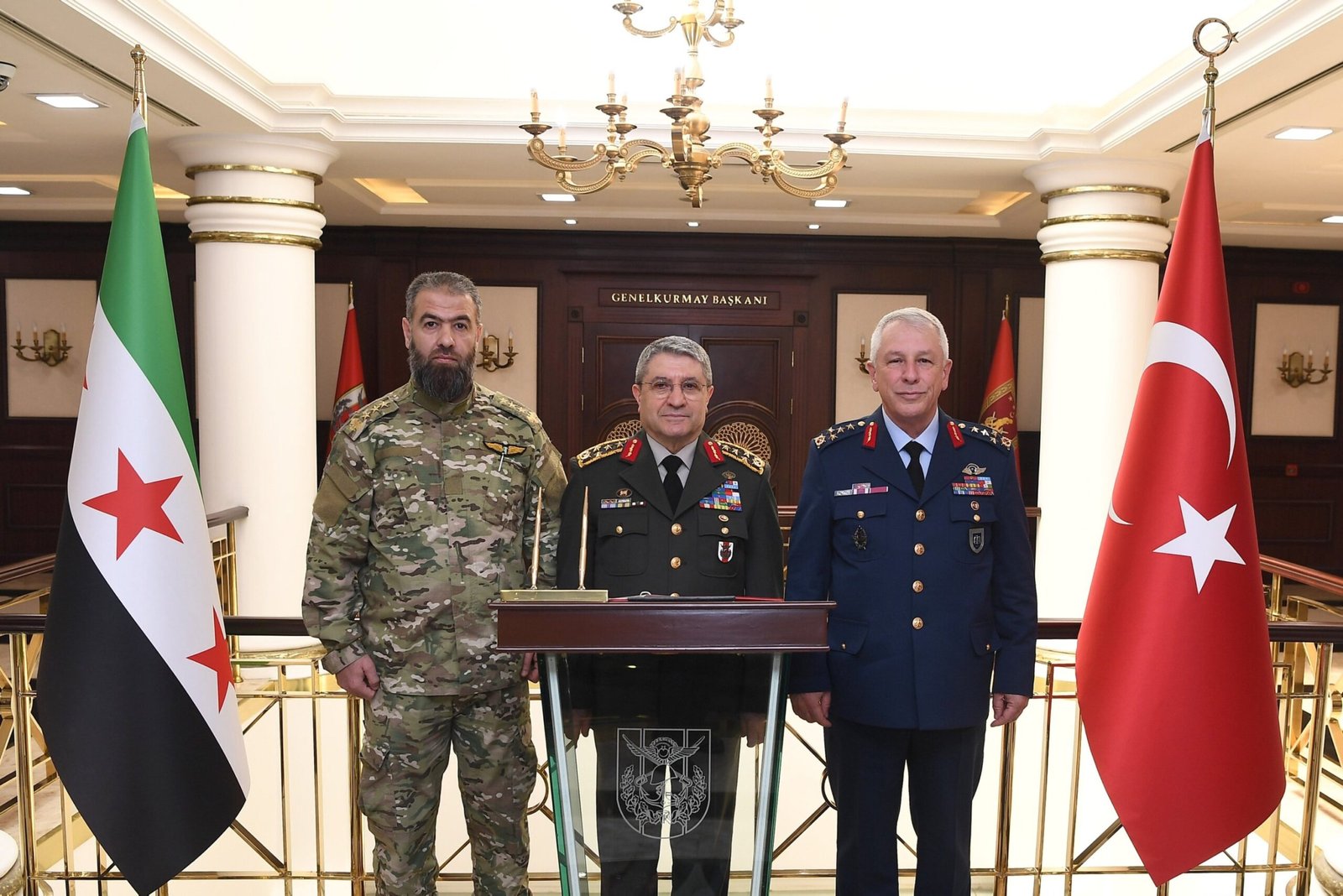
Israel has grown increasingly concerned about Turkey’s military role in the new Syria. Much of that concern has focused on the most immediate threat: Turkish troops, prospective bases and advanced systems that could restrict the Israeli air force’s freedom of action. Israeli strikes on Syrian military facilities that Ankara was reportedly considering using showed how seriously Israel views the possibility of a larger Turkish presence.
Ahmed al-Sharaa, the former rebel commander who took power after Bashar al-Assad’s fall, is pursuing a different objective. He appears determined to rebuild Syria as a significant regional power, including restoring a military badly damaged by more than a decade of war, without exchanging Syria’s old dependence on Russia for dependence on Turkey. Damascus has therefore cultivated Saudi Arabia and other Gulf states, reopened military relations with Moscow and maintained ties with the United States and Europe while keeping Turkey as its closest military partner.
The problem is that al-Sharaa has much less room to manoeuvre than this diplomatic balancing suggests. The international system is becoming more militarised at precisely the moment Syria needs to reconstruct almost every layer of its armed forces. Russia is consuming enormous quantities of equipment in Ukraine, European states are rearming in response to Russia, and the United States is rebuilding its own inventories after the Iran war. Washington has now warned allies that deliveries of some key missiles and air-defence systems may be delayed by as much as five years.
Rebuilding a powerful military is much harder than maintaining diplomatic relations with several competing powers. Aircraft, radars, air defence, communications, command systems, missiles, ammunition, logistics and training have to function together. Wealthy states with sophisticated defence industries can integrate equipment from many suppliers. Syria, with limited resources and damaged military institutions, cannot easily assemble a coherent modern force out of unrelated systems from five or six different countries.
Al-Sharaa therefore faces a basic strategic constraint. If he wants the powerful Syrian military he appears to envisage, one relationship will probably have to become deeper than the others. His task is to gain the capabilities that such alignment provides while preventing the principal partner from acquiring enough leverage to constrain Syrian policy. Russia, Saudi Arabia and other relationships can widen his options, and none of them currently offers an equivalent pathway for rebuilding the Syrian military as a whole.
Turkey is the exception, for reasons of geography, of years of involvement in Syria, and of timing. Its defence industry has reached a new stage of development at the moment when the traditional suppliers of complete military systems are least able to absorb another large customer. Turkey is therefore unusually close to being the only country that currently combines everything Syria requires at once: a broad defence-industrial base, comparatively affordable systems, available production, geographic proximity, political willingness and direct access to the institutions rebuilding the Syrian military.
Israeli policy may be strengthening that position. Israel has immediate security concerns about military capabilities developing across its northern frontier, and Turkish deployments in Syria could create direct operational problems for the Israeli military. Repeated Israeli strikes on Syrian military infrastructure, combined with Israeli opposition to the deployment of certain Turkish capabilities, also make the question of who will help Damascus regenerate military power more urgent. If Syria intends to rebuild despite Israeli pressure, its practical choices narrow further and Turkey becomes increasingly difficult to avoid.
For Ankara, Syria represents something larger than another friendly government buying Turkish weapons, because Turkey is itself trying to change the nature of its defence exports. Haluk Gorgun, who heads the agency that directs Turkish military procurement, said this year that Turkey was increasingly being sought out as a “defence ecosystem” rather than as a supplier of products. He described an industry extending from design and manufacturing through subsystems, software and ammunition to maintenance and sustainment, and emphasised joint production and long-term industrial relationships with foreign partners. Those relationships create recurring demand and more durable political links than individual platform sales.
This is already visible in smaller forms elsewhere. In Somalia, Turkey has spent years training national forces and has now committed under a ten-year agreement to build, train and equip the Somali navy. In Azerbaijan, years of Turkish training and joint exercises have created unusually deep interoperability, including repeated land and air exercises built around joint operational planning and coordination. The two cases demonstrate different parts of the model: Somalia shows institution-building, and Azerbaijan shows how deep military interoperability can develop without eliminating the partner state’s political autonomy.
Syria would be a different undertaking altogether. It has a much larger population and historically maintained substantial land forces, air defence, aviation and naval capabilities, much of which now has to be rebuilt at the same time. If Turkey becomes central to that process across several services and technologies, it would provide the first major test of whether Ankara can move from being a successful arms exporter to becoming an exporter of military ecosystems.
That distinction matters more than the base count. Turkey’s strategic opportunity in Syria may ultimately rest on whether it becomes the system within which Syrian military power is generated. That would mean educating officers, training formations, supplying communications and command software, providing radars and electronic warfare, producing weapons and ammunition, maintaining the equipment and offering the next generation of systems as Syrian capabilities develop.
For Syria, such a relationship could solve a practical problem. Turkey can supply much of what Damascus needs at prices and quantities that are more realistic than the highest-end Western alternatives, while providing capabilities progressively as Syrian finances and institutions recover. Al-Sharaa could continue balancing politically between Turkey, Russia, the Gulf and other powers while accepting that the military relationship with Ankara has to be deeper than the rest.
For Turkey, the calculation could be equally important. A Syrian military operating increasingly inside a Turkish defence ecosystem would give Ankara durable influence over its most strategically important Arab neighbour without requiring direct command over Syrian forces.
This produces the central puzzle. Al-Sharaa wants to build an independent Syrian power centre and minimise the leverage of any foreign patron, while Turkey wants to expand its regional influence and increasingly presents its defence industry as an integrated ecosystem that can be exported abroad. The international arms market leaves Syria with fewer realistic alternatives than it would have had a decade ago. Those ambitions may therefore be more compatible than they first appear. Syria needs an anchor to rebuild military power while trying to preserve political autonomy, and Turkey needs a state large and important enough to demonstrate that its defence model can extend beyond individual arms sales and limited partnerships. Syria may provide both.
A head start inside the institutions
The extent of Turkey’s head start is already visible in the way the Syrian military is being rebuilt. Ankara entered the post-Assad period with years of experience training, financing and working alongside factions of the Turkish-backed Syrian National Army, many of which were subsequently incorporated into the new Ministry of Defence. Syria’s first attempt at military unification largely absorbed existing armed groups into official divisions without immediately eliminating their internal structures, leaving the new army with much of the organisational legacy of the war. Turkey therefore began the transition with relationships inside formations that were already becoming part of the state.
That legacy is only part of Turkey’s advantage. The more significant development is the shift from influence through individual factions to direct cooperation with the Syrian military institution. The defence agreement signed in August 2025 established a framework for Turkey to provide weapons systems and logistical equipment while helping with training, consultancy, experience-sharing and strategic planning, and it was described at the time as the first concrete step in a broader effort to restructure Syria’s armed forces. The significance lies in the combination: Ankara is involved in how the force is being developed while also positioning itself to supply the equipment that force will eventually require.
Military education provides the clearest example of how far this relationship extends upstream of weapons procurement. Within days of the August agreement, the head of Syria’s military training authority led delegations through Turkey’s National Defence University, including its land, naval and air-force institutions, to discuss cooperation in military education and training. The relationship then moved beyond visits. By October, 49 Syrian cadets had entered Turkish military academies, including 10 from the land forces, 18 from the navy and 21 from the air force. Syria also sent officer cadets to Saudi Arabia, which underlines Damascus’s desire to diversify, while the Turkish programme forms part of a much wider institutional relationship that continued to expand through 2026.
A further Syrian Defence Ministry delegation returned to the National Defence University in June 2026 to discuss the expansion of military education, professional development and joint training. The immediate numbers should not be exaggerated, and the type of personnel involved matters. Training a few hundred soldiers improves individual units. Educating future officers across all three services begins to shape the professional class that will later make decisions about force organisation, doctrine, procurement and operations. What will matter over the coming years is how many future commanders come to know Turkish institutions and methods.
The relationship has also moved from military education into operational training. Syrian army units participated in Turkey’s EFES-2026 exercise in May, the first time the new Syrian army had taken part in a military exercise outside the country. Syrian personnel trained in an environment involving land, naval and air operations, while Syria’s chief of general staff attended and met his Turkish counterpart. The Syrian Defence Ministry said the exercise was intended to expose its forces to modern combat methods and joint planning mechanisms, and Turkey described Syrian participation as part of its support for the army’s reconstruction. Syria has not adopted Turkish doctrine, and repeated education and exercises create familiarity with Turkish planning, coordination and operational procedures before many of the new army’s own practices have settled.
Turkish involvement is also spreading across the services, beyond the land forces and the former opposition networks. In July, the commander of the Turkish navy travelled to Latakia aboard the frigate TCG Istanbul and met the Syrian naval leadership. Turkey’s Defence Ministry said the visit formed part of efforts to support the restructuring of the Syrian armed forces and develop the capabilities of the Syrian navy. For a navy that will eventually require significant reconstruction, early Turkish involvement creates the possibility that training, systems and future procurement develop together rather than through unrelated relationships.
The material side of the relationship is less transparent, and it is developing in parallel. The August agreement provides a mechanism for Turkey to supply Syria with weapons systems and logistical equipment and to train Syrian personnel to operate them. Turkish officials subsequently discussed a package extending across armoured vehicles, drones, artillery, missiles and air defence. Public information does not yet provide a reliable inventory showing how much of that equipment has entered Syrian service, so it would be premature to describe Syria as a Turkish-equipped military. What matters at this stage is that the categories under discussion already span several components of a combined-arms force.
This is what makes the timing of Turkish involvement significant. Many of the most consequential procurement decisions of the new Syrian military have not yet been locked in. Syria will eventually have to decide how to rebuild its communications, command networks, air defence, aviation, logistics and maintenance systems, and Turkey is already working with the institutions and personnel that will help define those requirements. A supplier that arrives after those choices have been made is competing for individual contracts. A partner involved while the force itself is being designed has an opportunity to shape the environment in which those contracts are awarded.
The shift from wartime proxies to state institutions therefore deserves particular attention. Al-Sharaa has been trying to impose a state monopoly over arms and reduce the autonomy of the factions that were initially folded into the new military. Syrian officials now describe the integration of armed groups as part of a wider effort to rebuild national defence institutions and ensure that weapons remain under state control. In one sense, that process weakens Turkey’s old form of influence by reducing the independence of commanders and formations that once depended directly on Ankara. In another, it opens the possibility of a more durable relationship in which Turkish influence is tied to the Syrian military establishment itself.
Influence over a militia depends heavily on personal relationships, financing and the political circumstances that allow the militia to remain autonomous. Institutional influence can survive commanders, governments and individual procurement decisions. If Syrian officers are educated in Turkey, units train with Turkish forces, naval institutions develop with Turkish assistance and future equipment is supplied through Turkish industrial networks, the relationship becomes distributed throughout the military rather than concentrated in a handful of allied factions.
Syria is still far from that point, and Damascus is clearly trying to preserve alternatives. Its officer corps is not being educated exclusively in Turkey, Russia has returned through new joint training arrangements, and other regional states are being cultivated as military partners. Turkey has established no monopoly. Its distinction is that no other external actor is currently involved across as many layers of the rebuilding process at the same time. Institutional access gives Ankara the first part of the equation. The second is whether its defence industry is broad, affordable and scalable enough to turn that access into the underlying material architecture of the Syrian military.
An industry shaped for a poor client
Syria’s economic circumstances make the character of Turkey’s defence industry particularly important. The World Bank estimates that repairing the country’s physical destruction alone will cost about $216 billion, including $82 billion for infrastructure. Syria therefore has to rebuild its military while simultaneously financing electricity, housing, roads, water networks and the wider reconstruction of the state. It cannot approach military procurement as Saudi Arabia or another wealthy Gulf country does, buying small numbers of the most expensive systems available and sustaining several separate supply chains. It needs large quantities of equipment at manageable prices and a military that can become more sophisticated gradually as the economy recovers.
Turkey’s defence industry has developed in a way that fits those requirements unusually well. Its principal advantage is the breadth of equipment it can provide across different levels of cost and sophistication, and several Turkish systems remain behind their Western equivalents at the high end. Turkish companies now produce small arms and ammunition, armoured vehicles, artillery, guided munitions, tactical and long-endurance drones, electronic warfare, tactical communications, command-and-control systems, radars, anti-tank weapons, cruise and ballistic missiles, layered air defence, helicopters, training aircraft and naval platforms. More than 4,500 companies now operate within the wider Turkish defence sector, compared with 56 in 2002.
That breadth allows Syria to enter the Turkish system at the level it can currently afford rather than waiting until it can finance a high-end military. Infantry formations can be equipped and supplied before the country rebuilds sophisticated air defence. Tactical drones and communications can precede advanced unmanned combat aircraft. Basic training and light combat aviation can develop before Syria can sustain a modern fighter fleet. As Syrian requirements become more demanding, Turkey can increasingly offer the next level of equipment without Damascus having to reconstruct the training, software, ammunition and maintenance relationships surrounding the previous generation.
This progression matters most in communications, electronic warfare and command-and-control, where the distinction between hardware and software becomes less meaningful. ASELSAN and HAVELSAN produce much of the electronic architecture connecting Turkish platforms, while Roketsan supplies missiles and precision munitions and a much larger industrial network provides ammunition, vehicles, sensors and support equipment. Turkish systems have also been tested for interoperability with NATO networks, including communications, command-and-control and the HISAR and SIPER air-defence systems. For Syria, the attraction is the possibility of acquiring several systems designed from the outset to work together, which is a different proposition from buying a Turkish drone or missile.
Turkey is already exporting this model in less comprehensive forms. A recent German study found that African customers purchasing Turkish UAVs increasingly operate within a wider Turkish ecosystem rather than buying isolated aircraft. A drone sale can bring Turkish precision munitions, electro-optical equipment, data links, communications, software, ground stations, training, maintenance and spare parts into the same military. ASELSAN and HAVELSAN then enter either directly or through their integration with other Turkish platforms, providing radars, tactical communications, electronic warfare and command systems. The study describes Turkish companies as building integrated ecosystems around platforms, munitions, electronics, training and maintenance.
Syria would be a much larger test of the approach than Somalia or Azerbaijan. It is rebuilding several military services simultaneously and has not yet fixed the technical architecture that will connect them, which would require Ankara to integrate legacy systems and supply large quantities of relatively basic equipment while introducing increasingly advanced technologies. If Turkish systems became central across communications, training, ammunition, drones, air defence and maintenance, Syria would demonstrate the model at the level of an entire national military rather than a particular capability or service.
The wider international environment makes this opportunity more unusual. Global demand for weapons is rising at the same moment Syria is trying to rearm. International transfers of major arms rose by 9.2 per cent between 2016-20 and 2021-25, the largest increase in a decade, and Europe’s arms imports increased by 210 per cent as governments responded to Russia’s invasion of Ukraine and to growing uncertainty over future American security commitments. Much of the world’s production is already claimed by states with more money and more urgent existing commitments, so Syria is not choosing among several fully available suppliers competing for its business.
The United States illustrates the problem. It remains by far the world’s largest arms exporter, accounting for 42 per cent of global major-arms exports in 2021-25, and possesses a more complete military-industrial ecosystem than any other country. American capacity is being pulled simultaneously by US requirements, Ukraine, European rearmament, Israel, Taiwan and wealthy Gulf partners, and the strain is particularly visible in air defence and precision munitions. Lockheed Martin is investing billions of dollars to expand production of PAC-3, THAAD and other missiles, while the Pentagon has begun bringing additional industrial suppliers into Patriot production in response to heavy global demand. The question for Syria is therefore whether Damascus would receive priority in an already congested system, quite apart from the political restrictions on such a relationship.
Russia faces the opposite problem. It remains deeply familiar with Syria’s inherited military infrastructure, can continue to support Soviet and Russian-origin systems, and retains a new institutional foothold through the joint training arrangements established at its former Syrian facilities. Its ability to act as a global arms supplier has contracted sharply as its defence industry concentrates on the war in Ukraine, with Russian major-arms exports falling by 64 per cent between 2016-20 and 2021-25 and its global share dropping from 21 per cent to 6.8 per cent. Russia can remain an important hedge and specialist partner for Damascus, and reconstructing the Syrian military on the scale once associated with the Soviet relationship would require diverting equipment and industrial capacity that Moscow increasingly needs for itself.
Europe has considerable technological capacity and is undergoing its own rearmament. European governments are trying to expand ammunition stocks, air defence, armour and long-range strike capabilities after decades of relatively low inventories. France and other European producers can offer Syria sophisticated individual systems, and Syria would be competing for manufacturing capacity against European governments with much larger budgets and immediate security concerns. That makes Europe more plausible as a future supplier of selected high-end capabilities than as the principal partner responsible for equipping the Syrian military at scale.
China is the strongest industrial counterexample. It has the breadth, manufacturing capacity and relatively affordable equipment required to supply most categories of a Syrian force. Its limitation is political and institutional. Beijing has not spent years working with the commanders and institutions of the new Syrian state, does not share a border with Syria and has not established an equivalent programme of military education, training and organisational assistance. China could become an important supplier later, particularly if Damascus deliberately seeks an alternative to Turkish systems, and it would be entering a military environment in which Turkey already holds substantial first-mover advantages.
The remaining partners Damascus is cultivating do not currently offer an alternative ecosystem. Saudi Arabia can provide money, political support and military education. Jordan is important for border security and specialised training. Qatar could become relevant through financing and defence-industrial cooperation, while Pakistan has useful expertise in training, ammunition and aviation. These relationships increase Syria’s bargaining power and reduce the political leverage of any single state, and none of them presently combines the industrial breadth and institutional access necessary to rebuild the Syrian military across several services.
Turkey, meanwhile, is actively expanding its exports, which have roughly tripled since 2021 and passed $11 billion on a rolling 12-month basis by mid-2026, with customers attracted partly by cost, adaptability and faster supply chains. Syria needs a broad, relatively affordable military partner at almost exactly the moment Turkey is trying to prove it can become one. The question that matters is therefore whether Turkey becomes the system into which Syria increasingly integrates everything else.
Influence that would be hard to see
If this relationship develops as Ankara appears to hope, its significance will be easy to underestimate, because much of the resulting influence would be difficult to see. A Turkish airbase can be photographed and a troop deployment counted. Dependence on military education, software, communications standards, ammunition, maintenance and supply chains is less visible, and it can be considerably harder to unwind. This is why the number of Turkish bases in Syria may ultimately prove a poor measure of Turkey’s position there.
Syria would not need to become exclusively Turkish-equipped for the model to work. Azerbaijan is the useful example: its deep military relationship and interoperability with Turkey have not prevented it from acquiring major Israeli systems or maintaining other defence relationships. Syria could do the same, retaining Russian equipment, sending officers to Saudi institutions, obtaining specialised systems from China or Pakistan and cooperating with the United States in selected areas while the architecture connecting much of the force remains predominantly Turkish. Russia’s continued presence illustrates the logic. Under the August agreement between Moscow and Damascus, Russia retains personnel in Syria while its military facilities are being reconfigured partly as joint training centres, and Russian vessels resumed supplying the coastal facilities in September.
The result could be a Syrian strategy in which diversification constrains the leverage of the anchor rather than avoiding an anchor altogether. That is a more workable model for a state trying to rebuild military power quickly. Damascus would retain bargaining options and access to technologies Turkey cannot provide competitively, while avoiding the financial and technical costs of integrating every major component of the armed forces around a different foreign supplier. Turkey, meanwhile, would have to remain attractive enough that Syria chooses to stay within its ecosystem rather than being forced to.
This also explains why Ankara may prefer structural influence to more visible forms of control. Permanent bases and large deployments generate political resistance inside the host country, create obvious targets for adversaries and can turn bilateral disputes into immediate military crises. A defence ecosystem operates through the sovereign institutions of the partner state. Syrian officers would command Syrian units and Damascus would formally control procurement decisions, while Turkey could still become difficult to replace, because those decisions would increasingly be shaped by earlier choices in training, communications, ammunition and maintenance.
The mechanism is cumulative. Once an army adopts a communications network, training system and particular families of weapons, subsequent choices are no longer made from scratch. A new Turkish air-defence system becomes easier to integrate with Turkish radars and command software already in service. Turkish ammunition becomes easier to procure when units are equipped around compatible weapons and logistics. Officers familiar with Turkish procedures require less retraining when new Turkish platforms arrive. Maintenance facilities, spare-parts stocks and technical personnel then reinforce the same logic. None of these decisions makes switching impossible, and together they raise its cost.
Success would therefore have consequences beyond Syria. A functioning Syrian force built substantially around Turkish training, electronics, weapons, ammunition and maintenance would become a reference case for Turkish defence companies seeking markets in Africa, the Middle East and parts of Asia. Turkey would be able to offer governments a pathway for building military capability over time with one supplier network capable of moving from relatively inexpensive equipment to more sophisticated systems as resources increase. That would distinguish the Turkish offer from both low-cost platform sales and the considerably more expensive military relationships traditionally offered by major Western powers.
There are clear limits to the argument. Turkey’s industrial capacity is expanding rapidly, and demand for its equipment is expanding with it, with defence exports already growing by more than a quarter year-on-year in the first seven months of 2026. Some of its most advanced programmes remain under development, and Syria’s requirements could eventually exceed what Turkey can provide competitively in particular categories. Turkish and Syrian political interests could also diverge, while Damascus may deliberately prevent any external partner from controlling especially sensitive systems. The ecosystem outcome is a trajectory rather than a settled fact.
The next few years should make it possible to test it. The clearest indicators will be who builds the communications and command network linking the Syrian armed forces, who provides the radars and integrated air-defence architecture, where successive generations of officers and specialists are educated, whose ammunition and maintenance infrastructure becomes standard, and which country eventually plays the leading role in reconstructing Syrian military aviation. These are the systems around which individual weapons purchases will have to fit, and they will say more than another Turkish armoured vehicle appearing in a Syrian parade.
The air force may become the most revealing test. Aircraft are among the most expensive and institutionally demanding capabilities a military operates, requiring pilots, ground crews, simulators, weapons, data links, maintenance and decades of support. If Syria eventually moves from basic training and legacy aircraft towards Turkish trainers, unmanned combat aircraft and later more advanced platforms, the relationship would extend far beyond the relatively inexpensive capabilities Ankara can provide today. The same logic applies to integrated air defence and naval reconstruction, where the value of common sensors, software, ammunition and maintenance is particularly high.
These developments will also show whether Israel’s current focus captures the longer-term transformation taking place to its north. Israel has understandable reasons to care immediately about Turkish aircraft, air-defence systems or military facilities in Syria, because those could change operational conditions quickly. Preventing Turkey from establishing a particular base would not prevent Syria from becoming increasingly integrated with the Turkish military-industrial system, and it could leave the most consequential part of the relationship largely untouched.
The larger change would be subtler. Turkey spent much of the Syrian war exercising influence through troops, territory and allied armed groups. If the current trajectory continues, its strongest position in the next Syria could come through a more conventional relationship with a stronger central state: Syrian officers educated through Turkish institutions, Syrian units connected through Turkish systems and Syrian military modernisation increasingly supplied by Turkish industry. Ankara could lose some of the direct control associated with the fragmented Syria of the civil war while gaining a form of influence that is more institutional and potentially more durable.
That is also why al-Sharaa’s ambitions and Turkey’s ambitions can run together. The Syrian president needs outside support to build enough military power to increase his own room for manoeuvre, while Turkey benefits if that power is built through systems it supplies and helps sustain. Damascus will continue trying to prevent the relationship from becoming dependence, and Ankara will continue trying to make itself difficult to replace. The tension between those two objectives will shape the relationship.
Syria therefore represents more than a large prospective market for the Turkish defence industry. It may become the first major demonstration of whether Turkey can export the interconnected institutions, technologies and supply chains that allow another country to generate military power. If it succeeds, Ankara will have achieved something substantially more consequential than securing another base in Syria: it will have shown that a rising middle power can export a military ecosystem of its own.


