


Peshmerga Unification Codifies the KDP-PUK Military Divide
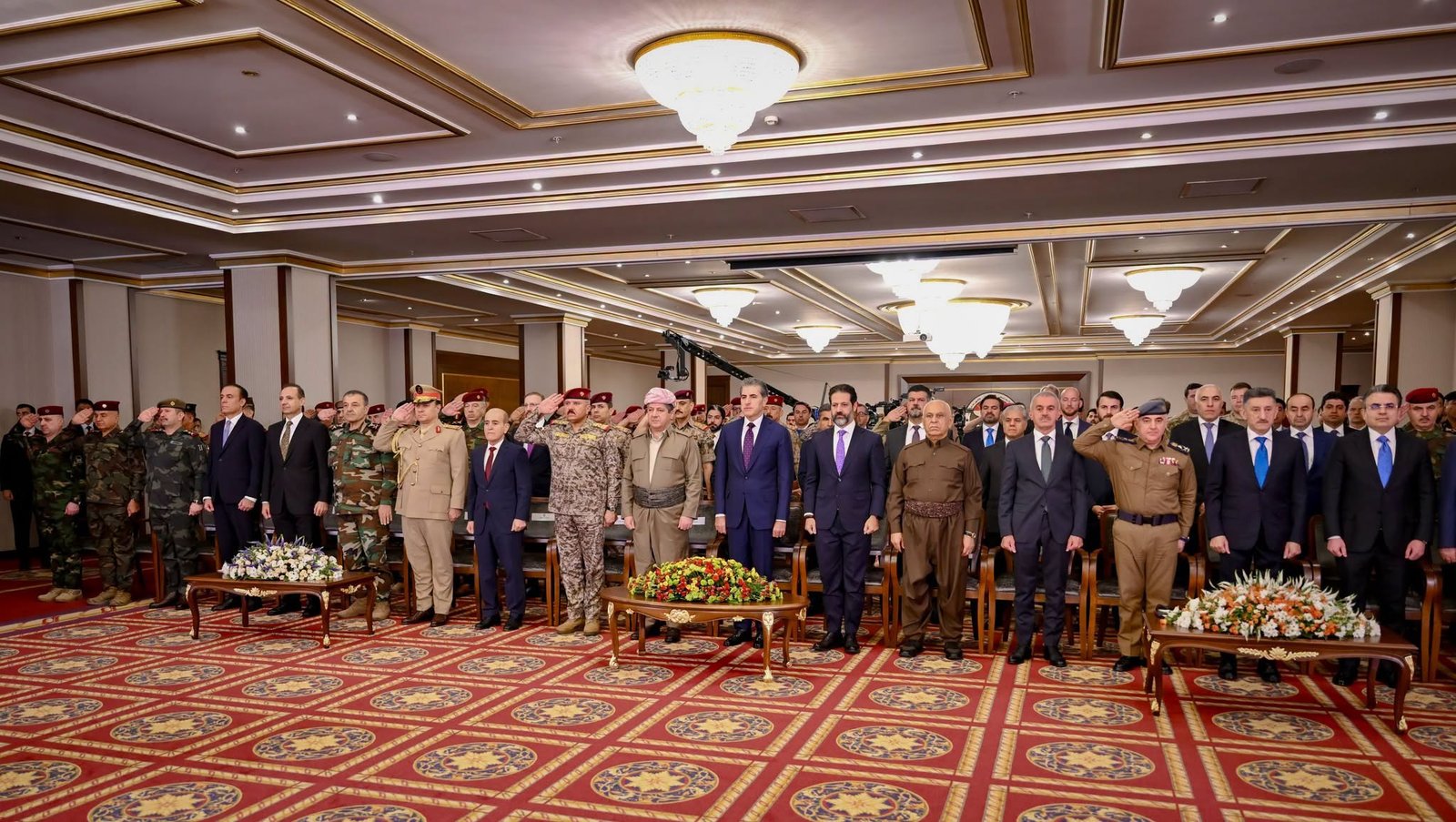
The Kurdistan Region’s new military structure keeps the KDP and PUK hierarchies intact, gives each sweeping control over appointments and spending, and makes a single Kurdish army harder to build.
On 21 September, the Kurdistan Regional Government (KRG) held a ceremony in Erbil to declare the decades-long unification of its Peshmerga forces complete, 11 days after the Ministry of Peshmerga Affairs announced that the process was complete. Kurdistan Region President Nechirvan Barzani, who is commander-in-chief of the Peshmerga, told the gathering that no force would remain outside the ministry. Under the new structure, the 80 Forces of the Kurdistan Democratic Party (KDP) and the 70 Forces of the Patriotic Union of Kurdistan (PUK) formally cease to exist. Their personnel now sit in two Regional Commands under the ministry, organised into 11 divisions, two support forces commands and a separate commando formation.
The details of the new structure show how little of the old one has been taken apart. The two Regional Commands are led by the men who led the party forces, cover the same territory, keep separate accounts and hold powers over appointments, discipline and spending that most armies reserve for a defence ministry or general staff. What has changed is their legal status: forces that were openly partisan are now government institutions whose authority is written into a KRG decree. The arrangement has no clear parallel in any other army in the world, and it makes a single Kurdish army harder to build.
The same commanders under new names: Regional Command 1 is led by Lieutenant General Najat Ali Salih, who commanded the KDP’s 80 Forces. Regional Command 2 is led by Lieutenant General Omar Salih Hassan, who commanded the PUK’s 70 Forces. Each party selected its own commander, and President Nechirvan Barzani formalised both appointments by decree. The two commands have also kept the insignia of the forces they replaced. Each emblem is unchanged from its party-era design, with the old force name swapped for “Regional Command 1” or “Regional Command 2”, and no new institutional identity has been created for either command.
The divisions follow the same line. Regional Command 1 holds the six odd-numbered divisions (1, 3, 5, 7, 9 and 11), all built from the 80 Forces, and Regional Command 2 holds the five even-numbered divisions (2, 4, 6, 8 and 10), built from the 70 Forces. On paper the force totals 33 brigades and 99 battalions, with 18 brigades in the first command and 15 in the second. In May, the ministry’s secretary-general, Bakhtiar Sidiq, explained that Regional Command 1 covers Erbil and Duhok and Regional Command 2 covers Sulaimani, Halabja and Garmian, the same zones each party has held since the 1990s.
The heavy weapons are divided the same way. Much of the Peshmerga’s artillery, armour, air defence and combat engineering sits in two Support Forces Commands that stand apart from the divisions. The 1st Support Forces Command comes from the KDP and the 2nd from the PUK, and each is aligned with its party’s Regional Command. The PUK side also keeps its commando forces as a separate formation, in effect a special division, outside the 11 numbered divisions. Infantry, heavy weapons and special forces are therefore all organised along the line that separated the two party armies before the reform.
Twelve joint brigades, unchanged for a decade: Mixing between the two forces is confined to 12 joint brigades. Each has four battalions, two from the KDP and two from the PUK, and command of the 12 is divided exactly in half: six have a KDP commander with a PUK deputy, and six have a PUK commander with a KDP deputy. The battalions inside each brigade remain identifiable by party, so the mixing stops at brigade headquarters. The joint brigades are spread across both Regional Commands, which means every joint brigade reports to a division headquarters and a Regional Command descended from a single party.
These brigades predate this year’s reform by about a decade. The practice of pairing KDP commanders with PUK deputies, and the reverse, was already documented in 2015, and the 12 joint brigades have kept roughly the same form ever since. No further joint brigades have been created in the intervening years. The process completed this month therefore added no integration at the one level where the two forces actually meet. What it did was rename the formations above the brigades and announce that unification had taken place.
A regional command with the powers of a ministry: The powers of each Regional Command are set out in Order 703, which KRG Prime Minister Masrour Barzani issued on 26 February. The order allows each command to appoint its own division commanders, deputy division commanders, division chiefs of staff, directorate heads and brigade commanders. The command can transfer officers, approve their annual reports and promotion assessments, discipline personnel, set up boards of inquiry, refer soldiers to military courts, sign contracts and issue operational plans. Its commander appoints the command’s only authorised spokesperson and can block any media appearance he judges to be a security or institutional risk.
In most armies these powers are held at the centre. In Israel, division commanders are chosen at appointment meetings led by the chief of staff and approved by the defence minister, and in Turkey general officers are promoted and posted through the Supreme Military Council and presidential decree. Regional commands elsewhere, such as Iraq’s operations commands, exist because each covers a defined area. Minister of Peshmerga Affairs Shoresh Ismail said in an interview this week that the two Kurdish commands have no defined boundary and can deploy anywhere in the region. They also have no distinct military function, which leaves party origin as the only thing that separates them.
One account, two budgets: The United States made a single line of accounting one of the benchmarks of the reform programme it funded, and in June officials said that all Peshmerga accounting had been merged into the ministry’s central system. Order 703 describes a different arrangement. The ministry’s budget, which depends on salary transfers from Baghdad, is paid by the Kurdistan Region’s treasury into a central ministry account, and the ministry then opens a subsidiary account for each Regional Command. Each command has its own accounting directorate, spends its own monthly cash advance and sends a trial balance to the ministry at the end of each month, where the figures are consolidated for the Ministry of Finance and Economy.
Within that system each command spends with wide autonomy. It can authorise official missions, fuel, supplies, rents and a daily ration allowance of 2,000 dinars per Peshmerga, approve maintenance projects worth up to 100 million dinars, pay rewards of up to 750,000 dinars and make a one-off payment of 5 million dinars for each member killed on duty. Salary schedules published in August still listed Regional Commands 1 and 2 as separate entries. The money legally goes to government institutions under the ministry, and the two commands that inherited the party forces decide how most of it is spent.
The forces left outside: The unification also covers only part of the Kurdistan Region’s armed forces. The KDP’s Zeravani and the PUK’s Emergency Forces fall under the Ministry of Interior and have not been folded into the new structure. The two parties’ counter-terrorism forces and their Asayish security agencies also remain separate and divided along party lines. Nechirvan Barzani’s statement that no force would remain outside the ministry therefore applies only to units the ministry already counted as Peshmerga, and several of the largest party-controlled formations in the region sit beyond its reach.
A third force shows how the two commands are defined. The Peshmerga of the Kurdistan Socialist Democratic Party, a small party led by veteran commander Mohammed Haji Mahmoud, belong to neither Regional Command. The party has said its force will abide by the ministry’s regulations and remain outside both commands. A unit loyal to neither ruling party has no place in a structure built from one KDP command and one PUK command. Its position outside both confirms that party affiliation is the organising principle of the new structure, as it was of the old one.
Why the timing matters: The ceremony fell on the fourth anniversary of the memorandum of understanding between the Ministry of Peshmerga Affairs and the US Department of Defense, renewed in September 2022, which tied American stipends, training and equipment to unification benchmarks. The memorandum expires on 30 September, and Washington has declined to extend it. The same date is the deadline for the US-led coalition to complete its departure from Iraq, nine days after the ceremony. The KRG needed to declare the reform complete while the framework that demanded it was still in force, and the result was a unification announced before the divisions in command, finance and territory had been addressed.
The announcement also serves Baghdad. The Iraqi government is pressing Shia armed factions to place their weapons under state control on a timetable that runs to June 2027, and Iran-aligned factions have argued that any law regulating weapons must apply nationwide, including to the Peshmerga. A Peshmerga formally unified under a constitutionally recognised ministry weakens that argument. Baghdad signalled its approval: Lieutenant General Abdul-Amir al-Shammari, director of the office of the commander-in-chief of the Iraqi armed forces, attended the ceremony, Iraqi Prime Minister Ali al-Zaidi welcomed it, and the army chief of staff, Lieutenant General Abdul-Amir Yarallah, called it a milestone for Iraq’s national security.
A harder path to one army: The practical effect of the reform is to codify the KDP and PUK forces as official commands of the KRG, which entrenches and consolidates the two parallel armies the reform was meant to merge. Before the reform, the 70 and 80 Forces could be criticised as party militias operating outside government control. They are now government institutions whose powers are set out in a prime ministerial order and whose unification has been endorsed by Baghdad. Any future effort to merge them into one hierarchy would have to strip legal authority from two official commands, each backed by one of the two ruling parties, which is a harder task than bringing party forces under a ministry.
Nechirvan Barzani appeared to recognise the problem. He said at the ceremony that the next phase must bring unity in command, decisions, orders, training, promotions, doctrine and discipline, and that success would be measured by whether every Peshmerga regards the ministry as the institution whose orders he follows, whatever his party or region of origin. Under Order 703, the institution that controls a Peshmerga’s promotions, postings, discipline and pay is his Regional Command. The test of the reform is whether the ministry can remove a division commander or move a brigade from one command to the other against that command’s wishes, and the published orders give no sign that it can.


