


Iraq’s Consensus System Faces a Floor Vote It Wasn’t Built For
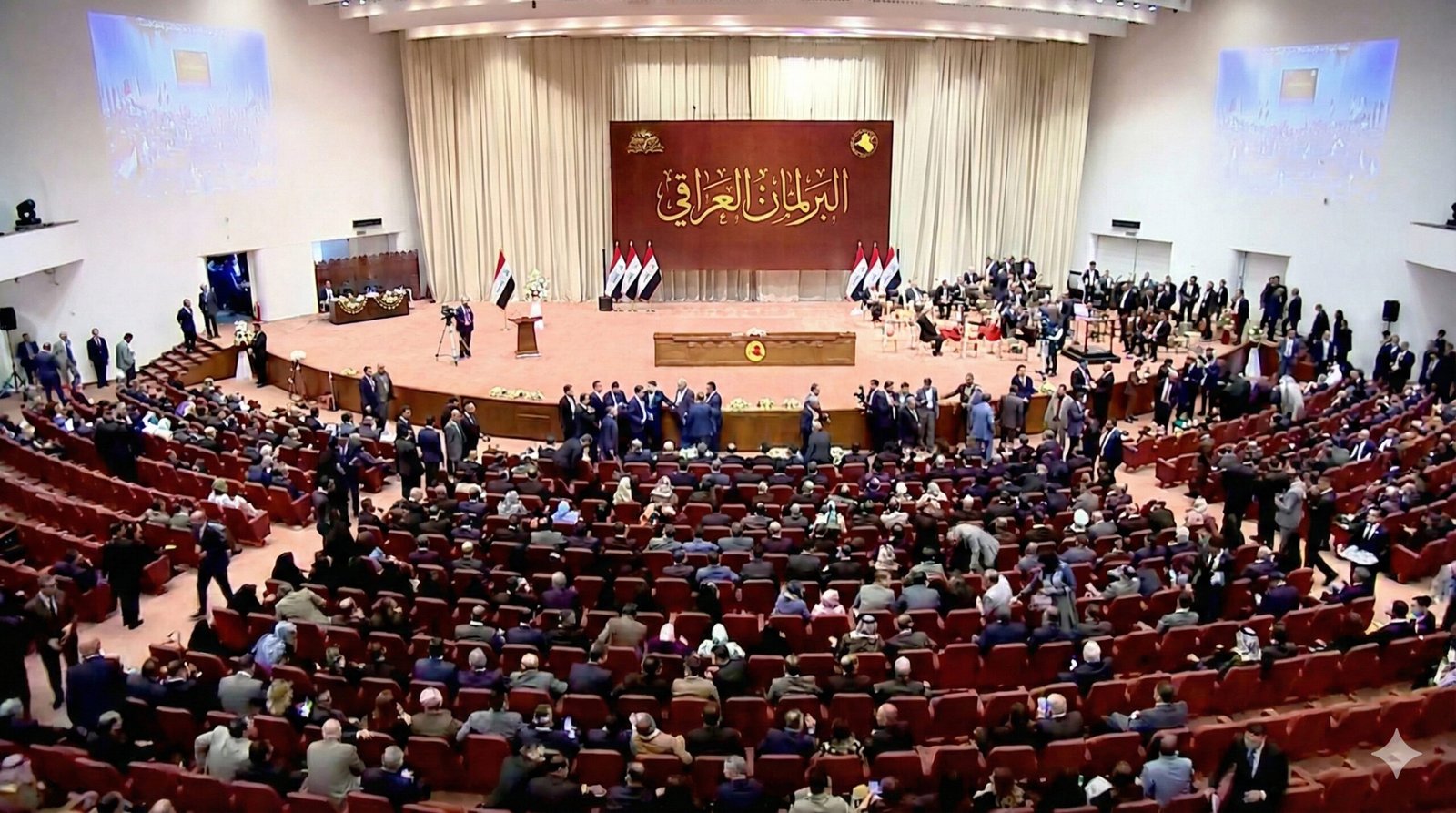
As Iraq approaches the constitutional timeline for forming a new government, disputes inside the main blocs are sharpening and beginning to test the informal power-sharing rules that have governed politics since 2003. The immediate flashpoint is not the prime ministership—that comes later—but the parliamentary leadership that must be settled first. With parliament scheduled to convene Monday, 29 December, the risk is that unresolved bargaining among Sunnis, Shia, and Kurds pushes the process into an open contest on the floor rather than the customary pre-cooked consensus deals.
The first session of the new term will be chaired by the eldest elected member. Its core tasks: swearing in new MPs and electing the speaker and two deputy speakers. Iraq’s top judicial authority has issued a blunt warning that the session must not be prolonged or postponed and must conclude with all three positions filled. The message is explicitly framed as a contrast to the Kurdistan Region, where parliament’s first session has effectively remained open for over a year amid KDP–PUK deadlock over cabinet formation and division of posts.
The Sunni speakership deadlock: Halbousi vs. Samarrai
The speakership is traditionally allocated to Sunnis, but Sunni forces have not agreed on a single nominee. The dispute centers on Mohammed al-Halbousi’s Taqaddum (35 seats) and Muthanna al-Samarrai’s Azm (16 seats), with wider Sunni factions unable to bridge the gap.
Halbousi is pressing to retain the post, arguing that his bloc holds the largest Sunni share and that the speakership should follow electoral weight. But multiple accounts indicate the Sunni house remains divided, with no consensus candidate in sight.
Some Sunni figures describe the situation more starkly: if the contest goes to a floor vote, Samarrai is a serious threat because he may attract backing from the Shia Coordination Framework and most Kurdish MPs. At the same time, other reporting suggests an outright veto by the Framework against Halbousi has not been formally communicated—much of what circulates on that point comes through media narratives or unofficial channels.
To avoid a humiliating public split, the Sunni-led National Council, a broad umbrella including multiple factions, is expected to meet tomorrow for a final push to produce a single nominee. The fallback: enter Monday’s session with multiple candidates and leave the outcome to parliament, effectively handing Shia and Kurdish MPs the role of kingmakers in a position that is nominally the Sunni share.
Sunni alternatives and internal fractures
The crisis extends beyond Halbousi versus Samarrai. It is also about what kind of Sunni representation the speakership symbolizes. Within Sunni discussions, Muhammad al-Tamimi, Taqaddum’s deputy leader and an Arab politician from Kirkuk, has been floated as an alternative. Some Sunni voices argue the speakership has become overly tied to Anbar and to Halbousi personally, and that other provinces should not be excluded from such a high-profile post.
That debate has bled into talk of tensions inside Taqaddum itself. Some accounts claim Halbousi opposes elevating his own deputy, fearing it could empower a rival center of gravity within the party—though Tamimi has denied such reports. Adding to the sense of internal strain, there is speculation that Haybat al-Halbousi, another senior Taqaddum figure, could declare his own candidacy, signaling a more explicit rupture. Separately, Jamal al-Karbouli, a Halbousi rival, has publicly hinted at the possibility of a “coup” and split within Taqaddum, warning of a potential major shake-up. Given his animosity toward Halbousi, Karbouli tends to exaggerate.
Taken together, these threads point to a Sunni landscape in which the speakership is no longer merely a single post to be allocated, but a contest over leadership, party hierarchy, and the distribution of Sunni political weight across provinces.
Iraq 2025 Election Seat Distribution
Parliamentary Seat Breakdown by Coalition & Faction
CF (Shia): 168
NC (Sunni): 73
Kurd: 59
Other: 29
329
Total Seats
165
50%+1 Majority
220
⅔ Supermajority
Detailed Seat Breakdown
Source: Iraqi High Election Commission – The National Context
The Shia file: deputy speakership and the points formula
While the prime ministership is the final prize and gives the Shia bloc more time on paper, internal Shia bargaining is already producing friction—especially around the first deputy speaker position, traditionally allocated to the Shias.
Shia parties grouped under the Coordination Framework are meeting at Shia leader Ammar al-Hakim’s office this evening to decide their nominee. Reporting from within the Shia camp frames this post through the logic of a long-used but informal mechanism: the points-for-positions formula. Under this approach, political weight (measured in parliamentary seats) translates into points, and major offices are assigned point values. In some accounts, the first deputy speaker is valued at around 15 points; in others, 15 to 17—with one point treated as equivalent to one seat in bargaining terms. Winning the post is not just procedural; it is a tangible share of the governing pie.
Three names have been cited as contenders:
- Adnan Fayhan (Asa’ib Ahl al-Haq)
- Mohsen al-Mandalawi (Asas Alliance)
- Ahmed al-Asadi (aligned with the coalition backing Prime Minister Mohammed Shia al-Sudani, framed around reconstruction and development)
These negotiations sit atop deeper Shia rivalries, including competition among Sudani, Nouri al-Maliki, and Haider al-Abadi. The stakes have been further complicated by a new alliance in the Shia arena: a coalition involving Hadi al-Amiri (Badr Organization) and Shibil al-Zaidi (Services Alliance). Political sources estimate this bloc at roughly 30 MPs, giving it leverage to seek not only the first deputy speakership but also a service ministry and an independent commission as part of a broader settlement.
Because the Framework has not yet settled on a prime ministerial nominee, some Shia insiders frame the first deputy speaker decision as a “starter agreement” that can unlock further compromises on other Shia-allocated posts.
The Kurdish dilemma: presidency and the deputy speaker signal
The Kurdish share of the post-2003 arrangement is the presidency, but the Kurds remain divided. Shia actors have urged the KDP and PUK to reach agreement and come to Baghdad with a single nominee, explicitly arguing they do not want to be dragged into intra-Kurdish competition that could also split Shia votes.
Against that backdrop:
- The KDP has indicated it is putting forward Fuad Hussein, Iraq’s current foreign minister, as its preferred presidential candidate.
- The PUK has prepared two names: Khalid Shwani (justice minister) and Nizar Amedi (a former minister), with the expectation that one will be nominated.
Kurdish bargaining is also tied to a broader KDP–PUK dispute over whether Baghdad posts should be negotiated together with the Kurdistan Region’s next cabinet. The PUK favors bundling Baghdad positions with KRG cabinet negotiations and dividing everything as one package, echoing earlier periods of KDP–PUK strategic understandings. The KDP favors separating the two tracks and allocating Baghdad posts according to electoral merit.
A parallel development adds another layer. The KDP’s political bureau has submitted a shortlist for the second deputy speaker, a Kurdish-allocated position the party has traditionally held. The four names—Shakhawan Abdullah (Kirkuk), Rebwar Hadi (Erbil), Farhad Atrushi (Duhok), and Ashwaq Jaf (Sulaimani), and the party is expected to announce its final pick shortly before the session.
This suggests the KDP may prioritize retaining the deputy speaker and avoid a losing battle for the presidency: most Shia factions and Sunni Taqaddum have indicated they would vote for the PUK candidate if the contest goes to parliament, continuing the pattern since 2005. The KDP still publicly stresses the principle of a consensual Kurdish presidential candidate, but if consensus fails, the Kurdish camp could mirror the Sunni scenario by entering with multiple candidates.
What happens Monday
Monday’s session is not just the opening ceremony of a new term. It is the first real test of whether Iraq’s blocs can still produce the minimum consensus required to keep the post-2003 system functioning. If the speaker and both deputies are elected on 29 December, the clock starts moving in a more orderly way toward the next steps: electing the president and then forming the cabinet.
If the blocs fail to settle these posts in the first session, they risk more than political embarrassment. They risk turning the constitutional timetable into a source of institutional pressure and legal controversy, especially after the judiciary’s warning that delay would be a violation. In that scenario, government formation becomes hostage to two simultaneous battles: the arithmetic of votes inside parliament and the political bargaining over the points formula outside it—with each bloc trying to avoid being seen as the side that broke the system while also trying to win inside it.


