


As the SDF Integration Deadline Nears, the Leaks Tell the Real Story
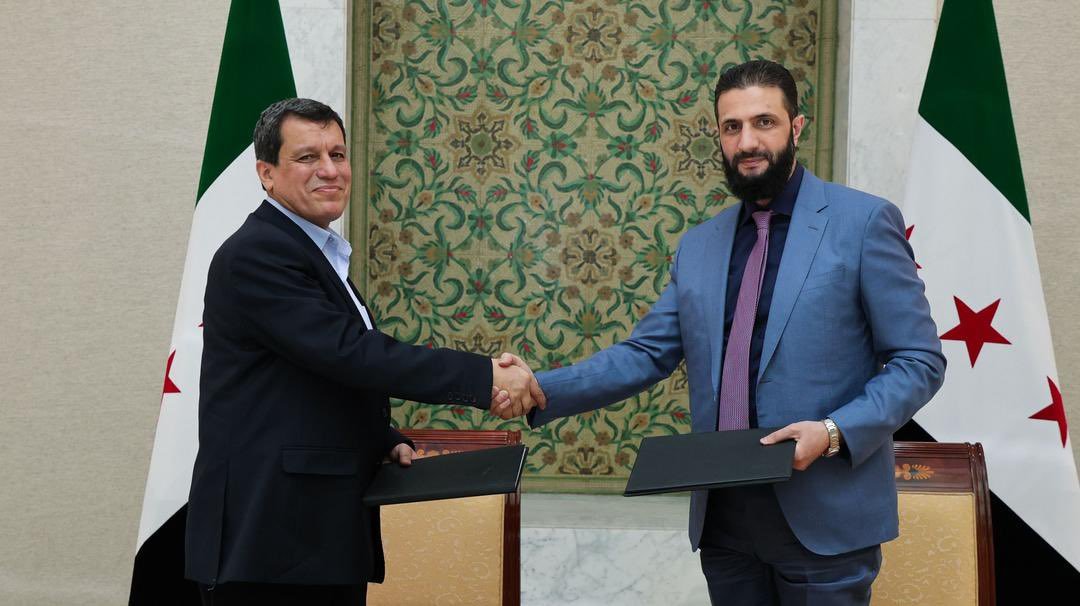
As the year-end deadline for SDF integration into the HTS-led Syrian army looms, a war of leaks is sweeping the media. This comes amid reports of an expected, US-pushed visit by SDF commanders to Damascus aimed at keeping the March 10 agreement alive.
Context: The March 10 agreement set out broad parameters for integrating the SDF into Syria’s security forces, while leaving the key details and the method of integration open. Syrian President Ahmad al-Sharaa and the Turkish government have both insisted that the end of this year is the deadline. By contrast, the SDF’s Mazloum Abdi has rejected that framing, insisting that no deadline has been set for completing the integration.
Analysis: As diplomatic contacts have peaked in the last few days, with the US rushing to rescue the March 10 agreement between Damascus and the SDF, leaks have surged in parallel as pressure tools and trial balloons. One of the more notable examples was a report on the 25th by Istanbul-based Syria TV, a Qatari-funded outlet, which cited an “informed source with knowledge of the negotiations” and claimed the SDF and Syrian government were close to an agreement under heavy US, French, and German pressure, with an expected breakthrough between 27 and 30 December. The report further claimed the deal would integrate 90,000 members of the SDF and the Asayish into Syria’s Ministries of Defense and Interior, and that three military divisions would be allocated to the SDF within the Ministry of Defense in Raqqa, Deir ez-Zor, and Hasakah. It also said differences remained over the deployment of other Syrian army troops to the northeast and over the nature of the chain of command.
Pro-Damascus sources swiftly denied the Syria TV report. What makes it interesting, however, is that it may signal more than a routine “informed source” story. Syria TV is run by a group of hardcore anti-SDF journalists, so the decision to publish such “leaks” was notable. It reads like a pre-emptive leak by a faction within Damascus that is unhappy with the growing US pressure to make compromises. On the same day, the SDF side issued a flurry of statements, including one by Mazloum Abdi claiming, “We have reached a mutual understanding regarding the integration of the military forces,” while still keeping the overall messaging vague, even if broadly positive. Within hours, a media advisor to Ahmad al-Sharaa accused the SDF of “failing to honor” the March 10 agreement. These contradictory statements, published within a tight window, are part of the tactical signaling between the two sides as US pressure increases. The immediate US objective appears to be finding a face-saving way to extend the March 10 framework and prevent it from collapsing.
Because the integration framework was also supposed to address the SDF file within the broader Turkish peace process with the PKK, it is worth watching whether the integration timeline is extended by two months, mirroring the two-month extension of Turkey’s parliamentary peace commission through the end of February. If that happens, it would suggest the two tracks are more intimately connected than previously assumed. If it does not, it would imply the tracks are being handled separately and in a more detached manner, which would open the SDF integration file to more scenarios than many have assumed until now. More broadly, this episode is a useful reminder of how to interpret the contradictory statements that dominate the media space: an “agreement” should only be treated as an agreement when an official document is signed.
A useful way to read the current leak war is to remember that “integration” is only the visible layer of a much larger negotiation over Syria’s post-Assad order. The disputes are numerous. First is the nature of the state itself: whether Syria moves toward a secular, democratic, constitutional system, or toward a more centralized “civil” state with a stronger religious reference point, a preference that is not confined to HTS and resonates with segments of the Sunni majority. Yet many minorities remain wary of any trajectory that dilutes pluralism or codifies exclusion, with some arguing it could reproduce coercion in a new idiom and prove no better than the Assad era. Second is the future of self-administration or federalism in the northeast and the distribution of powers: Damascus is reluctant to loosen central control in ways the Kurds and Druze reject. Third is control over the political economy of the region, including the management and distribution of oil and gas, the administration of border crossings, and authority over taxes, revenues, and the institutions of the northeast. Fourth is the SDF file itself: leadership, command structure, and ultimate fate, and what “integration” actually means in practice inside the Syrian army or the Ministry of Defense. Each issue is more complex than the last, and together they explain why this cannot be resolved by deadline-driven statements, but only through prolonged, technical bargaining.
It is also worth noting that a series of other developments in December helps contextualize the trajectory, especially in terms of how the US, which has often appeared unclear and ambiguous and refused to become a”guarantor“, is now moving. This month alone, several significant events have occurred. For the first time, Iraqi elite forces, in a joint operation with the US, arrested two ISIS members in Syria; importantly, the operation took place in SDF-controlled Hasakah, and it marked the first time the US conducted a joint operation in an SDF area with Iraqi forces rather than with the SDF’s own fighters. Separately, US and Damascus troops were inspecting the Syrian desert when they came under attack, after which the US began a series of air campaigns, while the Syrian government claimed it arrested key ISIS members. Meanwhile, the Jordanian air force struck Sweida in southern Syria, saying it coordinated the strikes with the Syrian government; reports suggest the targets included drug factories as well as arms depots.
In tandem, three major investigative reports relying on unnamed “sources,” published by The Washington Post, The New York Times, and Reuters, appear to strategically serve Damascus and weaken claims advanced by the SDF, Druze, and Alawites. The Washington Post report, for example, explicitly tied the Druze insurgency to Israel, with the SDF implicated, and suggested the channel began even before Assad’s collapse. That framing implies the issue is not simply about HTS becoming the power in Damascus and instead suggests the plot predates that shift. Meanwhile, Reuters and The New York Times investigations in recent weeks have framed Assad-era commanders as trying to build a new insurgency along the coast, which also helps the Syrian government justify its clampdown in coastal cities. At the same time, these stories underscore the tremendous challenges Damascus faces in unifying the country.
The fact that all of these developments and narratives have unfolded within a single month, precisely as SDF–Damascus talks face major hurdles, highlights how complex and interconnected the SDF file has become, and how many variables and layers shape it. That is also the clearest context for why implementing the March 10 agreement, and translating it into an integration mechanism that both sides can live with, is proving so difficult.


