


Iraq’s Weapons Deadline: What Is Actually Being Negotiated Before 30 September
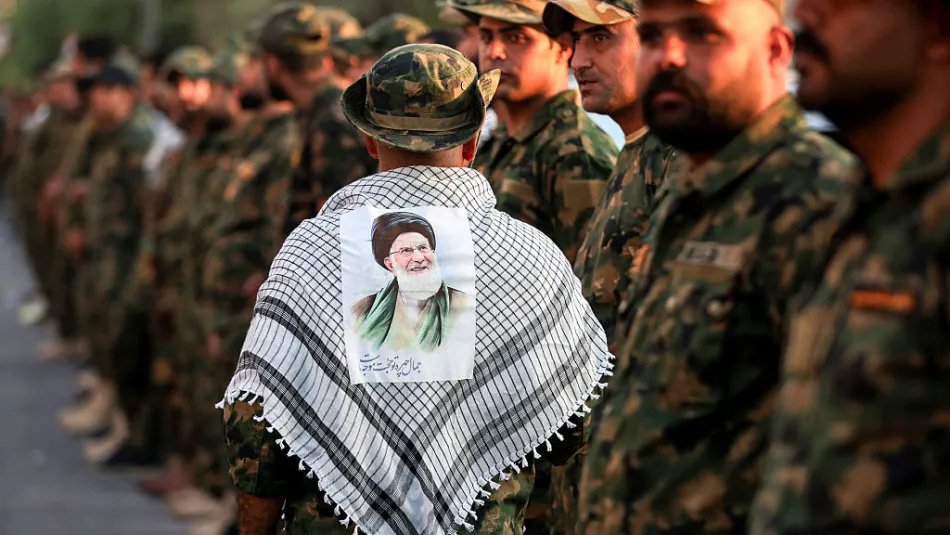
The argument over Iraq’s armed factions is an argument inside the Shia political establishment about how to protect what it has held since 2003. One camp has concluded that state institutions now protect its position better than autonomous weapons do. The other holds that the weapons are what protect the institutions. Iran is adapting to both positions at once.
The deadline and what it covers: The military mission of the US-led coalition in Iraq ends on 30 September 2026. Baghdad and Washington reached a final agreement on the timetable on 12 August, and Prime Minister Ali al-Zaidi has called the date final and irreversible. What replaces the coalition is a bilateral security partnership under the 2008 Status of Forces Agreement, with a US advisory and enabling presence in place of a multinational combat command.
A second process has been attached to the same date. The State Administration Coalition, the multi-bloc arrangement that sustains the government, authorised treating weapons held outside state authority after 30 September under the Anti-Terrorism Law. Al-Zaidi has separately ordered a draft law establishing a state monopoly on military weapons. The version circulating in Baghdad covers exclusive state ownership of military-grade arms, exclusive state authority over decisions of war, a ban on parallel chains of command, a prohibition on political parties financing or commanding armed formations, a national weapons inventory, surrender deadlines, criminal penalties after a transition period and a twelve-month implementation window. The text has not been independently authenticated and has not reached a parliamentary vote.
Iraqi officials use the 2011 withdrawal as the reference point. Coalition forces left that December and ISIS took Mosul thirty months later. The 2026 problem is differently shaped: ISIS is degraded, and the open question concerns the status of armed groups already inside the Iraqi system.
Enforcement has been visible. In the first ten days of August the interior ministry shut 71 offices operating under Popular Mobilisation Forces branding without authorisation, seized 49 drones, banned unauthorised drone flights and began a database covering roughly six million registered weapons. Al-Zaidi has merged security coordination into a revived office reporting to the commander-in-chief and replaced the heads of the Counter-Terrorism Service and the federal police. Government officials say a drone cell was dismantled in Baghdad during the security deployment of early August.
Two calculations inside one establishment: Saraya al-Salam, Asa’ib Ahl al-Haq and Kata’ib al-Imam Ali have accepted the principle of restricting weapons to the state. Asa’ib announced in June that it would begin handing weapons to the state and later moved to sever its formal link to the PMF. Kata’ib Hezbollah, Harakat al-Nujaba, Kata’ib Sayyid al-Shuhada and Ansar Allah al-Awfiya are among the factions that have refused.
The standard reading treats the first group as moderates and the second as hardliners. The more useful distinction is the calculation each group is making about where its power is now stored.
The factions moving into state structures already hold parliamentary seats, ministries, security appointments, budget lines, construction and import businesses and patronage networks. Their power is embedded in the institutions the state funds and administers. For them, transferring heavy weapons and formal command upward removes the most legally exposed and most easily sanctioned part of their apparatus while leaving the rest intact. Fighters move onto state payrolls, commanders move into political and administrative roles, and the organisation continues to exercise influence through the institutions it already staffs. This is closer to a conversion of militia power into state power than to disarmament as understood in post-conflict programmes elsewhere, where an armed organisation is defeated, disbanded and removed from political life.
Kata’ib Hezbollah and Harakat al-Nujaba make the inverse argument. They hold that the Iraqi state is not sovereign enough to be trusted with the final guarantee of their position: Washington retains leverage over Iraq’s dollar access, banking channels and oil revenue accounts; Iraq lacks functioning air defence; Israel and Turkey operate in Iraqi airspace. Nujaba calls the weapons file an American project and describes surrender as a red line. Kata’ib Hezbollah has said it intends to expand its arsenal. Factions have also demanded guarantees before any handover.
Their fear is sequencing. They expect that weapons would be followed by PMF structures, then economic networks, then parties, appointments and relationships with Tehran. Where the integrationists believe US pressure on the state is a reason to protect the state, the rejectionists read the same pressure as evidence that the state cannot hold the guarantee. Both camps are trying to preserve the same post-2003 order. They disagree about what preserves it.
The fiscal constraint: The economic position is the strongest single driver of the integrationist calculation, and it has hardened sharply in 2026.
Iraq’s monthly public salary bill is about 8 trillion dinars, roughly $5 billion. Oil revenue has fallen well short of covering it. July salaries were paid late, officials have acknowledged a liquidity crisis, and the 2026 budget has been described as the most strained in recent Iraqi history. Advisers have floated a 10 trillion dinar borrowing law to keep payroll moving.
The post-2003 political order rests on this distribution system: government salaries, PMF salaries, pensions, welfare, public employment, contracts and subsidies. It reaches Shia, Sunni and Kurdish populations, and the political structure administering it in Baghdad has been predominantly Shia since 2003. The most destabilising protest movements of the past decade came from inside the Shia south and Baghdad.
A US financial escalation that disrupted dollar access, import financing or oil revenue transfers would therefore reach the material basis of that order. Coordination Framework figures have started saying this openly, warning that Iraq risks the kind of embargo conditions Iran operates under. For a faction that already controls ministries and budget lines, an autonomous drone and missile capability is a diminishing asset if holding it puts the treasury at risk.
This is the weakest point in the rejectionist position. Kata’ib Hezbollah and Nujaba identify American financial leverage accurately and answer it with long-term arguments about financial sovereignty, de-dollarisation and trade diversification. They have no near-term answer to what happens if Baghdad cannot pay salaries.
The Hormuz asymmetry: The rejectionist sovereignty argument carries an unresolved contradiction. Those factions describe US economic pressure as intolerable interference in Iraqi sovereignty. They also support Iranian pressure on the Strait of Hormuz, and the closure of the strait during the war with Iran is the direct cause of the revenue collapse now driving the salary crisis. In that framing, damage to Iraqi state finances caused by Iranian regional strategy is treated as a consequence of Baghdad’s failure to diversify export routes, while damage caused by American policy is treated as an attack on sovereignty.
Washington has moved into that gap. The US-backed Kirkuk–Baniyas pipeline project, agreed with Syria in July under American sponsorship, is designed to route Iraqi crude to the Mediterranean and reduce the share of Iraqi exports exposed to Hormuz. Its strategic function is to lower the cost to Baghdad of resisting Iranian pressure.
The second layer: One development in 2026 changes the structure of the problem. Reuters reported on 19 June that the IRGC had created three or four cells of roughly ten Iraqi Shia fighters each, recruited partly from existing factions but placed outside established militia command structures and reporting directly to the Guards. Iraqi officials cited in the report attributed at least seven drone attacks on targets in Kuwait, Saudi Arabia and the UAE between 20 April and 17 May to these cells, and said their purpose included deflecting blame from the major factions and reducing US pressure on Baghdad to disarm them. Iraqi security services were still working to establish their chains of command. The Iraqi government denied the account.
Read alongside the integration process, the reporting describes a two-layer architecture. The large organisations move into parties, ministries, PMF payrolls and businesses, where they are legally protected and politically difficult to attack. A much smaller compartmentalised network holds the operational capability, with direct command lines to the IRGC, minimal public identity and no dependence on faction leaders’ domestic political calculations. Reuters noted that the willingness of Asa’ib and Kata’ib al-Imam Ali to disarm may itself have encouraged the Guards to build the new structure.
This solves several problems for Tehran simultaneously. It is cheaper than sustaining mass formations at a moment of Iranian fiscal strain. It removes the agency problem created by commanders who now have parliamentary careers, ministries and businesses to protect and are correspondingly reluctant to attack Gulf states on Iran’s timetable. It reduces attribution: an unknown group claims an attack, the established factions deny involvement, the PMF says the unit is not authorised, and Iraqi parties demand evidence before any action is taken.
The trade-off runs the other way at the tactical level. A ten-person cell is far easier to eliminate once identified than Kata’ib Hezbollah, and because it holds no formal PMF status, Baghdad has a cleaner legal basis to act against it. Tehran is exchanging mass and territorial resilience for deniability and compartmentalisation. That makes systemic dismantlement harder and individual dismantlement easier.
What Tehran appears to want: Iranian messaging separates into three levels that should not be collapsed into one position.
Official diplomacy emphasises Iraqi sovereignty, the legal status of the PMF as an Iraqi state institution and opposition to foreign attacks on Iraqi territory. IRGC-aligned Persian media argues the substantive case against disarmament: Mehr has asked whether disarmament is a step toward stability or the start of a new crisis, and Tasnim states that resistance weapons are not negotiable. Iranian policy writing goes further and accepts restructuring: protect the capability through political and parliamentary means, separate the political sphere from the resistance sphere, and trade concessions for changes to the PMF’s role and organisation.
Esmail Qaani’s unannounced Baghdad visit in the week of 10 August fits that reading. The reported message combined refusal of any handover at present with pressure for a political compromise in place of confrontation between the government and the factions. Tehran has invested two decades in the political order the Coordination Framework operates; an intra-Shia armed confrontation would damage that investment more than a negotiated restructuring would.
The objective that fits the evidence is redundancy. Iran maintains parties, parliamentary blocs, PMF influence, economic relationships, religious networks, personal ties to commanders and, now, a small clandestine military reserve. Institutionalisation is acceptable, and in several respects useful, provided it does not become irreversible. Removing the last independent coercive layer would leave Iranian influence dependent on who controls Baghdad, and governments change.
That is the actual disagreement with Washington. The United States wants the conversion of militia power into state power to be permanent. Tehran can accept much of the conversion while preserving the means to reverse it.
The regional frame: Two external changes tighten the calculation. The Mecca joint defence agreement signed by Saudi Arabia, Turkey and Pakistan on 7 August commits the signatories to treat an attack on one as an attack on all, which raises the cost of drone attacks launched from Iraqi territory against Gulf states. Iran-aligned Iraqi politicians publicly dismiss the pact as symbolic while warning privately that Turkish weight behind a Sunni alignment could be applied in Mosul and Kirkuk. The consolidation of a Sunni-led government in Damascus under Ahmed al-Sharaa has reinforced that anxiety and is used by both Iraqi and Iranian hardliners as a reason to retain capability.
The Kurdistan test: Nujaba’s central public argument is that the monopoly principle is being applied selectively. Its leadership has asked why pressure concentrates on factional weapons while the Peshmerga and Kurdish party forces are left untouched.
Baghdad’s answer is that the draft law is national and applies in the Kurdistan Region. That opens a constitutional problem. Article 121 of the constitution grants regions the right to establish internal security forces, and the Peshmerga are regulated by Kurdistan’s Ministry of Peshmerga Law No. 19 of 2007. Their legal position differs from that of the factions.
The distinction that matters is the same one at issue in Baghdad: a lawful regional security institution against partisan command of armed formations. The KDP-affiliated Unit 80 was merged into the Peshmerga ministry in a step toward unification, while assessments of the force continue to describe it as partisan in practice. If the draft law’s prohibition on parties commanding or financing armed formations is applied literally, it reaches the KDP and PUK as well as Kata’ib Hezbollah. The Iraqi question is whether political influence over security institutions can be separated from direct partisan command of armed force, in Erbil and Baghdad alike.
Al-Zaidi’s government depends on the Coordination Framework, in which faction-linked parties are principal actors. The 30 September framework was authorised by that coalition. The prime minister is implementing a settlement negotiated inside the Shia political establishment, with coercive capacity held in reserve for whoever refuses the consensus that emerges. The government’s force posture provides coercive backing for that settlement. Baghdad’s sequence is to secure Framework agreement, isolate the holdouts, offer them a negotiated exit, apply targeted force against small numbers if required, and avoid intra-Shia armed conflict.
How to judge the outcome: A former commander sitting in parliament or a ministry is a weak indicator of failure. The relevant tests are operational.
Who physically controls missile and drone stocks and the depots holding them. Who issues operational orders and who can mobilise units. Whether the prime minister can inspect any armed facility in the country, including in the Kurdistan Region. Whether a party can independently launch an attack across an international border. Whether any external actor retains a chain of command capable of converting a decision made outside Iraq’s constitutional institutions into military action from Iraqi territory.
Three outcomes are plausible after 30 September. The first is institutionalisation above and clandestine capability below: the large factions integrate and become political and economic actors while a small directly controlled network retains strike capability. This is the outcome the current evidence most supports. The second is cosmetic registration, in which units receive official numbers and state salaries while partisan commanders continue to make operational decisions and hidden arsenals remain. The third is genuine institutionalisation of the large factions combined with targeted security operations against a small number of holdouts, which would still leave the clandestine layer as the residual problem.
Most of Iraq’s faction-linked parties will survive 30 September, and much of their political and economic influence will survive with them. The measure that settles the question is whether any organisation or foreign state retains an independent chain of command able to turn a decision taken outside Iraq’s constitutional institutions into military action from Iraqi soil. On that measure, visible militia integration and a harder-to-eradicate architecture of coercive power can advance at the same time.


