


The Kurdistan Region’s Emerging Strategic Geography
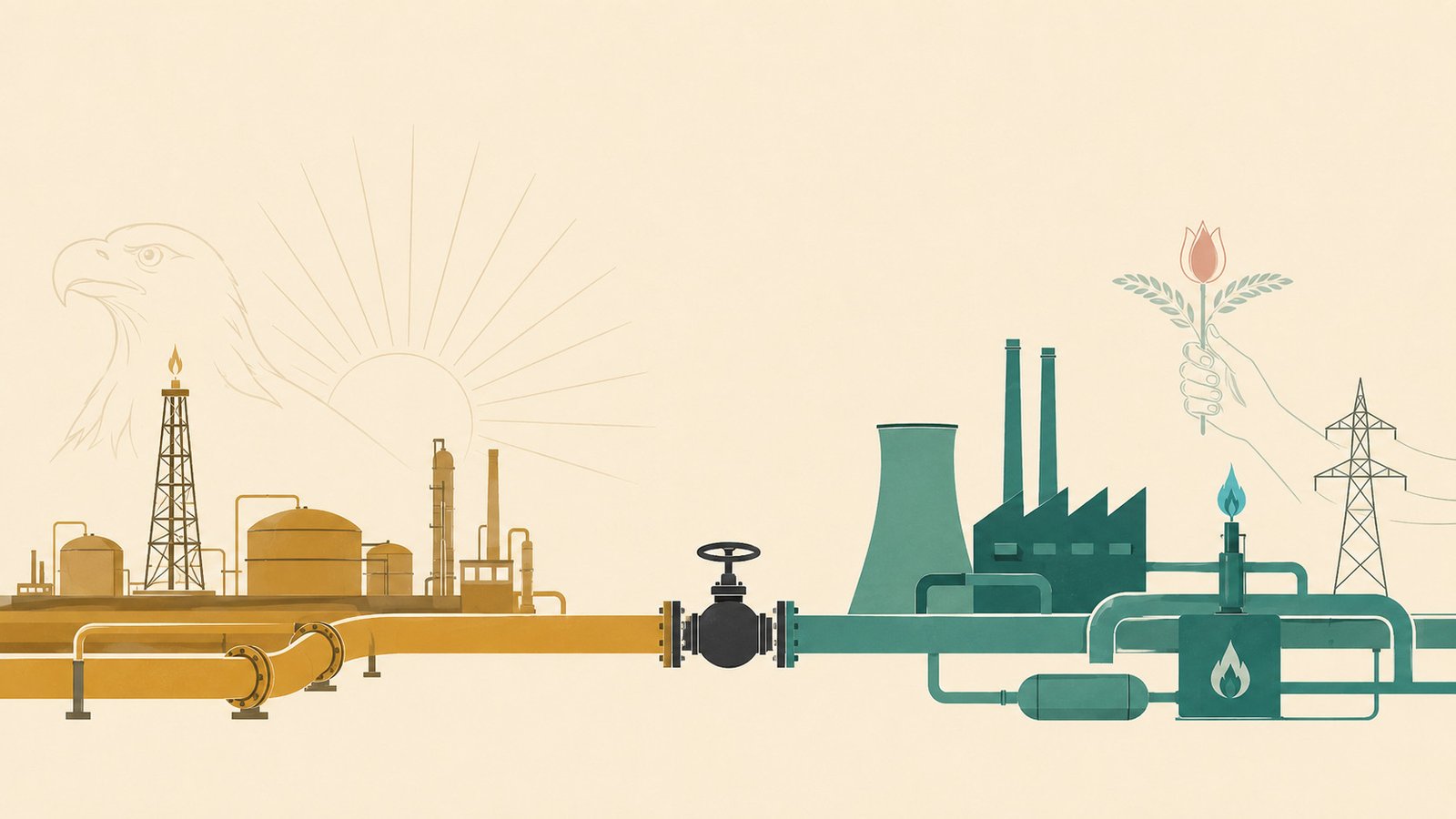
The Kurdistan Region’s energy and industrial map shows an emerging strategic geography in which the KDP and PUK, the two ruling parties that already run separate administrative systems inside one nominal regional government, check each other through control of different but interdependent assets. The KDP remains the larger economic power. The rapid build-out of the PUK’s gas and industrial base is narrowing an older structural imbalance, and it is doing so at the moment the two sides cannot agree on how political power should be divided, and the two developments are connected more tightly than they first appear.
To see why, it helps to look past the familiar shorthand that the KDP has oil and the PUK has gas, and to ask instead what each party’s assets actually let it do. The KDP’s strongest assets are built around monetisation: oil, refining, trade and external corridors. The PUK’s emerging system revolves increasingly around gas, which carries a different kind of strategic weight. Gas does not simply generate income. It feeds electricity, determines the cost structure of heavy industry, shapes energy security and creates long-term relationships between producers and consumers through infrastructure that is expensive to replace. The KDP’s oil gives it greater economic scale and more routes to monetisation; the PUK’s gas increasingly gives it influence over how the wider regional economy functions and over the energy choices available to actors beyond the Kurdistan Region itself.
The KDP’s system was built for the older logic of revenue, and it remains formidable on those terms. Most of the Region’s major producing oil fields lie across its Erbil-Duhok zone, together with the largest official refining capacity and the Fishkhabur corridor that carries crude north to Turkey. Erbil holds the broadest manufacturing base in the Region, spanning steel, pharmaceuticals, food and beverages, plastics, packaging, aluminium and construction materials, and that base continues to grow: the 6,000-tonne-per-day Dabin clinker line, built by the Chinese state contractor PowerChina alongside a 52 MW captive power plant, reached first ignition in January 2025. The KDP’s real advantage is therefore breadth rather than any single resource. It controls more sectors, more conversion capacity and more routes to external markets than the PUK, and that diversity has historically given it room to absorb shocks in any one area.
What has changed is that the KDP no longer controls the commercial terms on which its oil reaches the world. The physical geography still favours it, with production, refining and the northern route concentrated inside its territory, but the marketing of the crude has moved to Baghdad. SOMO, Iraq’s federal State Organization for Marketing of Oil, now sells the barrels, international operators are compensated at a fixed $16 a barrel, and pricing follows the Kirkuk blend. The model that made the KDP powerful in the 2010s, in which territorial control of the pipeline translated fairly directly into an autonomous external oil policy, has weakened, because the party can no longer decide on its own to whom the oil goes or on what terms.
That erosion of commercial autonomy has coincided with a rise in the strategic importance of the very corridor the KDP still controls, and the two facts sit together in a way that defines the party’s current position. Before the war, roughly 95 per cent of Iraq’s crude left through the Gulf, and when the Strait of Hormuz closed on 28 February that route became unreliable, which turned the northern pipeline through Kurdish territory into one of Baghdad’s few remaining outlets. The decades-old bilateral agreement governing the Iraq-Turkey pipeline expired on 27 July, and on 1 August Turkey’s BOTAS signed a one-year interim agreement in Ankara with Iraq’s SOMO and North Oil Company, providing for 750,000 barrels a day against current flows of roughly 180,000, while the two governments negotiate a wider framework covering oil, electricity and water. The KDP thus finds itself in an unusual position. It has lost the ability to use the corridor as an instrument of its own policy, and at the same time the corridor has become more valuable to Baghdad, which gives the party a positional form of leverage that comes from sitting astride infrastructure the federal government now depends on. That leverage is real, but it is leverage over a transit route. The PUK has been accumulating leverage over an input that the Region cannot function without, and an input is harder to route around than a route.
The gas that provides that leverage sits entirely in PUK territory, and its scale has grown quickly. The Khor Mor field’s latest expansion raised installed processing capacity to 750 MMscf/d in October 2025, and production reached roughly 700 MMscf/d by December. Dana Gas, the Sharjah-listed company that operates the field with Crescent Petroleum, reports that the system feeding Erbil, Chemchemal and Bazian now fuels more than three quarters of the Region’s electricity generation. The significance of that figure is easy to miss. It means the KDP zone’s own power supply runs substantially on gas produced in the PUK zone, which is what turns a resource endowment into political weight. It also explains why the PUK’s leadership has taken to describing its gas as the answer to Iraq’s national energy crisis rather than as a party asset. That framing is aimed at Baghdad and Washington at once, and it works because Iranian gas still supplies roughly a third of Iraq’s power generation, so any domestic Iraqi source that can reduce that dependence carries a strategic value well beyond the revenue it earns.
The clearest sign that the PUK intends to convert its upstream position into lasting industrial and political weight is what is happening at Chemchemal. Pearl Petroleum, the consortium through which Crescent and Dana Gas hold both fields alongside European partners, has committed $160 million to three wells, an extended well-test facility and enabling infrastructure, and six industrial customers have already signed ten-year contracts for up to 142 MMscf/d beginning in the second half of 2027. Five are cement producers in the Bazian industrial area, and the sixth is Van Steel, founded in 1999 and among Iraq’s largest steel producers, which opened a 750,000-tonne plant in Erbil in 2021 and sits inside KDP-held territory. A dedicated 40-kilometre pipeline will carry the gas from the field to those consumers. What makes this more than another field development is the structure of the arrangement. The customers are being locked into the resource on decade-long terms before production has even begun, and one of them lies inside the KDP economy, so the gas is being embedded physically into both the PUK’s own industrial base and part of Erbil’s, in a way that will be costly to unwind.
Bazian, which sits just northeast of Chamchamal, is consolidating into an energy-industrial cluster. However, its ownership is worth understanding, because it cuts against any assumption that this is a single party-controlled bloc. Mass Group Holding, the Amman-based conglomerate founded by the Erbil-born Kurdish businessman Ahmed Ismail, runs cement and a 1.25 million-tonne steel works at Bazian alongside power plants in both zones and in Baghdad, and it keeps clear of alignment with either party. Delta belongs to the Sulaimani-based Kolak Group, Gasin to Faruk Group, the Sulaimani conglomerate whose holdings include the telecoms operator Asiacell, and the Bazian and Sulaimani plants to Lafarge Iraq, the local arm of the Swiss building-materials group Holcim. The physical build-out is moving in parallel with the gas contracts: Delta commissioned a second 6,000-tonne-per-day clinker line in June 2025, built by the Chinese state cement-engineering group Sinoma, which also supplied Gasin’s plant and completed a 50 MW solar project at the complex, while ENKA, the Turkish engineering group, is converting the Bazian II power station from roughly 490 MW of simple-cycle generation to 740 MW combined-cycle, work that stood at 24 per cent completion in March 2026 and that will draw considerably more electricity from the same volume of fuel.
The reason all of this matters is that it changes the cost of production rather than simply adding capacity, and that is a more durable form of advantage. Bazian’s factories already operate and already sell into the Iraqi market, and their kilns burn heavy fuel oil to reach the temperatures cement production requires, which is expensive. Chemchemal gas would replace that fuel oil, which is the plants’ single largest input cost, and Crescent Petroleum’s chief executive said as much when the contracts were signed, describing the gas as displacing dirtier and more expensive heavy fuels. Combined with the solar generation, waste-heat recovery and more efficient gas-fired power coming online in the same area, the effect is to lower the energy cost across a plant’s entire operation. Should the gas arrive on commercially attractive terms, the combination of indigenous fuel, very large existing plants and an established customer base in federal Iraq gives the PUK zone an industrial position that a competitor elsewhere would struggle to reproduce, because building another cement line is straightforward while placing a large gas resource beside an existing industrial concentration is not.
The PUK’s manufacturing base extends beyond Bazian. Arbat, southeast of Sulaimani, is developing as a second and more diversified node. Almas Aluminium runs an integrated complex there, taking scrap through melting and billet production into extrusion and finishing. The wider Arbat-Sulaimani economy covers metals, plastics, building products, pharmaceuticals and food manufacturing, with the metal packaging producer Royal Can adding large-scale can production for the Iraqi beverage market. The division of labour is becoming clear: Bazian-Chemchemal handles energy-intensive heavy industry, and Sulaimani-Arbat supplies the diversified manufacturing around it.
Where that system sells its output is what gives it political as well as economic weight. Sulaimani’s cement, steel and packaging producers already sell well beyond the PUK zone, along an axis that runs west through Chemchemal and the Kurdish belt of Shwan and Laylan toward Kirkuk and into the wider Iraqi market. Kirkuk itself remains institutionally mixed, and the PUK’s position there is more subtle than simple control. Under a rotation agreed at Baghdad’s Rasheed Hotel in August 2024, Rebwar Taha resigned the governorship in April 2026, and the provincial council elected Mohammed Samaan Agha of the Iraqi Turkmen Front, with Taha becoming first deputy governor and Samaan since moving several departments back under his own office. A KDP official described the handover as an under-the-table agreement, which points to the reality behind it: the PUK brokered the rotation rather than losing the province, and it remains the strongest single Kurdish force there. What Kirkuk gives the Sulaimani economy is depth into the federal Iraqi market without having to pass economically through Erbil first, which loosens the KDP’s historic role as the intermediary between PUK production and the outside world.
The KDP is adapting to this changing geography, and the way it is doing so illustrates the interdependence rather than escaping it. In October 2025 Masrour Barzani inaugurated a 192-kilometre, $591 million gas pipeline running from Khurmala in Erbil province to the 1,000 MW Kwashe power station in Duhok’s Semel district, built by KAR Group in eighteen months, and the Region’s electricity minister noted at the ceremony that Kwashe had run for fourteen years without gas before this. Barzani himself described the project as extending a pipeline from Khor Mor to Erbil and onwards to Duhok, so that power stations held back by fuel shortages could resume operation. The important point is what the pipeline actually does, which is to extend Duhok into a regional gas network whose dominant source remains Khor Mor, at the same time that Chemchemal is being developed further east. It is a cornerstone of Runaki, the programme to bring 24-hour electricity to the whole Region by the end of 2026, and every additional megawatt Erbil brings online in this way deepens its reliance on gas that originates in the PUK zone.
Step back from the individual assets and two distinct economic models come into view, each following its own strategic logic. The KDP’s model is built to preserve optionality. By combining oil, refining, diversified Erbil manufacturing, Duhok and Zakho logistics and access toward Turkey, it ensures that weakness in any one sector or route can be offset by the others, which suits a party betting on autonomy and on external patrons who come to it. The PUK’s model is built on embeddedness. Gas feeds electricity, electricity and gas feed industry, that industry sells into Iraq, and the long-lived pipelines and offtake contracts binding those stages together are expensive to replace, which gives particular assets a leverage out of proportion to the PUK’s smaller share of total regional output. This is a more useful way to describe the difference than the oil-versus-gas shorthand, because it explains why the smaller economy has begun to constrain the larger one: the KDP controls the broader economic network, while the PUK is building the tighter and less substitutable production system.
The external environment points the same way. Washington’s 2025 National Security Strategy dropped governance quality and nation-building from its regional interests and put energy dominance and economic statecraft in their place. In each of the areas that remain, the KDP and PUK have functioned as separate counterparties for years, which means a unified cabinet is not a precondition for anything Washington now wants and its absence costs the American agenda nothing. Ankara’s calculation has moved too. A Turkey winding down the PKK conflict needs a partner able to talk to the movement more than one built to fight it, which turns the PUK’s proximity into an asset and erodes the specific value the KDP carried through three decades of that war. Neither party is under external pressure to settle.
The distinction matters because the parliamentary arithmetic has also moved. The KDP won the October 2024 regional election with 39 of 100 seats to the PUK’s 23, a result that follows in part from Erbil and Duhok together holding more people than Sulaimani. In July, Bafel Talabani and Shaswar Abdulwahid of New Generation movement signed the Alliance for Balance and Revitalisation, merging the PUK’s bloc with New Generation’s 15 seats. The KDP’s margin is now 39 to 38, and the two sides argue that with minority representatives and smaller allies their strength is effectively level. Their stated grievance is specific: on 39 seats the KDP holds the presidency, the premiership, the parliamentary presidency board, the security council, the judicial council, the chief prosecutorship, command of the armed forces and foreign relations.
The alliance also shows how the PUK now operates. Abdulwahid was detained in Sulaimani in August 2025 by PUK-aligned security forces and released on bail in January, and he proposed the coalition the following day. Officials who resigned from New Generation in protest have alleged that the seats were traded for the closure of his legal cases and protection for his business interests. Read either way, a party able to detain a rival leader in its own stronghold and then absorb his bloc is acting from strength, and it is doing so as its gas and industrial base expands.
The PUK is meanwhile arguing from a different measure of power altogether, and its recent conduct shows the confidence behind that argument. It runs its own territorial and security system, holds deep networks in Baghdad and Kirkuk, and sits over gas and industrial infrastructure that is becoming difficult and expensive to work around. The parliamentary alliance converts part of an already shifting material balance into institutional bargaining power, and a party able to detain a rival leader in its own stronghold and then absorb his parliamentary bloc is plainly negotiating from strength, at the same time as its gas and industrial base continues to expand.
This helps explain why the government-formation crisis has become so difficult to resolve. As of 15 August 2026, 664 days have passed since the regional election without a new KRG cabinet. Gas and industrialisation did not cause the dispute, which also involves security institutions, revenues, senior offices and the wider contest between the Barzani and Talabani systems. The emerging economic geography is making compromise harder. The KDP is trying to translate an electoral advantage into a more hierarchical political order at the moment that advantage has narrowed to a single seat and the material imbalance beneath it is becoming less pronounced. The broader disagreement over relative status has been independently identified as central to the continuing deadlock.
The contradiction sits between two measures of power. By economic size, private-sector breadth, population and external connectivity, the KDP remains clearly stronger. By control of gas, system-critical electricity inputs, a rapidly integrating heavy-industrial base, its own territorial-security structure and increasingly direct access to the federal Iraqi economy, the PUK’s relative weight is rising. Seats no longer settle the question either, which is part of why neither side accepts the other’s measure as the basis for the next government.
That is why the cabinet deadlock has become more than a dispute over ministries. The KDP believes its electoral superiority entitles it to institutionalise its primacy, at the same moment the PUK’s gas, industrial and territorial capacity gives it stronger grounds to refuse junior status. The political hierarchy the KDP wants to formalise is drifting out of line with the material balance developing underneath it.


