


What happens now after Turkey’s PKK framework law has been approved?
A new phase has opened with the Turkish parliament’s approval of a framework law on PKK disarmament. It is the first law to come out of direct negotiations conducted with the PKK and with Abdullah Ocalan, and the first to translate those talks into substantive legal provisions.
Turkey has passed eleven laws since 1985 offering legal benefits to PKK members, from the repentance laws of the 1980s and 1990s to the Social Reintegration Law of 2003, but all of them dealt with individual defection and none arose from negotiation with the organisation. The Solution Process Law of 2014 came closest: it authorised officials to hold contacts and talks with the organisation and its representatives and gave them immunity for doing so, but it contained nothing on prosecutions, sentences or releases. This law does both at once, and it is built around the organisation dissolving collectively rather than around individuals coming forward one by one.
The bill was drawn up over a process that began in October 2024, when MHP leader Devlet Bahceli offered Ocalan the prospect of release if the PKK disbanded. DEM Party delegations then began visiting Ocalan on Imrali, Ocalan called on the PKK to dissolve itself in February 2025, and the organisation announced its dissolution and began a symbolic disarmament in July 2025. A parliamentary commission worked on the resulting legislation for roughly a year before the bill reached the Justice Committee and then the floor.
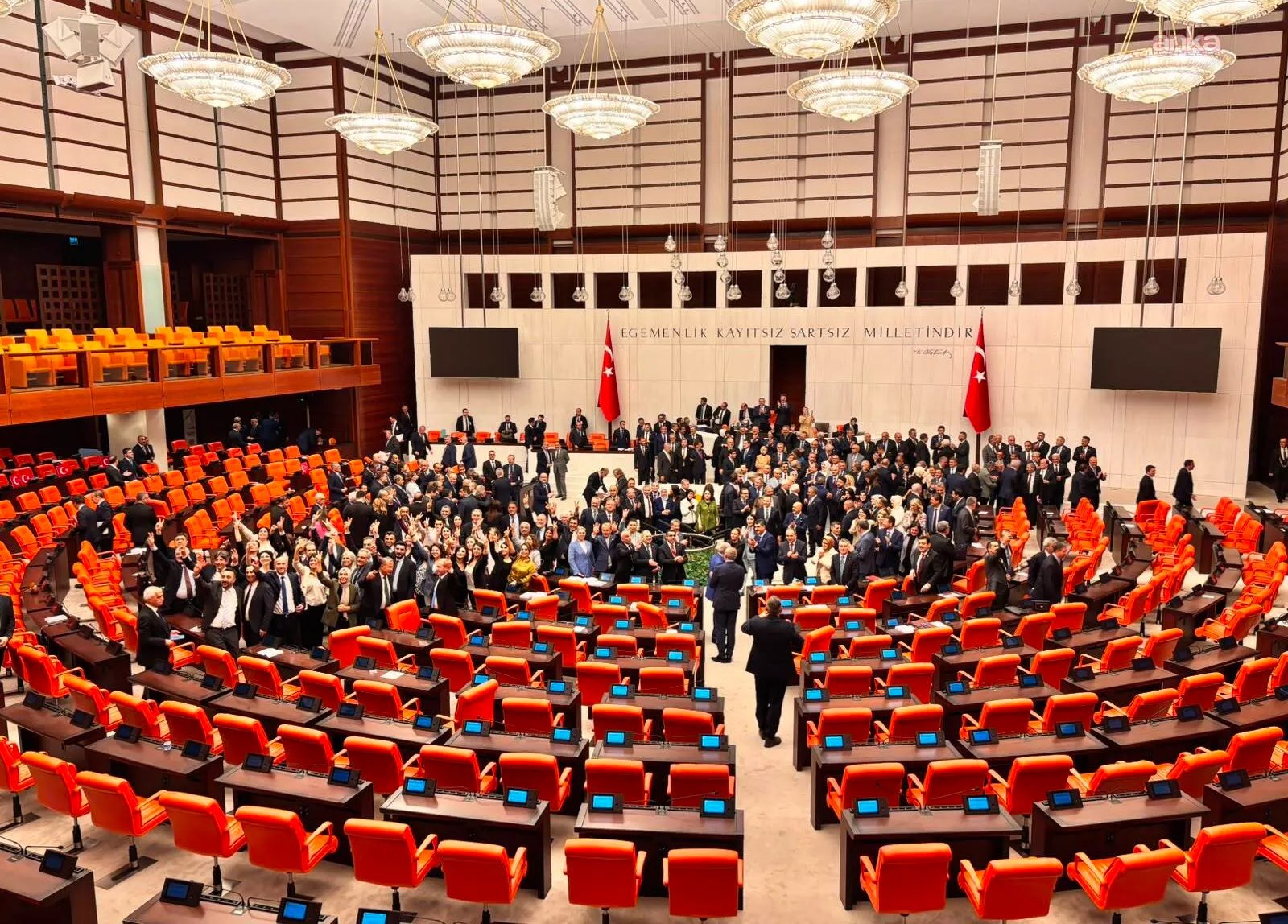
The General Assembly approved it on 10 August after a day of debate, by 467 votes to 87, with seven abstentions and two votes recorded as duplicates. It was backed by the AKP, the MHP and DEM together, which is why the tally is being described as a record.
The law creates the mechanism for suspending investigations, prosecutions and prison sentences for eligible PKK members and associated individuals. None of it applies yet. So what timetable now applies, what conditions have to be met, and what has to happen before the law can be used in practice?
1. The law has to enter into force
Parliament sent the law to the Presidency on 11 August. Under Article 11 it enters into force on the day it is published in the Official Gazette, and under Article 89 of the constitution the President has fifteen days either to sign and publish it or to return it to parliament for reconsideration. That fifteen-day window is the only fixed deadline anywhere in the process.
As of 11 August neither step had been recorded. The Gazette edition published that day, issue 33337, contained no laws at all, and the parliamentary record showed no entry for presidential approval or publication. Until that first publication happens, none of the institutions the law creates legally exist.
2. The machinery has to be built
Publication brings the implementing bodies into being. The central one is an executive board chaired by Vice President Cevdet Yilmaz, made up of the ministers of justice, interior, foreign affairs and defence, the Presidential Secretary-General, the Secretary-General of the National Security Council and the head of the National Intelligence Organisation.
Article 7 gives that board wide powers under the final law. It monitors disarmament and dissolution, sets up subcommittees, requests information from state institutions, maintains contact with the organisation where necessary, assesses periodically whether the dissolution conditions have been met, and can request judicial, administrative or legislative measures. It also holds two powers over individual cases: it can ask courts to restore rights lost through conviction, and under Article 3(3) it must give permission before any new investigation can be opened into a covered offence committed before the process began. That second power makes it a gatekeeper over which old cases can still be brought.
A separate Monitoring and Liaison Commission sits inside parliament with political parties represented, but it monitors and makes recommendations rather than running the scheme. The operational decisions belong to the board.
Alongside this, the interior and defence ministries have to issue the regulations governing how surrendered weapons, ammunition, explosives, vehicles and other material are registered, in consultation with the security institutions. The law says nothing about where returning members are physically received or what procedures they go through on arrival; those arrangements will come from these regulations and from whichever institutions the board designates to take applications. Both are worth watching, because they will determine what returning actually looks like.
3. Disarmament has to be verified and confirmed
The trigger for everything substantive in the law is not the parliamentary vote. It is formal state verification that the PKK/KCK and the formations covered by the legislation have ended their de facto organisational existence and surrendered all weapons and ammunition under their control.
Turkey’s security institutions make that determination, the National Security Council confirms it, and the MGK decision is then published in the Official Gazette. This second publication is what activates the criminal-law provisions. Nothing in the law can be applied to any individual before it happens, and the law sets no deadline for it.
The full chain runs: publication of the law → executive board and implementing regulations → verification of disarmament and dissolution → MGK confirmation → publication of the MGK decision → applications open.
4. A six-month window opens
Once the MGK decision is published, eligible individuals have six months to apply. The window does not renew, and this is an application process rather than an automatic amnesty — anyone who does not come forward stays in the existing legal system with their case unchanged. Applications take the form of a written declaration submitted to the relevant Chief Public Prosecutor’s Office or to another institution designated by the executive board.
The law covers membership of the PKK/KCK, establishing or managing the organisation, knowingly assisting it, propaganda offences, other crimes committed within the organisation’s activities, and terrorism financing under Law No. 6415. It applies to the PKK/KCK only, and personal crimes unconnected to the organisation’s activities fall outside it. Confiscation is unaffected: assets under confiscation orders can still be liquidated and the proceeds transferred to the Treasury.
How people physically return is still unresolved. Kurdish movement representatives are asking where returnees from the mountains and from Europe will first be received, what administrative procedures they will face and how military-service obligations will be handled. Remzi Kartal set out these questions in a post-vote interview with pro-PKK’s ANF website.
5. Releases and suspensions will be decided individually
There is no collective release. For someone already convicted, an execution judge issues the decision suspending the sentence. For someone held during an investigation or trial, the competent court reviews the detention or judicial-control measure and lifts it where the conditions are met. These decisions can be appealed. Investigations can be suspended, pending trials halted and sentences deferred, but only through individual prosecutorial and judicial decisions, file by file.
The suspension runs for ten years where the offence carries more than fifteen years or life imprisonment, and five years where it carries fifteen years or less. Limitation periods are frozen while a suspension is running, and committing another “terrorism offence” during it revokes the suspension and restarts the original process.
Rights lost through prosecution or conviction do not come back automatically, and the law does not impose a flat two- or three-year political ban as has sometimes been reported. The restrictions are the deprivations set out in Article 53 of the Turkish Penal Code, which reach well beyond voting and standing for election to cover public office, guardianship, licensed professions and management or audit roles in foundations, associations, unions, companies, cooperatives and political parties. Where the restriction stems from a conviction, the executive board can ask the relevant court to lift it, but not until two years into a five-year suspension or three years into a ten-year one, and the court then decides.
Pro-Kurdish MPs are already naming the Penal Code itself as one of the laws they want changed in a second package. DEM group deputy chair Gulistan Kilic Kocyigit has argued that political participation and returns should be secured in law rather than left to case-by-case decisions, and the party has opposed lasting bans on political activity in favour of short, time-limited restrictions. Amending the Penal Code would be the route to removing or loosening these deprivations at source, rather than lifting them individually through the board and the courts. No such amendment has been agreed.
At the end of the period the files close rather than reopen. If the individual has not committed another “terrorism offence”, the prosecutor issues a decision not to prosecute in an investigation, a pending trial is dismissed, and a final conviction is legally deemed to have been served. The law therefore closes eligible PKK-related criminal files permanently, provided its conditions are kept.
What the law leaves out
Two categories of offence are excluded outright: intentional killing committed within the organisation’s activities, and offences committed before 1 June 2005 that carry life or aggravated life imprisonment. The second of these covers Ocalan, who was convicted in 1999 and is serving aggravated life imprisonment. He cannot use the suspension and release mechanism at all, and any change to his status would require separate legislation.
The law also gives Ocalan no role in implementation, though the PKK-linked political movement presents him as central to it regardless. Kartal has claimed that a coordination mechanism involving Ocalan already exists and that returns from the mountains and Europe will require his involvement, while DEM’s Mehmet Rustu Tiryaki has called the absence of any provision on Ocalan’s status one of the law’s main gaps and expects it to be dealt with in later legislation. These are positions taken by the Kurdish movement, not features of the law.
What comes after
The law handles disarmament, dissolution, returns and existing criminal cases. It does not address the wider Kurdish political question, and it contains no promise to. Article 7 lets the executive board request further judicial, administrative and legislative changes as the process develops, which is a mechanism for a second package rather than a commitment to one, and no timetable attaches to it.
The political expectation is nonetheless that a second stage follows. DEM co-chair Tulay Hatimogullari has said that preparing the MGK report and publishing it matters as much as passing the law, warned that the process weakens the longer it is drawn out, and expects new legislation in the opening days of the next session. Parliament adjourned on 10 August and returns on 1 October, which makes the autumn session the venue for anything further. The areas most often named are the Anti-Terror Law, the Turkish Penal Code, the Law on the Execution of Sentences and the Political Parties Law.
Kurdish and pro-PKK media set out a considerably wider agenda for that stage: repeal of Anti-Terror Law provisions restricting expression and assembly, inclusion of pre-2005 cases, equal citizenship, mother-tongue rights, local democracy, an end to the kayyum system, implementation of European Court of Human Rights judgments, and Ocalan’s status and “right to hope”. These are demands rather than agreed provisions, and the Turkish government has committed to none of them.


