


With the Regime Still Standing in Tehran, Trump Finds Its Scapegoat in the Kurds, Tel Aviv in Turkey
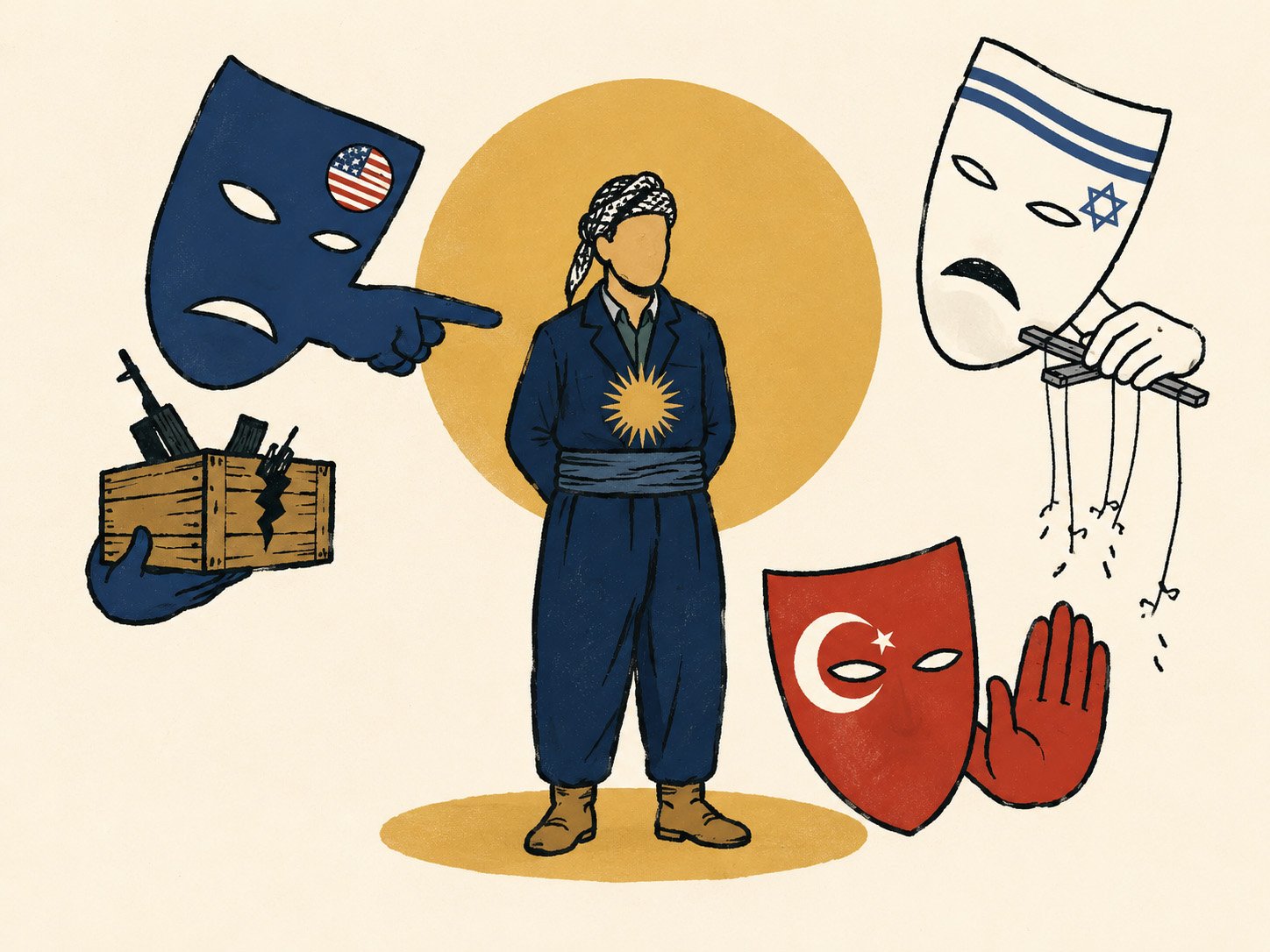
Trump has now accused “the Kurds” five times of diverting weapons intended for Iranian anti-government protesters, claiming Washington sent guns and ammunition through Kurdish intermediaries who kept the shipments for themselves. He has offered no evidence, and Kurdish groups have denied it. The repetition matters more than the content: it signals the wreckage of a broader strategy, and a president looking for someone to blame for it.
That strategy was to bring down the Iranian government, a campaign conceived primarily in Israel and partially adopted in Washington. It combined airstrikes, the killing of Khamenei, infrastructure targeting, and the activation of internal pressure points designed to fracture the political system in Tehran. Of those pressure points, the Kurdish front was the most developed and the only one that came close to execution. Reducing its collapse to a story about stolen guns converts a strategic failure into a logistical complaint, and assigns responsibility to actors with no capital, no seat, and no means to push back.
None of this is out of character. Trump tends to respect power and treat weakness as something to be exploited or blamed, and the Kurds, stateless and dependent on whoever is sponsoring them that decade, sit at the bottom of that hierarchy. He has done this before. In 2019, defending the withdrawal that exposed the Syrian Kurds to a Turkish invasion, he said they had not “fought at Normandy” and were only “fighting for their land,” recasting an alliance that had cost thousands of Kurdish lives against ISIS as a transaction with no claim on American loyalty. The 2026 weapons accusation follows the same pattern: when a Kurdish partner stops being useful, it becomes either a mercenary or a thief.
Israel is running its own version of the same operation, with Turkey in the role the Kurds play for Trump. The failure is narrated in Tel Aviv too, but the Israeli account is more revealing, because the Kurdish channel was an Israeli idea before it was an American one. The question there is not why the Kurds failed to deliver, but why they were never sent in at all, and the answer that has hardened across Israeli media and Netanyahu’s circle is Turkey.
The charge has now been made on the record by senior Israeli figures. Tamir Hayman, former head of Israel’s Military Intelligence Directorate, told PBS that the Kurdish incursion was the centrepiece of the entire regime-change sequence, and that Erdogan, viewing Kurdish nationalism as a strategic threat to Turkey, convinced Trump to drop it. The same account runs, with anonymous sourcing, through Al-Monitor, Maariv, Ynet, the Jerusalem Post, and i24NEWS: a Mossad-led operation, with CIA involvement, that armed Kurdish groups with weapons taken from Hamas and Hezbollah, staged thousands of fighters to cross from Iraq into Iran under Israeli and American air cover, and was cancelled after Erdogan raised it with Trump. Amit Segal, the Channel 12 commentator close to Netanyahu, wrote in Israel Hayom that Erdogan called Trump in a fury when Fox News reported the attack was beginning, and talked him out of it, one of two calls (the other from the Qatari emir, over strikes on Revolutionary Guard infrastructure) that he says cost the strategy its main levers.
Blaming Turkey does specific work for Israel, and the work explains the choice. It deflects attention from an incoherence inside Israel’s own war: Segal documented that the Mossad treated regime change as the objective while the IDF committed only to “creating the conditions” for it, a gap that left the war’s central aim without an agreed owner even before the Kurdish front collapsed. It assigns Iran’s survival, the war’s defining failure, to an actor Israel can attack freely. The honest address for the cancellation is Washington, where the decision was made, and Israel cannot afford to send the bill there. And it is costless: the Israel-Turkey relationship was already wrecked, Erdogan’s rhetoric makes him an easy villain for the Israeli public, and Naftali Bennett had spent the prewar months telling American audiences that Turkey is the new Iran. The Kurdish failure slots into a frame already built. Netanyahu has called Erdogan an antisemitic dictator who massacres his own Kurds, repeating the charge this week to Erdogan’s Hitler-invoking reply, while Israel Katz supplied the “paper tiger” line about unanswered Iranian missiles near Turkish airspace.
One detail in the Israeli telling deserves scepticism on its own terms. The image of a furious Erdogan bending Trump with a single call sits badly with how that relationship operates. Erdogan manages Trump through rapport and flattery, and he has watched Trump double down whenever he senses pressure; an ultimatum would be the least promising instrument available to him. A call registering firm objection is plausible. The fury and the instant capitulation read as dramaturgy for an Israeli audience, because the story requires the foreign veto to sound irresistible. A veto that merely contributed would leave too much of the failure at home.
Set side by side, the two accounts annihilate each other. Trump’s version requires the Kurds to have received weapons and kept them. Israel’s requires the opposite, that the Kurds never moved because Erdogan stopped them first. One aborted operation cannot evidence both. The parties at its centre, the PDKI, Komala, PJAK, and PAK, have denied receiving weapons from anyone, which strips the factual premise from both stories simultaneously, and they have warned that Trump’s accusation by itself invites Iranian retaliation against groups already absorbing missile and drone strikes.
Both stories also share a chronological problem: the plan was dying in Washington before Erdogan said anything. On 12 February, the day after Netanyahu presented the regime-change case in the Situation Room, CIA director John Ratcliffe told senior officials the Israeli assessment was “farcical,” and Marco Rubio rendered the judgment as “in other words, it’s bullshit.” A plan the CIA director dismissed before the war began did not need a Turkish veto to die, and a president whose own intelligence chief rejected the scheme cannot coherently bill the couriers for its collapse.
The deeper problem was the launchpad. The operation ran through Iraqi Kurdistan, and Iraqi Kurdistan’s leaders wanted no part of it. Trump called Masoud Barzani and Bafel Talabani directly in the war’s first days, and what came back was alarm. The region was already absorbing Iranian and militia strikes, its airspace closed and the Khor Mor field shut in, and hosting an Iranian Kurdish offensive would have converted it into a target on three fronts simultaneously: Iranian ballistic missiles from the east, Shia militia retaliation from the south, and Turkish anger from the north, the one neighbour the KRG cannot survive losing. Nechirvan Barzani declared publicly that the region must not become part of any escalation. The willing parties, the Iranian Kurdish factions, did not control the territory; the parties who controlled the territory were unwilling. That asymmetry, and Washington’s refusal to offer the political guarantees that might have shifted it, was killing the operation independently of Ankara.
Here the two scapegoat stories collapse into each other. A source with direct knowledge of the discussions told The National Context that Erdogan’s intervention with Trump ran in parallel with the Iraqi Kurdish leadership’s wishes rather than against them: Barzani and Talabani, judging Ankara a far more credible interlocutor with Trump than Erbil, wanted exactly the message Erdogan delivered. The call the Israelis present as Turkey’s veto over the Kurds was the channel through which the Kurds’ own refusal reached Washington. Turkey’s interest, that a fragmented Iran could seed a Kurdish entity on its border, and the KRG’s interest, survival on three fronts, converged on one outcome. Both blame narratives depend on an opposition between “the Kurds” and “Turkey” that, on this question, did not exist.
Israel’s framing carries a second-order cost that falls on the Kurds rather than on Israel. By blaming Erdogan for blocking the operation, Israeli officials confirm on the record that the Kurds were meant to be Israel’s instrument against Tehran. With the regime intact, that confirmation supplies Tehran, and the Arab and Turkish commentary already disposed to treat Kurdish nationalism as a foreign implant, fresh material for the charge that Kurdish movements amount to a second Israel on Iran’s and Iraq’s borders. The Israeli account scapegoats the Kurds a second time, by certifying the relationship that exposes them. Turkey’s framing, self-serving as it is, runs the other way: the dominant narrative from Ankara credits the Kurds, the Iraqi leadership above all, with having refused to become anyone’s instrument, presenting Barzani and Talabani as leaders who read the operation correctly and declined to gamble Kurdistan on it. That telling restores the agency Israel’s account strips away, and it travels well in Arab and Turkish opinion. It fits the Iraqi Kurds, whose reluctance is documented; it fits the Iranian Kurdish factions, who were meant to lead the incursion and were considerably more willing, far less.
The accounting for the war belongs to the two men who staked themselves on it. The regime change campaign ended with the regime in power: the succession to a new Khamenei absorbed, the nuclear programme damaged but not destroyed, and Tehran’s grip on Hormuz converted into daily leverage over oil markets and over Washington itself. Those are the failures that require an owner. Trump has handed his share to the Kurds, whose statelessness guarantees the charge goes unanswered. Netanyahu has handed his to Erdogan, whose hostility makes the charge free. The Kurds now appear in three versions of the war: thieves in Washington’s telling, a blocked proxy in Tel Aviv’s, and in Ankara’s, a people wise enough to refuse. None of the three was written for their benefit, and the two that damage them most were written by the powers that recruited them.


