


Bahceli Calls for Ocalan Coordinator Role as Turkey’s PKK Endgame Takes Institutional Shape
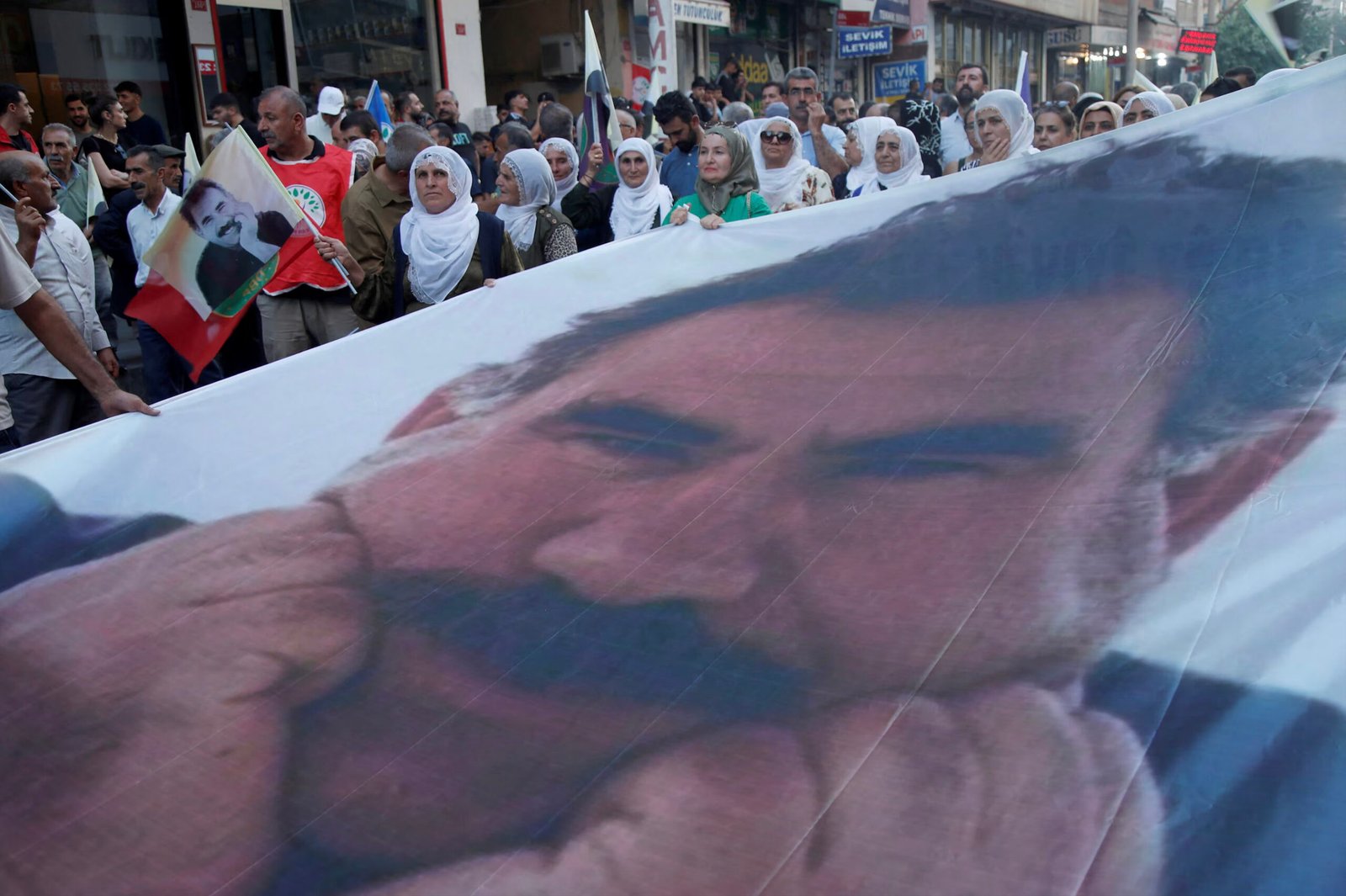
Devlet Bahceli, the Nationalist Movement Party (MHP) leader whose political intervention in late 2024 set the current peace process in motion, has put forward what amounts to the most concrete proposal yet for how that process should be structured going forward. In a wide-ranging assessment released yesterday, Bahceli called for the PKK’s jailed leader, Abdullah Ocalan, to be given an official designation as “Coordinator for the Peace Process and Political Integration,” a role that would allow him to maintain communication with PKK commanders and regional extensions from his prison cell on Imrali Island, with state-authorised logistical support and under state oversight.
The proposal is carefully worded to pre-empt nationalist objections. Bahceli makes clear that the coordinator role would be strictly limited to the operational task of dismantling the PKK and its affiliated structures, and would not confer any status as a Kurdish political representative or provide Ocalan with a platform for broader political claims. The Erdogan government responded warmly. The ruling AKP spokesman, Omer Celik said the People’s Alliance (which includes MHP) is acting as one and that Bahceli’s proposals will be incorporated into an updated roadmap for what Ankara calls the “Terror-Free Turkey” process.
Turkish media has also reported that a legal framework to manage the return of PKK members to Turkey may be close to finalisation, with a compliance window of one to two months being discussed alongside mechanisms for weapons inventories and verification of disarmament. These reports have not been officially confirmed, but they fit the broader pattern of language coming out of Ankara, which has become notably more procedural and deadline-oriented in recent weeks.
The regional dimension was underlined by Turkish intelligence chief Ibrahim Kalin’s visit to Damascus, where he met Syrian President Ahmad al-Shara and where discussions reportedly covered the implementation of the SDF-Damascus integration agreement. Ankara does not treat the PKK file and the SDF file as separate questions, and the fact that it is Kalin rather than a foreign ministry official leading on the Syria dimension signals how this is still being handled primarily as a security and intelligence matter.
Context: The current process has roots in Bahceli’s unexpected move in late 2024, when he publicly called on Ocalan, who has been imprisoned on Imrali Island since 1999, to address the PKK and renounce armed struggle. What made this significant was that Bahceli’s party had built its political identity on hard-line opposition to any engagement with either the PKK or Ocalan, and his reversal gave Erdogan the domestic cover to pursue a process that previous Turkish governments had attempted and abandoned.
Since then, the process moved through several visible stages. Ocalan issued a call for the PKK to dissolve. The PKK held a congress and announced it was ending armed struggle. A symbolic weapons-burning ceremony followed. A parliamentary commission representing all major parties produced a joint report calling for legal arrangements to support the process. At each stage, the emphasis was on political statements and symbolic acts rather than verifiable mechanisms. That is what now appears to be changing.
The Syrian dimension adds a layer that is often underappreciated in coverage of the Turkish process. After the fall of the Assad government, the SDF found itself in a drastically altered strategic position. It had administered a large swathe of northeastern Syria, but much of that territory was Arab-majority and had come under SDF control as a consequence of the anti-ISIS campaign rather than any organic Kurdish political base. When the new Syrian government consolidated its authority, the SDF surrendered most of what it had held, losing over 80 percent of its former territory. In the remaining Kurdish-majority areas of the northeast, the SDF signed an agreement with Ahmad al-Shara’s government committing its civilian and military structures, including border crossings, airports and oil and gas fields, to integration into the Syrian state. That process remains ongoing and contested in its detail, and Ankara is watching it closely, because it does not regard an autonomous Kurdish armed presence surviving on the Syrian side of the border as compatible with a PKK dissolution inside Turkey.
Analysis: Bahceli’s proposal can be best understood as an attempt to solve a practical problem. If Ankara wants the PKK to fully dismantle, it needs a mechanism that can reach the organisation’s commanders in Iraq and Syria and persuade them to comply. Ocalan remains the one figure whose authority over PKK membership is widely accepted, which is why his continued relevance is being treated as a functional asset rather than a political liability. The “coordinator” designation is a way of giving him the communications access needed to perform that function, while framing the entire arrangement as a state-managed operation rather than a negotiation between equal parties.
This is also where the tension at the heart of the process becomes most visible. Ankara’s framing is essentially about dismantling: the PKK is an organisation that has declared itself dissolved, its weapons need to be surrendered and inventoried, its members need to be processed through a legal mechanism, and those who do not comply within the given timeframe will be treated accordingly. In this model, the state is the actor and the PKK is the object being wound down. Ocalan’s role, however it is titled, is to serve that winding-down, not to shape its terms.
Ocalan’s own preferred framing, to the extent it can be read from his statements, leans toward something closer to integration: the idea that an armed historical movement is converting itself into legal-democratic politics, and that this conversion happens through a recognised interlocutor framework in which the movement retains some authorship over its own transition. For him, status matters not primarily as a personal privilege but because it changes what the process means. A prisoner helping the state dismantle an organisation is one thing; a recognised coordinator through whom a political movement transforms itself is something else entirely, even if the practical steps might look similar from the outside.
That gap between dismantling and transformation has direct consequences for what Kurdish politics looks like on the other side of the process. The pro-Kurdish DEM Party already has municipalities, members of parliament and an active electoral base, so legal Kurdish politics is not at risk of disappearing. The question is rather what kind of political agency it will carry going forward. Ordinary electoral agency, meaning the ability to win votes, hold office and participate in the legislative process, is clearly on offer, and it is genuinely meaningful. What does not appear to be on offer is what might be called settlement-making agency: the recognition that the Kurdish political movement is a party to a historical conflict with the right to negotiate over constitutional arrangements, decentralisation, security structures or collective rights. Mayors in Diyarbakir and Van carry real political weight, but governing a municipality is not the same as having a recognised seat at the table where the terms of Kurdish political life are determined. The government appears prepared to accept the first kind of agency while refusing the second.
The Syrian comparison makes this distinction clearest, because Syria is further along in the same underlying process. The SDF’s integration into the Syrian state is being presented as a political transition, and in formal terms it is: there is an agreement, there are frameworks, there are negotiations over specific files. In practice, however, Damascus is acquiring the border crossings, oil fields, airports and security apparatus while the Kurdish-majority northeast has not received a negotiated political status or any recognised form of autonomous governance in return. The SDF is effectively surrendering the independent military-territorial position that made it a distinct actor, in exchange for legal incorporation into a unitary state on terms largely determined by that state and shaped by Turkish pressure. Whether that constitutes integration or absorption depends almost entirely on whose definition you accept. Ankara’s preferred outcome in Turkey follows the same underlying logic, and Kalin’s presence in Damascus signals that Ankara wants both tracks to move at roughly the same pace, so that neither side of the border becomes a refuge or a precedent for the other.
The picture that emerges is of an Ankara that has decided the political question is settled and is now trying to build the machinery to deliver a result. Bahceli provides the nationalist legitimacy that makes the process domestically viable for Erdogan. Ocalan provides the organisational relay that makes compliance by PKK-affiliated structures achievable. The AK Party provides the state apparatus and the legislative framework. The reported return law, if it materialises, provides the compliance timeline. The parliamentary commission provides the legal wrapper. Kalin in Damascus provides the regional coordination arm. Each of these elements is doing a specific job inside what is increasingly looking like a single, interlocking design rather than a collection of parallel developments.
The risks in this design are real, and Bahceli’s own references to the IRA process hint at an awareness of them. The Northern Ireland peace process, which he cites as a precedent, also produced the Real IRA, formed precisely by those who rejected the leadership’s decision to disarm. A top-down process that relies heavily on one figure’s authority, moves on a fixed timeline and offers a defined compliance window rather than an open-ended negotiation creates exactly the conditions in which spoiler factions can establish themselves. The whole logic of Ocalan’s coordinator role is to prevent that outcome by keeping his authority intact over the organisation’s base, but the same logic creates a single point of failure if that authority is contested or simply does not reach deeply enough into the organisation’s more hardened elements.
For now, however, the direction of travel is not seriously in doubt. The process has moved from the question of whether there will be a settlement to the question of who controls the implementation, on what terms and within what timeline. Ankara’s answer to all three is the state, its own terms and sooner rather than later. Whether the Kurdish side will experience this as a historic political transformation or as a managed surrender on Ankara’s terms is a question likely to be contested for years, but the space in which that debate can be had is itself being defined, and bounded, by the process now underway.


