


Turkey, Syria, and Iraq edge toward a rail corridor that bypasses the KRG
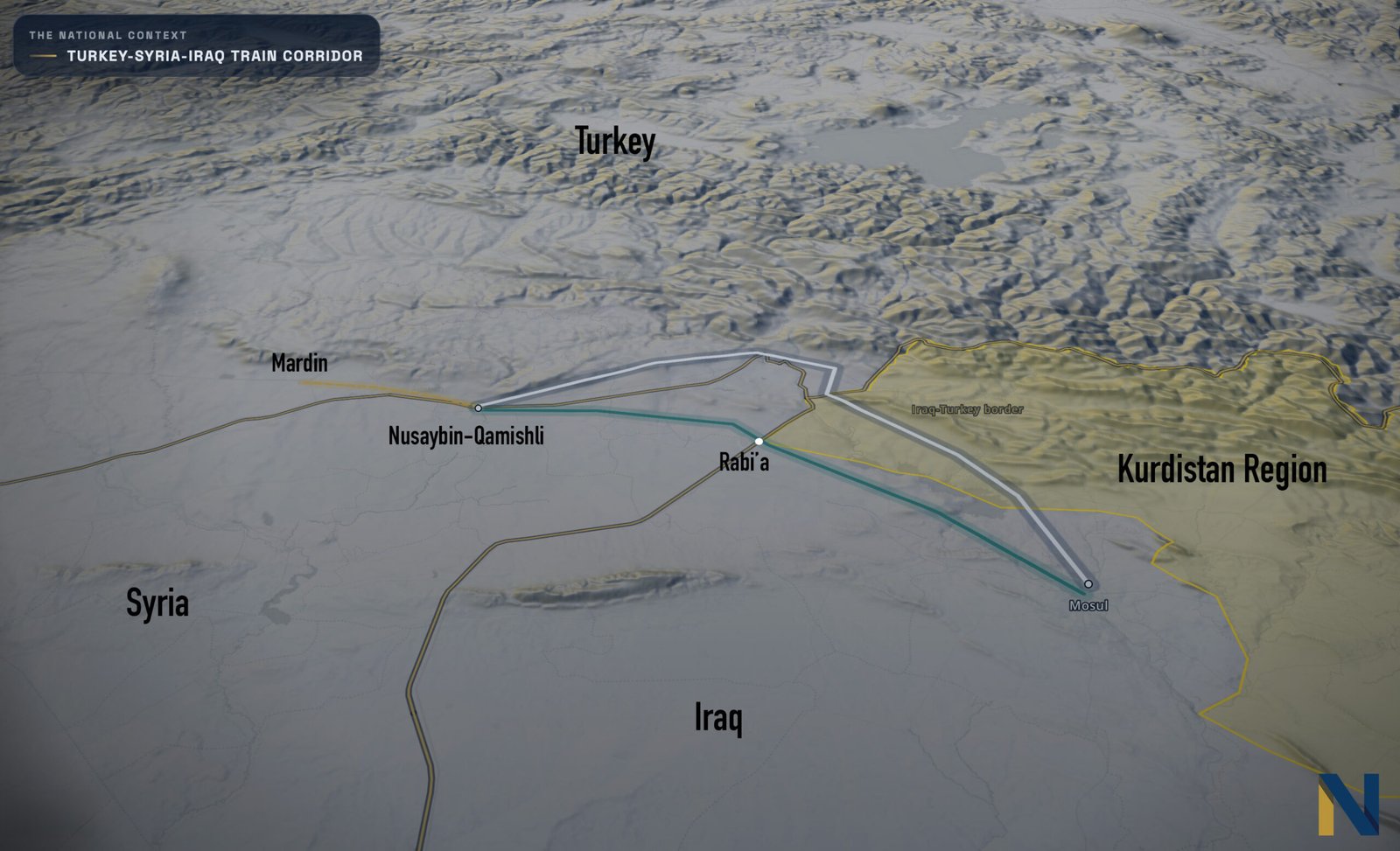
On April 4, 2026, Turkish Transportation Minister Abdulkadir Uraloğlu announced that Ankara will revive “the railway line from Nusaybin to Qamishli, thus connecting to both Syria and Iraq,” noting that existing rail inside Syria, including the Aleppo–Damascus line, would help with logistical integration. Weeks earlier, on February 16, shortly after the SDF formally agreed to integrate into the Damascus-led authority, the head of Iraq’s Border Authority said the prime minister had ordered the rapid opening of the Rabi’ah crossing with Syria, explicitly tying the move to the Development Road, the long-planned Iraq-to-Turkey trade corridor.
These developments suggest that a Turkey–Syria–Iraq rail route running from Nusaybin across to Qamishli, eastward along the Jazira plain to the Rabi’ah/Al-Yaarubiyah crossing, and into Iraq’s existing Mosul–Baghdad rail network is becoming an increasingly viable option. What was, until recently, a strategic possibility is starting to look like a policy direction.
Context: The collapse of the Assad order and the SDF’s phased integration into the Damascus-led state were always going to give Turkey and Iraq a viable alternative to KDP-controlled routes, and erode one of the KRG’s most important sources of leverage: its position as the indispensable corridor between Iraq and Turkey. The argument we set out earlier this year was that if the Syria–Iraq–Turkey border triangle came under firm Damascus control, projects like the Development Road could, in theory, be rerouted through Syria rather than relying on the KRG corridor, directly eroding one of the KDP’s most valuable assets: control of the Ibrahim Khalil crossing, Iraq’s single most important land border with Turkey, and both a political instrument and a major revenue stream.
That argument rested at the time on geography and regional realignment. Less than three months later, the same conditional sentence is being voiced, in different words, by a Turkish minister and an Iraqi border authority chief.
Analysis: For most of the past decade, the Syria–Iraq–Turkey border triangle was a frozen file. The Syrian side was held by an SDF that Ankara treated as hostile and Baghdad treated as an awkward neighbour, and the political conditions for using that triangle as a serious trade corridor simply were not there. With the SDF’s integration into the Damascus-led state and Syrian government forces now deployed along the border, those conditions have begun to change, and Ankara and Baghdad are both moving on it faster than expected.
For Turkey, this is the first time in over a decade that rail connectivity to Iraq through Syria can be negotiated as a normal state-to-state file with Damascus. Uraloğlu’s statement is exactly that: a transport minister announcing a project as if Syria were a regular bilateral partner. The political point matters as much as the technical one. Ankara now has the option to route a major Iraq-bound corridor through Syrian territory rather than through the Kurdistan Region, and given its close working relationship with Syria’s new leadership, that option is also a lever. If Turkey ever wants to punish or constrain the KDP, a viable Syria route gives it something to use.
For Baghdad, the calculation runs in a similar direction, and a recent episode has sharpened it considerably. The Sudani government has consistently preferred Development Road alignments that minimise the KRG’s role, and the decision to fast-track the Rabi’ah crossing, and to tie it explicitly to the Development Road, fits that pattern. The post-February 28 oil export crisis pushed that preference much further. After Iran effectively closed the Strait of Hormuz and Iraq’s southern terminals were halted, the federal Oil Ministry asked the KRG to allow Kirkuk crude through the Kurdistan-controlled Kirkuk–Ceyhan pipeline. Erbil refused unless Baghdad first lifted the January ASYCUDA customs measures and met a longer list of demands on dollar transfers, security guarantees against militia attacks on Kurdish energy fields, and electricity payments. The federal Oil Ministry described the KRG’s stance as a “gravely irresponsible” exploitation of the regional crisis, accused Erbil of breaching the constitution, and threatened legal action. In Baghdad’s reading, the KRG had used a national emergency to extract unrelated concessions, which the federal government and its allies essentially treated as blackmail. That experience pushed Baghdad to look much more actively for export and trade routes that do not depend on KRG-controlled infrastructure at all. The Iraqi Oil Ministry has since begun reviving an old Kirkuk–Ceyhan pipeline segment that bypasses the Kurdish system entirely, and a Syria-facing corridor is one of the few overland options that fits the same logic. So Baghdad’s interest in the Nusaybin–Qamishli–Rabi’ah–Mosul route is not just political. It is also infrastructural, fiscal, and increasingly defensive.
The technical case makes both moves credible. This is not a corridor being invented from scratch. Qamishli was founded in 1926 as a station on the Taurus railway, and Turkey’s TCDD network statement still identifies Iraq rail access as historically running through the Nusaybin–Qamishli crossing, which it lists as closed rather than nonexistent. Iraq’s rail network already extends from Baghdad through Mosul to Rabieh, and Turkey reopened the Karkamış–Nusaybin and Şenyurt–Mardin sections in late March 2026, restoring freight and passenger service to Nusaybin for the first time since 2013. The Jazira plateau across northeastern Syria and northwestern Iraq is rolling country at roughly 240 to 460 metres above sea level, which makes for straightforward railway terrain, while the Turkey–KRI border zone is the eastern extension of the Taurus range and then the foothills of the Zagros. Carnegie, citing Iraqi government reasoning on the Development Road, reported that a KRI alignment would add roughly $3 billion and around two years to delivery because of the mountains. So a Syria route is not only the politically easier project today; it is also the shorter, cheaper, and more easily revived one. None of these factors is decisive on its own, but added together, they make the bypass option significantly more attractive than the alternative.
They are the first concrete signal that the strategic possibility set out earlier this year is becoming a policy direction. And it lands at a moment when the KRG is already under pressure from several directions at once. Baghdad’s posture on revenue-sharing has hardened, the recent oil export standoff has left a residue of distrust that will not be easy to undo, the fiscal gap inside the Region is widening, and the disputed-territory framing around Khurmala, the KRG’s largest oil field, and Khor Mor, its largest gas field, both only kilometres from the federal–regional lines of control, gives Baghdad a familiar lever it could pull harder in a more permissive regional environment. The corridor question is the external face of the same squeeze.
For years, the KRG’s leverage in Baghdad and Ankara has rested on the fact that any serious Turkey–Iraq trade corridor had to go through, or near, Kurdish-controlled territory. Ibrahim Khalil is one of the KRG’s most important sources of revenue and one of its few remaining sources of strategic indispensability. A Nusaybin–Qamishli–Rabi’ah–Mosul corridor is, in effect, a project to make that indispensability optional. The question is no longer whether bypassing the KRG makes sense as a corridor strategy. On engineering, cost, and now political grounds, it does. The question is whether Erbil can offer a counter-proposition compelling enough to keep itself on the map before this becomes the assumed default.


