


Mapped, Exposed, Targetable: How Strike Risk Is Forcing a Managed Militia Transition
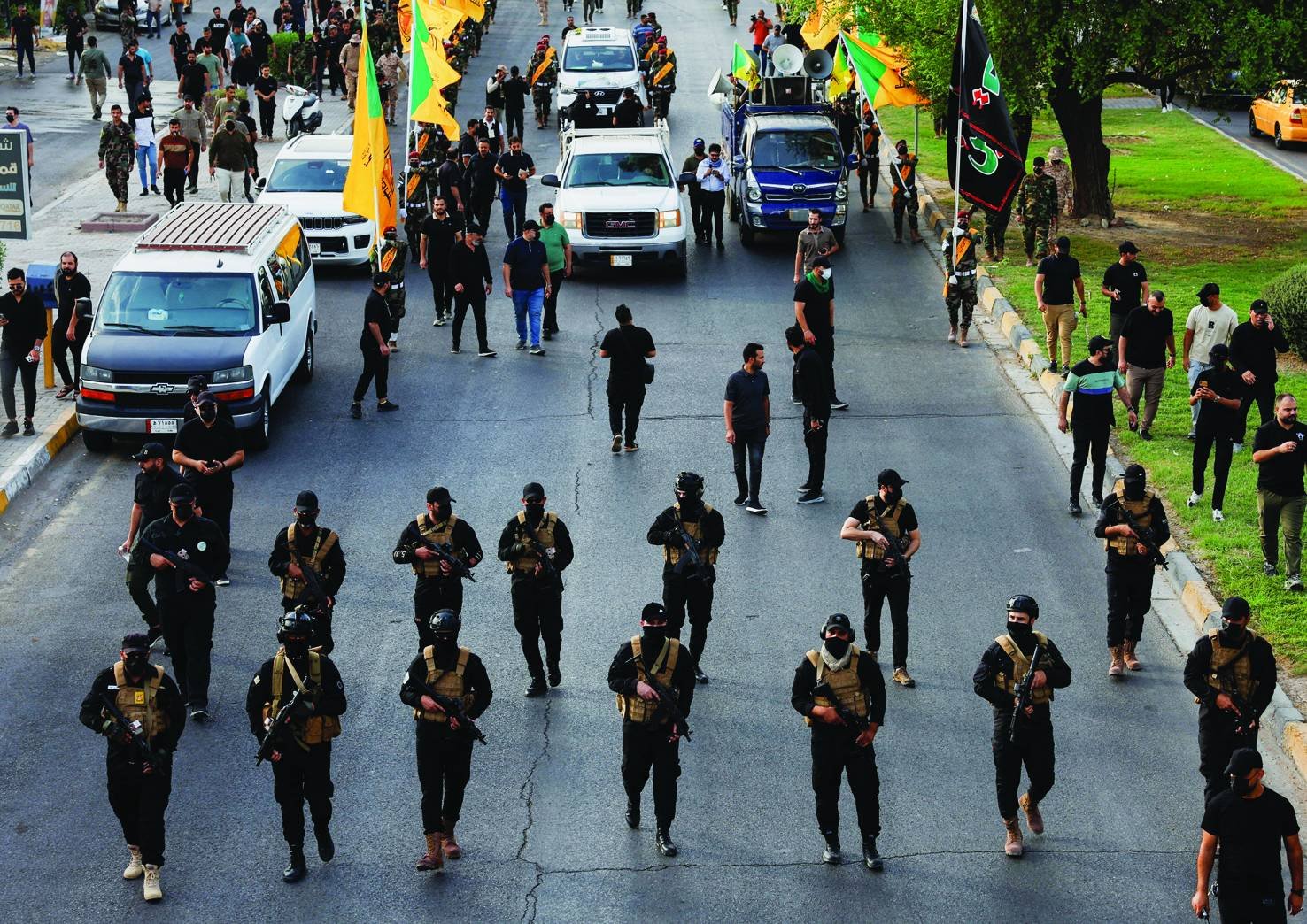
In an unusual statement, the head of Iraq’s top judicial body, Faiq Zaidan, has said Shia militia leaders have accepted to hand over their weapons to the “state” and transition to politics. Over the past week, several key militia leaders have publicly committed to what they frame as “restricting weapons to the hands of the state,” amid reports that the U.S. has warned Baghdad of imminent, potentially U.S.-greenlighted Israeli strikes if the militias do not move quickly to disarm.
Context: In the November Iraqi parliamentary elections, militia-aligned groups won an unprecedented 80 seats, with their broader Coordination Framework ecosystem taking over 170 of 329 seats. Before the vote, the U.S. explicitly warned Iraqi factions not to pass a PMF bill that would codify the Hashd as an IRGC-style parallel force. Since the elections, the militias’ ascent has not made them more reckless; it has made them more exposed. They now have more to lose. Against that backdrop, Sharq Al-Awsat reported that Iraqi government officials and influential political actors received two unusual warning messages over the past two weeks, including what was described as a “large file” transmitted via a Western intelligence service containing detailed Israeli lists of faction officials, inner-circle operatives, financial and commercial facilitators, and even state institutions described as fronts for militia influence. The point, as framed in the reporting, was blunt: Baghdad was shown that Israel has mapped the militias in a way that makes wide strikes realistic and fast.
Analysis: Over the past two weeks, militia leaders have issued a coordinated string of statements embracing what they call “restricting weapons to the hands of the state.” The names are telling: Qais al-Khazali of Asaib Ahl al-Haq, whose bloc won 27 seats; Kata’ib Sayyid al-Shuhada, led by Abu Alaa al-Wala’i; Haider al-Gharawi of Ansar Allah al-Awfiyaa; and Shibl al-Zaydi of the Imam Ali Brigades. This phrase is not neutral. It is a militia euphemism for accepting the basic U.S. offer: dismantle the militia structure as an autonomous force, integrate fighters into the Iraqi security apparatus, and move militia leaders into politics.
Washington has pushed that outcome using three levers that matter to the Shia-led order precisely because they target its survival fundamentals. The first is economic pressure. Sanctions and financial leverage are not just punitive tools; they strike at the patronage resources that bind the post-2003 system together, fund political machines, and suppress the kind of large-scale social breakdown that could threaten the entire order the Shia parties have built. The second is military assistance. Even if ironic, it has become more indispensable as Iraq’s western flank has been exposed since Assad’s fall, leaving Baghdad facing a Sunni-led power in Damascus that sits on the opposite side of Iran’s regional order. A serious weakening of Iraqi security institutions would not be an abstract risk; it would reopen vulnerabilities in a Sunni-populated west where political sentiment toward Syria’s new rulers is no longer marginal. The third lever is the most visceral: information warfare and the credible threat of imminent airstrikes. If the “large file” narrative is broadly accurate, the message to Baghdad is that the militias no longer have the protection of ambiguity. They can either accept a managed dismantling or risk a violent dismantling.
This is why Zaidan’s statement matters. He is not a routine official offering generic sovereignty language. Zaidan is known for deep-rooted ties to Iran, but he does not operate as a subordinate to any single Shia politician. He maintains direct ties with senior Iranian authorities and functions as one of the key guardians of Shia strategic interests in Iraq. When someone with that profile moves publicly on the militia file, it does two things at once. It gives the militias a face-saving exit by wrapping dismantlement in an Iraqi, state-led frame—delivered by a judiciary figure above daily partisan bargaining. And it signals that, at the strategic level, Iran is prepared to tolerate this shift because preserving the post-2003 Shia-led order in Iraq is now the higher priority.
Zaidan’s wording also quietly raises the ceiling on what is being conceded. “Transition to politics” implies more than regulating weapons; it implies the armed phase has ended in principle. If militia leaders are transitioning to politics because the “national need” for military action has ended, then the militia as an autonomous institution is not supposed to remain as a separate arena for them to command. That is exactly why the militias are clinging to the softer “restricting weapons” language: it is designed to preserve dignity and blur what is, in substance, dismantlement.
The broader strategic logic for the Shia ruling class—and, at the strategic level, Tehran—has hardened since the earlier 12-day Israel–Iran war. That war showed this is a contest decided by airstrikes and missiles, not by militia fighters on the ground. In that environment, Iraq’s militias cannot meaningfully shift the balance, but they can easily become targets inside Iraq. The risk of renewed escalation raises the cost of insisting on symbolism. If the militias refuse a managed dismantling, they risk inviting a military outcome that could shake the entire system and threaten the post-2003 order itself. For Iran as well, keeping Iraq politically aligned is more valuable than burning down the Iraqi arena to preserve a “resistance” posture that no longer delivers strategic payoff. As Nouri al-Maliki has put it in his own framing, Iraq may not be militarily part of the axis in the same way, but it remains politically part of it.
There is also a practical upside that many Shia insiders increasingly acknowledge: integration can strengthen, not weaken, the Shia grip on the security state. The Badr precedent is the clearest model. Badr’s earlier “integration” into the Interior Ministry did not erase influence; it institutionalised it. In that sense, the fight now is as much about optics as it is about power. The Hashd has been treated by many supporters as an almost sacred force, so dismantlement is symbolically painful. But the strategic case for the Shia establishment is that a more state-led, institutionalised security order can preserve Shia dominance while reducing the factional fragmentation that has turned the PMF into an arena of internal struggle and, increasingly, a liability.
None of this will be clean. The process is likely to be messy, disputed, and vulnerable to reversal – especially if the region slides back into direct Iran–Israel confrontation and factions revive “unity of arenas” logic. Even in the current moment, the details are contested. The phased concept circulating in the reporting is explicit: a first phase in which factions hand over ballistic missiles and drones and dismantle and surrender strategic camps north and south of Baghdad; a second phase that could include removing faction-linked officials from the PMF commission, depending on Washington’s response. Some Shia figures claim an understanding on removing heavy weapons existed even before the pressure spike, but the real fight is now over implementation: which government body can be trusted to take operational capabilities, receive weapons, and enforce restrictions when the U.S. distrusts institutions seen as penetrated by militia influence. And the timing is politically toxic. Shia leaders fear moving decisively on the weapons file while the premiership is still being negotiated, because it links disarmament to government formation and invites scapegoating.
The core story, then, is not a sudden embrace of state sovereignty. It is a forced strategic rebalancing dressed up as a sovereign decision: dismantle enough to survive, integrate enough to avoid social blowback, preserve the Shia-led order, and reframe a retreat from militia autonomy as state-building—before external threats and internal fragmentation make a controlled outcome impossible.


