


Iraq’s Shia Bloc Narrows Prime Minister Race, but Real Fight Is Behind Closed Doors
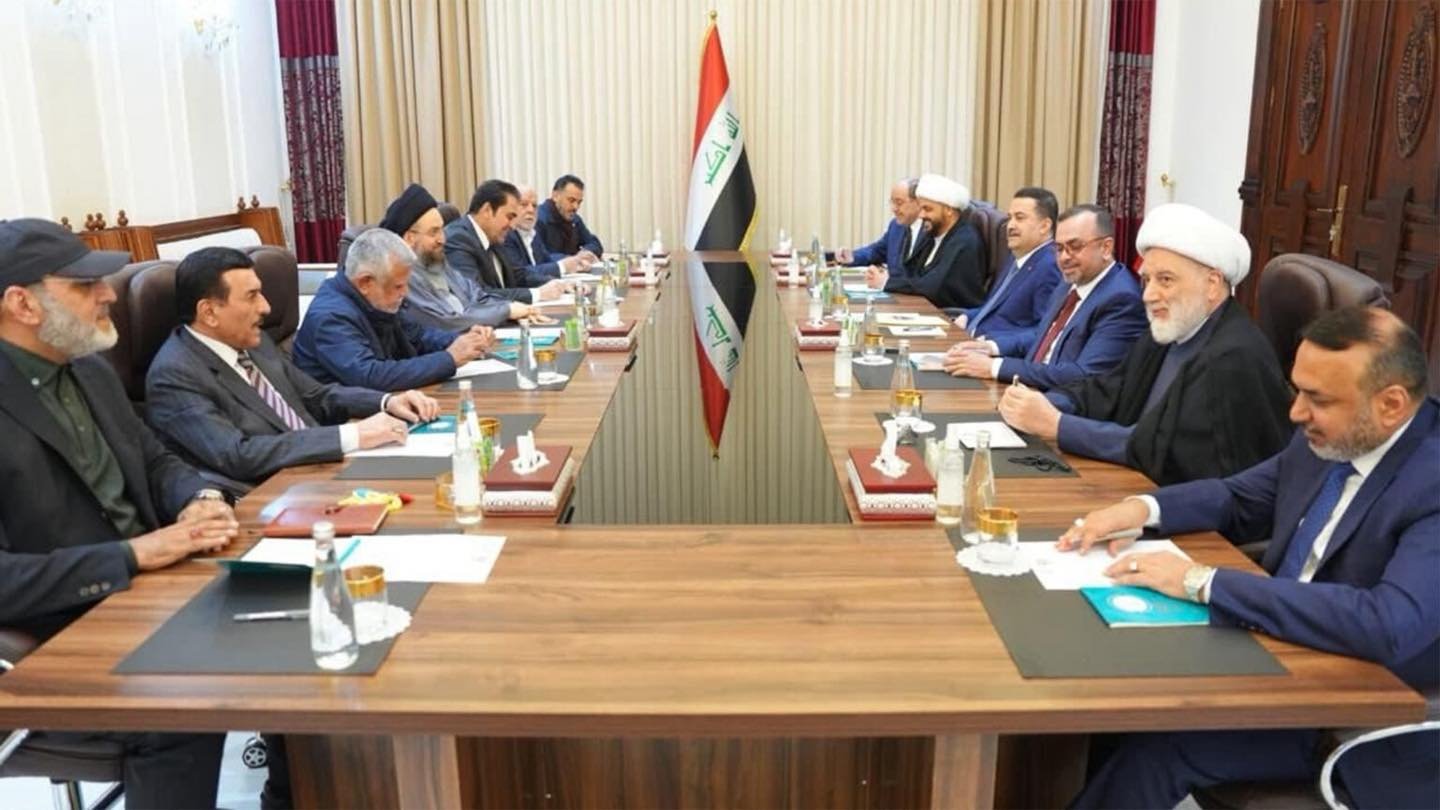
According to a well-informed Iraqi Shia source, the Coordination Framework, which encompasses all pro-Iran Shia blocs and collectively holds some 170 parliamentary seats, narrowed its list of prime ministerial candidates to three during last night’s meeting. A deadline has been set for selecting one candidate by consensus among the Framework’s leaders.
The Framework issued a statement confirming “a significant development” in discussions over the premiership during its regular meeting at the office of Abdul Hussein al-Moussawi, head of the National Approach Alliance. The statement noted that “an agreement was reached to set deadlines for completing the procedures to finalize the entitlements.”
Context: Rahim Aboudi, a leader in the Hikma Movement whose bloc holds 18 seats within the Framework, confirmed that Muhammad Shia’ al-Sudani, the current Prime Minister, is among the three candidates. Aboudi indicated a decision could come as early as next Monday during the Framework’s regular meeting.
Analysis: A second source also confirms al-Sudani is among the three candidates, but sources differ on the other two, underscoring how fluid and contested the process remains. One account, from sources close to the Framework, names Nouri al-Maliki, head of the State of Law Coalition, and Qasim al-Araji, Iraq’s National Security Advisor. But Salam al-Zubaidi, spokesperson for former Prime Minister Haider al-Abadi’s Victory Coalition, told Shafaq News that the three finalists are Sudani, al-Abadi, and “a third person who may be a surprise.” Sources familiar with internal dynamics suggest Maliki and allied factions have devised a strategy to sideline Sudani by nominating a “compromise candidate,” meaning neither Sudani nor Maliki but a third figure as a middle-ground solution. That person is likely al-Araji. According to these sources, Maliki’s decision to put himself forward was never about winning the post outright but about blocking Sudani and ultimately steering the selection toward al-Araji.
Despite official optimism about a swift resolution, reporting from Al-Mada newspaper paints a different picture. Sources close to Shia political circles describe the negotiations as an “open battle,” with expectations for a final decision potentially stretching to summer 2026, far beyond the timeline Framework officials have suggested. An Iraqi political insider with ties to Framework leadership offered a blunt assessment: the official meetings are largely theater. “Whoever tips the scales is whoever gathers the largest number of bloc leaders, specifically the five major blocs: State of Law led by Nouri al-Maliki, Construction and Development led by al-Sudani, Hikma led by Ammar al-Hakim, Sadiqoun led by Qais al-Khazali, and Badr led by Hadi al-Amiri,” the source said. “The rest come just to take photos.” The real negotiations happen behind closed doors, as they did when al-Abadi, al-Maliki, and al-Sudani were previously selected.
Beyond the question of who will lead the government, sources close to the negotiations reveal that key disputes center on the number of ministries to be granted to blocs that do not secure the premiership. Traditionally, the candidate who wins the post forfeits a full ministerial share, as all points are calculated exclusively toward the prime ministership. According to a politician and former MP familiar with the talks, the most significant sticking point concerns the distribution of sovereign ministries, foremost among them Foreign Affairs, Interior, Defense, and Finance. Leaked information from previous Framework meetings indicates discussions of a “comprehensive rotation” of ministries among the three main components, Shia, Sunni, and Kurdish, as part of an effort to rebalance power within the next government.
The Framework has imposed strict conditions on any candidate. The next Prime Minister must pledge not to form a political party and cannot contest future elections. Most critically, the candidate must consult the Framework “on all matters related to internal and external affairs.” This condition followed an incident in which Iraq’s official gazette listed Lebanese Hezbollah and Yemen’s Houthi group as terrorist organizations. Though the government dismissed it as an “oversight,” some factions called it “treason” and demanded al-Sudani be excluded from consideration for the premiership. Pressure on Sudani mounted further after reports that he nominated U.S. President Donald Trump for the Nobel Prize, a move his advisor confirmed but which Iran-aligned factions viewed with hostility.
It remains unclear how regional and international factors, particularly American influence, will shape the outcome. U.S. envoy Tom Barrack, who met Sudani during a surprise visit to Baghdad last week, assessed him as “a very good Prime Minister, but he has no authority and cannot form a coalition, as Popular Mobilization components in parliament obstruct the process.” According to multiple Iraqi sources, Washington has demanded that Iran-aligned factions be distanced from key positions and that Iranian influence be reduced, though it is unclear how that is possible given the groups that have militias alone hold 80 direct seats. The Framework has reportedly slowed its government formation efforts, awaiting what sources describe as “the green light” from Washington.


